PART 5: The Knot That Rang the Bell 058
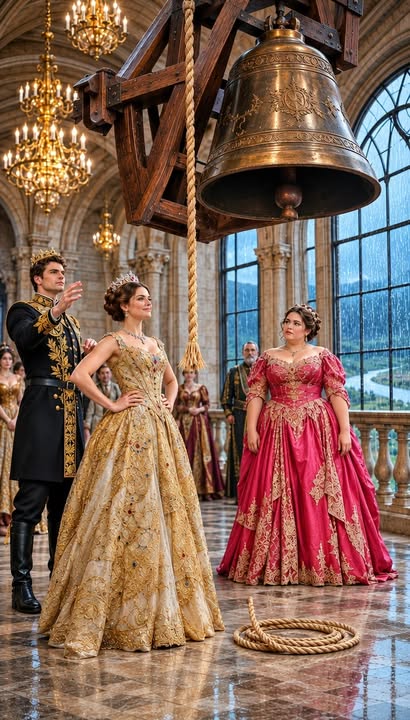
Part 5 – The Choice Before the River
Master Ivers nodded.
The prince looked at the hidden reference, then at the bell above them.
“Find it,” he said.
The archivist gathered the page into its protective folder and carried it back toward the records room.
For a little while, the three of them remained in the gallery, listening to the old wheel settle.
The faint click came once more, followed by silence.
Lena looked toward the dark windows.
“Is the river still rising?” she asked.
The prince crossed to the western window and peered through the rain-blurred glass.
“We should know soon.”
He rang for the tower keeper, then asked an attendant to contact the lower valley’s river office.
Amara took the old report from the table, careful not to disturb its edges.
“My family’s records may help identify that file number,” she said. “I can send for the account books tonight.”
“Please do,” the prince replied.
He sounded grateful, but his gaze remained fixed on the bell.
Amara watched him for a moment.
“You don’t have to read the page alone,” she said.
“I know.”
“Do you?”
The question was gentle, and because it was gentle, he could not dismiss it as an argument.
He lowered his eyes.
“I’ve spent the day trying to decide what the records say about my father,” he admitted. “I may have been asking the wrong question.”
“What should you be asking?” Lena said.
“What they require of me now.”
The answer seemed to leave him quieter than before.
A palace messenger entered with word that the river office had reported a steady rise, though the water remained below the marked danger line.
The prince thanked him and asked that the valley’s wardens continue their readings through the night.
When the messenger had gone, Lena moved to the bell rope.
The bend she had tied still held, but the old wheel above it looked more fragile than it had the day before.
“Could the mechanism fail if the water keeps rising?” Amara asked.
“I can’t say,” Lena replied. “The wheel needs a proper inspection. So does the frame. A knot can join two ropes, but it cannot make the rest of the system sound.”
The prince looked at the darkened ironwork.
“Then we have to assume the bell may not work.”
“We have to know whether it works,” Lena said. “And until we know, the valley needs another warning.”
He turned toward her.
“What would you use?”
“Riders, lamps, the river office’s signal flags. Whatever reaches the villages fastest and can be repeated clearly.”
The prince nodded once, absorbing the list.
“Send word to the wardens,” he told the attendant at the door. “Prepare the riders and check the lamps along the lower road. No one should wait on the bell alone.”
The attendant hurried away.
Amara placed the report back in its folder.
“The old report still needs to be released,” she said. “If people are asked to trust a warning now, they should know why the warning system is being reviewed.”
The prince’s face tightened.
“We haven’t found the second file.”
“We know enough to say the old report was incomplete,” Amara replied. “We know the bell was ordered quiet during a flood watch. We know the official account claimed it sounded, and that the account was not the whole truth.”
“We don’t know what my father wrote in the missing file.”
“No,” she said. “But we know what happened to the bell.”
“And we know your great-grandfather signed the report.”
Her fingers rested on the folder.
“Then include that too.”
The prince looked at her sharply.
Amara held his gaze.
“My family’s part should not be hidden because I’m afraid of what people will think of me,” she said. “And your father’s part should not be hidden because you’re afraid of what people will think of him.”
The words were quiet, but they carried the weight of everything they had learned together.
Lena saw Amara’s earlier embarrassment in her, the woman who had wanted to be admired for what she knew, now willing to be seen beside a truth that might bring judgment.
The prince turned back toward the window.
“I don’t want the valley to hear that its warning bell was silenced and believe every alarm is false,” he said.
“Then tell them what’s being done,” Lena replied. “Don’t make silence carry the message for you.”
He looked at her.
“Could the truth cause panic?”
“It could,” she said. “So could a river that keeps rising without warning.”
Amara moved to stand beside Lena.
“The question isn’t whether people will be frightened,” she said. “It’s whether they will have the information they need to act.”
The prince’s expression shifted, not toward ease, but toward recognition.
He had asked them to help him understand the problem before acting.
Now the problem was not a knot or a record, but the choice between protecting a name and protecting the people who lived beneath the river.
A sharp knock sounded at the gallery doors.
The tower keeper entered, his coat damp at the shoulders.
He had spent the afternoon examining the wheel and its upper housing, and he carried a small tool case in one hand.
“The wheel is badly worn,” he reported. “The lower support has shifted. I can brace it for a test, but I cannot promise it will hold under a full pull.”
“Can it sound?” the prince asked.
“It may. It may also jam.”
“How long would a repair take?”
“A proper repair would take several days. A temporary brace, if the frame permits it, could be ready by dawn.”
The prince looked at the bell rope.
“And if the river reaches the danger line before dawn?”
“Then I would not rely on this bell.”
Lena glanced toward the windows, where rain had thickened again.
“Can we test it without putting someone at risk?”
The keeper nodded.
“With a safety line and two people at the wheel. But I would not pull hard enough to send a warning.”
“That will tell us whether the wheel moves,” Lena said. “It won’t tell us whether the bell carries in the storm.”
“No,” the keeper replied. “It won’t.”
The prince thanked him and asked him to begin preparing a temporary brace while the other warning systems were checked.
When the keeper had gone, Amara stood with her back to the table.
“There is no safe way to make the bell our only plan,” she said.
“No,” the prince answered.
“And the records cannot wait until the repairs are finished.”
He looked at her.
“I understand.”
“I’m not asking you to publish every fragment before the archivist has copied it,” Amara said. “I’m asking you not to make privacy a condition for helping the valley.”
The prince’s hand tightened around the edge of the window ledge.
“I know what you’re asking.”
“No,” Lena said gently. “You know what it might cost.”
The room fell still.
Outside, the rain slid down the stone and gathered at the foot of the window.
The prince had grown up among people who measured every public choice against the stability of the crown.
He had been taught that a royal household could survive a scandal more easily than a shaken nation, that each private fault might be turned into a public weapon.
But there were people beyond the palace walls who had no use for a carefully preserved reputation if it left them uninformed.
He took his hand from the ledge.
“Bring the council to the west hall,” he said. “I want the river wardens, the valley representatives, and the household officials there before the next reading.”
An attendant hurried to carry the order.
“And the records?” Amara asked.
“I’ll release the documented facts along with the warning plan. The archivist can explain what remains uncertain.”
The decision did not soften his face.
It seemed to cost him something he had not yet named.
Amara drew a slow breath.
“I will place my family’s records at the archivist’s disposal,” she said. “I’ll also state publicly that my great-grandfather signed the report and failed to disclose the bell’s failure.”
The prince met her eyes.
“You don’t have to do that tonight.”
“If I wait until it is convenient, people may think I’m trying to choose which parts of the truth belong to me.”
“You cannot be responsible for every choice your ancestor made.”
“No. But I can be responsible for what I do with what I know.”
Lena reached for Amara’s hand.
She did it before she had time to question whether the gesture might be misunderstood.
Amara’s fingers closed around hers.
The contact was brief, steady, and more intimate than either woman had yet allowed.
“You don’t have to stand up there alone,” Lena said.
Amara looked at her, her guardedness briefly giving way.
“I don’t want to.”
“Then don’t.”
The prince watched them, and something in his expression eased, though the worry remained.
He had once imagined a queen beside him as someone who could enter a room with perfect poise.
He was beginning to understand that the more difficult kind of steadiness might be the willingness to stand beside people when the truth was not graceful.
The council gathered in the west hall as the evening deepened.
The river wardens arrived with wet cloaks and fresh readings.
The valley representatives came carrying their own reports, each one describing water at a different point along the lower road.
The household officials sat together beneath the high windows, uncertain whether the meeting concerned emergency preparations or an old scandal.
The prince entered without his crown.
He placed the copied report on a table at the front of the room and asked the archivist to describe the evidence.
Master Ivers spoke carefully, distinguishing what the records proved from what remained unknown.
He explained the old flood, the bell’s failure in the rain, the order to delay the signal, and the later official report that claimed the alarm had sounded.
He did not describe the hidden second file as though its contents were already known.
He did not soften the words that were clear.
The room listened in a silence broken only by the rain and the shifting of chairs.
When the archivist finished, the prince stepped forward.
“My father’s instruction was wrong,” he said. “The warning should not have been silenced for a celebration. The report that followed did not give the valley a truthful account of what happened.”
A murmur stirred among the gathered officials.
The prince waited for it to fade.
“My great-grandfather signed the report,” Amara said.
She had risen from her chair.
Her voice trembled at first, then steadied.
“He was pressured through the livelihoods of the workers and families who depended on his contracts. That pressure does not make the report truthful. It does help explain why he signed it.”
She rested both hands on the back of her chair.
“I am not asking anyone to excuse his choice. My family’s records will be made available to the inquiry, and I will help correct the public account.”
No one applauded.
No one asked her to sit down.
The room seemed to recognize that this was not a performance, but a commitment that would continue after the gathering ended.
The prince turned toward the valley representatives.
“The bell’s wheel is weakened, and the tower keeper cannot promise that it will hold. We will use riders, lamps, and the river office’s signals while it is repaired. The wardens will send readings directly to the villages, and the palace will provide whatever support is needed for evacuation.”
A woman from the lower road raised her hand.
“Are you telling us the river may rise tonight?”
“We don’t know yet,” the prince said. “The current readings show it below the danger line. The rain is continuing, and we will not wait for the bell to fail before warning you.”
The representative lowered her hand.
“Then tell us as soon as the readings change.”
“We will.”
The prince looked across the room, meeting the eyes of the people who would have to carry the warning beyond the palace.
“The records and the warning plan will be made public tonight. The old report will not be kept from the valley.”
One of the household officials rose.
“Your Highness, with respect, the details concerning your father may be misunderstood. There are unfinished records and a private file that has not yet been found. A premature statement could damage confidence in the crown before we know the full account.”
The prince’s gaze rested on him.
“Confidence built on an incomplete report is already damaged.”
“Your Highness, the public may not distinguish between what is proven and what is suspected.”
“Then we must explain the difference.”
The official lowered his eyes, not in surrender but in thought.
Another council member spoke.
“If the valley hears that the old bell was deliberately silenced, people may refuse to trust the present warning system.”
“Then show them the riders and the lamps,” Lena said. “Let them see how the warning will reach them. A warning is not a promise that nothing will go wrong. It is a way to give people time to choose what to do.”
Several faces turned toward her.
She had not expected to speak before the council, and for a moment she felt again the weight of being the outsider brought into a room of titles and inherited authority.
Then she remembered the bell, and the valley beneath it.
“The old system was neglected because people were told it was reliable,” she continued. “We should not repeat that by pretending the current system is sound. We can tell people what is ready, what is being repaired, and where they should go if the river rises.”
The valley representative nodded.
“That would help us plan.”
The prince looked at Lena, gratitude moving briefly across his face.
He turned back to the room.
“Prepare the notices. List the warning routes and the people responsible for each signal. The valley will receive the same facts we have.”
The council began to divide into practical tasks.
The river wardens marked locations where riders could meet local volunteers.
The palace attendants gathered oil lamps and checked their shutters.
The archivist took the old report to prepare copies.
Amara sat with two valley representatives and wrote down the names of families who might need extra help leaving their homes.
Lena joined the tower keeper to examine the rope and wheel once more.
By then the rain had become heavy enough to blur the courtyard lamps into trembling halos.
The tower keeper tightened a temporary brace around the lower support.
He inspected the knot Lena had made and tested each turn with careful pressure.
“It will hold,” he said. “The frame is another matter.”
“Could the bell be used for a short signal?” Lena asked.
“If the wheel moves freely during the test, perhaps. But I would not ask it to carry the whole warning.”
“Then we won’t.”
The prince joined them, holding a fresh report from the river office.
The latest reading showed the water had risen above the lower stones.
Not the danger line, but higher than expected.
“Has it reached the marked steps?” Lena asked.
“Not yet,” he said. “The wardens are checking the eastern gauge.”
The prince looked toward the bell.
The warning notices had not yet gone out.
The council was still assigning riders, and the first copies of the records were being prepared.
“Send the warning now,” Lena said. “Tell the valley to be ready to move while we confirm the next reading.”
A household official approached.
“Your Highness, the council has not approved a general notice. If the water remains below the danger line, it may cause unnecessary alarm.”
The prince looked down at the report.
The lower stones were already covered.
“An early warning is not a declaration of disaster,” Amara said. “It is time.”
The official shook his head.
“The council needs a few more minutes to confirm the figures.”
Lena looked toward the doorway, where a runner waited for instruction.
“How long does it take to reach the lower road?” she asked.
“Twenty minutes on horseback,” the runner replied.
“And to prepare to leave?”
“That depends on the household.”
“Then every minute we spend debating takes a minute from them.”
The prince looked at the runner.
“Send the warning.”
The official began to speak, then stopped.
The runner bowed and left at once.
Amara closed her eyes for a second, relief and fear mingling in her face.
The prince looked at Lena.
“Thank you.”
“You made the choice.”
“I needed to hear it clearly.”
The river office sent its next reading before the first rider had reached the lower village.
The water had crossed the lower marker and was moving faster than the wardens had expected.
The prince gave the order for the second warning.
This time, the signal was carried by riders, lamps, and a line of volunteers who passed the message from house to house.
The valley representatives joined them, taking names and routes as they went.
The palace staff opened the upper road and cleared the old stone path leading to higher ground.
Lena watched from the gallery doors as the first lantern appeared in the rain outside, a small amber light moving down the hill.
It vanished behind the garden wall, then appeared again beyond the arch.
The bell remained silent above her.
The old wheel had been braced, but not repaired.
It was no longer the valley’s only hope, and still Lena could not stop listening for it.
Amara stood close beside her.
“You were right to insist they go now,” she said.
“I hope the warning reaches them in time.”
“So do I.”
The prince had remained at the council table, coordinating the routes and answering questions.
He looked toward the two women.
“The next reading is due in five minutes,” he said.
No one asked him to wait.
A runner came through the gallery doors before the time had passed.
His coat was soaked, and he was breathing hard.
“Your Highness,” he said. “The eastern gauge has been overtaken. The water is moving toward the lower road.”
The prince took the report.
His face changed as he read it.
“Are the first villages evacuating?”
“The wardens say the lamps have reached the mill road. Several families are already moving uphill.”
“Then continue the second warning,” he said. “No one is to return for belongings.”
The runner departed at once.
The prince looked at the bell.
“We could try one pull,” he said. “It might carry farther than the lamps.”
The tower keeper had already joined them.
“If the frame holds,” he said. “If the wheel turns.”
“And if it doesn’t?”
“Then it could jam and leave us with nothing.”
Lena looked at the old hemp, the newer rope, and the carefully dressed bend between them.
The knot was sound.
The bell was not.
The prince studied the wheel.
“I can pull it myself.”
“That won’t make the frame stronger,” Lena said.
“No.”
“It also won’t bring back the time we already spent.”
He lowered his eyes.
“I know.”
Amara touched his sleeve.
“The riders are moving,” she said. “The lamps are moving. We have warned them. You don’t have to prove your father’s bell can still save the valley.”
The prince looked at her.
“I don’t know if I’m trying to prove that.”
“What are you trying to prove?”
His gaze shifted to the note and the old report on the table.
“That I can make one thing right without repeating the same mistake.”
Lena understood the longing in his answer.
He wanted the bell to ring, not for the crown, but because the sound might make a painful story feel less final.
But the valley did not need him to rescue his father’s name.
It needed a warning, and the warning was already moving.
“Then let the new system work,” Lena said. “Let the people see that you trusted them with the truth and gave them time to act.”
The prince stood motionless for a moment.
Then he turned away from the bell.
“Keep the riders moving. Keep the road clear. Send the records to the valley office with the public notice.”
The council attendants hurried to carry out his orders.
Master Ivers arrived with a sealed packet.
“The copies are ready,” he said. “I also found the reference to the private file.”
The prince took the packet.
“What does it contain?”
“I don’t know. The file was missing from the cabinet.”
“Missing?”
“Not removed from the archive entirely, I think. The index says it was transferred to the old tower office.”
The tower keeper frowned.
“That room has been locked for years.”
“Could there be another entrance?” Lena asked.
“Only through the upper stair,” he replied. “The door swells in wet weather. It can be difficult to open.”
The prince looked toward the dark stairwell leading above the gallery.
“Is it safe to go up?”
“Not in this rain,” the keeper said. “The upper walkway may be slick, and the wheel is unstable.”
The prince glanced at the packet in his hand.
For the first time, he seemed willing to leave the old record unfinished until morning.
“Then we wait,” he said. “The valley comes first.”
A low, distant sound carried through the open doors.
It was not the bell.
It was the river, rising against the stone banks below the palace.
The room quieted as the sound reached them.
Lena looked toward the western windows.
The rain was running in bright threads down the glass.
The next lamp appeared outside, moving toward the lower road.
Then another.
Then a third.
The prince watched them until they vanished beyond the courtyard.
No one spoke.
For a little while, the palace’s attention belonged not to the hidden file, nor to the royal name, but to the people making their way uphill in the dark.
A messenger arrived with a report from the mill road.
Most of the households had begun moving.
One family had not been found.
The prince ordered two riders and a local guide to search the path leading to the riverside cottages.
Amara volunteered to accompany them, but the prince asked her to remain with the valley representatives and record who had been accounted for.
She accepted without protest.
Lena went with the tower keeper to the lower gate, where the old road met the evacuation path.
The rain soaked her sleeves and darkened the hem of her gown.
A group of villagers came up the slope carrying blankets and small bundles, their faces pale in the lantern light.
The riders passed them, calling the names of the missing household.
One of the villagers stopped when she saw Lena.
“Is the bell working?” she asked.
Lena looked back toward the palace tower.
“No,” she said. “But the warning has reached us another way.”
The woman looked past her toward the line of lamps.
“Will it be enough?”
“I don’t know,” Lena said. “But we’re not waiting for the bell to decide.”
The woman nodded and continued uphill.
Lena watched her join the others.
The words had sounded almost too simple, yet they held the same truth that had carried her through the palace: a warning did not have to be perfect to matter, but it had to be given in time.
A rider returned from the riverside cottages with one of the missing household members, an old man who had been slow to hear the first warning.
The second rider followed, supporting him as they climbed.
No one was injured.
By the time the last of the households reached the upper road, the water had overtaken the lower lane.
The palace bell remained silent.
At the gallery, the prince stood beside Amara as she checked the names on her list.
The list was not complete, but each confirmed family had been marked with a small line in the margin.
“Everyone from the mill road is accounted for,” she said.
The prince touched the edge of the paper.
“Thank you.”
“Don’t thank me yet. We still need the cottages below the east bridge.”
The next runner arrived before either could move.
“The eastern cottages are clear,” he reported. “The bridge road is closed. The water has reached the first stones.”
Amara let out a breath she had been holding.
The prince shut his eyes briefly.
When he opened them, he looked toward the bell.
The old rope hung motionless beneath the bronze mouth.
“Do you think it would have rung?” he asked Lena.
She had returned from the gate, damp and cold, with river mud on her shoes.
“I don’t know,” she said. “And that is exactly why we couldn’t wait for it.”
The prince looked down at the public notice.
His father’s seal had been copied beside the old report, and Amara’s ancestor’s signature had been included.
The private file remained unfound.
The past was still incomplete.
But the valley had been warned, and the records were no longer hidden.
“Master Ivers will keep searching for the file,” he said. “Tomorrow, we’ll make the rest public too.”
Amara’s hand rested on the list of names.
“Whatever it says?”
“Whatever it says.”
“You don’t have to say that because we’re here.”
“I’m saying it because I should have said it sooner.”
For a moment, Amara seemed to see the man beneath the prince’s uniform, not the heir who had inherited his father’s decisions but someone choosing what to do with them.
She gave him a small, tired smile.
“Then we’ll keep searching together.”
The prince returned the smile, though his eyes moved once more toward the tower.
A sudden metallic groan sounded above them.
Everyone turned.
The old wheel shifted against its brace.
The rope drew taut.
Lena stepped toward it, but the tower keeper caught her arm.
“Don’t touch it.”
The bell gave a single, low note.
It rang through the gallery and into the storm, rough and wavering, but unmistakable.
Beyond the windows, the nearest village lantern stopped.
Then another light answered from farther down the valley.
The prince looked toward the darkness.
The bell had sounded, but nobody in the gallery knew whether it had reached the people who needed it.
The tower keeper turned pale as he listened.
“That wasn’t the wheel,” he said.
“What do you mean?” Lena asked.
“I braced it from below. The upper mechanism should not have moved at all.”
The prince looked up toward the shadowed tower.
A second note came, faint and distant, not from the bell above them but from somewhere beyond the palace walls.
Then a runner appeared in the doorway, clutching a damp sheet of paper.
“Your Highness,” he said. “This was found beneath the eastern signal lamp.”
The prince took it.
The paper bore the same faded royal seal as the hidden order, but its date was tonight.
Below the seal was a fresh line in the archivist’s hand:
“The private file has been found.”
The prince stared at the message
**–END OF PART 5–CLICK “NEXT” AT THE BOTTOM OF THE PAGE TO CONTINUE READING**
* * *
[PREVIOUS: PART 4](https://storyly.idolsgift.com/blog/part-4-the-knot-that-rang-the-bell-058) | [NEXT: PART 6(THE END)](https://storyly.idolsgift.com/blog/part-6-the-end-the-knot-that-rang-the-bell-058)
✓ Lynn R. Adams
Part 5 – The Choice Before the River Master Ivers nodded. The prince looked at the hidden reference, then at the bell above them. “Find it,” he said. The archivist gathered the page into its prote…