PART 5: The Key Brenda Couldn’t Explain 035
Part 5 – What the Truth Would Cost
“I wanted to hear your voice,” Dad’s message continued through the tiny speaker.
A soft rustle followed, then a breath he seemed to gather with effort.
“I’m not sure what day it is. Your mother says it’s Tuesday, but I thought it was Friday.”
At the kitchen table, I pressed my palm against the wood.
The old phone crackled faintly.
“I’m sorry I haven’t called more. Brenda says you’re busy, and I don’t want you to feel you have to come home because I’m getting mixed up.”
There was another pause.
“I’m still your father, Shawn. I’m still here.”
The message ended with a quiet click.
For several seconds, I sat without moving.
The kitchen had become so still that I could hear the refrigerator humming behind me and the clock marking time above the doorway.
Dad had not asked me to rescue him.
He had not asked me to hide him either.
He had simply wanted his son to hear his voice.
I replayed the message once, then stopped it before the final words could begin again.
A small part of me wanted to call Brenda immediately and ask how she could have let our parents believe I was unreachable.
Another part remembered her at the hospital, listening while Dad named the things he had not asked her to do.
I put the phone in my coat pocket and returned to the hospital.
The doctor was in Dad’s room when I arrived, explaining that the tests showed no new injury but that his weakness and memory changes needed careful follow-up.
Dad listened with his hands folded over the blanket.
Mom sat beside him, and Brenda stood near the wall, close enough to hear but not close enough to seem included.
I waited until the doctor had finished.
“Dad,” I said, “we found the message.”
His eyes searched my face.
“What did I say?”
“You said you were still here.”
He frowned, considering the answer.
“Did I say anything else?”
“You said you were sorry you hadn’t called more.”
Dad lowered his gaze.
“I don’t remember that.”
“That’s all right.”
He watched me closely, as if trying to decide whether I was being kind or merely careful.
“Did I sound frightened?”
“You sounded like yourself.”
The answer seemed to reach him.
He gave a small nod and rested his head against the pillow.
Mom looked at the phone in my hand.
“Could we hear it?”
Dad’s fingers tightened once on the blanket.
“Not today,” he said.
Mom nodded.
“Whenever you’re ready.”
Brenda had not spoken.
I turned toward her.
“It’s saved on the phone,” I said. “It won’t disappear.”
“I know.”
“We can listen together if Dad wants.”
She glanced at him.
“I don’t want him to feel he has to.”
“I don’t,” Dad murmured.
The doctor reminded us that decisions about support could wait until he was rested, and that there was no single answer the family had to settle that day.
He left us with instructions for the night and a plan to speak with a memory-care specialist the next morning.
After he was gone, Mom rested her hand on Dad’s.
“You can tell us what you want one thing at a time,” she said.
“I want to go home.”
“We’ll talk about how to make that safe,” I replied.
“I don’t want everyone whispering around me.”
“No more whispering.”
Dad looked toward Brenda.
She met his eyes, then lowered hers.
“I’m sorry,” she said.
“I know.”
“I should have called Shawn.”
“Yes.”
“I thought I was protecting you.”
“I know that too.”
Dad’s voice was tired, but not unkind.
“Thinking you’re protecting someone doesn’t mean you’ve asked what they need.”
Brenda nodded, accepting the words without trying to defend herself.
Mom leaned over and kissed Dad’s temple.
He closed his eyes, and the room settled around his breathing.
I left with Brenda after Mom agreed to stay beside him.
We walked toward the hospital café, though neither of us wanted food.
In the bright corridor, people moved quietly between rooms, carrying paper cups and folded coats.
Brenda stopped near a window overlooking the parking lot.
“I should tell you something,” she said.
“About the money?”
“About everything.”
We found a small table at the back of the café, away from the line.
Brenda took a folded sheet of paper from her purse and set it between us.
The page held a list of dates, amounts, and notes written in her careful handwriting.
“I started going through the bank statements,” she said. “I wanted to know exactly what I used.”
I read the first few entries.
Some were household bills, groceries, and payments for the care Nancy had provided before she was dismissed.
Others were transfers to a credit account and a loan company.
“How much is it altogether?” I asked.
“I’m still checking, but about fourteen thousand dollars.”
The number was large enough to change the shape of our conversation, though not so large that I could not understand how it might have gathered over time.
“Did you know the total?”
“No. I avoided adding it up.”
“Why did you give me this now?”
“Because if I wait until I have a better explanation, I’ll keep waiting.”
I studied the page again.
“Are the debts yours?”
“Some began as repairs to the house. Some were from when I lost my job for a while.” She paused. “Some were choices I made that had nothing to do with Mom and Dad.”
“Why didn’t you tell me you were struggling?”
“I didn’t want you to think I was only calling because you had money.”
“That could have been my mistake to make.”
“I know.”
She looked at the tabletop, where the light from the window made a pale square.
“I told myself the money you sent was meant for the house, and the house included me because I was the one keeping it running.”
“That wasn’t what I intended.”
“I know that now.”
“What did you intend?”
“For Mom and Dad to have what they needed.”
Her face tightened.
“And I didn’t make sure they had it.”
I folded the list carefully and slid it back toward her.
“We’ll figure out repayment after they’re home and safe.”
“You don’t have to make this gentle for me.”
“I’m not trying to.”
“It feels like you’re protecting me.”
“I’m trying not to turn this into revenge.”
“Are you angry?”
“Yes.”
She accepted the answer with a small nod.
“Are you ashamed of me?”
“I don’t know yet.”
The honesty hurt her, and I could see it.
I did not take the words back.
“If I say I’m not hurt, I’d be lying,” I continued. “If I say I know everything about why you did it, I’d be lying too.”
“I don’t expect you to understand.”
“I want to understand. That’s different.”
She ran her thumb along the edge of the paper.
“Nancy kept telling me that we needed outside help. She said Dad’s fall had changed things, and that I couldn’t keep making decisions alone.”
“She was right.”
“I know.”
“Did you fire her because she disagreed with you?”
“I fired her because she made me feel like I was failing.”
Brenda looked up.
“I was so tired, Shawn. Dad would ask the same question ten times, and Mom would tell me he hadn’t slept. The bills kept coming. Then I’d see you sending money and think, if I can hold on a little longer, nobody will have to know how bad it is.”
“You could have told me.”
“I know.”
“I could have come home.”
“I know.”
Her eyes shone, but she held herself still.
“I thought your life had moved beyond us,” she said. “When Mom and Dad asked to call you, I told myself they’d only hear a voice on the phone and still be afraid. Then I told them your number had changed, because I couldn’t bear to let them hear you and watch them ask why you hadn’t come sooner.”
I looked down at the table.
“I would have come.”
“I believe you now.”
The old voicemail remained in my pocket, a small, ordinary proof that our parents had tried to reach me.
I thought of the years when I could have visited more often, when I could have asked questions instead of trusting monthly transfers to stand in for presence.
Brenda’s choices had closed doors, but my own absence had left her room to believe she had to close them alone.
That did not make what she had done acceptable.
It did make the blame harder to place in a single, convenient place.
“What happens now?” she asked.
“First, the doctors help us understand what Dad needs.”
“And after that?”
“We make a plan with Mom and Dad, not around them.”
“Will you tell George what happened?”
“He already knows enough to help.”
“Will you tell Nancy?”
“I think we should.”
Brenda drew a slow breath.
“She’ll be angry.”
“She has a right to be.”
“She may tell people.”
“Then we’ll deal with the truth.”
Her hands closed around the paper.
“What about the money?”
“We’ll document everything. We’ll make sure their expenses are covered. Then we’ll work out what you can repay and when.”
“And the rest?”
“What rest?”
“The parts that weren’t for them.”
“If any of their money was taken for your debts, we’ll be honest about that too.”
She looked at me as if she had expected a harsher answer, or perhaps an easier one.
“You won’t hide it for me?”
“No.”
“You won’t call everyone we know and tell them?”
“No.”
“Why not?”
“Because accountability doesn’t require humiliation.”
For the first time since the night I found the lock, Brenda looked directly at me without seeming to brace for impact.
“I don’t know if I deserve that.”
“I’m not deciding what you deserve tonight.”
She lowered her eyes again.
“I’m going to have to answer for this.”
“Yes.”
“Even if I’m your sister?”
“Especially because you’re my sister.”
The words sat between us, painful but steady.
Brenda nodded, and a tear slipped down one cheek.
She wiped it away quickly.
“I’m afraid Mom and Dad won’t want me around.”
“They may be angry.”
“They should be.”
“They may also want you there.”
“What if they don’t?”
“Then you’ll have to give them time.”
“And what if you don’t want me there?”
“I don’t know yet.”
She took in the answer without argument.
I was grateful she did not ask me to make it easier.
When we returned to Dad’s room, Mom had gone to the family lounge for a short rest, and Dad was awake with the television turned low.
Brenda approached his bed.
“Would you like me to stay?” she asked.
He looked at her for a long moment.
“Yes.”
She sat in the chair beside him, leaving her coat folded on her lap.
I took the chair on the other side.
For a while, we listened to the quiet television without following the program.
Then Dad said, “I don’t want people making a story out of this.”
I leaned forward.
“What do you mean?”
“I mean I don’t want everyone in town talking about the basement.”
Brenda’s shoulders tightened.
“We’re not going to tell people more than they need to know,” I said.
“Will the authorities have to know?”
The question was not directed at me alone.
I looked toward Brenda, then back at Dad.
“Because you were kept without proper care and some money meant for your support may have been used for other things, we need to speak with the people who can make sure you’re safe.”
Dad’s brow creased.
“Does that mean Brenda will get in trouble?”
“It means the facts need to be clear,” I said. “I can’t promise what they’ll decide.”
Brenda folded her hands.
“I’ll tell them the truth.”
Dad stared at the ceiling.
“I don’t want her ruined.”
“No one is trying to ruin her,” I said.
“I know what people can do when they think they’re right.”
He looked at Brenda.
“I didn’t want to be sent away, and I thought that meant I should keep everything to myself.”
Brenda’s eyes filled again.
“I know.”
“I was wrong to ask you to hide that I was forgetting.”
“You don’t have to apologize for being afraid.”
“I do have to tell you what I asked for.”
She nodded, her mouth pressed tight.
Dad turned to me.
“And you need to tell them what you heard. Not just the part that makes your sister look bad.”
I felt the weight of his request.
“What do you mean?”
“Tell them I asked her to keep my memory trouble from you.”
“I will.”
“Tell them your mother was scared too.”
Mom had returned quietly and stood in the doorway, holding a paper cup of tea.
Dad glanced at her.
“Tell them I thought I could stay the same if nobody talked about what was changing.”
Mom came to his bedside.
“I’ll tell them,” I said.
Dad rested his hand over hers.
“Then tell it all.”
The words seemed to settle the decision that I had been trying to avoid.
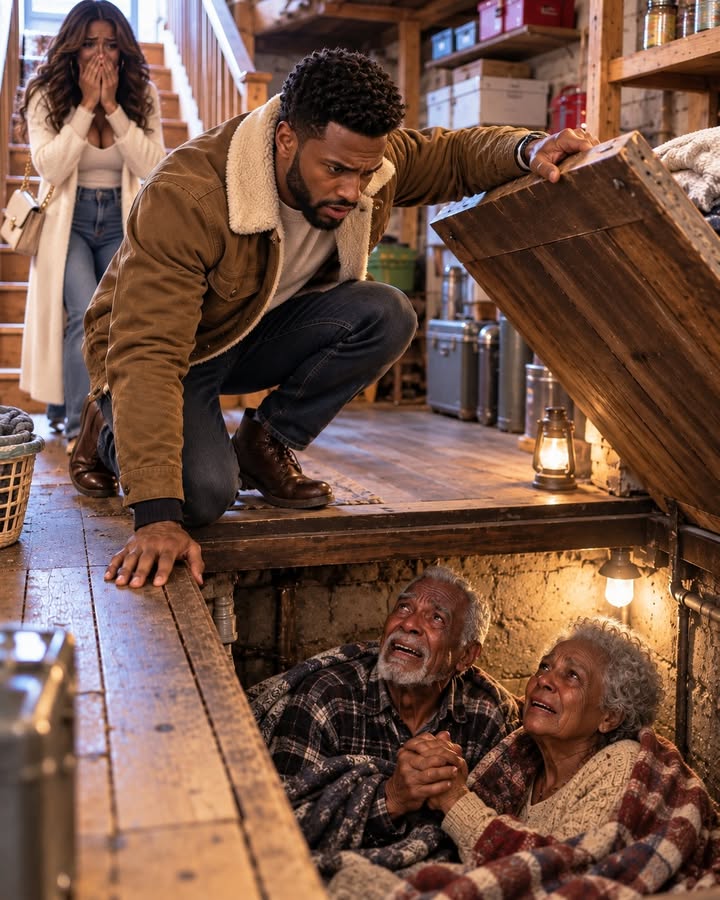
Later, when a social worker came to speak with us about support at home and follow-up care, I told her how I had found my parents in the basement.
I explained that Brenda had kept the door secured, that our parents had been living there for months, and that the money I sent for their care had been used partly for her debts.
I also told her what my father had asked of Brenda: that she keep his memory problems from me because he feared being treated as a burden.
I told her that Mom had initially gone along with the arrangement because she hoped it would be temporary, and that Brenda had dismissed Nancy after Nancy urged her to seek proper medical help.
I did not make Brenda sound innocent.
I did not make her sound like a monster either.
The social worker listened, asked careful questions, and wrote down the answers.
Brenda added what I could not know, including the dates when she had begun bringing meals downstairs and the times she had tried to get Dad to agree to see a doctor.
When she reached the point where she had fired Nancy, her voice shook.
“I was afraid she would report me,” she said. “I was also ashamed that she had seen how badly I was managing.”
The social worker told her that the hospital had procedures to follow and that the family’s immediate priority was making sure both parents had safe care.
Brenda nodded.
She did not ask us to leave anything out.
When the conversation ended, the social worker arranged for someone to check on the house and discuss a safe return plan with our parents before they were discharged.
Nothing was decided without Dad and Mom being included.
Dad asked several questions about whether he could keep his bedroom, whether someone would need to stay overnight, and whether he could still sit in the garden.
The social worker answered each one plainly.
Brenda listened from the chair, her hands folded together.
Afterward, Mom took her aside into the corridor.
I stayed with Dad while they spoke.
Through the partly closed door, I could hear only the rise and fall of their voices, not the words.
Dad stared at the blanket.
“Do you think your mother can forgive her?” he asked.
“I think forgiveness takes time.”
“Do you think you can?”
“I don’t know.”
He looked at me.
“That’s honest.”
“I don’t want to pretend something is settled just because everyone is tired.”
He gave a small smile.
“Good.”
He asked me to bring the old phone the next morning.
I said I would.
“I want to hear the rest,” he said. “Even if I don’t remember it.”
When Brenda and Mom returned, Mom’s eyes were red, though she seemed calmer.
She placed her tea on the table and sat beside Dad.
“I told her I love her,” she said.
Brenda stood by the doorway.
“And I told her I’m sorry,” she replied.
“Those can both be true,” Mom said. “But they don’t erase what happened.”
“I know.”
“Then we’ll start there.”
Brenda crossed the room and took Mom’s hand.
Mom let her.
I watched them, unable to tell whether the gesture was the beginning of forgiveness or simply the beginning of a conversation neither of them had known how to have.
That night, I returned to the house with the old phone and the list of Brenda’s debts.
I set the phone on the kitchen table and placed the folded list beside it.
The basement door stood open.
The small room below was empty now, stripped of the blankets and folding chairs so it could be inspected.
Without the bedding, it looked less like a bedroom and more like what it had always been: a narrow corner of a basement that had never been meant to hold two people’s lives.
I stood at the top of the stairs for a long time.
I could hear no movement beneath me.
The silence no longer felt like a secret being kept.
It felt like a room waiting for someone to say what would happen next.
My phone buzzed.
George had texted to ask whether I was all right.
I wrote back that Mom and Dad were safe at the hospital, and that we were working with the social worker on a plan.
Then I called Nancy.
She answered after several rings.
“Shawn?”
“Hi, Nancy. I’m sorry to call so late.”
“Is everything all right with your parents?”
“They’re safe. Dad’s in the hospital, and Mom is with him.”
There was a pause.
“I’m glad,” she said. “I’ve wondered about them for months.”
“I know Brenda let you go after you told her they needed medical care.”
Nancy sighed softly.
“I wish I had been able to help them.”
“I’m sorry you were put in that position.”
“It wasn’t your fault.”
“I should have asked more.”
“Most people don’t see what’s happening until someone lets them look.”
Her words recalled George’s warning that Brenda had been alone with the problem longer than I had.
“I need to ask you what you saw,” I said. “Not so I can build a case against her, but so we can understand what care they need and what happened.”
“I can tell you what I remember.”
“Would you be willing to speak with the social worker?”
“Yes.”
“Thank you.”
Before we ended the call, Nancy said she had kept the notes she made during her visits.
“They were mostly about Dad’s meals and his appointments,” she said. “I didn’t think they’d matter.”
“They matter now.”
“I’ll bring them to the hospital tomorrow.”
After the call, I sat at the kitchen table.
The old phone screen had gone dark, its battery holding a faint trace of light at the edge.
I pressed the button and opened the saved message again.
I listened to Dad’s first words, then stopped it before the rest.
There would be time to hear it with him.
There would be time to talk about the transfers, the locked door, the letters, and the calls that had never reached me.
There would be time for Brenda to repay what she could and to show, through the months ahead, that she understood the harm she had caused.
I could not decide whether I would one day forgive her.
I could decide not to use the truth as a weapon.
At the hospital the next morning, Dad was sitting up in bed when I arrived.
Mom rested in the chair beside him, and Brenda stood near the window with a paper cup in her hands.
The doctors had begun discussing follow-up appointments and a home-care plan.
Dad wanted to return to his own room, but he agreed that he needed support while his strength and memory were assessed.
Mom asked to be included in every visit.
Brenda said she would cooperate with the social worker and give her the account she had given us.
When I set the old phone on the table, Dad watched it closely.
“Did it work?” he asked.
“Yes.”
“Did you listen?”
“Only enough to know it was your voice.”
He looked toward Brenda.
“Will you stay while we hear it?”
She held the cup more tightly.
“If you want me to.”
“I do.”
I sat at the foot of the bed and placed the phone between us.
Mom rested one hand on Dad’s blanket.
Brenda set her cup down.
I pressed play.
Dad’s voice began again, familiar and uncertain.
“Shawn, it’s Dad.”
We listened in silence as the words about the day, the forgotten appointments, and the fear of becoming a burden moved through the room.
Then the message reached the part I had not heard before.
Dad paused for a long time.
When he spoke again, his voice was quieter.
“I asked Brenda to keep this from you because I thought you’d have to come back and choose between me and your life.”
Brenda bowed her head.
Dad continued.
“But if you’re hearing this, I hope you know I don’t want you to choose. I only want you to call when you can.”
Mom closed her eyes.
The message ended with a small breath and a soft click.
Dad looked down at his hands.
“I was wrong about that,” he said.
“About what?” I asked.
“Thinking you had to choose.”
“I should have come more often.”
“Yes,” he said. “You should have.”
The answer was plain, but there was no accusation in it.
“I’m here now,” I said.
“I know.”
Brenda touched the edge of the blanket.
“I should have let him call you.”
“Yes,” Dad replied.
“I’m sorry.”
“I know.”
He did not reach for her hand this time, but he did not turn away.
There was still a distance between them, and no one in the room tried to pretend otherwise.
A nurse entered with a clipboard and asked Mom and Dad to review the next day’s care plan.
They began discussing the appointments, the equipment needed at home, and who would be present when Dad returned.
Brenda volunteered to go back to the house and gather his glasses, clothing, and the repair kit he liked keeping beside his chair.
Mom asked her to bring the blue sweater from the bedroom.
Dad asked for his old work gloves.
As Brenda moved toward the door, I noticed the small bag she had brought with her.
A folded envelope protruded from the side pocket.
It was addressed to me in my mother’s handwriting.
The same careful slant.
The same faded date from seven months earlier.
I recognized the worn corners.
Brenda saw me looking at it.
She stopped with one hand on the door.
“I found this behind the kitchen drawer,” she said.
Mom turned toward her.
“You had that?”
Brenda swallowed.
“I didn’t know what it was until last night.”
“Why is it in your bag?”
“I was going to bring it here.”
“You could have told us,” I said.
“I was going to.”
The envelope was already open.
A thin sheet of paper showed through the torn flap.
My name was written at the top, and beneath it I could see the first line of my mother’s handwriting.
I knew the date now.
It was two days after Dad’s fall.
Brenda held the envelope out to me.
“I haven’t read it,” she said.
I took it carefully, feeling its lightness in my hand.
Mom leaned forward, but did not reach for it.
Dad watched us both.
“Should I read it now?” I asked.
Mom looked at the open door, where Brenda still stood waiting.
“That depends,” she said. “On whether you want the truth before you know what it will ask of you.”
**–END OF PART 5–CLICK “NEXT” AT THE BOTTOM OF THE PAGE TO CONTINUE READING**
* * *
[PREVIOUS: PART 4](https://puretales.idolsgift.com/blog/part-4-the-key-brenda-couldn-t-explain-035) | [NEXT: PART 6(THE END)](https://puretales.idolsgift.com/blog/part-6-the-end-the-key-brenda-couldn-t-explain-035)
✓ Lynn R. Adams
Part 5 – What the Truth Would Cost “I wanted to hear your voice,” Dad’s message continued through the tiny speaker. A soft rustle followed, then a breath he seemed to gather with effort. “I’m not s…