Part 5 – THE GIANT BRIDE AND THE VULTURE’S CURSE-039
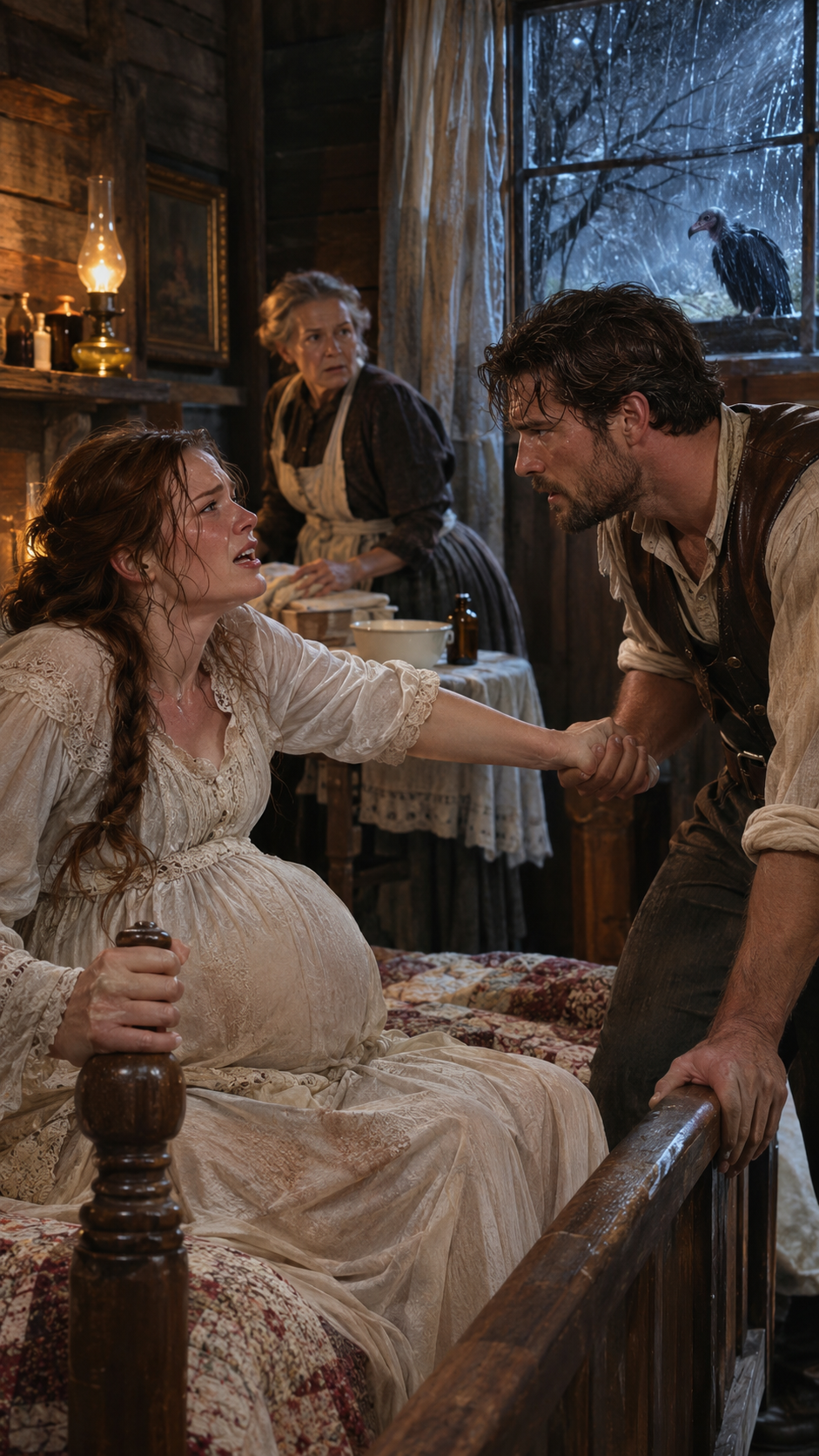
Part 5 – The Firstborn Who Lived
Part 5
Iris Thornwood answered their letter eleven days later.
The envelope arrived during breakfast.
Silas recognized no handwriting.
Magnolia did not wait for permission.
She opened it.
Silas protested.
“It has my name on it.”
“And I am your wife.”
“That does not make you the postal service.”
“It makes me faster.”
She unfolded the letter.
There were only four sentences.
Silas Thornwood,
I wondered whether anyone from that ranch would ever ask.
Yes, I am your aunt.
Yes, I was the firstborn.
Bring the family Bible.
Iris Bellamy
Silas read it twice.
“She sounds like you.”
Magnolia smiled.
“I already like her.”
Three weeks later, with spring opening the roads, they traveled north.
Clara came with them.
So did enough blankets, milk cloths, food baskets, and emergency supplies to survive an expedition across the continent.
Silas complained.
Magnolia added another blanket.
They found Iris Bellamy in a small town beneath snow-covered mountains.
She lived above a bookshop.
Silas stopped beneath the sign.
“Of course.”
“What?”
“The first Thornwood to survive became a bookseller.”
“Apparently literacy defeats curses.”
He gave her a look.
“You have become very smug since childbirth.”
“I earned it.”
The bell over the shop door rang.
A woman emerged from behind a tower of books.
She was nearly seventy.
Tall.
Not Magnolia tall.
But tall enough that Silas immediately saw the family resemblance.
Same straight nose.
Same gray eyes.
Same habit of studying a stranger before speaking.
She looked at Clara first.
Then Magnolia.
Then Silas.
“You have Jacob’s mouth,” she said.
Silas swallowed.
“You’re Iris.”
“So the letter claimed.”
She looked at Magnolia.
“You must be the giant bride.”
Magnolia blinked.
Silas coughed.
Iris smiled.
“Esther writes to me.”
Magnolia laughed.
“I think I like you.”
“You will until we disagree.”
They stayed above the bookshop.
That night, after Clara slept, Iris placed the Thornwood Bible on the table.
She turned to the page where her name had been crossed out.
“My father did that.”
“Amos?” Silas asked.
“Yes.”
“Why?”
“Because I embarrassed him by surviving.”
Silas frowned.
Iris smiled sadly.
“Not literally.”
She poured tea.
“I became inconvenient to the story he preferred.”
Then she began.
Iris had been born in the east bedroom.
The same room.
The same fireplace.
The same tradition.
Her mother, Eliza, had already heard rumors of the Thornwood curse from Amos’s mother.
On the night Iris was born, the stove smoked heavily.
By midnight, Iris stopped nursing.
By one, she became limp.
Eliza panicked.
Unlike the women who came later, she did something accidental and lifesaving.
She carried Iris outside.
“She thought cold air might wake me,” Iris said.
“It did?”
“Within minutes.”
Magnolia and Silas exchanged a look.
Eliza refused to take the baby back inside.
Mother and newborn spent the remainder of the night in the barn wrapped in horse blankets.
At sunrise, Iris was alive.
Amos called it a miracle.
Eliza called it evidence.
“She believed the room was making people ill,” Iris said.
“Then why wasn’t it repaired?” Silas asked.
“Because the stove behaved normally most of the time.”
Iris shrugged.
“And because people prefer mysteries to maintenance.”
Magnolia smiled despite herself.
“What happened next?”
“Eliza became obsessed with proving it.”
She noted headaches.
Smoke.
Wind.
Illness.
But medicine in those days offered few answers.
Nobody could explain exactly why a room that appeared merely smoky could leave someone weak or confused.
Then tragedy struck.
Eliza died of fever when Iris was six.
Amos remarried.
His new wife gave birth to a son.
The baby died in the east bedroom.
“The curse returned,” Iris said.
Silas sat back.
“And Father believed it.”
“He was a child.”
“No. Amos.”
“Ah.”
Iris considered.
“Amos needed to.”
Again, the same pattern.
Grief selecting the explanation that required the least unbearable self-examination.
Iris grew older and argued with her father.
When she was seventeen, she demanded the east-room chimney be removed.
Amos refused.
The argument became a rupture.
Iris left.
She married.
Moved away.
Her name was crossed from the family register.
“My father told people I had rejected the Thornwood name.”
“Had you?” Magnolia asked.
“Yes.”
Iris smiled.
“But he said it first.”
Silas looked down at the Bible.
“So the curse survived because the one firstborn who disproved it was erased.”
“Not entirely.”
Iris opened a drawer.
She removed a folded paper.
“Eliza left this.”
Magnolia read it.
IF THEY CALL IT A CURSE, OPEN THE WINDOW.
She closed her eyes.
The broken window.
The vulture.
The rush of cold air.
An accident had repeated Eliza’s choice after all those years.
Open the window.
Silas stared.
“That bird may have saved Clara.”
Iris lifted an eyebrow.
“The bird broke the glass?”
“Yes.”
“Then perhaps your family owes vultures an apology.”
Magnolia laughed.
Silas tried not to.
Failed.
Later, while Magnolia put Clara to bed, Silas remained downstairs with Iris.
He asked questions he had been carrying since childhood.
About his father.
His grandmother.
Thomas.
Miriam.
Iris answered what she could.
Not every mystery had survived.
Memory had gaps.
Letters had vanished.
People had died before explaining themselves.
Yet the absence of perfect answers no longer felt threatening.
Silas began to understand something his family never had.
Uncertainty did not require superstition.
Sometimes uncertainty was simply uncertainty.
Before they left, Iris gave him a bundle of letters.
“Your mother wrote to me.”
Silas stared.
“She knew you?”
“For years.”
“Why didn’t she tell me?”
“She planned to.”
“When?”
“When you were old enough to challenge your father without hating him.”
Silas looked down.
“She died first.”
“Yes.”
Magnolia joined them.
Silas handed her one of Miriam’s letters.
Near the end, his mother had written:
I fear Silas will inherit Jacob’s terror and my silence. Both are dangerous in different ways.
I hope someday he marries someone who asks questions neither of us had courage to ask.
Magnolia read the line twice.
Iris watched her.
“Well?”
Magnolia folded the letter.
“I suppose I’ve been useful.”
Silas looked offended.
“You have been considerably more than useful.”
“That may be the kindest thing you’ve ever said.”
“I told you I loved you.”
“Yes, but this sounds sincere.”
Iris laughed so loudly Clara woke upstairs.
On the journey home, Silas was quieter than usual.
The last evening before they reached the ranch, they camped beside a creek.
Magnolia found him watching the stars.
She sat beside him.
“You’re brooding.”
“I’m reflecting.”
“You’re brooding with vocabulary.”
He smiled.
Then grew serious.
“I almost lost you.”
Magnolia knew what he meant.
Not on the journey.
During childbirth.
In the east room.
“I know.”
“I brought the cradle in there.”
“You didn’t know.”
“I lit the stove.”
“You didn’t know.”
“I insisted on using the family room because it was tradition.”
“You didn’t know.”
Silas looked at her.
“How many times will you say that?”
“Until you believe it.”
“What if I never do?”
“Then I’ll become very repetitive.”
He laughed quietly.
Magnolia took his hand.
“I came west because your telegram offered me a bargain.”
Silas winced.
“Please never read that thing aloud again.”
“I thought you wanted strength.”
“I did.”
“I thought that was all I could offer.”
Silas turned.
Magnolia looked toward the dark water.
“When Robert left me, I decided the only useful parts of me were the things other women were not supposed to have. Height. Strength. Endurance.”
“Magnolia.”
“I came to you because you wanted those things.”
“I wanted you.”
“Eventually.”
“Immediately.”
She gave him a skeptical look.
“You insulted me at the train station.”
“I said you were tall.”
“You said taller than expected.”
“I was impressed.”
“You sounded alarmed.”
“I was trying to look masculine.”
She laughed.
Silas leaned closer.
“I failed.”
“Completely.”
“Good.”
His expression softened.
“I don’t want you because you can carry gates.”
“Useful skill.”
“I don’t love you because you gave me Clara.”
Magnolia’s eyes stung.
“I love you because when every person in a room accepts one answer, you ask another question.”
She looked away.
Silas touched her chin.
“And because you hate turnips.”
“That is central.”
“Very.”
They kissed beneath a sky crowded with stars.
When they returned to the ranch, spring had arrived fully.
The cottonwood remained dead.
The vulture remained alive.
It watched from the highest branch while wagons rolled through the gate.
Silas raised one hand toward it.
Magnolia stared.
“Did you just wave?”
“No.”
“You waved at the vulture.”
“I was stretching.”
“Your fearsome reputation is finished.”
Inside the house, the east room was bright.
The repaired chimney drew cleanly.
But they never put the stove back.
Instead, Magnolia placed shelves against the wall.
Silas brought in a desk.
They decided the room would become a library.
“No heirs,” Magnolia said.
“No curses,” Silas agreed.
“Only books.”
“And Clara.”
“And Clara.”
That evening, while unpacking the letters Iris had given them, Magnolia found one envelope that did not belong with the others.
It was newer.
Written only five years earlier.
Addressed to Miriam Thornwood.
The sender was unfamiliar.
DR. NATHANIEL REEVE
PHILADELPHIA, PENNSYLVANIA.
Magnolia’s hands went cold.
Philadelphia.
Silas noticed.
“What is it?”
She opened the letter.
Dr. Reeve wrote that Miriam had once contacted him about the deaths of Thornwood infants.
He had studied similar cases in houses with defective heating systems.
His conclusion was careful but unmistakable.
The symptoms Miriam described were consistent with poisoning from combustion gases accumulating in poorly ventilated rooms.
Silas read silently.
At the bottom was a final paragraph.
Magnolia nearly missed it.
The doctor mentioned that Miriam’s earlier inquiry had been prompted by another woman.
A woman who had visited Philadelphia years later seeking information about the same Thornwood family history.
Her name was not Iris.
It was not Esther.
It was someone neither Silas nor Magnolia had ever heard of.
Eleanor Voss.
And beside her name Dr. Reeve had added:
SURVIVING FIRSTBORN, SECOND BRANCH OF THORNWOOD FAMILY.
Magnolia looked at Silas.
“I thought Iris was the only one.”
“So did I.”
The curse had not merely failed once.
It had failed twice.
And somewhere, another forgotten branch of the Thornwood family had been living for years with a truth no one at the ranch had known existed.
**–END OF PART 5–CLICK “NEXT” AT THE BOTTOM OF THE PAGE TO CONTINUE READING**
✓ Lynn R. Adams
Part 5 – The Firstborn Who Lived Part 5 Iris Thornwood answered their letter eleven days later. The envelope arrived during breakfast. Silas recognized no handwriting. Magnolia did not wait for p…