PART 5: The Fourth Heartbeat5 025
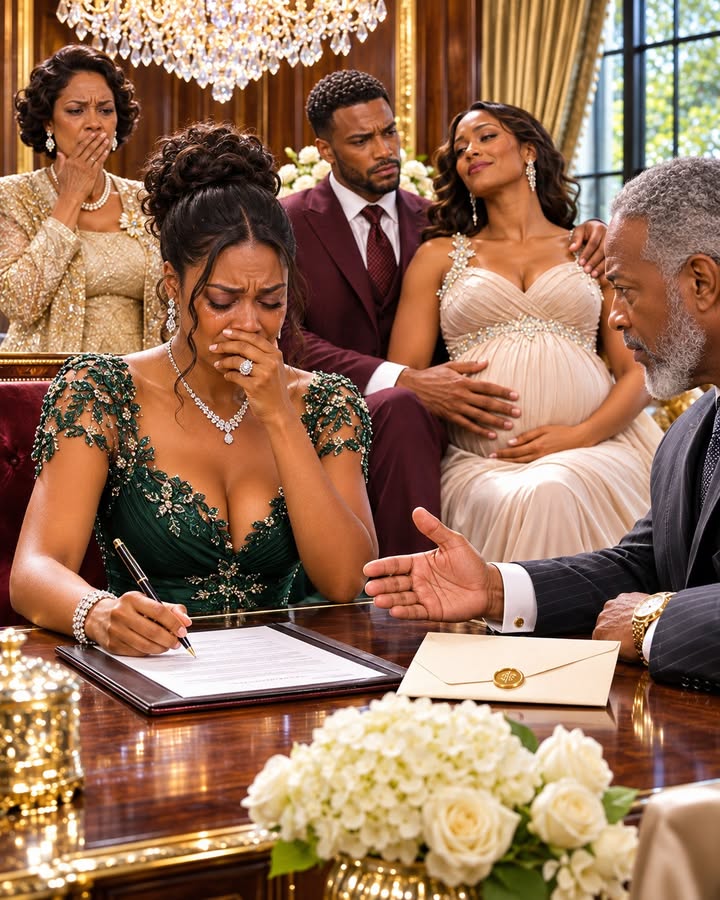
Part 5 – The Price of Silence
“Evelyn must not be allowed to carry the Whitmore heir before Vanessa’s pregnancy is confirmed.”
I read the sentence twice.
The words did not grow kinder the second time.
They sat on the screen with the same cold certainty as the payment record beneath them, turning my private fear into something Richard had written down and sent to a clinic.
Rachel reached for my hand.
“Is that really what it says?”
I nodded, though I could not make my voice work.
The car was parked outside the specialist’s office, and the gray afternoon pressed against the windows.
A moment earlier, we had been discussing the four heartbeats and the next scan.
Now my father-in-law’s message seemed to have entered the car with us, filling every bit of space.
Rachel read the rest of the page.
The message was dated several weeks before my appointment had been canceled.
Richard had written that my treatment should be paused until Vanessa’s pregnancy could be confirmed.
He called the decision temporary.
He described it as a way to prevent confusion and protect the family from “competing expectations.”
I gripped the edge of my phone.
“What does that even mean?” I whispered.
“It means he was trying to control what happened,” Rachel said. “But we still need the clinic’s complete review.”
“I know.”
My voice sounded thin and distant.
I knew the message was not the whole story.
I knew the audit still had to establish who had acted on it, what the sample’s final destination had been, and how the payment had been recorded.
But the sentence did not need those answers to hurt.
Richard had thought of my pregnancy as something to prevent until he knew whether Vanessa was carrying the heirs he wanted.
He had not known about the four babies growing inside me.
He had not known that the decision he tried to make for me would be followed by a truth none of us could have planned.
Rachel took the phone from my hands and placed it face down in the console.
“Let’s get you home.”
I looked through the window at the clinic entrance.
“I don’t want him deciding what this means.”
“He doesn’t get to decide that.”
“I mean the story. What happened. What I say. What I do with the records.”
Rachel turned toward me.
“Then we’ll make sure you have every document before you choose.”
The phrase settled inside me: before you choose.
For years, I had thought my choices were limited to continuing to try or giving up, staying married or leaving, accepting help or standing alone.
Now the clinic’s records had opened a different kind of decision.
What did I want done with the truth?
The next morning, the clinic coordinator called to explain that the audit team had confirmed the message’s date and its connection to the withdrawal request.
The clinic had also verified the payment from Richard’s family office.
It had been labeled “special administrative handling,” though the audit had not yet established precisely who had approved it or what the former finance manager had been paid to do.
The clinic was reviewing its own procedures and had notified its legal counsel.
They would provide a corrected record when the review was complete.
“Will the corrected record say what happened to the sample?” I asked.
“We’re still tracing its final status,” the coordinator said. “We have not found evidence that it was transferred to another clinic, but we also have not located a formal destruction record.”
“So it may be missing.”
“It may have been misclassified or closed incorrectly. I don’t want to give you an answer before we can support it.”
I appreciated the care in her voice.
I also hated that I had to ask whether part of my treatment history had disappeared without my knowledge.
“Does the clinic know who made the request?” I asked.
“The records identify Richard’s office as the source of the instruction. We have not verified which employee placed the call.”
“And Julian’s authorization?”
“The request was entered under his authorization, but the message asks that it be processed under his name. We have not found evidence that he personally approved the withdrawal.”
The distinction mattered.
It did not make Julian innocent of everything.
He had signed Richard’s administrative form without asking me.
He had canceled an appointment without telling me why.
He had been unfaithful, lied to me, and allowed his father’s pressure to shape decisions that belonged to us.
But Richard had used Julian’s name to give the request weight, then asked the clinic to treat his own instruction as ours.
I told the coordinator I wanted the full audit sent to my attorney as well as to me.
She said that could be arranged.
After the call, I sat at Rachel’s kitchen table with the documents spread in front of me.
The clinic had sent the audit summary, copies of the messages, the authorization form, and the payment record.
My attorney, Ms. Patel, had reviewed them the previous evening and asked to meet me that afternoon.
She had also warned me that the papers might eventually be requested as part of the divorce proceedings or a formal investigation into the clinic’s handling of my file.
“You can ask for privacy,” she had explained, “but no one can promise that every document will stay private if the clinic’s review becomes a legal matter.”
That uncertainty had followed me into the morning.
I wanted the truth established.
I did not want my pregnancy, my medical history, and the worst moments of my marriage turned into public property.
I wanted Richard’s actions corrected.
I did not want my children to begin life as characters in a family scandal.
I wanted to protect my peace.
I could not tell whether accepting silence would protect it or merely postpone another injury.
Rachel brought over a plate of toast and set it beside the papers.
“You should eat something before your meeting.”
“I’m not hungry.”
“I know,” she said. “Eat a little anyway.”
I broke off a corner and chewed without tasting it.
Rachel sat down opposite me.
“Do you want to talk through what you’re considering?”
“I don’t know what I’m considering yet.”
“That’s all right.”
“If I let the audit end with a private correction, Richard could say it was a clerical mistake.”
“Maybe.”
“If I cooperate with a full investigation, the story could spread further than I can control.”
“Maybe that too.”
I looked at her.
“You’re not going to tell me what to do?”
“No.” She reached across the table and touched the edge of one document. “This is your life. I can help you see the choices, but I can’t make them for you.”
I lowered my eyes.
“I’m scared that if I choose the fight, I’ll be thinking about the babies as proof.”
“Proof of what?”
“That he was wrong. That I mattered. That my body didn’t fail.”
Rachel’s expression softened.
“You don’t need to prove that you mattered.”
A tightness rose in my throat.
“I know that in my head.”
“Then let the decision come from what you want now, not from what he made you believe about yourself.”
I folded the corner of the toast wrapper, then flattened it again.
“What if what I want is to disappear from all of this?”
“Then we talk about what disappearing would cost you, and what it would protect.”
She did not tell me that accountability was always worth any price.
She did not tell me that money was poison or that silence was surrender.
She left room for my fear, which made it possible to look at it honestly.
Ms. Patel arrived after lunch.
She was a calm, precise woman who had handled the paperwork from my separation and never confused her opinion with my decision.
She reviewed the clinic’s latest documents with me and explained what a formal complaint might involve.
The clinic had already opened its internal investigation.
I could ask that its findings remain confidential to the extent allowed by law, and I could authorize the clinic to correct my record without making the entire matter public.
But if the investigation identified misconduct by an employee or a payment that had influenced the clinic’s actions, the clinic might have obligations to report it.
Richard’s messages could also become part of any legal proceeding involving the clinic.
“You do not have to choose a public fight,” Ms. Patel said. “You can cooperate privately and ask for a correction. You can also make clear that you do not consent to being used as a bargaining chip in the Whitmore family’s affairs.”
“What if I accept a settlement?”
“That would depend on the terms. Richard’s family office has contacted me.”
My stomach tightened.
“What does he want?”
“He wants to resolve the matter quickly and privately.”
“Has he offered me money?”
“Not yet in a formal written proposal, but he has asked whether you would consider financial terms in exchange for a confidentiality agreement and a release of certain claims.”
I stared at the clinic papers.
“He already offered me twelve million dollars to divorce Julian.”
“This is a separate matter,” Ms. Patel said. “That earlier offer was tied to the divorce. This one appears to be connected to the clinic’s records and your silence.”
The word silence felt heavier than settlement.
“Can I see the proposal?”
“When it arrives, yes. You are not obligated to consider it.”
I understood that.
I also understood that a choice did not become simple merely because I had the right to refuse.
The following morning, Richard’s attorney sent the formal offer.
The amount was large enough to cover more than the expenses of the coming year.
It could pay for specialists, support during the pregnancy, help after the babies arrived, and a home of my own if I wanted one.
The offer included a promise that Richard’s family office would cover any future medical costs connected to the pregnancy.
In return, I would agree not to discuss the clinic audit with the press or with anyone outside my legal and medical teams.
I would also release Richard and his family office from any claims connected to his involvement in my fertility treatment.
The offer was written in polished, careful language.
There was no threat.
There was no deadline in bold type.
But I knew what it asked.
It asked me to accept security in exchange for letting Richard decide what could be said about what he had done.
Ms. Patel advised me not to respond immediately.
I carried the proposal back to Rachel’s apartment and placed it beside the audit documents.
For the rest of the day, I moved from room to room without accomplishing anything.
Four babies had turned every practical question into a calculation.
How many appointments would I need?
How much help might I need when the pregnancy became more difficult?
What would happen if one of the babies required additional care?
The doctor had warned me that this was a high-risk pregnancy, not a certain disaster.
There was no immediate crisis.
Still, I could not pretend that support would be unimportant.
The money could make a frightening future more manageable.
That was what made the offer hard.
If it had been cruel or obviously self-serving, refusing it would have felt easy.
Instead, it was framed as help.
A very large amount of help, attached to a very specific silence.
That evening, Rachel found me looking at the figure again.
“Are you thinking about accepting it?” she asked.
“I’m thinking about what it could provide.”
“That’s fair.”
“If I accept, I could stop worrying about bills.”
“Some of them, yes.”
“I could get help at home.”
“Yes.”
“And I wouldn’t have to keep explaining what happened.”
Rachel sat across from me.
“What would accepting require you to leave unfinished?”
I looked down at the papers.
“The clinic might correct my file, but the records could still say Richard’s request was made with our agreement.”
“Could that be changed?”
“I don’t know.”
“Would you be able to ask for that before signing?”
“Maybe.”
“Then the choice isn’t just accept or fight.”
I let out a tired breath.
“It feels like every choice has a hidden cost.”
“Most important ones do.”
“I don’t want my children growing up with this story hanging over them.”
“Neither do I,” she said. “But keeping it quiet doesn’t mean it disappears. It just means fewer people know.”
I lifted my eyes.
“Would you think I was weak if I took the money?”
“No.”
“Would you think I was reckless if I refused it?”
“No.”
She held my gaze.
“I would think you were making the hardest choice you could see, and I would still be here afterward.”
The next day, Vanessa asked if we could meet.
She wanted to bring the documents from her care file, this time with her lawyer’s approval to share them with the clinic’s audit team.
I agreed to see her at Rachel’s apartment.
Vanessa arrived carrying a thin folder and looking as if she had not slept well.
She sat at the far end of the table from me.
“I found the original agreement Richard had me sign,” she said. “My lawyer says it wasn’t a medical consent form. It was a financial agreement tied to the care arranged through the family office.”
“What did it require?”
“That I use the providers they selected and keep them informed about the pregnancy. It also said I would consult Richard about any major change in the plan.”
Rachel’s eyebrows drew together.
“Did you think that was normal?”
“No,” Vanessa admitted. “But I thought it was the price of getting support. I didn’t know it also gave him permission to manage information between offices.”
She handed me a copy.
The agreement did not say that Richard owned her decisions.
It did not grant him authority over her body or medical treatment.
But it did create a channel through which his office could coordinate appointments and payments, giving his staff a position of influence in her care.
“My lawyer says I can leave the arrangement,” Vanessa continued. “I’ll lose the financial support, but he says I can ask the babies’ fathers for proper support through the normal process.”
She looked at me, then corrected herself.
“Julian’s the father of mine. I know he’s also the father of yours.”
The admission carried no claim, only discomfort.
“Have you told Julian you’re leaving the arrangement?” I asked.
“Yes.”
“What did he say?”
“He said he would support the children, but he didn’t ask me to trust him. He said he knows I don’t.”
I considered that.
“Are you planning to testify to the clinic?”
“If they ask me to explain the agreement, yes. I won’t pretend Richard didn’t help me. He did. But I also won’t let the agreement be described as my informed approval of everything his office did.”
I nodded slowly.
“You understand that whatever you say may make this more public.”
“I do.”
“Why are you willing to do it?”
Vanessa lowered her gaze to the folder.
“Because I thought I was being given a place in the family. I don’t want to keep pretending that the place was mine if it only existed while I did what Richard wanted.”
She looked up.
“I can’t undo what I did to you. I know that. But I can at least stop letting him tell the story as if I chose every part of it freely.”
I studied her face.
She was not asking me to forgive her.
She was not asking to be treated as another victim and nothing more.
That mattered.
“I appreciate you bringing the documents,” I said.
“I appreciate that you let me.”
We did not embrace.
We did not call each other friends.
But when Vanessa left, the space between us felt less like a contest and more like a line neither of us wanted Richard to draw for us.
That evening, Julian called and asked whether I had received the offer.
“Your father’s lawyer contacted you?” I asked.
“He contacted my lawyer too.”
“Did he offer you money?”
“No.”
“Did he ask you to keep quiet?”
“He asked me not to make this harder for the family.”
The familiar phrase left me cold.
“What did you tell him?”
“That it isn’t mine to decide for you.”
I waited.
“Evelyn, I don’t want you to feel pressured by me either. If you choose privacy, I’ll respect it. If you choose to cooperate with the clinic, I’ll support you.”
“You say that as if the decision has no cost for you.”
“I know it may affect my family.”
“Your father’s business?”
“Yes.”
“Your place in it?”
He paused.
“I don’t know.”
The old Julian might have looked to me for reassurance that his future would be safe.
This time, he did not.
“Do you think your father intended to stop me from getting pregnant?” I asked.
“I think the message says what it says.”
“And the sample?”
“I didn’t know he requested it. I didn’t know he used my authorization.”
“You still canceled the appointment.”
“Yes.”
“You still decided we should stop trying without asking me.”
“Yes.”
The answer came without a plea.
“I can’t separate those things for you,” he said. “You shouldn’t have to pretend they don’t matter because Dad went further.”
I looked at the settlement offer on the table.
“Why didn’t you tell me you were overwhelmed?”
“I thought I could keep everything calm by avoiding the conversation.”
“You avoided it by making me carry the uncertainty alone.”
“I know.”
“Do you?”
“I’m beginning to understand how often I called silence peace.”
The words landed differently than his earlier apologies.
They did not excuse him.
They did not ask anything of me.
For a moment, I could hear the person I had once loved beneath the man who had betrayed me.
That frightened me more than anger.
“I don’t know whether I can forgive you,” I said.
“I’m not asking you to.”
“Good.”
“I would like to be there for the babies, if you decide that’s right.”
“I’ll decide what contact makes sense after the next appointments. Not before.”
“I understand.”
We ended the call gently, which did not mean we had made peace.
It meant we had stopped pretending that one conversation could solve what years of choices had broken.
Two days later, Ms. Patel arranged a meeting with Richard’s attorney.
She said I could attend or ask her to handle it without me.
I chose to go.
I wanted to hear the offer discussed in a room where I could see the people who had written it.
Richard was not present.
His attorney, Mr. Hale, greeted us with a professional courtesy that felt almost kind.
He said Richard wanted to avoid further distress and believed the settlement could provide stability during my pregnancy.
He emphasized that the offer was confidential, that it included medical support, and that accepting it would not require me to speak negatively about anyone.
“It would simply allow everyone to move forward privately,” he said.
I folded my hands in my lap.
“Privately for whom?”
Mr. Hale glanced at Ms. Patel.
“The agreement would protect all parties from unnecessary public attention.”
“Would the clinic still correct my medical record?”
“Yes, subject to its own review.”
“Would the corrected record say that Richard asked them to withdraw the sample?”
“That would depend on the clinic’s findings.”
“Would it say I never gave permission?”
“If the clinic confirms that.”
“And would the settlement require me to release Richard from any responsibility for the request?”
“The draft includes a release of claims connected to the matter.”
“Even if the audit confirms that he told the clinic to act under Julian’s authorization?”
Mr. Hale did not answer at once.
“The purpose is to resolve uncertainty without prolonged dispute,” he said.
I looked at the page in front of me.
The payment was not compensation in the simple sense.
It was a way to make uncertainty permanent.
“What does Richard want from me?” I asked.
“He wants to prevent a painful family matter from becoming a public conflict.”
“What does he want me not to say?”
“Nothing outside the agreement.”
I looked at him.
“I want the clinic to correct the record. I want the audit to finish. I want the sample’s status documented as accurately as possible. I don’t want anyone calling my treatment a family decision when I was never asked.”
Mr. Hale took a note.
“I can relay those conditions.”
“Those aren’t conditions for accepting the settlement. I’m telling you what I believe needs to happen.”
Ms. Patel’s hand rested lightly beside her folder.
The choice was still mine.
No one in the room could tell me what I ought to value more: protection from exposure, financial security, or the certainty that Richard could not quietly rewrite what had happened.
I thought of the babies, of the specialist’s calm voice, and of the next scan waiting on the calendar.
I thought of Rachel bringing me tea and telling me there would be room for me in her life.
I thought of Vanessa handing over the agreement that had made her support conditional.
I thought of Julian admitting that his father’s pressure had not removed his own responsibility.
And I thought of Richard’s sentence, written down before he knew I was carrying four children.
I must not be allowed.
Something in me had changed when I read those words.
The phrase did not make me want to punish him.
It made me want to stop being spoken about as if my wishes were an obstacle to manage.
“I won’t sign this version,” I said.
Mr. Hale’s expression remained composed.
“Would you like time to consider a revised agreement?”
“I will consider any proposal that does not require me to release Richard from responsibility before the clinic has completed its review, and that does not restrict the clinic from correcting its records.”
“I can communicate that.”
“I also want the agreement to make clear that support for the babies cannot be used to control my medical choices or their care.”
“I’ll note that.”
I stood.
Ms. Patel gathered the documents.
The refusal did not bring relief.
It brought a different fear, sharper because it belonged to the path I had chosen.
Outside, the air was cold and bright.
Rachel had waited in the car, and when she saw us, she unlocked the door.
“How did it go?” she asked.
“I didn’t accept.”
She did not smile or congratulate me.
She only reached for my hand.
“Are you all right?”
“No.”
“That’s okay.”
I sat beside her and watched the office building shrink behind us as we pulled away.
“I’m scared this will become bigger than I can handle.”
“Then we’ll handle what’s in front of us.”
The words did not promise that the future would be simple.
They promised that I would not meet it alone.
That evening, I sent the clinic a written statement.
I authorized the audit team to share relevant records with its compliance counsel and with the appropriate authorities if its review required it.
I asked them to correct every inaccurate entry, identify the limits of what they could confirm about the sample, and provide a clear written account of the payment and the withdrawal request.
I also stated that I did not consent to Richard making medical or scheduling decisions on my behalf.
My attorney reviewed the statement before I sent it.
Then I pressed submit.
For a moment, nothing happened.
The screen showed a confirmation number and the words: Your request has been received.
That was all.
I set the phone down and rested my hand over my stomach.
The babies were too small for me to feel.
Still, I imagined four separate lives continuing without regard for settlement offers, family names, or the old arguments that had brought us here.
The next morning, I went to the clinic for another scheduled check.
The specialist found all four heartbeats.
The smallest baby remained behind the others in its measurements, but there was still no immediate crisis.
I listened carefully as the doctor described the monitoring plan, asking questions this time before fear could silence me.
Rachel stayed beside me with her notebook open.
When the appointment ended, the clinic coordinator asked if I could come by her office for a brief update on the audit.
She looked tired but composed.
The review team had verified that Richard’s message preceded the withdrawal request and that the payment had gone to a staff member involved in closing the file.
The clinic had suspended that employee’s access while its internal investigation continued.
The record would be corrected to show that the request had originated with Richard’s office and had not been authorized by me.
“They still haven’t located a destruction or transfer record?” I asked.
“No,” she said. “We’re continuing to search the archived logs.”
“Could the sample have been preserved elsewhere?”
“We can’t rule that out, but we have no evidence that it was transferred.”
I let the answer settle.
It was neither a promise nor a final loss.
The coordinator gave me an updated copy of the audit summary and asked whether I wanted the clinic to notify Julian directly about the limits of his authorization.
I hesitated.
“I want the correction to be accurate,” I said. “You can tell him what the records show. I don’t need to be included in that conversation.”
She nodded and made a note.
As we left, I felt tired but steadier than I had the day before.
I had chosen not to sign away the question.
I had not chosen a public fight.
I had chosen to let the record say what the clinic could prove.
For now, that was enough.
At Rachel’s apartment, I rested on the sofa while she made lunch.
My phone rang with an unfamiliar number.
I answered.
A woman introduced herself as a former records clerk from the clinic, now speaking through the clinic’s compliance office.
She said she had reviewed the archive after hearing that the audit team could not locate the sample’s final status.
“I can’t tell you what happened to it,” she said. “I don’t know.”
I sat up.
“Then what can you tell me?”
“I found a storage log that wasn’t attached to your file.”
“What does it show?”
There was a pause.
“Only that the sample was not marked destroyed.”
My hand tightened around the phone.
“Was it transferred?”
“I can’t say. The log has a number, but no destination.”
“What number?”
She read it to me.
I wrote it down on the back of Rachel’s grocery list.
Then the woman added, “There’s something else. The entry was created several weeks after Richard’s request, and the person who entered it left a note.”
My pulse quickened.
“What did the note say?”
“I can’t read the whole thing clearly. The last line says the sample was being held pending instructions from the patient.”
The kitchen went quiet.
I stared at the number on the page.
“Which patient?” I asked.
“I don’t know.”
“Can you send the log to the audit team?”
“I already have.”
The call ended a moment later.
Rachel appeared in the doorway, a dish towel in her hands.
“What is it?”
I looked from the number on the grocery list to the clinic summary in my lap.
For the first time since the audit began, the missing sample did not feel like a closed door.
It felt like something still waiting on the other side.
My phone buzzed.
A message from the clinic coordinator appeared on the screen.
The
**–END OF PART 5–CLICK “NEXT” AT THE BOTTOM OF THE PAGE TO CONTINUE READING**
* * *
[PREVIOUS: PART 4](https://puretales.idolsgift.com/blog/part-4-the-fourth-heartbeat5-025) | [NEXT: PART 6(THE END)](https://puretales.idolsgift.com/blog/part-6-the-end-the-fourth-heartbeat5-025)
✓ Lynn R. Adams
Part 5 – The Price of Silence “Evelyn must not be allowed to carry the Whitmore heir before Vanessa’s pregnancy is confirmed.” I read the sentence twice. The words did not grow kinder the second ti…