PART 5: The Door Michael Closed 046
Part 5 – The Crown’s Price
“If my father had the charter,” Rose said, “why did he leave it with me?”
The question seemed to reach into every corner of the records room.
The paper in my hand bore my father’s seal, but the words beneath it were not a command to seize the charter.
They were a note to the steward, written in the hurried, slanted hand my father used when he believed time was against him.
Elias has taken the village charter and must be found before he can return it.
I read the sentence once more, though it could offer no answer beyond the one it already held.
“Perhaps he knew your father had the charter and was trying to recover it,” I said.
Rose’s eyes remained on the page.
“Then why did he accuse Elias of stealing silver shears?”
“I don’t know.”
“Why tell the village the grove was diseased?”
“I don’t know that either.”
Michael stood beside the table, his face drawn.
“The order says he must be found,” he said. “It doesn’t say what he intended to do once he found him.”
“Nor does it say he meant to return the charter,” Rose replied.
“No,” Michael said. “It does not.”
I set the paper down beside the ledger.
The words did not soften because I had spoken them aloud.
The king had known the charter existed.
He had believed Elias had taken it.
And for years, I had lived inside the story my father told, while Rose lived with the consequences of a story that had been made to erase her family.
“We should take this to the council,” Michael said.
Rose closed the ledger.
“Not yet.”
“Rose,” I began, “the council needs to know what we found.”
“The council needs to see the charter before they decide what it means.”
“They cannot dismiss the ledger and my father’s order.”
“They can question their dates, their source, and whether the charter is authentic.”
“They will do that whether we wait or not.”
“Then we should give them the strongest evidence, not only the most painful one.”
I looked from her to the document.
She was right.
But the thought of sitting with the council while they debated the meaning of my father’s orders made my stomach tighten.
The council chamber had been where I first learned that silence could sound like agreement.
I had heard elders speak around an injustice until its edges disappeared.
I had sat beside my father and waited for the moment when it would be proper to ask a question.
Sometimes that moment had never come.
“I want to call them together,” I said.
Rose’s expression grew guarded.
“Before we find the charter?”
“Before they hear about it from someone else.”
“If they know what we have found, they may ask me to produce it.”
“Then they will hear that it remains in your keeping until it can be examined properly.”
“And if they insist?”
“They cannot take it from you.”
She held my gaze.
“That is not the same as saying they will not try.”
“No,” I said. “It isn’t.”
Michael rested his hands on the table.
“If the charter is genuine, it will change the crown’s claim to the grove, the cottage, and the land between them.”
“It will change more than that,” I said.
“The village may seek the return of other ground.”
“They may have a right to.”
“The council will worry about what that means for the stability of the palace.”
“Then the council can explain why the palace’s stability depends on keeping land that was never ours.”
Michael’s eyes moved to the old map.
He did not challenge me.
Rose studied me as though waiting for the certainty in my voice to falter.
I felt it beginning to.
Not because I had changed my mind, but because the choice was larger than the sentence that described it.
If I acknowledged the land as common ground, I might have to relinquish the cottage where I had imagined living.
The palace treasury might face claims from families whose boundaries had also been changed.
The council could refuse to confirm me as king when the time came.
My inheritance, which I had always thought of as a duty handed down with a name, might become a thing I had to examine before I accepted it.
“I will call the council,” I said. “But I won’t ask them to decide the charter’s meaning tonight.”
“Then what will you ask?” Rose said.
“To hear what we know, and to help prepare for a public examination of the evidence.”
“And if they tell you to keep it quiet?”
“Then I’ll tell them the truth cannot be made safer by hiding it.”
The words sounded stronger than I felt.
Rose did not mistake them for proof.
“I won’t stand in front of the council as your witness,” she said.
“I understand.”
“I haven’t decided whether I’ll stand before the village at all.”
“I understand.”
“And I will not let anyone make this into a story about you choosing me.”
Her voice held no anger, only a boundary she had learned to set clearly.
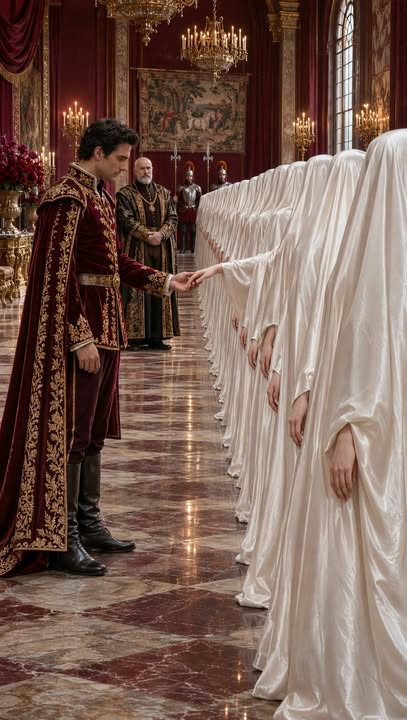
I remembered the veiled women and the gathered courtiers.
I had thought my choice in the glasshouse had been a declaration.
To Rose, it had also been a public act performed without asking what she wanted.
“You are right,” I said. “I chose you before I knew what you needed.”
“You recognized me.”
“I recognized your hand.”
“That isn’t the same thing.”
“No.”
She looked down at the seed I had placed beside the documents.
“I don’t want to be the reason you do the right thing.”
“You aren’t.”
“Then don’t tell yourself you’re making this choice for me.”
“I’m making it because the land belongs to the village.”
“And because?”
I glanced at my father’s order.
“Because I have spent too long letting my affection for him excuse what he did.”
The answer was harder to give than I expected.
Rose’s expression softened, but her eyes remained cautious.
“You can love someone and still tell the truth about them,” she said.
“I’m trying to learn that.”
“Then begin without asking me to forgive you.”
“I will.”
Michael took the king’s order and placed it in a protective sleeve.
“I will arrange for the council to meet at first light,” he said.
“Not in the great chamber,” Rose replied. “The village should not be treated as an audience in a room built to remind them who has power.”
Michael nodded slowly.
“The old hall?”
“It has a door that opens onto the market square,” she said. “People can choose whether to come inside.”
I considered the suggestion.
The old hall had been used for harvest gatherings and public accounts before the palace expanded.
Its walls were plain, its benches worn smooth by generations of people who had come to hear decisions that affected their lives.
“That is where we’ll meet,” I said.
Michael looked at me.
“The council may object.”
“They can object there.”
Rose turned the ledger over in her hands.
“Bring the records, but leave the charter with me.”
“I will,” I said.
“And don’t call the people there to watch you confess.”
“I won’t.”
“Call them to hear the evidence.”
“I will.”
She slipped the letter from Elias back into its cloth covering.
The question of where her father was remained between us, unanswered.
I wanted to ask whether she believed he had kept the charter with her because he trusted her.
I wanted to ask if she thought he had survived all these years.
Instead, I let her gather the things that belonged to her.
That evening, the council met in the old hall.
Word traveled faster than any formal notice could, and by the time I arrived, people had gathered outside the open doors.
Some were villagers who remembered the grove.
Others had come from the market, curious about the prince’s sudden invitation.
The council members sat on the raised bench at the far end of the hall.
They looked uncomfortable without the carved backs and polished table of their usual chamber.
I was grateful for it.
A plain room made it harder to pretend that rank was the same as truth.
Rose stood near the entrance, not beside me.
She had chosen a place where she could leave if she wished.
Michael stood at my right, his hands clasped behind him.
I placed the old map, the ledger, and my father’s order on a table where everyone could see them.
I did not bring the charter.
“I asked you here because the records concerning the orange grove contradict the account we have repeated for twelve years,” I began.
A murmur passed through the hall.
The eldest councilor, Lord Pell, leaned forward.
“What account do you refer to?”
“The account that the grove was removed because it had become diseased.”
“That was the official explanation,” he said.
“It was not true.”
The hall grew quiet.
I explained the entries in the gardening ledgers, the crossed mark on the old sketch, the altered boundary line, and the order written in my father’s hand.
I did not soften the parts that implicated him.
When I reached the note about the charter, I read the words aloud.
Elias has taken the village charter and must be found before he can return it.
The sound of the sentence seemed to settle over the benches and the open doorway.
A woman near the back pressed her fingers against her mouth.
An older man looked down, his expression distant.
Lord Pell’s face had tightened.
“This document proves that the king believed Elias had the charter,” he said. “It does not prove the charter was authentic.”
“No,” I replied. “It does not.”
“Nor does it prove that the village held a legal claim to the grove.”
“The old boundary map identifies it as common ground.”
“An old map is not a deed.”
“The ledger records a charter.”
“A charter not yet produced.”
“I know.”
“Then you are asking us to draw conclusions from incomplete evidence.”
“I am asking you to acknowledge that the evidence is incomplete, and that the official account we have relied on was false.”
Another councilor spoke from the far end of the bench.
“If this becomes public before the charter is verified, the crown may face claims it cannot answer.”
“The village has already faced the consequences of the crown’s claim,” I said.
“The village may not be the only party affected.”
“Then every claim should be examined.”
Lord Pell folded his hands.
“Your Highness, no one here wishes to deprive the village of what is rightfully theirs. But the crown cannot abandon its holdings on the strength of one ledger and a disputed map.”
“I am not asking the crown to abandon anything that belongs to it.”
“What do you propose?”
“That we gather the village records, compare the boundary maps, and have the charter examined by independent clerks. Until then, the palace will make no claim to the grove, the cottage, or the land marked on the older map.”
A low murmur moved through the hall.
One of the councilors shook his head.
“That would be understood as a concession.”
“It would be a pause in our claim.”
“A pause can become a precedent.”
“If the crown’s claim rests on a false story, perhaps it should.”
Lord Pell studied me for several seconds.
“Your Highness, you are speaking as though the land were already proven to belong to the village.”
“I am speaking as though we have enough evidence to stop pretending we know it belongs to us.”
“Your father’s actions are not yours.”
“No,” I said. “But the authority that carried them forward will be mine if I accept it without question.”
The words seemed to reach Rose.
She looked at me across the room, though she did not move closer.
I felt the pull of the moment, the easy temptation to turn her attention into a reward.
I resisted it.
This was not a speech for her approval.
It was an answer to what I had found.
One councilor leaned toward Lord Pell and whispered.
Another examined the map, tracing the older boundary with a fingertip.
The discussion turned to records, precedents, and the limits of the crown’s authority.
They spoke cautiously, as they were entitled to do.
They were not villains for fearing uncertainty.
But their caution could not be allowed to become another wall behind which the truth was kept.
Lord Pell returned his gaze to me.
“You are asking us to delay judgment until the charter can be examined.”
“Yes.”
“And if the charter is genuine?”
“Then the land must be returned to the village.”
“Even if the council believes that would weaken the crown?”
“Yes.”
The answer left my mouth before I could bargain with it.
A silence followed.
I had always believed the crown was a house I would inherit.
I had not understood that a house built partly on stolen ground could not be made just by living in it kindly.
Lord Pell’s voice lowered.
“Such a decision would have consequences for your succession.”
“I understand.”
“Your title is not yours alone to set aside.”
“I know.”
“If the council concludes that the crown has acted unlawfully, it may place limits on your authority.”
“Then I will live under those limits.”
One of the younger councilors looked startled.
“You would accept a diminished inheritance?”
“I would accept an honest one.”
The words did not make me brave.
They only made it harder to return to the life I had lived before hearing the evidence.
Lord Pell looked toward Rose.
“Has Miss Rose brought the charter?”
“No,” she answered.
The room turned toward her.
She remained where she was, near the door.
“I have the charter in my keeping,” she said. “I will not place it before the council until I know it can be examined without being altered, dismissed, or quietly removed.”
“Do you believe the document is genuine?” Lord Pell asked.
“I believe my father trusted it enough to risk his home and his name to protect it.”
“That is not the same as proof.”
“No,” Rose said. “It isn’t.”
She did not raise her voice.
She did not need to.
“I also know that the records you have already seen show the grove was not destroyed by disease. The king ordered the trees removed and the ground searched. Elias was accused of theft. The palace changed the boundary in the same year.”
She looked from one councilor to the next.
“If you want proof, you should help us find it. If you want me to hand over the only document my father left me, you will have to give me a reason to believe that this time the palace intends to protect the truth.”
No one answered at once.
The councilors were not accustomed to being asked to earn trust from someone without a title.
I had not been accustomed to it either.
Lord Pell lowered his eyes to the map.
“The council will review the records,” he said. “We will not make a public declaration until the charter is examined.”
“That is your decision,” I said. “But the village should hear what we know tonight.”
“The village is not prepared to hear that its land may have been taken from it twelve years ago.”
“It was already taken twelve years ago.”
“Such a statement could unsettle people.”
“The truth may unsettle people. That does not make it ours to withhold.”
The councilors gathered in a private knot at the far end of the bench.
Their voices were low, but the room was small enough that the pauses between words carried farther than the words themselves.
Rose remained by the door.
I wanted to go to her.
I stayed where I was.
When the council turned back, Lord Pell spoke for them.
“We will not oppose a public account of the evidence, provided it is clearly described as unverified.”
“Agreed.”
“The council will convene a review at dawn and invite representatives from the village.”
“Agreed.”
“And you will make no promise concerning the land until the charter has been authenticated.”
“I will make no promise about what the evidence does not yet prove.”
Lord Pell nodded.
“Then we have an understanding.”
“No,” I said. “We have a beginning.”
The distinction unsettled him.
It mattered to me.
The gathering outside had grown quiet.
Word had reached the square that the grove had not been diseased, and that the king had searched beneath its roots for something.
The people watched through the open doors as the council began to file out.
Some looked uncertain.
Some looked angry.
Most looked tired of waiting for the palace to tell them what had happened to a place they remembered.
An old woman stepped forward from the crowd.
“My brother planted the eastern row,” she said.
I had no answer ready.
She looked toward Rose.
“Do you know if any of those trees survived?”
“I don’t know,” Rose said. “But we will look.”
The woman nodded, then turned away before either of us could offer comfort that would be too small.
By the time the hall had emptied, dusk had settled across the square.
Michael remained with the council records, arranging for the pages to be copied and witnessed.
Rose stood outside beneath the hall’s plain stone arch.
I walked toward her but stopped several paces away.
“You didn’t have to speak,” I said.
“I wanted them to hear what the evidence could not say for itself.”
“Thank you.”
“Don’t thank me as if I did it for you.”
“I won’t.”
She glanced back through the doorway at the benches.
“You were willing to let the council limit your authority.”
“I was willing to let them examine it.”
“You could lose more than you think.”
“I know.”
“Do you?”
“No,” I said. “Not fully.”
That was the most honest answer I had.
Rose looked at the market square, where people were still gathered in small knots.
“I thought if I saw you stand beside me, I would know whether the boy I remembered was still there,” she said.
“And do you?”
“I saw a prince speak.”
The words stung, though I knew she had not said them to wound me.
“That isn’t all I am.”
“No,” she said. “But it is what you showed them.”
I looked toward the palace, its windows beginning to catch the first lights of evening.
“I spent my life learning how to stand in front of people.”
“And less time learning how to stand beside them.”
“I did.”
For a moment, she seemed about to say more.
Then Michael emerged from the hall carrying a copied sheet.
“The council’s clerk found another record in the registry,” he said. “A list of documents removed from the old archive.”
“What does it say?” I asked.
“Only that a sealed charter was transferred to the king’s private papers.”
“When?”
“The year the grove was cleared.”
Rose’s gaze moved to him.
“Could it have been the village charter?”
“It could have been,” Michael said. “The description is too brief to tell.”
“You never saw it?” I asked.
“No.”
“Did you know it had been moved?”
“No.”
He looked at the paper, then at the palace.
“I should have searched the private archive years ago.”
“You didn’t know what to look for,” I said.
“I knew the grove had been searched. I knew Elias had been accused. I knew the charter was missing from the registry.”
“You could not have known the pieces belonged together.”
“I could have asked why they were kept apart.”
No one answered.
It was not useful to tell him that guilt could not repair the past.
He knew that.
Rose drew her coat closer around herself.
“I’m going to return the charter to its hiding place tonight.”
“Where is it?” I asked.
“Somewhere safe.”
“That isn’t a place.”
“It is the only answer I can give you.”
I nodded.
“I won’t follow you.”
“I know.”
“Rose, if the council asks you to bring it in the morning, you do not have to agree.”
“I know that too.”
She turned toward the old streets leading back to the cottage.
“Will you stand with the village tomorrow?” I asked.
“I will stand where I think I can do the most good.”
“That is enough.”
She looked at me, and the familiar warmth moved across her face, faint and guarded.
“It will have to be.”
She left the square alone.
Michael waited until she had disappeared around the corner.
“You may lose the succession,” he said.
“I heard Lord Pell.”
“He was not speaking to make a point.”
“Neither was I.”
“If the council limits your authority, the palace will change.”
“Perhaps it should.”
“And your life?”
I looked toward the darkening road Rose had taken.
“I don’t know what my life will be.”
Michael lowered his gaze.
“I once thought keeping the palace quiet was the same as keeping it safe,” he said.
“And now?”
“Now I think the silence was what endangered it.”
We returned to the palace without speaking.
In my rooms, I placed the seed beside the old map.
I had not planted it.
Rose had asked me to keep it safe, and I had learned that an object could be more than its promise of what it might become.
At first light, the village would come to the old hall.
The council would examine the records.
Rose might bring the charter, or she might decide the palace had not yet earned the right to see it.
I would have to accept either choice.
I went to the window.
Beyond the palace wall, the old orange tree stood in the darkness, its branches shifting in the night wind.
For the first time, I understood that choosing justice did not mean I could choose how others received it.
In the morning, I would have to name what my father had done.
I would have to accept that the crown might be smaller afterward.
A knock sounded at my door.
Michael entered carrying the registry page from the old archive.
Behind him stood the palace clerk who had brought us the order.
“I found the transfer record,” the clerk said. “There is a second line beneath the one Michael copied.”
Michael set the page on my desk.
The ink was faint, nearly hidden beneath the fold.
The sealed charter was removed from the private papers by order of the queen.
I read the line twice.
My mother had died when I was young.
I had never known she had touched the records of the grove.
At the bottom of the page, beside her name, someone had added a short note in another hand.
Returned to the keeper before the king could destroy it.
**–END OF PART 5–CLICK “NEXT” AT THE BOTTOM OF THE PAGE TO CONTINUE READING**
* * *
[PREVIOUS: PART 4](https://echoesofstories.idolsgift.com/blog/part-4-the-door-michael-closed-046) | [NEXT: PART 6(THE END)](https://echoesofstories.idolsgift.com/blog/part-6-the-end-the-door-michael-closed-046)
✓ Lynn R. Adams
Part 5 – The Crown’s Price “If my father had the charter,” Rose said, “why did he leave it with me?” The question seemed to reach into every corner of the records room. The paper in my hand bore my…