PART 5: The Cufflink in Bethany’s Hand 027
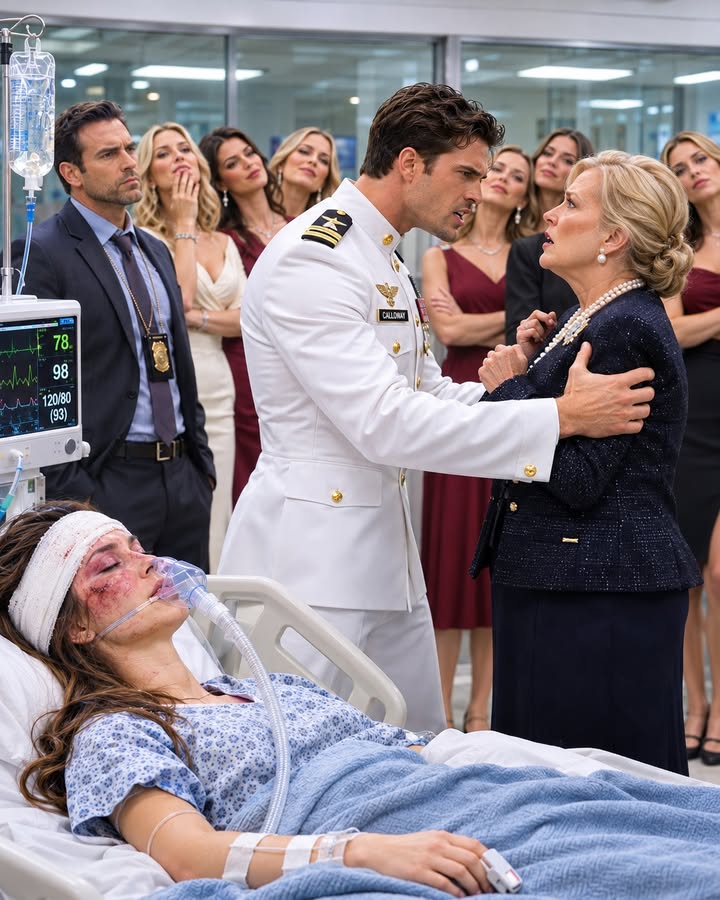
Part 5 – The Names We Could Not Risk
“It was still in the house.”
Adeline’s eyes closed almost at once, the effort of answering leaving her pale and trembling beneath the hospital lights.
Dr. Pike stepped between us and asked everyone to give her room.
I backed away, though my hand remained lifted for a moment, as if I could hold her awake by wanting it badly enough.
“She needs rest,” he said. “That was a great deal for her to communicate.”
Granger lowered the sealed document he had been carrying.
“Did she say where in the house?”
“She doesn’t have the strength to answer now,” Dr. Pike replied. “We’ll ask again only when she’s ready.”
I nodded, forcing myself to accept that the truth could not be pulled from her faster than her body could bear to give it.
Bethany waited just beyond the doorway, her face drawn with worry.
“Is she all right?” she asked.
“She’s exhausted,” I said. “But she’s awake.”
Bethany pressed her hands together.
“Do you think the original ledger is really there?”
“Adeline believes it is.”
“Then someone could find it.”
The question hung between us, plain and reasonable, and suddenly the hospital corridor felt too open, too close to every person who might overhear.
Granger glanced at the nurses’ station before answering.
“We’ll arrange to secure the house as soon as we can do it lawfully,” he said. “No one should go in alone, and no one should move anything.”
“Who has the keys?” Bethany asked.
“I do,” I said. “And Adeline’s neighbor has a spare for emergencies.”
Granger made a note.
“I’ll contact the county investigator assigned to the property and request a joint entry. We’ll document every room before we touch anything.”
“Can you trust the county investigator?” Bethany asked.
Granger did not dismiss her concern.
“I can trust the process if I make sure it’s documented and witnessed. If we have reason to believe local handling is compromised, I’ll bring in the federal field office.”
The steadiness in his voice gave me something to hold on to.
It did not make the danger disappear, but it gave it boundaries.
Vale came from the family room, where he had been speaking with the federal liaison.
“They’re prepared to receive the copy tomorrow,” he said. “The original should go directly to them once it’s found.”
“And the people named in it?” I asked.
“The investigators will need to review those names under seal before any public disclosure.”
“Adeline may not agree to wait.”
“I know.”
The matter-of-fact way he said it made me study him.
He had spent years treating the ledger as something he could safeguard through patience and private arrangements.
Now he seemed to understand that what he called patience might have looked like delay to the people who had already been harmed.
Granger looked at the three of us.
“Let’s be clear about the choice in front of us,” he said. “The ledger may prove that safety reports were falsified, and that could help investigators prevent further harm. But it also contains names and information that could expose people who never agreed to become part of a public case.”
“Some of them may still work for Voss Aeronautics,” Vale added.
“Some could face pressure, dismissal, or unwanted attention,” Granger said. “We can seek protective handling, but that takes time.”
“And if we wait?” Bethany asked.
“Records can be lost,” Granger said. “People may continue making decisions without knowing the risks. We can’t guarantee that waiting is harmless either.”
I looked through the ICU window.
Adeline’s face was turned toward the room’s dim light, her breathing steady beneath the careful work of the machines.
The choice was hers in the deepest sense.
But she was still too weak to carry all of it alone.
“She said she wanted the truth out,” I said.
“She did,” Granger replied. “But we should confirm what she wants now, when she’s able to speak.”
“Every day we wait feels like another day someone else decides for her,” Bethany said.
Her voice carried no anger, only the weariness of someone who had seen silence mistaken for consent too many times.
I turned toward her.
“You’re right to remind us of that.”
She looked surprised that I had not argued.
“My instinct is to keep her safe,” I continued. “But safety can become another reason to take the decision away from her.”
Vale gave a slow nod.
“That is the problem I failed to see when I kept the ledger from the authorities.”
Granger folded his hands over the file.
“Then we need to move quickly, but not carelessly.”
He outlined the next steps with the calm precision of someone arranging a complicated operation.
The county investigator would meet us at the house, accompanied by a federal agent who could oversee the evidence transfer.
Every item would be photographed and logged.
The ledger would be placed in federal custody, and its contents would remain restricted while investigators identified the people at risk.
No one would take a copy home, make a private record, or speak to the press.
I agreed.
Vale agreed.
Bethany listened carefully, then asked, “What happens if someone at the company finds out before it’s secured?”
“Then we document that too,” Granger said. “And we tell the federal agent immediately.”
It was a plan, not a guarantee.
I had learned the difference years ago in places where the best plan could still meet a changed landscape before sunrise.
This landscape was a hospital corridor, and I could not make myself believe it was any less uncertain.
A nurse returned to say Adeline was resting and could not receive visitors for several hours.
I asked if I could leave a message for her.
The nurse said I could speak from the doorway, as long as I kept it brief.
I went inside alone.
The room held its familiar rhythm: ventilator, monitor, the faint rustle of the nurse adjusting a sheet.
I stood beside the bed and waited until the nurse had moved to the far side.
“I know you said the original is still at the house,” I whispered. “Granger is arranging a careful search.”
Adeline’s eyelids remained closed.
“The ledger could help protect people. It could also put them in danger if it’s released without safeguards.”
I paused, uncertain whether she could hear me or whether I was speaking because I needed to.
“I want to keep you safe, but I won’t use that as a reason to decide for you.”
Her fingers shifted beneath the blanket.
I leaned closer.
“When you’re ready, I’ll listen.”
Her hand moved again, faintly, toward mine.
I took it gently.
“Whatever you want to do, we’ll do it with the truth in the room,” I said.
Her thumb rested against the side of my finger.
I stayed for a few minutes, then left her to sleep.
In the corridor, Bethany was waiting beside the window.
She had removed her cardigan and folded it over one arm, as if she had realized she no longer needed to make herself smaller to stay.
“Do you think Mother will come back?” she asked.
“Probably.”
“Will you tell her what Adeline said?”
“Not unless the investigators decide it’s necessary.”
Bethany nodded, but her gaze went toward the elevators.
“I used to think Mother always knew what was best because she never seemed uncertain.”
“Certainty can look convincing.”
“Now I wonder if she was only certain about what she wanted.”
There was no accusation in her voice, which made the thought feel more lasting.
She sat down, leaving the chair beside her open.
I took it.
For a while, neither of us spoke.
Then Bethany said, “When we were little, Adeline used to hide the family’s old photographs in her bedroom.”
I looked at her.
“Why?”
“Mother wanted to throw them away after Father died. She said the pictures made the house feel stuck in the past.”
Bethany’s mouth curved sadly.
“Adeline kept them anyway. She’d bring them out when Mother was at work, and we’d sit on the floor and make up stories about where everyone was going.”
“I didn’t know that.”
“Neither did most of my sisters. Adeline didn’t want the pictures to become another reason for a fight.”
She turned the folded cardigan over in her hands.
“I think she spent her whole life trying to keep the people she loved from having to choose sides.”
I thought of the hidden ledger, the notebook, and the words written in Adeline’s hand.
If Vale gives the ledger to Constance, she’ll have proof against all of us.
“She may have been protecting people by keeping it quiet,” I said. “But she may also have been carrying too much by herself.”
Bethany looked at me.
“Will you tell her that when she wakes?”
“Yes.”
“Even if it makes her feel guilty?”
“I’ll tell her gently.”
“That’s what she would want.”
A familiar scent of perfume arrived before its owner.
Constance appeared at the end of the corridor, accompanied by Vivian.
They walked toward us without hurrying, both composed, though Vivian’s fingers had tightened around her phone.
Constance stopped several feet away.
“I was told Adeline woke.”
“For a few minutes,” I said.
“Did she say anything?”
“Only what the investigators need to know.”
It was not a lie, but I did not offer the details.
Constance studied my face.
“You look exhausted.”
“I am.”
“Then you should let the family help.”
Bethany’s shoulders stiffened at the word family.
Constance turned to her.
“I’ve arranged a private nurse and a rehabilitation specialist for Adeline. The hospital can transfer her to a quieter facility once she’s stable.”
“Who chose that facility?” Bethany asked.
“I did.”
“Did Adeline?”
“She isn’t in a position to make those decisions yet.”
“She may be able to soon.”
Constance’s expression softened into something that could have passed for patience.
“We’re all trying to do what’s best for her.”
“Then let her decide when she can,” Bethany said.
For a moment, the corridor seemed to narrow around the three of them.
Constance looked at me.
“You have people from the federal office involved now, I understand.”
“I don’t discuss the investigation with you.”
“I’m not asking for details.” She lowered her voice. “I’m asking you to think about the consequences before you turn a family matter into a public one.”
“It isn’t a family matter.”
“It involves Adeline, her sisters, and the people whose names may be in those records.”
Her eyes moved briefly toward Vale, who had come out of the family room but remained near the doorway.
“Some of those people have families of their own,” she continued. “Children, mortgages, lives built without knowing what they were signing.”
“Which is why the ledger will be handled under protection,” I said.
“Protection is a word people use when they want to believe they can control what happens after a document leaves their hands.”
“That doesn’t mean we leave the document buried.”
“No,” Constance said. “It means we choose carefully.”
Her words did not sound unreasonable.
That was the danger of her offer: it came wrapped in a concern that could be genuine and still serve her interests.
She approached the wall beside me but did not sit.
“I can fund all of Adeline’s care,” she said. “The specialists, the rehabilitation, the home modifications. Whatever she needs.”
“We’ll make sure she receives proper care.”
“You shouldn’t have to fight over every bill while she recovers.”
“I’m not asking you to pay.”
“You needn’t ask. I can also ensure Bethany has a secure place to live and enough support to begin again.”
Bethany stood.
“I didn’t ask for that.”
“You shouldn’t have to ask,” Constance replied.
Bethany’s face went pale, but her voice held.
“Why are you offering now?”
Constance’s eyes rested on her daughter.
“Because you are my daughter.”
“Is that all?”
“What else would it be?”
Bethany looked down at her hands.
“You could have said that when I was afraid to tell the truth.”
For the first time, Constance’s composure faltered.
It was only a breath, a brief tightening around her mouth, but I saw it.
Vivian looked away.
Constance recovered quickly.
“I did not know what you were afraid of.”
“You knew I was afraid of you.”
The words landed softly.
No one raised their voice.
No one stepped closer.
Yet I felt the years of swallowed sentences gathering in the space between them.
Constance’s expression settled into something harder to read.
“I will not have my daughter’s future decided in a hospital hallway,” she said.
“I’m deciding it myself,” Bethany replied.
The quiet certainty in her voice seemed to surprise her again.
Constance looked toward me.
“Wesley, you have spent seven months away. You can’t understand the family’s history or everything Adeline has endured.”
“No,” I said. “I can’t understand all of it.”
She seemed to expect more.
I continued.
“But I can listen to Adeline now, and I can refuse to make a promise on her behalf.”
“And what if the evidence destroys the people it was meant to protect?”
“Then we take steps to protect them.”
“What if it isn’t enough?”
“Then we deal with what comes, instead of pretending nothing happened.”
Constance’s gaze held mine.
“You speak as though certainty is available.”
“It isn’t.”
“That is what worries me.”
“It worries me too.”
I meant it.
The ledger could bring accountability.
It could also expose people who had trusted Adeline with small pieces of a much larger truth.
I did not know how to protect all of them.
I only knew that keeping the ledger hidden would preserve the same conditions that had allowed the reports to be altered and the questions to be ignored.
Constance reached into her handbag and removed a business card.
“If you change your mind, call me,” she said. “The offer of care stands.”
She placed the card on the table beside Bethany.
Bethany did not pick it up.
Constance glanced toward the ICU doors.
“May I see her?”
“The doctor said she needs rest,” I replied.
“Then I’ll wait until he allows it.”
She sat in the chair opposite us.
Vivian remained standing, her eyes fixed on the floor.
For a while, the four of us shared the corridor without speaking.
A nurse emerged from Adeline’s room and asked Granger to come inside.
He returned a few minutes later with a quiet, focused expression.
“Adeline is awake again,” he said. “The doctor says she can manage one short conversation, but we should keep it simple.”
Constance stood.
“I’m her mother.”
“I’m her husband,” I said. “I’ll go in first and ask if she wants anyone else there.”
The words came without force, but I knew they were a boundary.
Constance stared at me.
Then she nodded once.
“Ask her.”
I entered the room alone.
Adeline’s eyes were open, though her gaze moved slowly as she tracked me.
The nurse checked her breathing, then positioned herself nearby.
“Your mother is here,” I said. “So are Bethany, Vivian, Vale, and Detective Granger.”
Adeline blinked once, acknowledging she understood.
“Do you want to see anyone?”
Her gaze moved toward the door.
I waited.
She blinked once.
“Who?”
The nurse reminded her to answer with one blink for yes and two for no.
I named the people one at a time.
“Bethany?”
One blink.
“Granger?”
One blink.
“Vale?”
One blink.
“Vivian?”
Two blinks.
“Your mother?”
Adeline’s eyes closed.
For a moment, I thought she had fallen asleep.
Then she opened them again and blinked twice.
I did not ask her to explain.
“I’ll tell them,” I said.
Her gaze stayed on me.
“We need to decide what happens to the ledger,” I continued. “It contains names that could put people at risk. The federal investigators can take it under seal and review it before anything becomes public.”
Adeline blinked once.
“Do you still want it released?”
One blink.
“Even if it takes time to protect the people named in it?”
Her eyes held mine.
One blink.
“Would you rather have your mother arrange your care and let the ledger disappear?”
Two blinks, slow and certain.
My throat tightened.
“I won’t make that promise for you,” I said. “I also won’t let the evidence be released carelessly.”
She blinked once.
The answer gave me no relief.
It gave me responsibility.
“I’ll ask Granger to arrange the protected disclosure,” I said. “You can testify when you’re strong enough, if that’s what you want.”
Adeline’s eyelids fluttered.
The nurse said we should stop.
I leaned closer, careful not to touch anything but her hand.
“I’m listening,” I whispered.
Her thumb shifted beneath my palm.
I stepped back and left the room.
Granger was waiting at the door.
“She wants the evidence submitted under seal,” I said. “She wants it investigated. She wants to testify when she can.”
“That’s consistent with what she told us before.”
“It’s her choice.”
Granger nodded.
“The federal agent can receive the ledger tomorrow. We’ll document the transfer and request that the names remain restricted while the safety claims are reviewed.”
“Do it.”
Vale stepped forward.
“I can bring the copy and provide the location of the original.”
“You’ll come with us?” Granger asked.
“Yes.”
Constance had risen again.
“You are making a decision that may affect people whose lives you don’t understand,” she said.
“I know.”
“Then why rush into it?”
“Because the evidence has been hidden for years.”
“And you believe an outside office will be kinder to everyone?”
“I don’t know if it will be kinder.”
I glanced toward the ICU.
“But it will have to answer to more than this family.”
Constance looked at me for a long moment.
Then she turned to Bethany.
“Come home with me tonight.”
Bethany shook her head.
“I’m staying here.”
“You can’t stay in the hospital indefinitely.”
“I know.”
“Then where will you go?”
“I’ll figure it out.”
“You don’t have to make this harder than it needs to be.”
“I’m not trying to make it harder,” Bethany said. “I’m trying to choose without being frightened into agreeing.”
Constance’s face went still.
For a moment, I wondered whether she would answer with the same familiar certainty.
Instead, she looked toward the ICU doors and said nothing.
Vivian stood apart from them, arms folded over her chest.
When I turned to her, she met my gaze.
“You believe I did it,” she said.
“I believe Adeline identified you.”
“From a hospital bed.”
“She identified what she could.”
Vivian’s mouth tightened.
“You don’t know what she was like before you met her.”
“I know what she said.”
“You think that’s enough?”
“No.”
The answer surprised her.
I continued before she could mistake it.
“I think it’s enough to investigate. I think she deserves the chance to give her account when she can. I think the evidence deserves to be examined. After that, the people handling it will decide what they can prove.”
Vivian looked away.
“That sounds very fair.”
“It’s the least I can offer.”
She did not answer.
A federal liaison called Granger back to the office, and the detective stepped aside to speak with him.
Vale began preparing the materials for the next morning’s transfer.
Bethany sat beside the untouched business card, her shoulders slumped with fatigue but her chair still turned toward the ICU.
Constance remained across from her.
I could feel the pull of the offer she had made: expert care, a quiet facility, financial relief, the promise that none of us would need to fight for anything.
It was the kind of offer I had been trained to consider.
A route that lowered immediate risk.
A solution that kept the wounded person safe while postponing the larger objective.
But there was no clean map here, and Adeline was not a mission I could complete on her behalf.
I went back to her room.
She had drifted into a light sleep, her breathing steady.
I sat beside her and held her hand where the bandages allowed.
“Tomorrow, we give the copy to the federal office,” I whispered. “We’ll search the house with them, and we’ll protect the people named in the record as carefully as we can.”
Her fingers moved faintly against mine.
“I can’t promise no one will be hurt by the truth,” I said. “I can promise we won’t hide it just to make the next few days easier.”
Her hand rested in mine.
I could not tell whether she had heard.
At the end of the corridor, the elevator opened.
A woman in a gray coat stepped out, carrying an identification case and a narrow document folder.
She showed her credentials to the hospital security officer, then spoke quietly with Granger.
The detective turned toward me, his expression suddenly alert.
“Major,” he called.
I stood and walked toward them.
The woman introduced herself as Agent Maren Cole, from the federal field office.
“Detective Granger requested an independent review of the evidence and the dispatch records,” she said. “I’m here to take custody of the materials scheduled for transfer tomorrow.”
“Tomorrow?” Granger asked. “We agreed on a documented intake in the morning.”
“I’m aware,” Cole said. “But we’ve received information that the original ledger may be in immediate danger.”
Vale took a step toward her.
“From whom?”
Cole opened the folder and removed a single sheet of paper.
It was a copy of a security notice from Voss Aeronautics, timestamped less than an hour earlier.
A company team had been authorized to enter my home at first light for what they described as an urgent property recovery.
The request had been filed under Constance’s authority.
Beneath it was a handwritten note, added in dark ink.
Locate the original before the federal team arrives.
I read the line once, then again.
The ledger was still in our house.
The federal team had not yet reached it.
And someone knew exactly what we were about to do.
**–END OF PART 5–CLICK “NEXT” AT THE BOTTOM OF THE PAGE TO CONTINUE READING**
* * *
[PREVIOUS: PART 4](https://puretales.idolsgift.com/blog/part-4-the-cufflink-in-bethany-s-hand-027) | [NEXT: PART 6(THE END)](https://puretales.idolsgift.com/blog/part-6-the-end-the-cufflink-in-bethany-s-hand-027)
✓ Lynn R. Adams
Part 5 – The Names We Could Not Risk “It was still in the house.” Adeline’s eyes closed almost at once, the effort of answering leaving her pale and trembling beneath the hospital lights. Dr. Pike …