PART 5: The Crown That Wouldn’t Be Chased 058
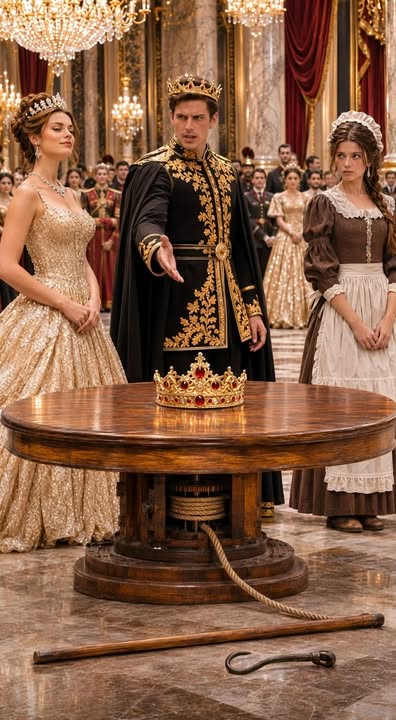
Part 5 – The Truth Before the Court
“What if my family was the reason it never reached the queen?”
Celestine’s question lingered above the open ledger.
For a moment, the library seemed to hold its breath around them.
Mara looked at the noblewoman’s pale face and saw no attempt to turn the question aside.
“I don’t know,” Mara said. “But we should find out before you decide you are guilty.”
Celestine lowered her eyes to the page.
“I have spent years believing that if something was hidden, it was because someone had a good reason to hide it.”
“Sometimes people do have reasons,” the prince said. “That does not make every reason just.”
He closed the transfer book with care, as if a careless hand might bruise the years it contained.
“We have the workshop warning, the queen’s note, and this account entry,” he continued. “We also have a receipt we have not yet seen. We should gather the evidence before we ask the court to judge what it means.”
Celestine nodded.
“I’ll send another message to my father. I’ll ask him to bring the original papers himself.”
“He may refuse,” Mara said.
“He may,” Celestine replied. “But I would rather hear his answer from him than from a clerk who has already decided what my family did.”
The prince looked toward the sealed packet.
“And the court must hear the truth when we know it.”
The words were quiet, but their weight filled the room.
Mara could not forget the entry in the incident register, where her father’s name had been attached to the fire without the warning he had written only two days earlier.
She had imagined, since childhood, what it might mean for someone in power to say that her father had been right.
She had not imagined how many people might have to look at their own choices first.
“Will you clear his name?” she asked.
The prince met her eyes.
“If the evidence confirms what we have found, yes.”
“Even if it harms the palace?”
His gaze dropped for an instant to the royal seal on the archive cloth.
“Especially then.”
Celestine’s hands tightened around her notebook.
“The court will ask why the crown kept the old record unchanged.”
“Then I will answer.”
“And your father?”
“He will have to answer too, if he knew.”
The prince did not sound angry.
That, somehow, made his decision feel more serious.
He would not turn the truth into a weapon against his family, but he would not shield them from it either.
Mara looked again at the open ledger.
“My father’s warning was folded inside that drum for years. No one has asked what it cost him to have his name left there.”
“I know,” the prince said.
“No,” she replied, her voice gentle but steady. “You know what the records say. You don’t know what it was like when people in Bellmere heard that he had caused the fire.”
The prince’s face changed.
Mara continued before she could lose courage.
“My mother stopped speaking of the palace after we left. When people asked why Father had lost his position, she said he had done his work honestly and that was all they needed to know.”
She held her hands together beneath the table.
“When I was older, I learned that some people thought he had been careless. Others thought he had stolen from the workshop. No one could prove it, but the accusation followed him anyway.”
The prince listened without interrupting.
“He never asked for pity,” Mara said. “He only wanted someone to record what he had warned them about.”
The prince looked down at the pages.
“I’m sorry that no one did.”
“That is why I need more than a private apology.”
“You will have more.”
Celestine watched him, her expression sober.
“What will you do if the court asks you to suppress the evidence for the sake of the crown?”
The prince’s answer did not come at once.
Beyond the library windows, a winter wind stirred the bare branches in the courtyard.
The palace had been built to seem enduring, its stone walls and carved crests assuring every visitor that the crown had outlasted every hardship.
But the history in the ledger was not stone.
It was a collection of choices made by people who had believed their silence would keep the kingdom safe.
“I will publish what we can prove,” he said at last. “And I will say plainly what we cannot prove.”
Celestine drew in a slow breath.
“My father will need to hear that before he arrives.”
“He should.”
That afternoon, the prince asked the royal archivist to make copies of the relevant pages and ordered the original documents secured.
He did not forbid Mara or Celestine from seeing them.
Instead, he asked them to help check each copied date and entry against the original, so that no detail could be dismissed as an error in transcription.
The work took several hours.
They compared the queen’s ledger to the workshop register, then to the diagram found beside the drum.
Each record strengthened the same quiet truth: Mara’s father had reported the faulty mechanism before the fire, and someone in the household office had altered the story afterward.
Still, one link remained missing.
The account entry said the warning had been returned with a receipt.
The receipt itself was not in the palace archive.
Celestine sent a second letter to her father before the day ended.
She wrote it herself, not through the estate secretary.
She asked him to bring every paper concerning the queen’s relief payments and the workshop fire, and not to send any document that had been “made tidy for the sake of family comfort.”
When she finished, she read the letter once, then folded it.
“That last part is unkind,” she said.
“Is it untrue?” Mara asked.
Celestine considered that.
“No.”
“Then perhaps it is only uncomfortable.”
The prince’s mouth softened at the corner.
“Those are often the words people use when they hope a question will go away.”
Celestine sealed the letter.
“I hope he understands that I’m asking him to come as my father, not as the head of our house.”
“And if he does not?” Mara asked.
“Then I’ll still have to decide what I believe.”
She gave the letter to the steward, who carried it away before she could change her mind.
That evening, the prince asked Mara to walk with him in the inner courtyard.
The fountain there had been covered against the cold, and the paths were silvered with frost.
They walked at an unhurried pace beneath the arching branches, with the palace windows glowing behind them.
“I wanted to speak to you without making every sentence sound like a decision for the court,” he said.
Mara glanced at him.
“You do not have to make every sentence a royal one.”
“I’m learning that.”
“Are you?”
“I am trying.”
He looked toward the fountain’s still, dark basin.
“When I first announced the challenge, I thought it was a harmless way to see who could keep her judgment under pressure.”
“A crown is rarely harmless.”
“No. I know that now.”
“You didn’t expect anyone to take the marriage part seriously?”
“I thought the guests would understand it as a royal flourish.”
“Many of them did not.”
“I should have known better.”
Mara stopped beside the fountain.
The prince stopped with her.
“You changed what you said in the ballroom,” she told him. “You said a contest could not choose a life for anyone.”
“I meant it.”
“You could have allowed the court to treat me as a prize.”
“I could have.”
“But you did not.”
He looked at her steadily.
“I won’t ask you to believe that makes me worthy of anything.”
“I don’t.”
A hint of a smile passed over his face, followed by something more earnest.
“Good.”
She turned her gaze to the courtyard’s high windows.
“When this is over, people may call me the reason your family’s records were opened.”
“Then I will tell them the records were opened because the truth was there.”
“People may still say I wanted something from you.”
“I cannot stop people from saying what they like.”
“No,” Mara said. “But you can decide whether you let their words decide what you do.”
The prince’s expression grew intent.
“You’re right.”
She looked back at him.
“I don’t want a reward for my father’s name.”
“I understand.”
“I don’t want to be given a place at court as if it makes the past fair.”
“I understand that too.”
“Do you?”
He accepted the challenge without offense.
“I think I am beginning to. But you should tell me whenever I fail.”
The honesty in his voice made the distance between them feel smaller.
That frightened Mara more than any grand promise might have.
She had spent years making herself useful, then making herself unnoticed.
The prince made it difficult to disappear without making her feel trapped.
“I will,” she said.
He looked relieved.
“And what will you do if the truth costs your family’s reputation?” she asked.
“I will let it cost what it must.”
“What if it costs you the crown?”
“That is not mine to measure against your father’s name.”
Mara’s gaze held his.
For a moment, the prince seemed less like the heir to a throne than a man trying to learn whether the words he had spoken could carry the weight he had put upon them.
She reached for the cuff of her sleeve, where the small, plain needle rested inside the pocket she had sewn there.
The cloth had worn thin from years of carrying it.
“My mother used to say a useful thing is worth more than a beautiful one,” she said.
“You told me something similar about the mechanism.”
“She was right about many things.”
“Would you tell me about her sometime?”
Mara looked at him, surprised by the gentleness of the question.
“Yes,” she said. “When I can.”
He did not ask her to explain why not yet.
They walked back to the palace in silence, the unspoken parts of their conversation walking with them.
The following morning, Celestine’s father arrived.
He came with a small traveling chest and no entourage beyond a single attendant.
He was a dignified man in his late fifties, with silver at his temples and a careful manner that suggested he had spent many years choosing words before speaking them.
The prince received him in the council chamber, where Mara and Celestine waited beside a table cleared for the family papers.
“I was told this concerned an old payment to our estate,” Lord Ashcombe said.
“It concerns more than the payment,” Celestine replied.
Her father’s gaze moved to Mara.
“Miss Mara.”
“My lord.”
He inclined his head, neither warmly nor coldly.
Then he saw the copies of the workshop records.
His expression altered.
“Where did you find those?”
“In the royal archive,” the prince answered.
Lord Ashcombe looked at the prince, then at Celestine.
“You have opened the matter of the fire.”
“It was never properly closed,” Celestine said.
“There are reasons some matters are left in the past.”
“Were they good reasons?”
Her father placed one hand on the traveling chest.
“We should not settle that before examining the papers.”
He opened the chest.
Inside were letters tied with faded ribbon, a narrow account book, and a folded receipt bearing a red seal.
Celestine recognized it at once.
“That’s the original?”
“Yes.”
“Why did you tell me the payment was a service fee?”
“I did not say that.”
“You said the queen’s account had been settled.”
“That was my understanding.”
“Your understanding, or the version you were given?”
Lord Ashcombe’s jaw tightened, but he did not answer.
The prince gestured toward the chair.
“Please sit. We are trying to establish what the papers show, not accuse anyone before we have read them.”
“That is a fair beginning,” Lord Ashcombe said.
He sat and untied the ribbon.
The first letter concerned the repair of an estate mill after a flood.
The second listed payments for food and replacement tools for the workers living nearby.
The third was a household receipt, signed by Lord Ashcombe’s grandfather, who had been a young steward at the time.
Celestine turned the receipt over.
“There is writing on the back.”
The prince leaned in.
The ink was faint but legible.
Mara read it aloud.
“Received with the queen’s account: one workshop warning, to be returned to Lord Varrick’s office for review.”
The room went still.
Celestine’s father closed his eyes.
Mara looked at the date.
It was the day after the workshop fire.
“Do you know what the warning was?” the prince asked.
Lord Ashcombe opened his eyes.
“No.”
“Did your grandfather?”
“I cannot say.”
“Did he keep it?”
“The receipt suggests it passed through his hands.”
“Did he deliver it to Lord Varrick?”
Lord Ashcombe looked down at the paper.
“I don’t know.”
Celestine sat very straight beside him.
“Father, you have kept these papers for years.”
“I kept them because I was told they were records of a payment.”
“And you never asked what the warning was?”
“I asked my father once. He said the note had been returned to the palace.”
“Did he explain why it had been included?”
“No.”
Celestine’s voice softened, though the hurt in it remained.
“Why didn’t you tell me that?”
“Because I had no reason to believe it mattered.”
“You had the queen’s seal, a workshop warning, and the name of Lord Varrick’s office.”
“I knew nothing about the fire until yesterday.”
The prince examined the receipt.
“Your grandfather’s name is here as a witness, not as the recipient.”
Lord Ashcombe nodded.
“He was a steward for the estate. He often signed for deliveries.”
“Could he have known what the warning said?” Mara asked.
“I don’t know.”
“Could he have chosen not to pass it along?”
“I don’t know that either.”
Lord Ashcombe’s voice had lost its formality.
He looked not at the prince but at the receipt, as though the truth might be hidden between its faded lines.
“I thought I was bringing you a family record,” he said. “I did not expect to find my grandfather standing at the edge of another man’s ruin.”
Celestine’s expression softened, but she did not reach for him.
“Neither did I.”
The prince placed the receipt beside the workshop warning.
The dates aligned.
The names did too.
Mara felt the years settle into place, not as a complete answer, but as a shape that could no longer be dismissed as coincidence.
The queen had arranged help for Bellmere and for the Ashcombe estate.
The warning had traveled with one of those payments.
The paper had reached the hands of Celestine’s family.
Somewhere after that, it had been sent to Lord Varrick’s office—or perhaps it had never left the estate at all.
Celestine examined the lower corner of the receipt.
“There is another mark.”
A small circle crossed by three lines had been drawn beside the red seal.
Mara’s fingers moved to the pocket where she kept the needle.
The prince saw the gesture.
“The same mark as the workshop diagrams,” he said.
“And the needle,” Celestine added.
Lord Ashcombe looked up.
“What needle?”
Mara did not reach for it.
“It belonged to my mother,” she said. “The late queen gave it to her in Bellmere.”
The old lord’s face changed.
“You are Rowan’s daughter.”
Mara held his gaze.
“Yes.”
He looked back at the warning.
“I am sorry.”
The words came quietly, with no attempt to make them sufficient.
Mara felt the small needle pressing against her palm through the fabric of her pocket.
“Did you know my father?” she asked.
“No. I was a child when the fire happened.”
“Did your father know him?”
“I don’t know.”
“Did he ever speak of the warning?”
Lord Ashcombe shook his head.
“No.”
Celestine looked at the papers spread across the table.
“Then the receipt does not prove that my family hid it.”
“No,” the prince said. “It proves that the warning passed through the estate office.”
“It proves my grandfather held it,” she said.
“For a time.”
“And after that?”
“That is what we still need to learn.”
Her father studied her face.
“You have already decided what this means.”
“I have decided that we should not treat the old story as settled.”
The prince looked toward the chamber doors.
“The council is waiting.”
Mara turned to him.
“You have told them?”
“I asked them to hear the evidence before any formal decision is made.”
“Will they want to know who is responsible?” Celestine asked.
“They will.”
“And if they decide the palace should keep the old account because changing it would make the crown appear weak?”
“Then I will disagree with them.”
Lord Ashcombe folded his hands on the table.
“Your Highness, the kingdom may not understand the difference between acknowledging a past failure and accusing the crown itself.”
“Then I will explain the difference.”
“That may not be enough.”
“No,” the prince said. “It may not.”
He looked at the documents, then at Mara.
“But the possibility that the truth will be difficult is not a reason to keep it hidden.”
They entered the council chamber together.
The council was smaller than Mara had expected, though its dark wooden table and high-backed chairs gave the room an air of solemnity.
The king’s seal hung above the far wall.
The prince stood at the head of the table.
Celestine sat beside her father, while Mara remained near the clerk who had brought the archive copies.
The council members studied her with careful expressions.
Some appeared curious.
Others looked troubled by the sight of a palace maid standing among nobles and royal officials.
The prince began by explaining what they had found.
He did not dramatize the discovery or soften the details.
He read the entry that named Elias Rowan as dismissed after the fire.
He showed them the warning his father had written two days earlier.
He read the instruction signed by Lord Varrick, directing that the mechanism be recorded as properly maintained.
Then he placed the queen’s note beside the receipt from the Ashcombe estate.
“Here is what we can establish,” he said. “Elias Rowan reported a dangerous fault before the fire. The fault was not repaired. The workshop burned. Rowan was dismissed, while the official record omitted the warning.”
A councilor with white hair folded his hands.
“Can we prove that the fault caused the fire?”
“The warning describes a danger consistent with the damage recorded in the incident book,” the prince replied. “The mechanism was never tested again, and the relevant parts were preserved. We cannot reproduce the fire, but the evidence strongly supports that conclusion.”
“Strongly supports is not the same as certainty.”
“No,” the prince said. “It is not.”
Another councilor glanced toward Mara.
“And this servant is the daughter of the dismissed mechanic?”
“She is,” the prince said.
The councilor’s gaze returned to the prince.
“Does she have any claim on the crown?”
Mara felt Celestine shift beside her father.
The prince answered before Mara could.
“She has made no claim. She asked that the record of her father’s dismissal be examined.”
“Her position in the household gives her access to the prince,” the councilor said. “The court may question whether this inquiry is personal.”
“It is personal,” the prince replied. “That does not make the evidence false.”
A quiet stir passed around the table.
Mara stood still, hands clasped before her.
She understood the question beneath the councilor’s words.
Would the court believe her because the truth was convincing, or doubt it because she had stood near the prince?
The prince did not pretend she was an abstract matter.
He did not hide his regard for her.
He also did not allow that regard to become a reason to dismiss her.
“The inquiry is personal to me too,” he said. “The records belong to my family’s administration, and I will not use my affection for anyone as an excuse to avoid them.”
The councilors exchanged glances.
Mara’s heart gave a painful, uncertain beat.
Affection.
He had said it plainly, but not as a claim upon her.
He had placed it beside his responsibility, not above it.
Celestine looked down at her hands.
The eldest councilor turned to Lord Ashcombe.
“What does your family’s receipt prove?”
“It proves that my grandfather received a workshop warning with a payment from the queen’s household,” Lord Ashcombe said. “It does not prove what he did with the warning afterward.”
“Could he have been instructed to deliver it to Lord Varrick?”
“Yes.”
“Did he?”
“I do not know.”
The councilor looked toward Celestine.
“Lady Celestine, do you believe your family helped conceal the warning?”
She rose.
“I believe my family received it. I do not know whether my grandfather understood its significance, or whether he delivered it as instructed. But I will not ask the court to call the record harmless simply because my family’s name is on it.”
Her father’s eyes closed briefly.
Celestine continued, her voice steady.
“If further evidence shows that my family failed to pass the warning along, then I will say so. If our estate received funds that were meant to compensate the Rowan family, we should return them. And if we benefited from silence, we should not keep those benefits.”
No one spoke for a moment.
Mara looked at Celestine and remembered the woman who had laughed at her beside the spinning table.
That woman had not disappeared.
She had changed, slowly, through questions she could have avoided and truths she could have blamed on someone else.
The prince placed his hands on the table.
“I will publish the corrected account,” he said. “Elias Rowan warned the palace of the fault. The warning was not acted upon, and the official record failed him.”
The white-haired councilor leaned forward.
“Your Highness, a public correction could be seen as an admission that the royal household knowingly punished an innocent man.”
“It would be an admission that the royal household allowed an incomplete record to stand.”
“That distinction may not survive public discussion.”
“Then the public should hear the whole truth, not only the part most convenient to us.”
“You risk damaging trust in the crown.”
“I risk damaging it more if we leave a false account in place.”
The councilors looked at one another.
The prince’s face remained composed, but Mara could see the effort in his jaw.
This was no longer a private promise made in a quiet courtyard.
The court was asking him to weigh his family’s reputation against a dead mechanic’s name.
The answer would reach beyond the room.
The eldest councilor spoke carefully.
“If the correction is issued, the court will expect you to explain why the old records remained unchallenged for so long.”
“Then I will explain that too.”
“And if the king opposes the publication?”
The prince’s eyes flickered toward the empty chair beside the head of the table, reserved for the king.
“My father must answer for his part,” he said. “But I will not ask him to approve the truth before I can tell it.”
Mara’s hands began to tremble.
She remembered the rope beneath the spinning table, its pull steady and relentless.
The way it had fought her when she tried to resist it.
The way it had slowed when she guided it against the brace.
The truth felt like that now: not easy to stop, not safe to rush, but moving toward the place where it could finally settle.
The prince turned toward her.
“Mara, you have heard the evidence. Is there anything you want the council to understand?”
The room’s attention fell upon her.
She could have asked for compensation.
She could have asked for a title, a place at court, or a promise that no one would ever question her father again.
Instead, she thought of her father’s careful hand writing a warning no one had wanted to read.
“I want the record to say what he did,” she said. “Not just what happened to him.”
The prince nodded.
“He warned the palace.”
“Yes.”
“And he was dismissed.”
“Yes.”
“And then he left with his family, carrying a blame that belonged to the people who refused to listen.”
Her voice did not rise.
It did not need to.
The council chamber had grown very quiet.
Mara looked at the papers before her.
“If the palace gives my family money now, but leaves his name in the old record, then it has only changed the price of silence.”
The eldest councilor’s expression softened.
The prince did not look away from her.
“No reward will be offered in exchange for your silence,” he said.
“I know.”
“And no marriage, title, or royal favor will be used to settle this matter.”
Mara felt the councilors’ attention sharpen at the word marriage.
The prince continued without hesitation.
“What happens between Mara and me, if anything ever does, must have no bearing on whether her father’s name is cleared.”
Mara’s throat tightened.
She had not asked him to say that in front of the council.
But she understood why he had.
He was removing the promise of a future between them from the evidence that needed to stand on its own.
He was refusing to make her father’s vindication depend upon her becoming part of the royal family.
The eldest councilor folded his hands.
“Your Highness, the council can authorize a corrected record and a public review of the household accounts. The final proclamation, however, will require the king’s consent.”
“Then I will speak to him today.”
A councilor glanced toward Lord Ashcombe.
“And the Ashcombe estate?”
Lord Ashcombe rose.
“Until the receipt is understood, I will place the disputed payment in trust. If it is established that the money was intended as compensation, the estate will return it.”
Celestine rose beside him.
“I will testify to the receipt and to our family’s records.”
The prince looked to her.
“You understand that testimony may damage your family’s standing.”
“I do.”
“And your father’s.”
“I know.”
Lord Ashcombe looked at his daughter.
For the first time since he had entered the palace, his careful expression gave way to hurt.
“Celestine.”
She turned toward him.
“I’m not accusing you, Father.”
“You are asking the court to consider that we benefited from an injustice.”
“I am asking the court to consider what the papers say.”
“And if the papers show your grandfather failed to deliver the warning?”
“Then we must say so.”
The old lord looked at his daughter for a long moment.
He seemed to be searching for the child he had raised, and finding instead a woman who would not offer him
**–END OF PART 5–CLICK “NEXT” AT THE BOTTOM OF THE PAGE TO CONTINUE READING**
* * *
[PREVIOUS: PART 4](https://storyly.idolsgift.com/blog/part-4-the-crown-that-wouldn-t-be-chased-058) | [NEXT: PART 6(THE END)](https://storyly.idolsgift.com/blog/part-6-the-end-the-crown-that-wouldn-t-be-chased-058)
✓ Lynn R. Adams
Part 5 – The Truth Before the Court “What if my family was the reason it never reached the queen?” Celestine’s question lingered above the open ledger. For a moment, the library seemed to hold its …