PART 5: The Count Beneath the Music 046
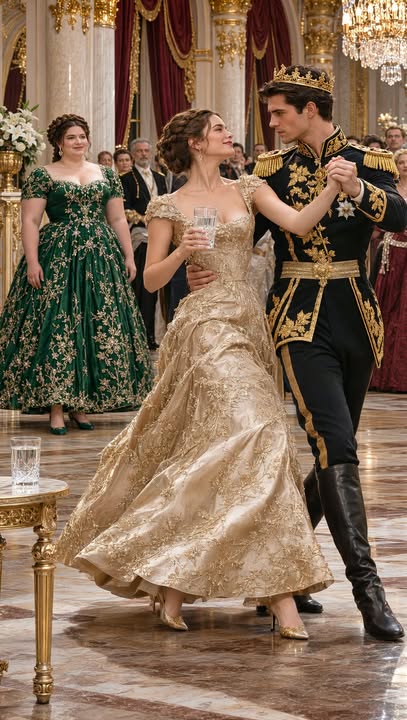
Part 5 – The Cost of Silence
The footsteps paused at the top of the stairs.
The archivist held the lantern high, and its small flame trembled against the stone walls.
No one spoke.
Then a voice called from above, measured and familiar.
“Your Highness?”
The prince’s shoulders tightened.
“Lord Ashcombe,” he said quietly.
Master Vale lowered his gaze.
The king’s former private secretary had retired years ago, but he still attended palace functions and advised the household when asked.
The archivist looked at the prince.
“Shall I bring him down?”
The prince glanced at the letter in my gloved hands.
“Yes.”
The footsteps resumed, slower now, descending the narrow staircase.
Lord Ashcombe appeared beneath the arch with one hand resting on the rail.
He was a silver-haired man with a composed face and a dark walking coat, and his eyes moved at once to the open box.
For a brief moment, surprise broke through his calm.
Then he bowed.
“I was told you were reviewing old rehearsal materials,” he said.
“Who told you?” the prince asked.
“The archive clerk saw the lights below.”
The archivist did not look up from the register.
“I sent no message.”
Lord Ashcombe’s gaze shifted to her, then back to the prince.
“Then someone must have noticed the lantern.”
The explanation was plausible.
It did not make the timing feel less unsettling.
The prince held out the unopened envelope.
“Do you recognize this?”
Lord Ashcombe took care not to touch it.
“I recognize the file.”
“Do you recognize the instruction written beneath the seal?”
He looked down.
His expression remained composed, though the fingers resting on his cane curled more tightly.
“I would need to examine it.”
“You may look.”
The archivist carried the letter closer, keeping it in view.
Lord Ashcombe leaned over the page.
“Yes,” he said after a moment. “That was my hand.”
The prince’s gaze sharpened.
“You wrote ‘Deliver to the prince’s father.’”
“I did.”
“Why was it never delivered?”
“I cannot say with certainty.”
The old man’s voice was steady, but something in it had thinned.
“You were the king’s private secretary,” the prince said. “You must have known where the letter went.”
“I filed it in the correspondence box.”
“Unopened?”
Lord Ashcombe glanced at the sealed envelope.
“I did not open private correspondence.”
“Then why did you redirect it?”
“To ensure it reached the king. At the time, matters concerning the queen’s official duties were often brought to him.”
“That is not what the note says,” I said.
Lord Ashcombe turned his attention to me.
“No,” he agreed. “It is not.”
He studied the writing beneath the flap.
“There should have been another notation.”
“What notation?” the prince asked.
“A delivery date, or the initials of whoever carried it onward.”
The archivist examined the envelope.
“There is no such entry in the register.”
Lord Ashcombe looked again at the box.
“I cannot account for that.”
Master Vale shifted beside the table.
“You were there when the account of the accident was prepared.”
“I was.”
“You knew the staging had failed.”
“I knew there had been a concern about the support.”
“You knew the crew had reported it was cut too short.”
Lord Ashcombe’s face remained still.
“I knew a preliminary report had raised that possibility.”
“Yet the public account blamed the instructor.”
“The final account was written by the household office, not by me.”
“But you advised the king.”
“I advised him on many matters.”
The prince’s voice stayed controlled.
“Did you tell him that Elianor’s letter was here?”
Lord Ashcombe looked toward the prince, and for the first time his expression seemed less certain.
“I cannot remember whether I mentioned it.”
“You cannot remember whether you delivered a letter addressed to the queen and redirected to your king?”
“I cannot remember the individual handling of every item from that period.”
I thought of my mother’s words inside the envelope, waiting in darkness while a story she had refused to accept became the official one.
I wanted to ask how an unopened letter could be forgotten.
But the question would not restore the years it had been hidden.
“What do you remember?” I asked.
Lord Ashcombe met my gaze.
“I remember a palace trying to prevent a minor accident from becoming a public scandal.”
“It was not minor to my mother,” I said.
“No,” he replied after a pause. “I expect it was not.”
His answer carried no defense.
It carried something closer to regret, though I could not tell whether it had arrived too late or had simply been kept private.
The prince looked down at the letter.
“Would you be willing to give a statement about the way it was handled?”
“I would need to review the records before I could offer anything useful.”
“That is not a refusal.”
“No.”
“Nor is it a promise.”
Lord Ashcombe inclined his head.
“No, Your Highness.”
The prince let the silence remain between them.
At last, Lord Ashcombe stepped away from the table.
“I hope you will allow me to examine the old register tomorrow,” he said. “If there is an account of the delivery, it may still be found.”
The archivist closed one ledger but left the box open.
“You may consult the register in the archive room with me present.”
“Of course.”
Lord Ashcombe bowed once more and returned up the stairs.
His footsteps faded into the palace above.
No one moved until the sound was gone.
The prince turned to Master Vale.
“Did he know more than he told us?”
“I don’t know.”
“You believed no one else knew this letter was here.”
“I did.”
“And he knew it existed.”
“Yes.”
The tutor’s answer was quiet.
The prince looked toward the stairs.
“I am not asking you to defend him.”
“I wasn’t going to.”
Master Vale’s hands had begun to shake slightly where they rested on his cane.
“I spent years believing the secrecy was a decision made by the court as a whole. I may have been wrong about who knew what.”
The archivist placed the letter inside a clean archival sleeve.
“We should not draw conclusions from a missing delivery note,” she said. “We have evidence of the failed staging, evidence that the queen objected, and a letter that was never opened. Those facts are significant enough without making claims we cannot support.”
The prince nodded.
“Then we will be exact.”
It was the first time I had heard him speak like the ruler the court expected him to become.
It was not a performance.
It was a choice.
We carried copies of the records upstairs and arranged for the originals to be secured by the archivist.
The prince did not ask me to leave when the late hour grew inconvenient.
He did not ask me to remain, either.
He simply walked beside me to the doors of the east wing, where the night pressed dark against the windows.
“What happens now?” I asked.
“Tomorrow, the court will ask me to announce the final selection.”
“And the charity ball?”
“I will still hold it.”
“With the truth included?”
His gaze remained on the corridor ahead.
“Yes.”
The answer came quickly, but his expression did not.
I could see the calculation he had to make, not because he was weighing my worth against his position, but because one decision could affect every reform he hoped to carry through.
A public correction would place his family under scrutiny.
It might cost him the confidence of the court officials whose cooperation he needed to restore the schools fund and other charitable programs.
Silence would be easier.
It would also turn my mother’s name into a decorative detail in an event built on the very work she had been denied.
“Are you certain?” I asked.
“No.”
He looked at me.
“But I am certain that leaving the record untouched would be wrong.”
We reached the guest apartments.
He stopped at the threshold and did not cross it.
“Will you stand beside me at the ball?” he asked.
I considered the phrasing.
“Beside you as what?”
“As yourself.”
“That is not what the court will call it.”
“I know.”
“If I stand there, they’ll assume I’m supporting the match.”
“I can tell them otherwise.”
“Will they believe you?”
“Some will.”
“And the others?”
He did not answer at once.
“They may not.”
I appreciated that more than I would have appreciated a promise.
“I won’t be a symbol for your courage,” I said.
“No.”
“I won’t let them say you cleared my mother’s name as a favor to me.”
“Then we will make sure the evidence is clear.”
“And if it ends my chance of becoming your bride?”
His eyes stayed on mine.
“Then it ends it.”
The simplicity of the answer struck deeper than a plea could have.
He was not asking me to choose my future for his sake.
He was telling me the truth about the cost, and leaving the decision in my hands.
“I came here to compete,” I said.
“I remember.”
“I wanted to be judged on what I could do.”
“You were.”
“I don’t want that to disappear beneath a story about a prince making a noble gesture.”
“Neither do I.”
I looked past him into the guest room, where the maid had left a lamp burning beside the bed.
I thought of my mother, who had walked away rather than accept a private apology in place of a public truth.
I had spent the evening wanting to know what she had done at the palace.
Now I knew.
I also knew that learning the truth did not make me responsible for carrying it in whatever way suited the court.
“If I stand beside you,” I said, “I will speak in my own words.”
“You should.”
“I will not promise that the court will like them.”
“I would be disappointed if you tried to make them like you at the expense of the truth.”
The words warmed me, though I kept my face steady.
“I need time to think.”
“Take it.”
He bowed, not as a prince dismissing a contestant, but as a man accepting a boundary.
Then he turned away.
I watched him cross the corridor until the shadows of the window arches softened his outline.
That night, sleep came in fragments.
I dreamed of a ballroom before it had been renovated, of my mother’s hand guiding another woman through a pause in the music.
When I woke, the memory had vanished, leaving only the feeling that I had missed a step.
The final selection was announced the next morning in the palace’s formal audience room.
The finalists stood in a row before the court.
Lady Celeste was three places to my left.
She wore a deep blue gown without the glitter of the night before.
Her mother sat among the court families, watching her closely.
The prince entered with the king’s advisers and Master Vale.
He looked composed, but I noticed he did not carry the list of candidates.
The chief court secretary stepped forward.
“Your Highness will announce the name selected to advance to the next stage of consideration.”
The next stage.
The wording made the choice sound orderly and distant.
I looked at the prince.
He looked back at me for only a moment, then faced the room.
“Before I make any announcement,” he said, “I need to address a matter that should have been corrected long ago.”
A small murmur moved through the audience.
The secretary’s expression tightened.
The prince continued.
“The palace records concerning a former charitable performance are incomplete. They wrongly attributed responsibility for an accident to a dance instructor who was not at fault.”
My palms grew damp.
Beside me, Lady Celeste stood very still.
“The staging failed because it had been built incorrectly,” the prince said. “The instructor had warned that the account was inaccurate, and the queen of that time objected to it. The surviving documents show that those objections were never properly carried forward.”
He did not say my mother’s name yet.
He did not look at me.
He was giving the facts room to stand on their own.
“The instructor was Elianor Vale,” he said. “She created a dance with my mother for a public event intended to raise funds for dance schools. The event was canceled, the fund was left dormant, and the record was never corrected.”
A stillness settled across the audience.
The chief secretary rose.
“Your Highness, these matters have not yet been fully reviewed.”
“The documents have been reviewed by the palace archivist.”
“There may be further context.”
“There may be.”
The prince did not raise his voice.
“That is why we will publish the evidence rather than ask the court to rely on my account.”
The secretary glanced toward the king’s council.
One of the older advisers stood.
“Your Highness, a public statement today could complicate the funding agreement for the spring ball.”
“I know.”
“It could be taken as an admission of fault by the household.”
“It is an admission that the household failed to correct a false account.”
The adviser’s mouth tightened.
“Your reforms require the court’s support.”
“My reforms require the court’s honesty.”
The prince paused, letting the words settle without dressing them in a flourish.
“If we cannot say plainly why a charitable fund disappeared, then we have no business asking the public to trust us with its restoration.”
A faint movement passed through the room.
The chief secretary sat down.
The prince turned toward the gathered families and staff.
“The spring ball will proceed. The fund will be restored, with a guaranteed contribution from the royal household. Dance teachers and students from the schools will be invited to attend and perform.”
His gaze moved briefly to the card on the secretary’s table, where the Royal Dance Schools Fund had been written in formal script.
“The archival documents will be made available for independent review, and a corrected account will be entered into the official record.”
I felt the room’s attention shifting toward me.
I had wanted the truth spoken.
I had not wanted it to become a spectacle.
The prince seemed to understand the difference.
He did not name me as the reason for his decision.
He did not turn the discovery into a declaration about the woman he might choose.
He let the wrong belong to the institution that had made it.
The chief secretary rose once more.
“There remains the matter of the selection.”
“Yes,” the prince said.
The king’s adviser leaned toward him and spoke too softly for me to hear.
The prince listened, then answered in a voice that carried clearly.
“I will not make an announcement today.”
The court shifted.
“Your Highness, the families have been told—”
“I will not select a bride by the end of a dance.”
The words were calm, but they changed the shape of the room.
He went on.
“I will continue the process only if it gives every person involved the freedom to decide whether she wants the life being offered. No one will be expected to accept a marriage as payment for influence, and no one will be chosen because the palace needs a particular alliance.”
His attention moved across the contestants.
I could not tell whether the court had heard the distinction or only the refusal.
The prince did not ask me to confirm his words.
He did not offer me a place beside him.
He had promised that the disclosure would proceed either way, and he had kept that promise.
The formal audience ended without a selection.
The court dispersed in careful groups, their conversations quiet and unsettled.
Lady Celeste’s mother was already speaking to one of the council advisers.
Celeste stayed behind.
She looked toward me, then toward the prince.
“I never thought I would be relieved not to hear my name,” she said.
“You might still be chosen in some other way.”
“I hope not today.”
There was a trace of humor in her voice, but her eyes remained serious.
“My mother will call this a missed opportunity,” she said.
“What do you call it?”
She considered.
“A chance to decide what I want without pretending the answer is obvious.”
I nodded.
“I hope you take it.”
“So do I.”
She glanced toward the prince, who was speaking with the archivist and Master Vale near the doors.
“He did not mention you,” she said.
“No.”
“Did you want him to?”
“I wanted the record corrected.”
“That isn’t quite the same thing.”
“No.”
Celeste’s expression grew thoughtful.
“Perhaps that is what made me believe him.”
We left the audience room separately.
The palace staff moved quickly through the corridors, arranging for the relevant documents to be copied and verified.
The official account could not be corrected by a speech alone.
It would take the archivist’s review, a statement from the tutor, and a careful public explanation of what the surviving evidence did and did not show.
That was the right way to do it.
It was also slower than the court’s appetite for a simple story.
At midday, the prince sent word that he wished to speak with me in the library.
I found him beside a table stacked with copies of the old letters.
Master Vale sat near the windows, reading through the rehearsal notes with the archivist.
The prince waited until they had finished a quiet exchange before he addressed me.
“I will proceed with the public correction,” he said.
“I heard.”
“But I do not want you to feel you must appear at the ball.”
“Would anyone believe I had nothing to do with it?”
“Some might.”
“And the others?”
“Some may say you influenced me.”
I looked at the copies on the table.
“My mother’s name was already on those pages.”
“Yes.”
“I did not put it there.”
“No.”
“If I speak, it should be because I have something to say, not because the court wants a grieving daughter to make the story feel complete.”
The prince’s gaze softened.
“I agree.”
“Will you let the archivist present the documents first?”
“Yes.”
“Will you let Master Vale explain what he knew and what he failed to do?”
“If he is willing.”
The tutor looked up.
“I am.”
His voice carried across the room.
“I will answer for my silence.”
I did not want his shame to become the center of the evening, either.
“Answer honestly,” I said. “That is enough.”
He lowered his head.
“It should have been enough years ago.”
The prince moved a copy of the program closer to me.
“The court may ask whether you intend to continue as a candidate.”
There it was.
The question beneath the charity work, beneath the archive, beneath every conversation about whether I would stand beside him.
“Do you want me to?” I asked.
“I want you to choose freely.”
“That is not an answer.”
“No,” he said. “It isn’t.”
He rested one hand on the back of a chair.
“I would like to know you beyond the contest. I would like to keep working with you on the schools and the ball. I would like to find out whether the respect we have begun to build can become something more.”
His honesty was careful, not persuasive.
“But if you continue,” he added, “I do not want you to think I am asking you to accept a marriage because I have corrected a record. The disclosure will happen whether you stand with me or not.”
I looked at him across the table.
The question I had asked the night before returned to me.
If the truth cost me my chance, would I accept that?
I had believed I would.
Now the cost had a face.
It was the face of a man who had listened when I disagreed, who had asked what an equal meant and waited for my answer.
It was the face of someone who could still disappoint me, and who had not asked to be trusted simply because he had made one right choice.
“I want to continue the work,” I said.
“On the ball?”
“On the schools. On the record. On all of it.”
His shoulders eased slightly.
“I would be glad to have you.”
“As an adviser, not a candidate.”
“If that is what you want.”
“For now.”
He nodded.
“For now.”
We did not touch.
We did not need to.
The next few days were filled with meetings, letters, and careful revisions.
The archivist prepared certified copies of the program, the staging report, the correspondence, and my mother’s unopened letter.
Master Vale wrote a statement describing the work he had done with her, the accident he had witnessed, and the years in which he had kept silent.
He did not soften his part in it.
The court secretary reviewed each line for accuracy, but the prince would not let the secretary remove the sentence that said the public account had been false.
The spring ball was moved from the palace ballroom to a larger civic hall near the dance schools.
The change gave the schools more space and made it easier for families to attend.
It also made the event less convenient for the court.
The prince approved the move without hesitation.
Lady Celeste helped revise the invitation list and arranged for her family’s hospital charity to contribute to the transportation costs.
She did not offer an apology again.
She did not need to.
Between us, trust grew in small acts rather than speeches.
She asked what the students might need.
I asked her to check a revised budget.
She caught an error in the cost of the stage supports.
Together, we sent the plans back to the organizers with a request that the platform be inspected by someone who had not helped build it.
When the prince heard, he approved the change and asked the archivist to keep the inspection report with the event records.
It was a practical measure.
It was also a quiet way of refusing to repeat an old mistake.
On the afternoon before the ball, I stood in the half-finished civic hall and watched the students rehearse.
The room smelled of fresh paint and sawdust.
A new stage had been built low and wide, with sturdy steps and handrails along the sides.
The younger dancers moved across it in pairs, their faces serious with concentration.
At the far end of the hall, my mother’s pattern had been written on a chalkboard for the teachers.
One, two, three—hold—five, six, turn.
It looked different there.
Not secret.
Not ceremonial.
It belonged to the people who had first been meant to dance it.
The prince joined me near the edge of the floor.
“Do you think it should be performed tomorrow?” he asked.
“By the students?”
“By whoever wants to.”
I watched a girl in a plain blue rehearsal dress stumble on the pause, laugh, and begin again.
“Only if they like it.”
“They do.”
“Then yes.”
He followed my gaze.
“I wish my mother could see it.”
“So do I.”
The words surprised me with their ease.
He looked at me, and something tender passed between us, but neither of us tried to name it.
We had agreed to let the evening stand on its own.
The next day, the civic hall filled with families, teachers, donors, palace staff, and members of the court.
The old program had been reproduced beside the entrance, though not as decoration.
A copy was displayed with the supporting documents, each one labeled and explained by the archivist.
People paused to read.
Some came back to read again.
Master Vale arrived early and stood beside the display, ready to answer questions.
The prince greeted the teachers before the court officials.
He wore a dark formal coat, but no crown or ceremonial sash.
Lady Celeste stood near the entrance with the revised guest list, helping direct families to their seats.
When she saw me, she touched my elbow gently.
“You look lovely,” she said.
“Thank you.”
“I mean it.”
“I know.”
Her smile was warm, and this time I believed there was no competition hidden behind it.
I wore my emerald gown.
I had considered choosing something less noticeable, but that seemed too much like apologizing for the first evening.
My skirt moved easily when I walked, and my feet felt steady beneath it.
The prince found me just before the program began.
“You don’t have to speak,” he said.
“I know.”
“If you do, you can take as long as you need.”
“I know that, too.”
He studied my face.
“Are you ready?”
“No.”
He nodded.
“Neither am I.”
That made me smile.
The archivist began with the documents.
She explained what the records established and what remained uncertain.
Master Vale followed, speaking plainly about the rehearsal, the faulty support, the false conclusion, and his own failure to challenge it publicly.
He did not ask for forgiveness.
He did not offer the court an excuse.
When he finished, the prince stepped to the lectern.
He named my mother.
He named the work she had done with the queen.
He said the palace had failed to correct the record when it had the chance.
Then he announced that the Royal Dance Schools Fund would be restored with a guaranteed contribution from the household.
A quiet wave moved through the hall.
The teachers listened without applauding.
They were not there for a speech.
The prince seemed to know that.
He invited them to speak about what the schools needed, and he left the lectern.
The evening was proceeding as we had planned.
The truth was being offered with the evidence beside it, not polished into a flattering story.
I stood near the display, listening as a teacher described the cost of replacing worn floorboards in her studio.
The prince listened without interruption.
A court adviser waited at the edge of the room, watching him with the tense patience of someone who knew the evening could change more than the dance program.
When the teacher finished, the prince made a note.
Then the adviser leaned close and whispered something.
The prince’s expression altered.
He did not step away from the teacher.
He waited until she had returned to her seat before asking the adviser to speak aloud.
“Your Highness,” the adviser said, “there is a message from the palace.”
The hall had not gone silent, but those nearby heard him.
“What is it?”
“The king has reviewed the documents.”
The prince’s attention sharpened.
“What did he say?”
The adviser hesitated.
“He confirms that your grandfather directed the letter to the private secretary’s office.”
A murmur passed through the small group around us.
The prince looked toward Master Vale.
“Did my grandfather know it had been intercepted?”
“We do not know,” the tutor said.
The adviser continued.
“The king has also found a private note in the royal papers. It suggests that the letter was brought to him, but not opened.”
The words fell with a weight the room could feel.
The prince looked at me.
“Where is the note now?”
“On its way here,” the adviser said. “The king asks that you read it before making any further statement.”
“Why?”
“He says it may explain why the letter was held.”
The prince looked toward the display, where my mother’s words rested beneath the clear cover.
“If the note changes the record, we will make that clear.”
“Yes, Your Highness.”
The adviser did not move.
The prince’s eyes narrowed slightly.
“What else?”
The man drew a
**–END OF PART 5–CLICK “NEXT” AT THE BOTTOM OF THE PAGE TO CONTINUE READING**
* * *
[PREVIOUS: PART 4](https://echoesofstories.idolsgift.com/blog/part-4-the-count-beneath-the-music-046) | [NEXT: PART 6(THE END)](https://echoesofstories.idolsgift.com/blog/part-6-the-end-the-count-beneath-the-music-046)
✓ Lynn R. Adams
Part 5 – The Cost of Silence The footsteps paused at the top of the stairs. The archivist held the lantern high, and its small flame trembled against the stone walls. No one spoke. Then a voice ca…