PART 5: The Barefoot Dance That Uncovered Isabella’s Mother’s Hidden Royal Legacy-060
## PART 5 – The Crown Margaret Refused
For several seconds, no one in King Frederick’s old study seemed able to move.
The ancient register remained open beneath the lamplight, its faded ink offering a truth so enormous that every other discovery of the past two days suddenly seemed to rearrange itself around it.
Margaret Vale had not merely been a forgotten duchess.
She had been King Robert Ashford’s firstborn daughter.
And if the marriage recorded beside her birth had been lawful, then Margaret had belonged to the senior royal line.
Which meant Isabella did too.
Adrian was the first to speak.
“This record must be verified.”
His voice was calm, but Isabella could see the strain beneath it.
Eleanor looked toward him.
“Yes.”
“No announcement should be made until every document has been authenticated.”
“No announcement will be made tonight.”
Christopher folded his arms.
“Authentication will not solve the larger question.”
Adrian turned toward him.
“What larger question?”
“What happens if it is genuine.”
Silence returned.
Isabella stepped away from the desk.
She suddenly wanted distance from every document in the room.
All her life, other people had defined her according to where they believed she belonged.
Poor village girl.
Farmer princess.
Unpolished outsider.
Duchess’s daughter.
And now, perhaps, something far more dangerous.
She looked at Eleanor.
“What would this mean legally?”
The queen did not answer immediately.
“Our laws are complicated.”
“That is not an answer.”
Eleanor closed the register.
“If your grandfather’s first marriage to Beatrice Vale was legally valid and never annulled before his marriage to my mother, then Margaret would have been legitimate.”
“And older than you.”
“Yes.”
“Which means?”
Eleanor met her eyes.
“It means Margaret should have stood before me in the line of succession.”
Adrian inhaled slowly.
Isabella looked toward him.
“And after Margaret?”
He gave a faint, humorless smile.
“You.”
The word landed with astonishing softness.
Isabella had imagined thunder accompanying life-changing truths.
Instead, somewhere outside the study, a clock chimed two in the morning.
The ordinary sound made the moment almost unbearable.
“I don’t want this,” she said.
Eleanor watched her carefully.
“You do not yet know what this is.”
“I know enough.”
Isabella walked toward the dark window.
“The last forty-eight hours have given me a dead mother I never truly knew, an inheritance I never expected, land stolen through fraud, a cousin I did not know existed, a husband I am not sure I can trust, and now a birth record suggesting I belong in a line I never asked to enter.”
Christopher leaned against the desk.
“That sounds reasonably inconvenient.”
Isabella looked at him.
He lifted one shoulder.
“Margaret appreciated understatement.”
A reluctant smile touched Isabella’s mouth.
Then disappeared.
“What would my mother have done?”
Eleanor answered softly.
“She would have run.”
Isabella turned.
There was no judgment in the queen’s voice.
Only familiarity.
“Is that what you think I should do?”
“No.”
“Why not?”
“Because Margaret spent the rest of her life wondering whether running had protected you or merely postponed the day you would have to face what frightened her.”
Isabella looked again at the register.
“What frightened her most?”
Eleanor’s expression grew distant.
“The thought that your existence would become political currency.”
Christopher nodded.
“She was right to fear that.”
Adrian looked toward him.
“Explain.”
Christopher uncrossed his arms.
“If the court learns that Isabella may represent the senior royal line, every faction in Ashford will begin deciding what her existence means for them.”
“Some will support her.”
“Some will reject her.”
“Some will suddenly discover principles they never possessed yesterday.”
Harrow gave a weary sigh.
“Politics has always been remarkably efficient at manufacturing conviction after opportunity appears.”
Isabella glanced at him.
“You sound experienced.”
“I am.”
Eleanor moved toward the fire.
“Then we do this differently.”
Adrian frowned.
“How?”
“We do not decide what Isabella represents.”
She turned.
“Isabella does.”
The sentence surprised everyone, including Isabella.
Eleanor continued.
“The mistake that shaped Margaret’s life was made when people in this palace decided that the stability of the institution mattered more than her right to choose her own path.”
“I will not repeat that mistake with her daughter.”
Adrian lowered his gaze.
Isabella sensed the words had reached him too.
“Before anything else,” Eleanor said, “we verify the documents.”
“Quietly.”
“Completely.”
“And without involving anyone whose interests may be affected by the outcome.”
Christopher looked toward Harrow.
“That excludes most of the palace.”
Harrow nodded.
“Comfortingly accurate.”
By dawn, arrangements had been made.
Three independent legal historians would examine certified copies of the marriage record, Margaret’s birth registration, the Frederick Ashford Trust, and associated correspondence.
A forensic archivist would inspect ink, paper, seals, corrections, and registry alterations.
No one would be told why the documents mattered.
The originals would remain under Eleanor’s personal authority.
When Isabella finally returned to her rooms, the eastern sky had begun turning pale.
She stopped outside her bedroom.
The door to Adrian’s adjoining apartments remained closed.
For nearly a year after their marriage, she had slept expecting him to enter without knocking.
Eventually, she had stopped expecting privacy at all.
That morning, the door remained shut.
A small folded note lay on the table beside it.
I will not come in unless you ask me to.
A.
Isabella read the sentence twice.
Then she placed the note beside the anonymous warning she still carried.
Change, she thought, was difficult to trust when one had wanted it too long.
But perhaps difficulty did not make it meaningless.
She slept until afternoon.
When she awoke, Eleanor was waiting in the garden.
They walked beneath bare winter branches while palace gardeners worked in distant flower beds.
For several minutes, neither mentioned kings, succession, inheritance, or Margaret.
Eleanor finally said, “Your mother hated winter roses.”
Isabella looked at the rows of white blossoms protected beneath glass covers.
“Why?”
“She said flowers should know when to rest.”
Isabella laughed softly.
“That does sound like her.”
Eleanor smiled.
“She once ordered every winter rose removed from Bellhaven.”
“Were they removed?”
“No.”
“The gardener ignored her.”
“What happened?”
“She promoted him.”
Isabella laughed again.
The sound eased something between them.
They continued walking.
“Were you jealous of her?” Isabella asked.
Eleanor’s pace slowed.
“When we were young?”
“Yes.”
“Sometimes.”
The honesty surprised Isabella.
“Why?”
“Because Margaret never seemed afraid of disappointing anyone.”
Eleanor looked ahead.
“I mistook that for freedom.”
“And it wasn’t?”
“She cared deeply.”
“She simply chose different people to disappoint.”
Isabella smiled.
“That sounds less heroic.”
“Margaret was never as heroic as memory wishes to make her.”
“She was impatient.”
“She could be unfair when angry.”
“She once refused to speak to me for three weeks because I criticized a hat she liked.”
“What was wrong with the hat?”
“It was dreadful.”
Isabella laughed.
Then Eleanor grew quiet.
“But she also had a way of looking at people as though their lives were not interruptions to more important matters.”
“That made her dangerous to anyone whose power depended on treating ordinary people as invisible.”
Isabella thought of her mother kneeling beside a sick neighbor during one cold winter.
Margaret had spent the entire night there.
No title had been necessary.
“What would happen to you if I were recognized as the senior heir?” Isabella asked.
Eleanor’s expression did not change.
“It depends.”
“On what?”
“On whether the law treats the succession as having been invalid from the moment my father died.”
Isabella stopped walking.
“You could lose the throne.”
“Yes.”
“And Adrian?”
“His place in succession would change.”
“Would you fight me?”
Eleanor looked at her for a long moment.
Then she answered.
“No.”
The simplicity of it startled Isabella.
“Even after ruling for twenty-seven years?”
“Yes.”
“Why?”
“Because if the law says the crown should have passed through Margaret’s line, then keeping it by suppressing that truth would make me part of the same wrong that drove her away.”
Eleanor’s voice softened.
“But I hope you understand something.”
“What?”
“A crown is not a prize.”
“I know.”
“No.”
Eleanor shook her head.
“You know that intellectually.”
“I mean that power carries an emotional weight no law can explain.”
“Every decision becomes larger than the person making it.”
“Every weakness becomes public.”
“Every friendship is questioned.”
“Every kindness can be mistaken for strategy.”
“Every mistake may affect people you will never meet.”
She looked toward the palace.
“I have loved serving Ashford.”
“But if you choose this path, do not choose it because you think winning a crown will finally prove the people who mocked you were wrong.”
Isabella absorbed the warning.
“They were wrong whether I inherit anything or not.”
Eleanor’s eyes warmed.
“Yes.”
“That may be the first royal thing you have said.”
Three days passed.
Then four.
Rumors began spreading anyway.
They always did.
No one knew the details, but servants had seen archivists entering restricted rooms.
Legal scholars had arrived unexpectedly.
Eleanor postponed two public engagements.
By the fifth day, newspapers began speculating about “historical irregularities in the royal archive.”
Isabella refused to read them.
Instead, she traveled with Christopher to Bellhaven.
Adrian asked whether he could accompany them.
She said no.
He accepted the answer without argument.
That mattered more than Isabella wanted to admit.
Bellhaven House looked less abandoned in daylight.
Workers had opened the swollen front doors.
Several damaged windows had been temporarily covered.
A fire burned in the old morning room.
Christopher spread maps across a table.
“I met with representatives from six tenant villages.”
“What did they say?”
“That they do not trust you.”
Isabella looked up.
“Efficient.”
“They do not trust me either.”
“That is reassuring.”
“They have spent generations being told that wealthy people are reorganizing land for their benefit.”
Christopher rolled up one map.
“Most have learned to hide whenever they hear the word reform.”
“So what do they want?”
“To be asked.”
The answer pleased her.
“Then we ask.”
They spent the next two days visiting farms.
Not announcing plans.
Listening.
An elderly farmer named Samuel Price explained that his family had worked the same eighty acres for five generations but had never been allowed to purchase them.
A young widow named Lena Brooks worried that conservation rules might prevent her from expanding a dairy barn.
Two brothers argued for nearly an hour about whether the old southern forest should remain untouched.
Isabella listened until her hands went numb from cold.
That evening, Christopher found her standing outside Bellhaven House beneath a sky filled with stars.
“You are good at that.”
“At freezing?”
“At listening.”
“My mother taught me.”
“I know.”
She looked at him.
“How much did you know her?”
“Less than I wish I had.”
Christopher leaned against the stone railing.
“My father rarely spoke of Margaret.”
“He loved her, I think.”
“But the family had been divided for years.”
“Over Bellhaven?”
“Over Beatrice.”
Isabella felt her attention sharpen.
“What about her?”
Christopher hesitated.
“My grandmother believed Beatrice’s marriage to King Robert was the family’s greatest secret.”
“Why?”
“Because she was told the marriage had been annulled.”
“Was it?”
“No.”
Christopher looked toward the valley.
“According to family letters, Robert tried.”
“But Beatrice refused.”
“Why?”
“She was pregnant.”
“With Margaret.”
“Yes.”
“And then?”
“Robert’s advisers convinced him the marriage was politically disastrous.”
“Beatrice came from an aristocratic family, but not one considered suitable for the future king.”
“They pressured her to disappear.”
“She agreed on one condition.”
“What condition?”
“That Margaret retain her legal rights.”
Isabella felt chilled.
“Did Robert agree?”
“Privately.”
“And publicly?”
“He married Eleanor’s mother four years later.”
“Without an annulment.”
“Yes.”
“Then he committed bigamy.”
Christopher exhaled.
“In very formal clothing.”
Isabella stared at him.
He gave her an apologetic look.
“Margaret would have laughed.”
“She probably would.”
The next morning, a courier arrived from Ashford.
The forensic report was complete.
Every major document was authentic.
The marriage between Robert Ashford and Beatrice Vale had been valid.
No annulment had ever been registered.
Margaret’s birth record was genuine.
The alteration had been made decades later, after Robert became king.
Legally, the conclusion was extraordinary.
Margaret had been legitimate.
And under Ashford’s succession law, she had held the superior hereditary claim.
Isabella read the report twice.
Christopher watched her from across the table.
“Well?”
“I feel nothing.”
“That may be useful.”
“Is it?”
“Feeling nothing is better than feeling whatever the newspapers will tell you to feel tomorrow.”
She looked up.
“Tomorrow?”
“The palace cannot contain this much longer.”
He was right.
By evening, one of the examining scholars had been photographed leaving the palace.
By midnight, journalists had discovered her specialization in royal succession law.
The next morning, the headline appeared.
ASHFORD SUCCESSION RECORDS UNDER REVIEW.
Eleanor summoned Isabella back immediately.
The palace had changed.
Reporters crowded behind the outer gates.
Members of Parliament requested briefings.
Senior nobles arrived without invitations.
Adrian met Isabella inside the entrance hall.
“You should know before you see anyone.”
“What?”
“Someone leaked Margaret’s name.”
Isabella stopped.
“How much?”
“Enough.”
“Do they know about me?”
“Not officially.”
“But they suspect.”
“Yes.”
She closed her eyes.
“So it begins.”
Adrian did not touch her.
He stood near enough that she could choose whether to reach for him.
She did not.
But she appreciated that he understood the difference.
The royal council gathered that afternoon.
Eleanor sat at the head of the long table.
Isabella sat opposite her.
Adrian, Harrow, senior constitutional advisers, and three parliamentary representatives filled the remaining chairs.
For two hours, lawyers explained history.
The conclusion remained unchanged.
Margaret had possessed a stronger hereditary claim than Eleanor.
But another question complicated matters.
Eleanor had been publicly recognized, crowned, and accepted as sovereign for twenty-seven years.
Every parliament, court, ministry, military oath, treaty, and international agreement had operated under that recognition.
Removing her retroactively would create legal chaos.
One adviser cleared his throat.
“There is precedent for separating hereditary legitimacy from practical sovereignty.”
“What does that mean?” Isabella asked.
“It means the state could recognize that Margaret was the senior heir without declaring Queen Eleanor’s reign invalid.”
“And me?”
“You would become first in the line of succession unless Parliament enacted a settlement otherwise.”
Adrian leaned back slowly.
Which would place Isabella before him.
Eleanor looked toward him.
“Are you prepared for that?”
Everyone waited.
Adrian’s face revealed a brief internal struggle.
Then he nodded.
“If that is the law.”
Isabella watched him.
Months earlier, such an answer would have been impossible.
The adviser continued.
“There remains another possibility.”
“What?”
“Princess Isabella could formally renounce any hereditary claim deriving from Margaret.”
Silence fell.
Isabella looked at Eleanor.
The queen did not react.
Christopher, standing near the rear of the chamber, folded his arms.
The lawyer continued.
“That would preserve Prince Adrian’s position.”
Every eye turned toward Isabella.
She suddenly understood what her mother had feared.
Not danger in the dramatic sense.
Not masked enemies or palace conspiracies.
Pressure.
Expectation.
People arranging themselves around her decision before she had made it.
People imagining consequences.
People needing something from her.
She stood.
“I need time.”
No one objected.
She left the council chamber alone.
Her feet carried her through corridors she barely noticed.
Eventually, she entered the ballroom.
The room was empty.
The chandeliers were unlit.
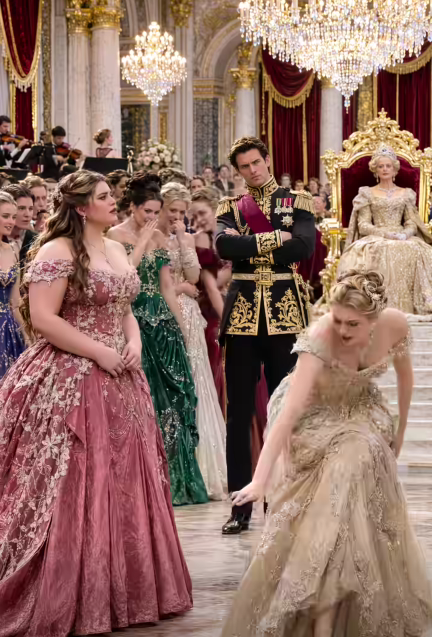
Gray afternoon light stretched across the marble floor where she had danced barefoot less than a week earlier.
She crossed to the center.
For the first time, she understood Margaret differently.
Her mother had not run because she was weak.
She had run because everyone around her had already begun assigning meaning to her existence.
A door opened behind Isabella.
She turned.
Adrian stood there.
“I can leave.”
“No.”
He remained near the door.
Isabella looked around the ballroom.
“What do you want me to do?”
Adrian’s expression tightened.
“I’m not going to answer that.”
“Why?”
“Because every answer I could give would be contaminated by what it means for me.”
The honesty startled her.
“If you renounce the claim, I remain heir.”
“If you do not, I may never become king.”
He drew a slow breath.
“I have spent my entire life being prepared for something I assumed was mine.”
“And what do you feel?”
“Terrified.”
She waited.
“And strangely relieved.”
“Relieved?”
“Yes.”
Adrian laughed softly.
“I never realized how much of my personality was built around becoming a man I thought a king had to be.”
“Certain.”
“Controlled.”
“Unquestioned.”
His eyes moved toward the floor where he had nearly struck her.
“And that version of me became someone I do not like.”
Isabella felt her anger shift.
Not disappear.
But become more complicated.
“What happens to us if I become heir?”
“I don’t know.”
“What happens if I renounce it?”
“I don’t know that either.”
He looked at her.
“But I know one thing.”
“What?”
“I do not want you to choose based on whether it makes my life easier.”
For the first time since their marriage, Isabella believed he had spoken without protecting himself.
She stepped closer.
“Thank you.”
Adrian nodded.
Then he left her alone.
That night, Isabella opened Margaret’s letter again.
Do not let pride steal yours.
She read the sentence repeatedly.
Near dawn, she made her decision.
The next afternoon, the palace announced that Princess Isabella would address the kingdom.
The ballroom filled again.
But this time Isabella wore simple shoes.
She did not remove them.
She stood beside Eleanor while cameras and journalists waited.
Christopher remained near the rear.
Adrian stood several steps away.
Isabella unfolded no notes.
“My mother spent most of her life hiding a truth she believed would turn her daughter into a symbol before she had the chance to become a person.”
The room remained silent.
“She was right about one thing.”
“Bloodlines can become cages when people mistake inheritance for identity.”
She looked toward Eleanor.
“Queen Eleanor has served Ashford for twenty-seven years.”
“Nothing discovered in an old register erases that service.”
“Nothing about my mother’s birth makes the queen less worthy of respect.”
Then she looked toward the gathered council members.
“But neither should the truth be buried simply because it is inconvenient.”
“Margaret Vale was the legitimate firstborn daughter of King Robert Ashford.”
“She was denied recognition.”
“That wrong should be acknowledged.”
A ripple moved through the room.
Isabella continued.
“As for my own place in the succession, I will not renounce it today.”
Adrian’s expression did not change.
“But I will not claim the crown today either.”
The journalists began writing furiously.
“I am asking Parliament to create a lawful settlement that recognizes Margaret’s place in our history, protects the stability of the kingdom, and allows the future of the succession to be decided transparently rather than through secrecy.”
Eleanor’s eyes filled with quiet pride.
Isabella continued.
“And Bellhaven will not become a private reward for me.”
“The lands wrongfully separated from the estate will be placed into a public trust developed with the families who live and work there.”
“Some tenants will receive pathways to ownership.”
“Some land will remain protected.”
“And Bellhaven House will become a center for rural education, legal aid, and historical preservation.”
Christopher lowered his head, smiling.
Isabella finished.
“My mother believed titles mattered less than how people treated one another when no one was watching.”
“I intend to honor that.”
For several seconds, there was silence.
Then Eleanor began to clap.
Adrian followed.
Then Christopher.
Then Harrow.
Gradually, the room joined them.
Isabella did not smile until she saw Mrs. Bell standing near the rear among invited villagers from Willowmere.
The old woman was crying.
Later that evening, after the palace had quieted, Harrow came to Isabella’s sitting room.
He carried a narrow envelope.
“This arrived during your address.”
“Another anonymous letter?”
“No.”
His expression was strange.
“Not anonymous.”
He handed it to her.
The name on the front made Isabella’s breath stop.
Not Margaret.
Not Frederick.
Not Christopher.
Beatrice Vale.
“That’s impossible.”
Harrow nodded.
“Beatrice died decades ago.”
Isabella opened the envelope carefully.
Inside was a yellowed letter.
A second, much newer note had been attached.
The old letter began:
To the granddaughter I may never meet—
Isabella stared at it.
“How did this arrive today?”
Harrow handed her the newer note.
It contained only a few lines.
Your grandmother left this with my family under strict instructions.
We were to deliver it only if Margaret’s daughter was ever publicly identified.
Until yesterday, we did not know whether you existed.
There is something your family has never understood about why Beatrice disappeared.
The letter will explain.
Isabella looked up.
“Who sent this?”
“A family named Holloway.”
“Where do they live?”
Harrow hesitated.
“In Willowmere.”
Isabella unfolded Beatrice’s letter.
Most of it was personal.
She wrote of King Robert.
Of loving him when they were young.
Of realizing too late that affection could not survive the machinery surrounding a throne.
Then Isabella reached the final paragraph.
Her eyes moved slowly across the page.
She read it again.
“What does it say?” Harrow asked.
Isabella looked toward him.
“Beatrice says Margaret was never supposed to inherit the crown.”
Harrow frowned.
“That contradicts the legal records.”
“No.”
Isabella felt her pulse quicken.
“She says there was another child.”
Harrow became completely still.
“Another child?”
“A son.”
“Older or younger than Margaret?”
“Older.”
Harrow stared at the letter.
“Then why is there no record?”
Isabella read the final sentence aloud.
“Because, according to Beatrice, he was taken away immediately after birth and raised under another name.”
The room seemed suddenly colder.
Harrow whispered, “What name?”
Isabella looked at the final line.
And the name written there belonged to a family still living in Ashford.
A family standing much closer to the throne than anyone had imagined.
**–END OF PART 5–CLICK “NEXT” AT THE BOTTOM OF THE PAGE TO CONTINUE READING**
✓ Lynn R. Adams
## PART 5 – The Crown Margaret Refused For several seconds, no one in King Frederick’s old study seemed able to move. The ancient register remained open beneath the lamplight, its faded ink offering…