PART 5: The Bags Beside the Door15 026
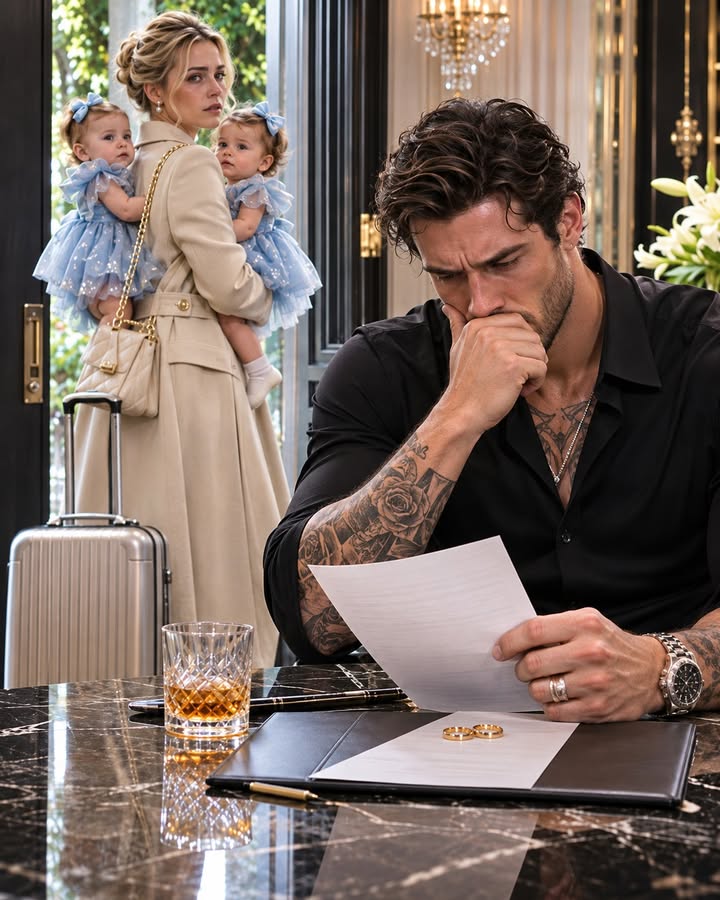
Part 5 – The Distance Between Promises
Garrett asked whether I would read the letter with him.
I looked at the sleeping girls, then at the path ahead, where the leaves had gathered in a golden line along the curb.
“Not today,” I said.
He nodded, though disappointment moved across his face.
“All right.”
“I don’t want to open another piece of your family’s past while we’re still trying to understand what’s happening between us.”
“That makes sense.”
“Maybe we can read it after the next counseling session.”
He glanced at Lena, who had kept one hand on the stroller.
“I’ll ask Mom to wait.”
There was no pressure in his answer, no insistence that the letter might explain everything.
Still, when we parted at the edge of the park, I felt the old pull of curiosity follow me.
A letter tucked into a notebook from the first days of our daughters’ lives seemed to belong to a story we had never told ourselves.
But I knew how easily a hidden truth could become a shortcut, a way to explain pain without changing what came next.
I needed to see whether Garrett could change without the letter telling him how.
The following evening, we met with Elise again.
The room was warm, the window cracked slightly to let in the cool air, and the girls slept in their carriers near my chair.
Garrett sat across from me with his hands resting loosely on his knees.
Elise asked what we had been thinking about since the last session.
“I’ve been thinking that I don’t want to go back to the way things were,” I said.
“I also don’t want the girls to grow up with their parents living separate lives if there’s a way to build something better.”
Garrett looked at me, but didn’t interrupt.
“I can’t come home because he apologized,” I continued.
“I can’t come home because he understands one painful thing about himself.”
“I know,” he said.
Elise turned toward him.
“What do you hear Nora asking for?”
Garrett took a breath.
“Time to see whether I can be consistent.”
“And what would consistency look like to you?”
He looked down at his hands, thinking carefully.
“Taking responsibility for the girls without waiting for Nora to make a list.”
“That’s part of it,” I said.
“What else?”
“I don’t know yet.”
I felt a flicker of frustration, but he caught it before I had to name it.
“I’m not saying I don’t want to figure it out,” he added.
“I’m saying I don’t want to invent an answer that sounds right and then hand you another promise.”
Elise nodded.
“What do you need, Nora?”
I had thought about it with Lena, and then again alone in the quiet room while the twins slept.
“I need a gradual trial,” I said.
“Not a move back in next week, and not a decision that everything is repaired.”
Garrett’s shoulders tightened, but he stayed still.
“I need specific caregiving shifts that belong to him completely.”
“Daily and overnight?” Elise asked.
“Yes.”
“I need him to manage those shifts from beginning to end, including getting things ready, knowing what the girls need, and handling the difficult parts without calling me unless there’s a genuine concern.”
Garrett nodded slowly.
“I can do that.”
“I need you to arrange dependable backup,” I continued.
“Not because I’m expecting you to fail, but because two babies need more than one plan.”
“I can talk to my mom,” he said.
“I don’t want your mom to become the automatic backup.”
He stopped.
“All right.”
“She can help if she chooses, but I need us to have a plan that doesn’t depend on one person stepping in whenever you’re overwhelmed.”
Elise asked what that might look like.
Garrett thought for a moment.
“We could make a list of people both of us trust,” he said.
“And see whether one or two are willing to be part of a regular schedule.”
“Or we could look into a caregiver for a set number of hours,” I said.
“Something we agree on together.”
“I can research that,” he replied.
“Bring options to the next session. Don’t book anyone before we talk.”
“I will.”
Elise asked whether we would be comfortable putting the trial in writing.
I looked at Garrett.
“I would.”
“So would I,” he said.
The counselor took a sheet of paper and drew a simple column for responsibilities, another for times, and a third for backup plans.
It looked ordinary, almost too ordinary to carry the weight it did.
We started with two evening shifts during the week, from the time Garrett came home until the girls were settled for the night.
He would handle feeding, baths, bottles, pajamas, and the bedtime routine on those nights.
We added one Saturday morning, when he would take both girls for a full stretch while I slept or left the house.
Then we discussed overnight care.
I had not expected to decide that part so quickly, but once we were talking about a trial, leaving it out felt like avoiding the hardest truth.
“Two nights a week,” I said.
“Garrett takes the first wake-up and the early morning.”
“We can alternate the second wake-up if both girls are unsettled.”
He looked at me.
“Do you want to be in the house while I do that?”
“No.”
The answer came faster than I intended.
I saw him absorb it.
“I can take them at my place,” he said.
“Not yet.”
He lowered his gaze.
“I don’t think you should take them overnight somewhere they haven’t slept before until we’ve planned it.”
“That’s fair.”
“For now, I want the overnight shifts to happen at my sister’s house, with you responsible for the girls and Lena in the guest room if we need her.”
“I can stay in the living room,” Lena offered from the chair near the door.
She had joined the session at my request, not to speak for me, but to help make the first steps practical.
“I’m not here to supervise you, Garrett,” she said.
“I just want Nora to know there’s another adult nearby while the girls are still learning the routine.”
“I understand,” he replied.
“I don’t want you to have to supervise me.”
Lena gave him a measured look.
“Then show us you can do the work without needing supervision.”
He nodded.
Elise asked what would happen if one of the shifts became difficult.
Garrett glanced at me.
“If I’m overwhelmed, I’ll ask for help before I reach the point of walking away.”
“That’s important,” Elise said.
“But I need to be more specific,” he added.
“I’ll tell Nora or Lena what’s happening, and I’ll stay responsible for the girls unless we agree someone else needs to take over.”
“That sounds reasonable,” I said.
He looked relieved, then cautious, as if he did not want relief to be mistaken for certainty.
We spent the rest of the session filling in details.
The girls’ health information.
The numbers to call if one developed a fever.
Where their medicine would be kept.
Which parts of the bedtime routine seemed to calm them.
The plan did not require me to list every item they might need.
It required Garrett to gather the information and keep it where he could find it.
At the end, Elise asked what each of us hoped the trial would show.
“I hope it shows that the girls can count on both of us,” I said.
“And that I can take a breath without wondering whether everything will fall apart.”
Garrett looked down at the page.
“I hope I can become someone Nora doesn’t have to manage.”
“That’s your goal,” Elise said.
“What can you commit to doing?”
He considered the question.
“I’ll attend counseling, even if Nora decides she doesn’t want to continue with me.”
I felt a small ache at the phrasing.
“That isn’t what I want,” I said.
“I know,” he replied.
“But I don’t want counseling to become something I do only if it earns me a way back.”
Elise asked whether we were ready to begin the trial the following Monday.
I looked at the plan.
It was clear enough to protect me from drifting back into the old arrangement, but not so rigid that the girls’ needs would be treated like appointments.
The first overnight shift was written in for Tuesday.
My stomach tightened when I saw it.
“Monday for the evening shifts,” I said.
“Tuesday night for the first overnight.”
Garrett nodded.
“Okay.”
I signed my name at the bottom.
He signed beneath mine.
The paper did not say that we were reunited.
It did not promise forgiveness or make the difficult years smaller.
It said only what we would do next, and what we would not assume.
Outside the office, Garrett walked beside me to Lena’s car.
The air had turned sharp with evening cold.
“I don’t want you to think the plan means I’m coming home soon,” I said.
“I don’t.”
“I don’t want the girls’ progress to depend on you doing everything perfectly.”
“Neither do I.”
“But if you miss a shift, or decide you’re tired, or make me chase you for an answer, I’ll need to reconsider the trial.”
“I understand.”
I stopped beside the car.
“Do you?”
He met my eyes.
“I understand that you’re giving me a chance to show up, not a promise that you’ll come back.”
The words were careful, but not resentful.
I let myself believe that he meant them.
That was all I could offer.
On Monday evening, he arrived at Lena’s house five minutes before his shift began.
He had packed the diaper bag himself, with diapers, wipes, spare clothes, two clean bottles, and the little cloth toys the girls liked.
He had also brought a small notebook of his own.
“What’s that?” I asked.
“Notes from the pediatrician’s portal, and the routine I’ve been learning.”
He opened it to a page where he had written down the girls’ usual feeding times and the signs he had started noticing when they were tired.
There were a few crossed-out guesses.
I appreciated that more than a perfect-looking page.
“You don’t have to write everything down,” I said.
“I know.”
“I just wanted to check.”
“I’m writing it for me.”
He looked toward the living room, where both girls lay on a blanket.
“Are you ready?” he asked them.
One gave a delighted squeal.
The other stared solemnly at his face.
Garrett smiled.
“I think that’s a yes.”
For the next three hours, he handled dinner, feeding, a diaper change, and the beginning of the bedtime routine.
I stayed in the kitchen with Lena, where I could hear the girls but did not intervene.
There were moments when Garrett called out to ask where something was.
Each time, I reminded myself that the first shift would not be perfect.
Then, when he asked where the clean sleep sacks were, I pointed him to the drawer.
“The top one is full,” I said.
“The next one down has the warmer ones.”
“Got it.”
He did not ask me which one to use.
He checked the room temperature, chose a lighter sack, and carried the girls through the rest of the routine.
When one began crying, he stayed with her.
I heard his voice, low and steady, then the soft rhythm of his steps along the hall.
He did not ask me to show him how.
At the end of the shift, both girls were asleep.
Garrett came into the kitchen alone.
“I wrote down what they ate and when,” he said.
“Good.”
“One of them fought the sleep sack.”
“They both do sometimes.”
“I know now.”
He set his notebook on the table.
“Do you want to see it?”
“Not tonight.”
“All right.”
He gathered his things and looked toward the hallway.
“I’ll be back for the Saturday shift.”
“I’ll send you the time.”
“Thank you.”
He started toward the door, then paused.
“I don’t expect you to tell me I did well.”
“I wasn’t going to.”
A shadow of a smile crossed his face.
“I know.”
He left.
I returned to the living room and sat beside the crib, listening to the girls breathe.
I was still tired.
I was still angry in ways that came and went without warning.
But I had not spent the evening directing every movement or calculating what would happen if I stopped paying attention.
It was a small thing.
It was also a new thing.
On Tuesday night, Garrett came back for the first overnight shift.
He arrived with the girls’ bottles prepared and the medicine bag checked.
Lena showed him where the spare sheets were.
I watched him place the phone numbers on the counter, then put the girls’ feeding notes in the kitchen drawer.
He had remembered the cloth they liked near their crib.
He had remembered that one twin sometimes startled awake when a door clicked.
He had not asked me to tell him twice.
When I told him I was going to bed, he looked at my face.
“Are you sure you’re ready?”
“I’m sure I need to sleep.”
“Okay.”
“If you need help, wake Lena.”
“I will.”
“Not me?”
“If it’s a real emergency, I’ll wake you.”
“That’s not what I mean.”
He took a moment.
“I won’t wake you because I’m uncomfortable or unsure. I’ll try to work through it first.”
I studied him, listening for the promise behind the words.
“Thank you.”
He carried the girls toward the nursery.
I watched him disappear down the hall, then closed the guest-room door.
Sleep did not come right away.
I listened to the house settle around me, the occasional creak of the floorboards, the distant rush of a car on the road outside.
At midnight, one of the girls woke.
I heard Garrett enter the nursery and lift her from the crib.
His voice rose softly through the wall.
“You’re okay, sweetheart. I’ve got you.”
The baby cried for several minutes.
He walked with her, humming under his breath.
I pressed my palms against the blanket and stayed where I was.
The crying eased.
A little later, I heard the other twin stir.
There was a pause, then the sound of Garrett setting one baby safely in the crib and lifting the other.
He moved between them, slow and quiet, trying to settle both without turning the house into a storm.
I wanted to go to him.
I wanted to know whether he was all right.
I wanted to remind him where the spare pacifiers were.
I wanted to do what I had always done, which was take over before anyone had to ask.
Instead, I stayed in bed.
At some point, the house grew quiet again.
When I woke, pale morning light had reached the window.
Lena was already in the kitchen, and Garrett stood at the counter with one baby resting against his shoulder.
The other was sleeping in the travel crib.
His shirt was wrinkled, and his eyes looked tired.
He had a faint smear of formula near one cuff.
“Did you sleep?” he asked.
“Some.”
“Good.”
“How was it?”
He looked toward the baby in his arms.
“Hard.”
The answer was simple, and it did not sound like a complaint.
“What happened?”
“They both woke at once around two.”
He shifted the baby gently.
“I fed one, then changed the other, and by then the first was crying again.”
“What did you do?”
“Put them both in the crib for a minute while I made sure I had everything ready.”
He met my eyes.
“I thought they’d be upset, but they were safe. I needed both hands.”
“That was a good choice.”
He nodded.
“After that, I held one and let the other settle beside me while I sat on the floor.”
Lena placed a cup of coffee in front of him.
“You got through it,” she said.
“Yeah.”
He did not look proud.
He looked like someone who had finally discovered what the night asked of the person who stayed awake.
I sat across from him.
“Thank you for taking the shift.”
“I’m glad I did.”
“I’m not saying everything is fixed.”
“I know.”
“But I noticed.”
He looked down at the baby’s small hand resting against his chest.
“That matters to me.”
“I’m not trying to reward you.”
“I know.”
The second overnight shift was harder.
The girls were both restless, and one had trouble settling after her feeding.
Garrett called Lena once to ask whether she thought the baby’s fussing sounded unusual.
Lena listened, checked the temperature, and agreed that the baby seemed tired rather than unwell.
He stayed with her after Lena returned to the guest room.
In the morning, he told me what had happened before I had to ask.
He also told me that he had been frightened.
“I kept thinking I’d miss something,” he said.
“Did you?”
“No. But I was scared I might.”
“You can be scared and still be responsible.”
“I’m starting to understand that.”
A week later, we met with Elise again.
She asked how the trial was going.
“Better than I expected in some ways,” I said.
“Harder than I expected in others.”
“What was hard?”
“Letting go of the urge to monitor everything.”
Elise looked at Garrett.
“And for you?”
“Doing the work without turning it into a performance.”
“What do you mean?”
“I keep wanting to show Nora I remembered something.”
He glanced at me.
“Then I catch myself waiting to see whether she noticed.”
I held his gaze.
“I do notice.”
“But you don’t always say so.”
“No.”
He nodded.
“I think I’m used to hearing that I’m doing enough before I know whether I’ve done enough.”
“That isn’t Nora’s job,” Elise said.
“I know.”
Garrett looked at me.
“I don’t expect her to reassure me.”
“Good,” I said.
“I’m still learning to sit with the fact that the girls need me whether or not I feel confident.”
The session moved to practical matters.
Garrett had researched a few options for backup care, as we had agreed.
He brought a list of local caregivers and a note about an infant-care class offered through the community center.
He had not registered for anything.
He had included the hours, costs, and questions we would need to ask before deciding.
I looked at the list.
“You did this on your own?”
“Yes.”
“Did anyone help you?”
“My mom gave me the names of two people she knew, but I checked them myself.”
“Thank you.”
He waited, then looked back at Elise.
We chose one person to interview together and decided to attend the class.
Nothing about the decisions felt dramatic.
That was part of why I trusted them.
By the end of the second week, the girls knew Garrett’s voice well enough to turn toward him when he entered the room.
One of them had started reaching for his shirt when he held her.
He noticed and smiled, but did not call me over to witness it.
I did notice.
I watched from the kitchen doorway while he sat on the floor between them, making a soft clicking sound with his tongue.
The girls answered with delighted babbles.
For a moment, I felt a sharp, unexpected grief.
This was what I had wanted from the beginning.
Not the perfect husband in the stories we told our friends, or the neat house, or the photographs where everyone looked rested.
I had wanted to watch my daughters trust their father.
I had wanted to feel that I could leave the room without leaving the family alone.
And now that something I wanted was beginning to happen, I could not pretend the time before it had not hurt.
Garrett looked up and caught me watching.
He did not ask whether I was all right.
He only smiled gently and turned back to the girls.
I appreciated that too.
A few days later, Marlene called to ask whether she could bring over the letter she had found.
I said yes, but asked her not to come during one of the girls’ shifts.
She suggested Saturday afternoon, when Garrett would already be at Lena’s house for his scheduled time.
“I don’t want to make a big event of it,” she said.
“I understand.”
“I can leave it with you if you’d rather read it alone.”
I considered that.
“Bring it, and we’ll decide when it feels right.”
When she arrived, she carried a small cardboard box.
The edges had softened with age, and a faded blue ribbon was tied around it.
Garrett had gone with the girls to the backyard.
Lena sat beside me at the kitchen table as Marlene placed the box between us.
“I found it when I was looking for the girls’ old hospital bracelets,” she said.
“I thought I had packed those in another box, but this was behind the feeding notebook.”
She lifted out a narrow spiral notebook, its cover marked with a date from the week we brought the twins home.
A folded envelope was tucked into the back.
The paper had yellowed along the edges.
Garrett’s father’s handwriting covered the front.
Marlene looked at the envelope but did not touch it.
“I haven’t read it,” she said.
“Why not?” Lena asked.
“Because I thought it might have been meant for Garrett.”
She swallowed.
“I also thought it might be something private between his father and me.”
“Do you know when he wrote it?” I asked.
“Not exactly.”
“He was at the house one afternoon while I was sleeping. The girls had been home for a few days.”
She brushed one finger over the notebook cover.
“He wrote down the feeding times while I was holding one baby and Garrett was trying to settle the other.”
I looked at the envelope again.
“Why would he put a letter in the notebook?”
“He may have meant to leave it for me.”
“Or for Garrett,” Lena said gently.
Marlene nodded.
“I can’t tell.”
A sound came from the backyard.
One of the girls had laughed.
Then I heard Garrett laugh too.
The ordinary warmth of it made the envelope seem suddenly heavier.
Marlene looked toward the window.
“I thought being a good mother meant keeping our family’s private worries inside the family,” she said.
“I’m not sure that was wise.”
I looked at her.
“You’re allowed to read it now.”
She turned back to the letter.
“I don’t know if I should.”
“Does Garrett know it’s here?”
“Yes.”
“Then maybe we let him decide with us.”
Marlene nodded, though her eyes stayed on the envelope.
When Garrett came in with the girls, he stopped at the sight of the box.
“I wondered if you’d brought it,” he said.
“I did,” Marlene replied.
He looked at me.
“Do you want to read it?”
I glanced at the girls, then at the paper.
“Not before their nap.”
He nodded.
We set the box on the counter and finished the afternoon as planned.
Garrett changed the girls, gave them their bottles, and carried them to the bedroom for their nap.
He returned alone and washed the bottles without being asked.
Marlene watched him at the sink.
“I used to call this helping,” she said softly.
Garrett turned off the tap.
“I know.”
“I’m sorry.”
“I know that too.”
She touched his arm.
“I wish I’d taught you that the work belonged to all of us.”
He looked at her with tenderness and regret.
“You were doing what you thought was right.”
“That doesn’t mean I don’t wish I’d done better.”
He held her hand for a moment.
“I’m trying to do better now.”
“I can see that.”
When the girls were asleep, we sat around the kitchen table.
The box remained on the counter.
Garrett pulled out a chair but did not sit.
“I’m ready to read it,” he said.
Marlene looked at me.
“So am I,” I said.
Garrett took the envelope from the notebook.
The paper made a dry whisper as he opened it.
He read the first lines silently.
Then he stopped.
His face changed.
“What is it?” I asked.
He looked at his mother.
“I think Dad wrote this to you.”
Marlene’s breath caught.
Garrett turned the page so we could see the first line.
It began, Dear Marlene, I watched you carry both girls from room to room while Garrett stood beside you, wanting to be useful and not knowing how.
My husband’s eyes moved over the next sentence.
He didn’t look at me.
He looked at his mother, then at the letter, as if the words had turned the past toward us in a direction none of us had expected.
“What does he say?” I asked.
Garrett lowered the page.
“I think he saw the beginning of this,” he said.
“Maybe more than we knew.”
He looked down at the letter again, then took a careful breath.
“Do you want me to read it aloud?”
**–END OF PART 5–CLICK “NEXT” AT THE BOTTOM OF THE PAGE TO CONTINUE READING**
* * *
[PREVIOUS: PART 4](https://puretales.idolsgift.com/blog/part-4-the-bags-beside-the-door15-026) | [NEXT: PART 6(THE END)](https://puretales.idolsgift.com/blog/part-6-the-end-the-bags-beside-the-door15-026)
✓ Lynn R. Adams
Part 5 – The Distance Between Promises Garrett asked whether I would read the letter with him. I looked at the sleeping girls, then at the path ahead, where the leaves had gathered in a golden line …