PART 5: MAFIA BOSS KNEELS BEFORE A MAID—HER DRESS REVEALS A 16-YEAR SECRET! 😱❤️ 066
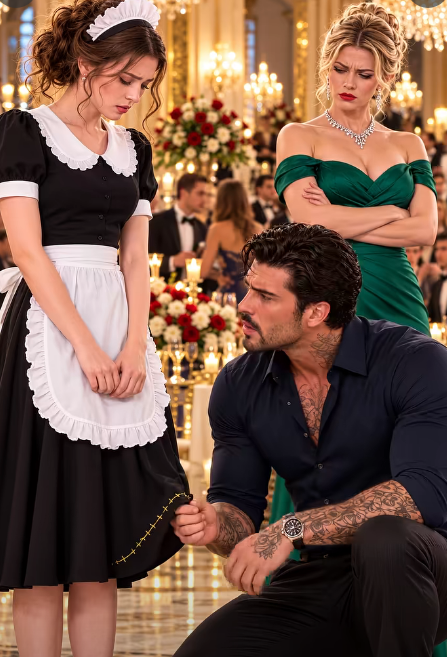
“Victoria was protecting someone she loved?”
I stared at Daniel Carter as he stood inside the gardener’s cottage, holding his mother’s letter.
For a moment, nobody spoke.
Outside, the autumn wind stirred the yellow roses.
Claire stood beside the wooden cabinet, her face pale.
“Daniel,” she said carefully, “what do you remember about Victoria’s father?”
Daniel looked toward the window.
“Richard Ashford was my father’s closest business partner. He handled investments and property development.”
“And the maintenance contracts?”
Daniel nodded slowly.
“He supervised those too.”
Noah stepped forward.
“Then he could have approved the transfer.”
“Yes.”
“But Victoria was a young woman when Dad died,” I said. “She couldn’t have been responsible for what happened.”
Daniel looked at me.
“No. She couldn’t.”
He folded the letter.
“And that’s what makes this so difficult.”
I frowned.
“What do you mean?”
“Victoria may have spent sixteen years protecting her father’s reputation without knowing the full consequences of his decisions.”
Claire sighed.
“Richard could be a generous man. He funded schools, hospitals, and community projects. But he was also deeply concerned with how people saw him.”
Daniel nodded.
“He hated admitting mistakes.”
I looked down at my mother’s yellow stitches.
Sixteen years ago, my father had died.
My mother had disappeared.
Noah and I had grown up believing we’d lost both parents.
And now a trail of yellow thread was leading us toward a truth hidden beneath decades of wealth and respectability.
“What happens now?” I asked.
Daniel looked at me.
“We ask Victoria to tell us what she knows.”
Victoria arrived at the Carter estate shortly after noon.
She stepped out of a silver car wearing a simple navy-blue coat.
There were no diamonds on her hands.
No carefully arranged audience.
Only a woman who looked exhausted.
When she saw Claire standing beside me, she stopped walking.
For several seconds, she stared.
Then her hands rose toward her mouth.
“Claire?”
My mother nodded.
“Hello, Victoria.”
Victoria began crying.
“I never thought I’d see you again.”
Claire approached her slowly.
“I heard you saw me at the flower shop.”
Victoria nodded.
“I wanted to speak to you. But I was frightened.”
“Of what?”
Victoria looked toward Daniel.
“Of everything coming back.”
Claire reached for her hand.
“The past was never really gone.”
Victoria began shaking.
“I know.”
We gathered in the conservatory.
Sunlight poured through the glass ceiling.
The smell of fresh roses filled the air.
Daniel placed Eleanor’s letter on the wooden table.
“Victoria, my mother left this behind.”
Victoria stared at the handwriting.
Her face changed.
“Eleanor…”
“She wrote about the missing maintenance payments,” Daniel said. “And about a meeting with your father.”
Victoria closed her eyes.
“I remember.”
I leaned forward.
“Tell us.”
She looked at me.
“Emma, before I begin, I need you to know something.”
I waited.
“I was wrong to treat you the way I did. I was wrong to keep your mother’s letters. And I was wrong to believe that protecting a family’s name mattered more than telling the truth.”
Her voice shook.
“I can’t undo any of those things.”
“No,” I whispered. “You can’t.”
Victoria nodded.
“But I can stop hiding.”
Sixteen years earlier, Victoria had been twenty-three.
Her father, Richard Ashford, was one of Chicago’s most respected businessmen.
He was handsome, charismatic, and famous for donating enormous sums to charity.
Victoria adored him.
“He used to take me to his office after school,” she began. “He’d let me sit at his desk and pretend I was running the company.”
A faint smile crossed her face.
“He told me I could accomplish anything if I worked hard enough.”
Daniel listened silently.
“But as I grew older,” Victoria continued, “I began noticing how worried he became whenever financial reports arrived.”
She looked at Claire.
“One evening, I found him examining a stack of invoices. Several payments had been made to contractors who weren’t listed on the actual building projects.”
Claire nodded.
“That’s what I discovered later.”
Victoria swallowed.
“When I asked him about it, he said it was a temporary accounting arrangement. Something about moving money between subsidiaries until the next financing agreement was completed.”
“Did you believe him?” Noah asked.
“Yes.”
She looked ashamed.
“I wanted to believe him.”
Daniel leaned forward.
“What happened next?”
“Your father began questioning the same payments. Richard told me he was under enormous pressure to keep the company solvent.”
Claire frowned.
“The construction business was profitable that year.”
“On paper,” Victoria said. “But several outside investments had failed. My father had secretly borrowed against future project revenue to cover the losses.”
Daniel stared at her.
“How much?”
“Enough that admitting the truth would have ended his position at Carter Holdings.”
I looked at the journal.
“So he moved money that was supposed to pay for repairs?”
Victoria nodded.
“Yes.”
“Did he know the repairs weren’t being completed?”
She wiped her eyes.
“He knew some were delayed. He believed the company could catch up once new investment money arrived.”
I thought of my father’s final day.
The loading mechanism.
The inspection report.
The warning he’d tried to give Daniel.
“Dad died because the repairs were delayed.”
Victoria looked at me.
“The evidence suggests that’s what happened.”
I felt tears rising.
“Then your father knew what he’d done?”
“He learned the full circumstances after the accident.”
“What did he do?”
Victoria looked down.
“He was devastated.”
She clasped her hands.
“But instead of immediately telling the truth, he tried to correct the accounts quietly.”
Daniel shook his head.
“And my father allowed it?”
“Yes.”
The conservatory fell silent.
Daniel looked at Claire.
“My father knew.”
Claire nodded sadly.
“I was afraid he did.”
Victoria continued.
“Both men believed admitting what had happened would destroy the company, cost hundreds of employees their jobs, and expose years of improper financial decisions.”
Noah spoke quietly.
“So they chose their business over the truth.”
Victoria looked at him.
“Yes.”
It wasn’t a dramatic confession.
There were no raised voices.
No sudden threats.
Just a terrible realization.
The people who’d built their lives around success had been so afraid of losing it that they’d allowed a grieving family to live without answers.
Daniel stood and walked toward the roses.
“My father died five years ago,” he said.
Victoria nodded.
“Richard died two years before that.”
Daniel looked at the letter.
“Neither of them ever told me.”
Claire sighed.
“Perhaps they were ashamed.”
“Shame doesn’t excuse silence.”
“No,” she said. “It doesn’t.”
I looked at Daniel.
“Can anything be done now?”
He turned toward me.
“Yes.”
“How?”
“We can establish the truth through an independent review. We can correct the company records, identify the people affected, and make restitution where it’s owed.”
Noah frowned.
“Even after sixteen years?”
“Some legal remedies may be limited,” Daniel admitted. “But that doesn’t prevent us from making the findings public or accepting responsibility.”
I studied his face.
“Would that damage your company?”
“Yes.”
“Your reputation?”
“Probably.”
I waited.
He walked back toward the table.
“Emma, I spent most of my adult life believing power meant never allowing anyone to see weakness.”
He glanced at Claire.
“Your mother was one of the first people who tried to teach me otherwise.”
He touched the letter.
“I failed to listen when it mattered most.”
His voice softened.
“I won’t repeat that mistake.”
For the first time, I believed him.
Not because he was rich.
Not because he was powerful.
But because he was finally willing to lose something in order to do what was right.
Margaret arrived carrying tea and sandwiches.
Nobody had eaten much that morning.
She set the tray on the table and smiled at Claire.
“You used to forget lunch when you were working on the accounts.”
Claire laughed softly.
“And you used to bring me sandwiches whether I wanted them or not.”
“Some things never change.”
Margaret sat beside her.
For a moment, the atmosphere grew lighter.
Then Noah opened the old journal.
“There’s still something I don’t understand.”
We turned toward him.
He pointed to a page covered with numbers.
“These entries aren’t just financial records.”
Daniel leaned closer.
“What do you mean?”
Noah pulled out his notebook.
“Look at the dates. Some of the figures have little yellow flowers beside them.”
Claire nodded.
“I marked those entries because Eleanor thought they were important.”
“But the numbers aren’t arranged like ordinary accounts.”
My brother pointed to four rows.
“There’s a repeating sequence. Four-seven-two-nine.”
I felt my heart leap.
“The numbers Mom taught me.”
“Yes.”
Noah turned another page.
“If these numbers identify a hidden account or a reference code, they might lead to the missing original documents.”
Daniel studied the page.
“The archived records we reviewed were copies. We still haven’t located the complete set of authorizations.”
Claire became thoughtful.
“Eleanor believed the original records had been altered. She insisted we preserve independent copies.”
“Where?” Daniel asked.
Claire looked around.
“I don’t remember everything clearly. But I know she gave me more than one envelope.”
Margaret suddenly stood.
“Wait.”
Everyone turned.
“Eleanor used to keep her important papers inside the old music room.”
Daniel frowned.
“The music room?”
“At the family house,” Margaret explained. “She played the piano every evening. After your father stopped using the room, she kept it as her private space.”
Daniel looked toward the conservatory windows.
“The house has been closed for years.”
Margaret nodded.
“But the piano is still there.”
I thought about the notes hidden inside my dress.
The letters hidden inside the cabinet.
The numbers.
The flowers.
And I smiled despite myself.
“Your mother really liked hiding things, didn’t she?”
Daniel laughed quietly.
“She did.”
The Carter family house stood beyond a long avenue of maple trees.
It was enormous, with pale stone walls, tall windows, and broad steps leading to a carved wooden entrance.
Yet as we approached, it seemed strangely lonely.
A place built for grand gatherings that had forgotten how to welcome people.
Daniel unlocked the front door.
Dust floated through shafts of afternoon sunlight.
Old paintings lined the walls.
Crystal chandeliers hung above furniture covered in white sheets.
I imagined Eleanor walking through these rooms.
My mother following her.
Perhaps my father arriving with a little girl holding his hand.
Me.
Sixteen years ago, I’d been part of this world without knowing it.
Daniel led us to the eastern wing.
At the end of a long hallway stood a pair of white double doors.
He pushed them open.
The music room was beautiful.
An enormous grand piano stood beside tall windows overlooking the rose garden.
Bookshelves lined one wall.
A faded blue rug covered the polished wooden floor.
On the piano rested a vase filled with dried yellow roses.
Margaret stopped in the doorway.
“I used to hear Eleanor playing from the kitchen.”
Daniel smiled sadly.
“She played every evening when I was young.”
Claire approached the piano.
Her fingers touched the keys.
A few soft notes echoed through the room.
“Do you remember what she played?” I asked.
Claire nodded.
“A little melody she wrote herself.”
She sat on the bench and played a gentle sequence of notes.
The sound was imperfect.
A few notes came hesitantly.
But it filled the old room with something warm.
Daniel closed his eyes.
“I remember that song.”
Claire smiled.
“Eleanor called it ‘The Yellow Rose Waltz.’”
Noah examined the piano.
“Maybe there’s a compartment underneath.”
Daniel crouched beside him.
Together, they inspected the polished wood.
Nothing.
Margaret searched the shelves.
Victoria examined the music books.
I stood near the window, looking at the garden.
Then I noticed a narrow line of yellow thread tied around the corner of a picture frame.
My breath caught.
“Mom?”
Claire stopped playing.
I lifted the frame.
It held a photograph of Eleanor standing beside the piano.
A tiny yellow stitch had been sewn through the fabric backing.
I showed it to Claire.
She stared.
“Emma…”
“Does it mean something?”
Claire smiled through tears.
“She used to mark the places where she hid things.”
I turned the frame over.
The backing had a narrow opening.
Inside was a little folded note.
It contained just four words.
Beneath the final song.
Daniel looked at the piano.
“The final song?”
Margaret frowned.
“Eleanor’s last composition.”
Daniel crossed to the bookshelf.
He searched through a stack of old music.
Finally, he found a worn blue folder.
Its cover read:
For Daniel, When the Time Comes.
Inside were several handwritten pages of music.
The final page carried a drawing of four yellow roses.
Noah leaned closer.
“Four roses.”
I smiled.
“Four-seven-two-nine.”
We examined the music carefully.
Daniel noticed that four measures had been marked with tiny yellow dots.
“Maybe the numbers identify the bars,” he said.
Noah counted through the measures, following the sequence.
Four.
Seven.
Two.
Nine.
Each contained a single note circled in yellow pencil.
“C, A, F, E,” Noah read.
He looked up.
“Cafe?”
Margaret gasped.
“The garden café.”
Daniel turned.
“What?”
“Eleanor built a small café beside the conservatory years ago. She used it for charity events.”
Claire nodded.
“I remember.”
Margaret’s eyes widened.
“The old café had a wooden counter with a hidden drawer. Eleanor kept her fundraising records there.”
Daniel looked at the sheet music.
“Then we should go.”
The café had been closed for more than a decade.
Its windows were dusty, and ivy covered part of the doorway.
But the little building was still standing.
Inside, old tables and chairs were stacked beneath white dustsheets.
A long wooden counter stretched across the back wall.
Daniel examined it.
“No drawers.”
Margaret frowned.
“There used to be one.”
Noah knelt beside the counter.
“Maybe it was removed.”
He studied the wood.
Then he pointed toward a narrow brass latch.
“What’s this?”
Daniel pressed it.
A concealed panel slid open.
Inside was a small metal box.
My heart began racing.
The box bore an engraving.
Four yellow roses.
Daniel looked at me.
“Emma?”
I took out the silver key.
It fit perfectly.
The lock turned.
Inside lay a thick ledger wrapped in faded yellow fabric.
Claire covered her mouth.
“Oh, Eleanor.”
Daniel carefully removed it.
The first page carried a handwritten inscription.
For the families who deserve the truth.
Beneath it was a list of names.
Michael Bennett appeared at the top.
My father.
I reached toward the page.
Daniel placed the ledger in front of me.
“Emma, I think this is what your mother wanted us to find.”
I turned the pages.
There were invoices, dates, handwritten notes, and signed authorizations.
Everything was arranged carefully.
Every missing payment.
Every postponed repair.
Every decision that had been hidden behind official paperwork.
Claire began crying.
“This is it.”
Daniel nodded.
“The original records.”
But then Noah pointed to the final page.
“There’s something else.”
A single envelope had been tucked into the back cover.
It bore the Carter family seal.
Daniel opened it.
Inside was a letter written by his father.
His eyes moved across the page.
Then he sat down.
“Daniel?” Victoria whispered.
He looked at her.
“My father knew what happened. And he wrote a confession.”
The room fell silent.
Daniel read aloud.
I allowed financial decisions to continue after I learned they were wrong. I believed protecting the company would protect the people who depended on it. I see now that the truth should have come first.
Michael Bennett’s death revealed how badly we had failed.
Richard Ashford authorized the transfers, but I was responsible for allowing the system that made them possible.
I cannot undo what happened. I can only leave this record so that my son may someday do what I lacked the courage to do.
Daniel lowered the letter.
For several seconds, nobody spoke.
Then I looked at him.
“Your father wanted you to find this?”
He nodded.
“It seems so.”
Victoria began crying quietly.
“My father never told me.”
Daniel looked toward the yellow roses outside.
“Neither did mine.”
He closed the ledger.
“Tomorrow, I call an independent legal team and begin the formal disclosure process.”
Claire took his hand.
“Your mother would be proud of that decision.”
Daniel swallowed.
“I hope so.”
That evening, we returned to the flower shop.
Noah helped Thomas prepare dinner while Claire showed Margaret the little garden behind the building.
Daniel stayed in the kitchen with me.
For a long time, he said nothing.
Then he asked, “Are you angry with me?”
I considered his question.
“Sometimes.”
He nodded.
“I understand.”
“But I also think you’re trying.”
“I am.”
I looked at him.
“My mother told me once that good things deserve to be kept, even when the world thinks they’re worthless.”
Daniel smiled faintly.
“I remember Claire saying that.”
“She was talking about clothes. But I think she meant people too.”
His eyes filled.
“Your mother always saw more than the rest of us.”
We sat quietly.
Then I asked something I’d been wondering since the ballroom.
“Why did you kneel when you saw my dress?”
Daniel looked surprised.
“Because I recognized Claire’s stitches.”
“But you could have simply asked me about them.”
He smiled sadly.
“Yes.”
I waited.
He looked toward the window.
“The last time I saw Claire before she disappeared, she was sitting in my office with a needle and yellow thread.”
My heart tightened.
“She was sewing?”
“She’d noticed a tear in the lining of my coat. While I was reading financial reports, she quietly repaired it.”
I smiled.
“That sounds like Mom.”
Daniel nodded.
“When she finished, I told her I could afford a hundred new coats.”
“What did she say?”
He looked at me.
“She said, ‘Then you can certainly afford to take care of the one you already have.’”
I laughed through my tears.
Daniel’s smile faded.
“That was the day she asked me to investigate the accounts. I didn’t listen.”
He took a slow breath.
“When I saw those stitches on your dress, I remembered the woman I’d failed. I knelt because I couldn’t bear to stand above her daughter while asking about something so precious.”
I wiped my cheeks.
“Mom would say you were being dramatic.”
Daniel laughed.
“She probably would.”
Before bedtime, Claire called me into her room.
She was sitting beside the window holding an old photograph.
“Emma, there’s something I want you to have.”
I sat beside her.
She handed me a small velvet pouch.
Inside was a delicate gold necklace.
A tiny yellow rose hung from the chain.
“It belonged to your father,” she said.
I looked at her.
“Dad wore a flower necklace?”
She laughed softly.
“No. He had it made for me when you were born.”
I turned the pendant over.
On the back were three engraved words.
Always Find Home.
Tears filled my eyes.
Claire fastened the necklace around my neck.
“Your father used to say that no matter how far we wandered, love would always show us the way back.”
I touched the pendant.
“Did you believe him?”
She nodded.
“I did.”
“And now?”
Her eyes filled.
“More than ever.”
I hugged her.
For the first time in sixteen years, she kissed my forehead and whispered goodnight.
As I walked toward the door, she called my name.
“Emma?”
I turned.
She looked at me with an expression I couldn’t read.
“There’s one more thing I need to tell you.”
My heart tightened.
“What?”
She lowered her eyes.
“Before your father died, he and Daniel made an agreement.”
I frowned.
“What kind of agreement?”
Claire hesitated.
“They were planning to establish something together. Something for the children of workers who couldn’t afford an education.”
I smiled.
“That sounds like Dad.”
“It was his dream.”
“What happened to it?”
She looked down at the photograph.
“The plans disappeared after his death. I thought they were lost.”
“Were they?”
Claire shook her head.
“No. Eleanor kept copies.”
My heart raced.
“Where?”
Claire reached beneath her pillow and withdrew a folded document.
“I found this among the letters Thomas saved.”
I opened it.
At the top were two names.
Michael Bennett.
Daniel Carter.
Beneath them was the proposed name of a foundation.
The Yellow Rose Children’s Trust.
I stared at the document.
Then I saw the final section.
It contained a signed declaration establishing a substantial education fund, intended to benefit the children and surviving families of Carter Holdings employees.
The fund had never been formally activated.
I looked at Claire.
“What does this mean?”
She squeezed my hand.
“It means your father’s final dream may still be possible.”
I examined the signatures.
Then I noticed a handwritten sentence at the bottom.
The first trustees shall include the Bennett family, beginning with Emma Bennett upon her reaching adulthood.
I looked up.
“Mom…”
She smiled through tears.
“Your father wanted you to grow up knowing that kindness could change the world.”
My hands trembled.
“And Daniel never knew?”
“No.”
“Then we need to tell him.”
Claire nodded.
“Yes.”
But before I could stand, she placed another paper in my hand.
It was a letter written by my father.
The date was the day before his death.
I unfolded it carefully.
My darling Emma,
You’re too young to understand why your father sometimes comes home tired.
One day, I hope you’ll know that the best thing a person can build isn’t a tall building or a successful company.
It’s a place where somebody else gets a chance.
I began crying.
At the bottom, he’d written one last sentence.
If I cannot finish what I started, I hope you’ll be brave enough to finish it for me.
I pressed the letter to my heart.
And at that moment, I understood something extraordinary.
The yellow stitches hadn’t simply led me back to my mother.
They’d led me toward a dream my father had left unfinished.
But there was still one question.
Was Daniel Carter truly willing to give up a portion of his empire to make that dream real?
✓ Lynn R. Adams
“Victoria was protecting someone she loved?” I stared at Daniel Carter as he stood inside the gardener’s cottage, holding his mother’s letter. For a moment, nobody spoke. Outside, the autumn wind s…