PART 4: What the Velvet Box Held 053
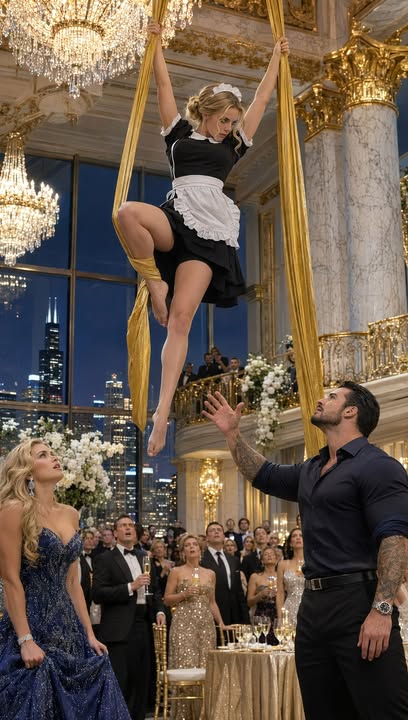
Part 4 – The Name She Never Learned
“For the performer whose name I never learned.”
Emily repeated the words silently as Marisol read them aloud again.
The sentence seemed to reach backward through the years, crossing the distance between a hospital room and the quiet arts center where Emily now stood.
“Is there more?” she asked.
“Vanessa says the note continues on the next page,” Marisol replied. “She doesn’t want to read it over the phone.”
Emily looked toward the arts center’s front windows.
Evening had settled over the street, and the glass reflected the room back at her: the dance floor, the bright paper stars, her own still face.
“Tell her I’m coming.”
She ended the call and stood for a moment with the receiver in her hand.
Then she called Clara.
“I need you at the center,” Emily said when Clara answered. “Bring the inspection log.”
Clara did not ask why.
“I’ll be there as soon as I can.”
Emily found Vincent near the estate’s front hall, speaking with one of the household staff.
She waited until he had finished.
“Vanessa has a page from the trust file,” she told him. “It has my name on it.”
His expression changed, but he did not step closer.
“Do you want me to come with you?”
The question held no assumption, only an offer.
“Yes,” Emily said after a moment. “But I want you to listen, not take over.”
“I can do that.”
“And no calls on the way.”
“I won’t.”
They drove to the arts center in silence, the city slipping past in bands of light and shadow.
Emily watched the reflections move across the window and tried to prepare herself for a page she had not yet seen.
She had spent years believing the most important thing about her accident was what it had taken from her.
Now she wondered what someone else had known, and why they had kept it hidden.
Vanessa stood in the reception area when they arrived.
She wore no jewelry except a small pair of pearl earrings, and the leather handbag from her earlier visit was clasped in both hands.
A folder rested on the desk beside her.
“I’m glad you came,” she said.
“I came to see the document,” Emily replied. “Not to reassure you.”
“I understand.”
Vanessa opened the folder and removed two pages.
The first was a photocopy of the attorney’s letter Emily had already seen.
The second was a handwritten note on pale, lined paper, the edges softened with age.
Emily recognized no name at the top.
There was no signature at the bottom.
She read the first line again.
“For the performer whose name I never learned.”
The words blurred, and she blinked until they came clear.
The note continued:
“I read about the accident involving your troupe and was told that one of the young performers would need surgery.
“I have arranged for the hospital to receive funds for her care without placing her family under further strain.
“If she recovers, I hope she will have the freedom to choose what comes next, whether that means returning to the air or leaving it behind.
“Please do not make this gift a debt.
“She owes nothing to me.”
Emily’s hand trembled around the page.
She read the note once more, slower this time.
The writer had known about the hospital.
She had known there was a young performer.
She had chosen to help without knowing Emily’s name.
“Who wrote this?” Emily asked.
Vanessa sat down in one of the waiting chairs.
“The attorney says the note was kept with the trust papers. He showed it to my father after I asked about the original purpose of the money.”
“Did he tell you the name?”
“No. He said the person who created the trust is dead, and the records contain private arrangements that he can’t disclose without authorization.”
“Then why do you have it?”
“My father asked him to prepare a summary for the family. The note was included in the copy by mistake.”
“By mistake?”
“That’s what the attorney told us.”
Emily looked down at the handwriting.
It was neat and steady, each letter shaped with care.
The writer had not known her name.
She had not asked for gratitude.
She had simply wanted Emily to have a choice.
Vincent stood at Emily’s side, still and silent.
She glanced up at him.
“Do you recognize the handwriting?”
He had been looking at the page.
When he met her eyes, his face had gone pale beneath its composure.
“I think I do.”
“Whose is it?”
“My mother’s.”
The room seemed to hold its breath.
Vincent looked at the note again, as if the answer might change when spoken aloud.
“I’ve seen her handwriting in her letters,” he said. “The way she crossed her t’s, the slant of the words. It’s hers.”
Emily’s fingers closed around the paper.
“Your mother arranged my surgery?”
“I don’t know if this is the whole record, but it says she arranged the funds.”
“You didn’t know?”
“No.”
“Not even that she helped someone from the circus?”
“She supported medical and arts charities. I knew that much. She never told me the details.”
His gaze lowered.
“She believed help should be offered without making the person who received it feel watched.”
Emily looked back at the note.
The words were brief, but she could feel a person inside them: someone who had thought carefully about what it meant to be injured, frightened, and indebted.
Someone who had understood that survival was not a promise to return to the life one had lost.
“What was her name?” Emily asked, though she already knew.
“Lucia Moretti.”
The name settled over the room, joining the note and the past and the man standing beside her.
Emily had known Vincent’s mother was dead, but only as a fact mentioned in passing.
She had never imagined the woman might have reached into the most painful chapter of her life and changed its outcome.
Vincent did not try to touch her.
He seemed to understand that the discovery belonged first to Emily, even if it had altered him too.
Clara arrived a few minutes later, carrying the clear sleeve with the inspection log.
She looked from Emily to Vincent, then at the pages on the desk.
“What happened?”
Emily placed the handwritten note beside the trust letter.
“This is from Vincent’s mother.”
Clara’s brows drew together.
“Lucia Moretti?”
He nodded.
“She helped pay for my surgery.”
Clara’s eyes moved across the note.
“Did you know her?”
“No.”
“Did you ever meet her?”
“No.”
“Then she knew about the accident from the newspaper?”
“Maybe,” Emily said. “Or someone told her.”
Clara set the inspection log on the desk.
“If she helped after the accident, perhaps she saw the reports about the rigging.”
“That’s possible,” Vincent said.
Emily looked at him.
“Are you going to investigate?”
“I won’t do anything unless you ask me to.”
“I asked you to listen.”
“And I am.”
Clara carefully opened the sleeve.
The three of them stood around the table, studying the faded inspection record and Lucia’s note as if the two documents might complete each other.
The line about the main suspension cable had been written weeks before the accident.
The note about the surgery had been written after.
A long silence stretched between the pages.
“She may have found out the company ignored the warning,” Clara said.
“Or she may simply have read that I was hurt,” Emily replied.
“Either way, the note says nothing about the equipment.”
“Not this page,” Vincent said.
He was looking closely at the photocopy’s bottom edge.
“There’s writing here.”
Emily leaned in.
A faint gray line had been almost lost in the fold of the paper.
Vanessa shifted closer.
“Can you make it out?”
Vincent tilted the page toward the light.
“Not all of it.”
Marisol brought a small lamp from her office, and they positioned it so the light fell across the paper at an angle.
The faint writing sharpened.
It was another line, partly hidden beneath the crease.
“After the inquiry,” Vincent read slowly, “the remaining funds are to support injured performers and young people seeking training in safe movement arts.”
Emily straightened.
“So the trust wasn’t meant for me alone.”
“It appears to have been meant for more people,” Clara said.
“It was never a prize,” Vincent replied.
The words carried a quiet grief.
Emily could hear him understanding the same thing she was: the money had been turned into a spectacle in the ballroom, but its beginning had been a private act of care.
Vanessa sat very still.
“My family treated it like an asset,” she said. “They never told me the reason it existed.”
“Why was it in your name?” Emily asked.
“I don’t know. The attorney said my grandmother managed the trust for a time, but it wasn’t hers to spend.”
“Did your grandmother know Vincent’s mother?”
“I believe they were acquainted through a hospital foundation. That’s all I know.”
The explanation did not answer every question, but it made the arrangement feel less like a secret wager and more like a purpose that had gradually been buried beneath family paperwork.
Vanessa had offered the money because she believed it belonged to her.
Her father had refused to pay because he considered the wager a foolish public promise.
Neither had understood the trust’s original purpose.
“Could the money still be used for what the note says?” Emily asked.
Vanessa looked at the letter.
“The attorney said the trust documents would have to be reviewed. There may be conditions.”
“Can he tell me?”
“He can tell you,” Vanessa said. “You’re named in the file, and the trust concerns the accident. He said he would speak directly with you if you asked.”
Emily turned to Vincent.
“You knew your mother supported charities.”
“Yes.”
“But you didn’t know she supported me.”
“No.”
“Did you ever hear her talk about the circus?”
“Not specifically. She once said that talent was wasted when people treated safety as an expense. I thought she was speaking generally.”
Clara glanced at the inspection log.
“Maybe she wasn’t.”
Vincent’s jaw tightened, not with anger but with the effort of holding several memories in a new arrangement.
“My mother knew that a troupe had ignored a safety warning,” he said. “She helped you recover, and she tried to make sure the money could help others too.”
“We don’t know that she knew about the warning,” Emily said.
“No. We don’t.”
His quick agreement mattered.
He did not reach beyond what they had evidence for, even though the larger story was beginning to form.
Clara tapped the edge of the inspection sleeve.
“If the company records still exist, this might explain why there was an inquiry.”
“Was there one?” Emily asked.
“I don’t know. The troupe closed not long after I left.”
“Could you find out?”
“I can try through the old performers’ association. But only if you want me to.”
Emily looked down at the note again.
The writer had asked that the gift not become a debt.
That sentence mattered more than the amount in the bank draft.
It meant Lucia had not wanted Emily to feel she owed a stranger a performance, a thank-you, or even a life shaped around the injury.
“I want to know what happened,” Emily said. “But I don’t want anyone trying to make the story simpler than it is.”
“I can help look for records,” Clara said. “I won’t speak to anyone in your name.”
“Good.”
Vincent kept his hands at his sides.
“I can give you the attorney’s contact information,” he said. “You can decide whether to speak with him.”
“I want to speak with him.”
“I’ll write down the number.”
“Don’t call ahead.”
“I won’t.”
Vanessa closed the folder.
“I can ask my father to authorize the release of the complete trust documents.”
“Will he?”
“I don’t know.”
“Can you ask without promising anything?”
“Yes.”
“Then do that.”
Vanessa nodded.
“I will.”
The conversation ended without a tidy conclusion.
They left the arts center with the trust letter, the handwritten note, and a copy of the inspection log, each of them carrying a different piece of the same uncertain history.
Outside, the evening air was cold enough to sharpen Emily’s breathing.
Vincent walked beside her toward the car, leaving a small distance between them.
“My mother would have wanted you to know,” he said.
“Maybe.”
“She didn’t like being thanked for help.”
“I don’t know whether that makes it easier or harder.”
“I understand.”
Emily stopped beneath the streetlamp.
“No, you don’t.”
He accepted the correction.
“You’re right. I don’t.”
“I’m grateful she helped me,” Emily said. “I’m also angry that I never knew. And I’m confused that the money was tied to Vanessa’s wager.”
“You have a right to feel all of that.”
“People keep telling me what I have a right to feel.”
“I’m not trying to tell you what to feel.”
“Then don’t.”
“I won’t.”
She looked at him for a long moment.
“I don’t want your mother’s kindness to become another reason I owe you something.”
“It won’t.”
“How can you promise that?”
“I can’t promise what you’ll feel. I can promise that I won’t ask you to repay it.”
Emily’s throat tightened.
The answer was imperfect, and perhaps that was why she believed it.
She wanted to say that Lucia’s kindness had reached her before Vincent ever had.
She wanted to say that this made the space between them feel more tender and more complicated.
Instead, she nodded once.
“Thank you for coming to listen.”
“Thank you for asking me.”
At the estate, Emily placed the handwritten note in the drawer with the attorney’s letter.
She sat at the edge of her bed, both pages in her hands, and read Lucia’s words until they no longer seemed like a document from someone else’s life.
She had once believed her survival depended on her own stubbornness alone.
Now she knew that, at a moment when she could not pay for the care she needed, someone had stepped in quietly.
A stranger had given her the chance to choose what came next.
The next morning, Emily called the attorney.
He agreed to meet with her the following afternoon at his office.
Vincent offered to arrange a car.
She declined.
He offered to give her directions.
She accepted.
When she arrived at the office, the attorney welcomed her with professional warmth and confirmed that the trust had been established by Lucia Moretti.
“Your mother paid for my surgery,” Emily said.
“She arranged a grant for your emergency care through the hospital,” he replied. “The hospital received the funds without being asked to reveal your name.”
“Why?”
“She believed that medical help should not be used to create personal obligations.”
Emily thought of the note.
“Did she ever try to contact me?”
“No.”
“Why not?”
“She didn’t know your name, and she did not want to intrude on your recovery.”
The attorney opened a folder and showed her a copy of the original trust agreement.
Lucia had created it with a charitable purpose: to assist injured performers and to support safe movement education for children.
The trust was later placed under the Whitmore family’s administration because Vanessa’s grandmother had managed several charitable funds for Lucia.
The ten-million-dollar amount had grown over the years through investments.
“So the wager had nothing to do with the trust,” Emily said.
“Not originally.”
“Can Vanessa claim it?”
“She cannot claim it personally. The trust was never hers to spend.”
“And the public confirmation?”
“That condition was added later, when the family used the amount as a guarantee for Vanessa’s offer. It does not override the trust’s original terms.”
The attorney turned another page.
“However, the trust is now in a complicated position. The original administrators are deceased, and the family’s records are incomplete. Before it can be released, the beneficiaries and the intended purpose must be confirmed.”
Emily looked at the paper.
“Who decides that?”
“The trustees, guided by the original agreement and the available records.”
“And am I a beneficiary?”
“You are named as the performer whose surgery was funded, but the trust was not intended solely for you.”
The answer was both reassuring and unsettling.
Emily had not been turned into the owner of a fortune.
She had been remembered as part of a purpose.
“Did Lucia know about the unsafe rigging?” Emily asked.
The attorney paused.
“She was involved in a review of the circus accident.”
“What review?”
“After your injury, several people raised concerns about the company’s equipment. Mrs. Moretti helped fund an independent safety inquiry.”
“Did they find the rigging had been neglected?”
“I’m not authorized to interpret the old findings without locating the complete report.”
“Do you know where it is?”
“I know there was a copy in Mrs. Moretti’s private papers. Some of those papers were transferred to the family archive after her death.”
“Where is the archive?”
“In the Moretti residence.”
Emily’s hands went cold.
The attorney continued, unaware that the name of the place had altered the room.
“Mr. Moretti may be able to help locate it, if he chooses.”
Emily stood.
“I’ll ask him myself.”
The attorney closed the folder.
“Before you go, there is one more thing you should understand. The trust can be released in two ways. One is to follow its original charitable purpose. The other is to honor the later wager as a personal award, if you choose to publicly accept it and the trustees approve.”
“Can I decide later?”
“You can.”
“And if I choose the charitable purpose?”
“The trustees would need a plan that fits the agreement. The money could support injured performers and safe movement education, but the details would need to be approved.”
Emily thought of the arts center, the children, the old rigging log, and Clara’s carefully preserved record.
“What happens if the trustees don’t approve?”
“Then the funds remain in trust until an acceptable plan is presented.”
She left the attorney’s office with more answers than she had expected and still not enough certainty to feel settled.
Vincent was waiting outside, not because he had sent a car, but because he had asked if she would tell him when the meeting ended.
He did not ask what the attorney had said until they were walking toward the street.
“My mother funded my surgery,” Emily told him. “She also helped pay for an inquiry into the accident.”
He looked at her, his expression quiet.
“Did they determine the rigging was unsafe?”
“The attorney says there may be a report in your family archive.”
“Our archive?”
“Your mother’s private papers were moved there after she died.”
Vincent looked down the block, his thoughts turning inward.
“I can help you search for it.”
“Only if I ask.”
“Yes.”
She was quiet for several steps.
“Will you help me search?”
“Of course.”
“I want to see the records myself.”
“You will.”
“And if you find anything, you don’t decide what it means before I read it.”
“I won’t.”
The archive occupied a study on the second floor of the estate, a room Emily had passed many times without knowing what it held.
The door had been kept locked since Lucia’s death.
Vincent opened it with a key from his desk, then stepped aside so Emily could enter first.
The room smelled of paper, cedar, and the faintest trace of lavender.
Shelves lined two walls, filled with labeled boxes and old journals.
A writing desk stood beneath the window, its surface clear except for a brass lamp and a framed photograph of Lucia Moretti.
She looked younger in the photograph than Emily had imagined, her dark hair pinned loosely and her smile unguarded.
The eyes were Vincent’s.
Emily felt a quiet ache she could not name.
For more than an hour, they searched through folders relating to medical charities, theater programs, and hospital grants.
Vincent worked carefully, reading each label before opening a box.
He did not make calls or direct staff to assist them.
He simply stayed with the work.
At the bottom of a drawer, Emily found an envelope marked MARLOWE—SAFETY REVIEW.
Her hands paused above it.
“Is this it?” Vincent asked.
“I don’t know.”
The envelope contained several pages of typed notes, a few photographs of the circus rigging, and a report with signatures at the bottom.
Emily read the first page, then the second.
The inquiry had found that the troupe’s maintenance records were incomplete.
A cable had been flagged for replacement and remained in use after the warning.
The report did not identify the person who deferred the replacement, but it stated that the equipment failure had been foreseeable.
Emily sat down.
The room seemed to tilt, not from shock, but from the weight of the years gathering around a truth she had never been allowed to see.
“Someone knew,” she whispered.
Vincent stood behind her, close enough to hear and far enough not to crowd her.
“The report says the company knew the cable needed replacement,” he said. “It doesn’t say they knew you would fall.”
“But they knew it wasn’t safe.”
“Yes.”
Emily pressed her palms against the paper.
For years, she had blamed her body for failing to return to the air.
She had wondered whether she had been careless, whether she should have checked the rigging more thoroughly, whether she had somehow missed a warning that might have saved her.
The report did not repair her shoulder.
It did not return the years she had spent rebuilding a life around work she never intended to do.
But it gave the fall a different shape.
“You don’t have to read the rest tonight,” Vincent said.
“I do.”
He did not argue.
The final page contained a handwritten note in Lucia’s unmistakable script.
Emily read it aloud.
“I cannot undo what happened to this young woman, or return the years she has lost.
“I can only make certain the truth is kept, and that the help given to her does not become another chain.”
The words struck Emily more deeply than the report.
She looked at the photograph of Lucia on the desk.
A stranger had believed that truth mattered, even if it arrived too late to change the outcome.
A stranger had tried to help without claiming the right to decide what came next.
Vincent’s face was drawn.
“She kept this for years,” he said.
“Why didn’t you know?”
“She didn’t tell me. Perhaps she thought I didn’t need to know. Perhaps she wanted it kept separate from the family.”
“Or perhaps she planned to tell you.”
He looked at the note.
“Maybe.”
Emily returned the report to its envelope, though she kept a copy of the final page beside her.
She had not expected the truth to make her feel grateful and furious at the same time.
She had not expected to feel tenderness for a woman she had never met.
Most of all, she had not expected the past to hand her a choice.
The trust could erase her debts and give her security, but it could also support the work Lucia had intended: safe training for children and aid for performers whose lives had been altered by injury.
The arts center needed funding.
So did people who had nowhere to go after an accident.
Emily could not choose that night.
At the door, Vincent waited while she gathered the papers.
“I’m sorry my mother’s kindness arrived with so many unanswered questions,” he said.
“It wasn’t her kindness that hurt me.”
“No.”
“It was everything that happened around it.”
“I know.”
She held the copy of Lucia’s note close to her chest.
“I need time.”
“Take all of it.”
The following morning, Emily returned to the arts center.
The children were practicing balance on a painted line along the floor, their arms out like wings.
Ana looked up as Emily entered.
“Are we going to do the floating arms today?”
“Yes,” Emily said. “We are.”
She joined them, lifting her arms slowly, listening to her shoulder, and letting the movement be enough.
After class, Marisol gave her a message from Vanessa.
The attorney had agreed to release the complete trust records, but the trustees needed Emily to state whether she intended to claim the wager personally or submit a plan for the original charitable purpose.
The decision would have to be made soon.
The arts center was facing a rent increase, and Marisol had been quietly preparing for the possibility that they would lose the movement room.
A program for safe training and rehabilitation could help the center survive.
It could also help performers who had no one to pay their hospital bills.
But ten million dollars placed in Emily’s hands would give her the freedom to rebuild her own future first.
That night, she laid Lucia’s note beside the bank draft and stared at both.
The amount had been promised to her in public.
The purpose had been offered to her in private.
She did not know which of those promises she was meant to honor.
A message arrived from the attorney just before midnight.
The subject line read: “Additional record located in Lucia Moretti’s archive.”
Emily opened the attachment.
It was a photocopy of a letter dated two weeks before the accident.
The first line was addressed to the circus’s manager.
“Unless the suspended cable is replaced before the next rehearsal, I will withdraw my support and notify the independent inspectors.”
Below it, Lucia had written a second sentence in the margin.
“The performer most at risk is the young woman scheduled to work the right-side silk.”
Emily read the sentence again.
Then she read it a third time.
Lucia had known the warning applied to her.
She had tried to stop the rehearsal.
And someone at the circus had gone ahead anyway.
**–END OF PART 4–CLICK “NEXT” AT THE BOTTOM OF THE PAGE TO CONTINUE READING**
* * *
[PREVIOUS: PART 3](https://storyly.idolsgift.com/blog/part-3-what-the-velvet-box-held-053) | [NEXT: PART 5](https://storyly.idolsgift.com/blog/part-5-what-the-velvet-box-held-053)
✓ Lynn R. Adams
Part 4 – The Name She Never Learned “For the performer whose name I never learned.” Emily repeated the words silently as Marisol read them aloud again. The sentence seemed to reach backward through…