Part 4 – The Winter at Broken Spur-039
### Part 4 – What Forty Acres Were Worth
We rode into Oak Haven two days later.
The deed traveled inside Beatrice’s coat.
Neither of us spoke much during the twelve-mile journey.
The silence wasn’t angry.
That almost made it harder.
Before discovering the document, we had been two people learning how to share a table, a cabin, and an uncertain winter.
Now forty acres stood invisibly between us.
When Oak Haven appeared beyond the snowy rise, Beatrice finally said, “If the land is mine, I didn’t know.”
“I know.”
“You believe me?”
“Yes.”
She studied me.
“That was fast.”
“I’ve watched you save bacon grease in a teacup because you refuse to waste anything. If you knew you owned the best forty acres on my ranch, I doubt you’d have waited two weeks to mention it.”
A smile touched her mouth.
“That is not especially romantic.”
“I haven’t had much practice.”
“I noticed.”
The county clerk, Walter Pence, occupied a narrow office between the bank and a harness maker.
He was seventy if he was a day, with spectacles so thick they magnified his eyes.
He read the paper.
Then disappeared among shelves.
We waited.
And waited.
Beatrice folded her gloves.
Unfolded them.
Folded them again.
Finally, Pence returned carrying a book that looked heavy enough to anchor a boat.
He set it down.
“Here.”
My chest tightened.
There was Samuel Hayes.
There was Margaret Miller.
Forty acres.
Recorded.
Legally transferred.
“Is there another filing?” I asked.
“A transfer back?”
“Anything.”
Pence searched.
There wasn’t.
“If Margaret Miller died,” Beatrice said carefully, “what happened to the land?”
“Depends on her estate.”
“She had no estate worth mentioning.”
“She had this.”
Pence looked at her.
“Any other children?”
“No.”
“Husband living?”
“My father died before she did.”
He nodded.
“Then you’ll want an attorney to settle it formally, but from what I’m looking at, Mrs. Hayes, you’ve got a respectable claim.”
Mrs. Hayes.
Beatrice glanced at me.
The strange part was that hearing my surname attached to her affected me more than hearing that she might own part of my ranch.
Outside, snow drifted along Main Street.
We stood beneath the mercantile awning.
“You should claim it,” I said.
She looked at me sharply.
“Caleb.”
“It’s yours.”
“We don’t know that yet.”
“Pence knows.”
“Pence also thinks spectacles should be half an inch thick.”
“I’m serious.”
“So am I.”
“If the land belongs to you, then you shouldn’t surrender it because you married me.”
A long pause followed.
“What do you think I came here to do?” she asked.
I frowned.
“Marry me.”
“Exactly.”
“That doesn’t change ownership.”
“It changes how I think about it.”
“No.”
The firmness in my voice surprised us both.
“Beatrice, if those forty acres are yours, they stay yours until you decide otherwise.”
She stared down the street.
“Even if losing them ruins Broken Spur?”
My answer came slower.
“Even then.”
That frightened me.
But it was true.
She looked back at me.
Something warm and sorrowful passed through her expression.
“You’re different from the man who met me at the depot.”
“I hope so.”
“So do I.”
Our next stop was the cattle buyer.
Selling fifteen head hurt exactly as much as I had expected.
Perhaps more.
I knew every animal.
The white-faced heifer with the bent ear.
The steer my father had once called the finest calf on the place.
The old cow that had raised twins during the wet spring of ’78.
Beatrice stood beside the holding pen while the buyer made his offer.
I almost refused.
She didn’t speak.
She didn’t tell me what to do.
She simply waited.
That made my decision mine.
“Take them,” I said.
The money felt heavy in my pocket afterward.
Not triumphant.
Heavy.
But we used it well.
Hay.
Beans.
Dried apples.
Rice.
Cornmeal.
Lamp oil.
Coffee.
A small sack of sugar Beatrice tried to put back until I quietly returned it to the counter.
“You don’t need sugar,” she said.
“Neither do I.”
“Then why?”
“Because I would like one thing in that pantry that isn’t there because we’re afraid of starving.”
She stared at me.
Then she placed the sugar carefully into the wagon.
“Thank you.”
Before leaving town, Beatrice stopped at the boardinghouse.
The owner, Mrs. Bell, had recently lost her cook to marriage and nearly dragged Beatrice into the kitchen the moment she learned about her experience.
I waited by the wagon.
Twenty minutes later, Beatrice emerged carrying a paper sack.
“What’s that?”
“Two loaves of bread.”
“Why?”
“Mrs. Bell paid me.”
“For what?”
“Fixing her biscuits.”
“You fixed biscuits?”
“She was committing crimes against baking powder.”
I laughed.
Beatrice climbed into the wagon.
Then she held up a small slip of paper.
“She wants twelve loaves next Saturday.”
I stared.
“From you?”
“Unless you have secretly become a baker.”
“How would we get them here?”
“We come to town once a week anyway.”
“We do not.”
“We should.”
“For bread?”
“For anything people will pay for.”
I was about to object.
Then I remembered the ledger.
Eleven onions.
Fifteen cattle.
Small things gathered.
“How much?”
“For twelve loaves? Three dollars profit if flour prices don’t change.”
Three dollars.
Not fortune.
But lamp oil.
Salt.
Coffee.
Wire.
“Do it,” I said.
She smiled.
That smile made me feel as though I’d just offered her the whole town.
The following weeks changed the rhythm of Broken Spur.
I still worked outside.
Beatrice still managed the house.
But those descriptions no longer seemed large enough.
We discussed everything.
Hay.
Money.
Weather.
Which cow should be bred.
How much flour could become bread for town without risking our own supply.
She began baking every Friday.
The cabin filled with warmth and yeast.
I built her another worktable.
Then shelves.
Then a cooling rack.
At first she sold twelve loaves.
Then eighteen.
Mrs. Bell bought biscuits.
The mercantile took four pies one week after someone tasted Beatrice’s dried-apple filling.
We didn’t become prosperous.
We became less desperate.
There was a difference.
And desperation, I discovered, had been poisoning Broken Spur long before Beatrice arrived.
It had made every problem look permanent.
It had made me ashamed to ask neighbors for help.
It had made me regard marriage as another calculation.
One Friday evening I returned from the barn to find Beatrice sitting silently beside the stove.
A burned loaf sat on the table.
I stopped.
“I didn’t know you could burn bread.”
“Apparently I remain human.”
“That’s disappointing.”
She didn’t smile.
I sat across from her.
“What happened?”
She turned the loaf.
One side was black.
“I was thinking.”
“About the land?”
A nod.
The legal notice had arrived that morning.
Her claim was valid pending routine probate.
The lower meadow belonged to her.
Beatrice Miller Hayes.
Not me.
Not Broken Spur.
Her.
“You can do whatever you want with it,” I said.
“I know.”
“You could sell it.”
“I know.”
“There’s a neighbor who would probably pay.”
“I know.”
She looked irritated.
I leaned back.
“I seem to be helping.”
“Immensely.”
Silence.
Then she said, “Do you regret marrying me?”
The question took me by surprise.
“No.”
“You hesitated.”
“I was surprised.”
“That isn’t the same answer.”
I studied her.
“At the depot, I regretted spending fifty dollars.”
Her face tightened.
I continued before fear could stop me.
“I regretted it because I was frightened. I looked at you and saw another mouth to feed.”
Beatrice’s gaze dropped.
“I’m not proud of that.”
“No.”
“But that was my failure. Not yours.”
She said nothing.
“Now,” I continued, “when I ride out in the morning, I think about coming home.”
Her eyes lifted.
“I haven’t done that in years.”
The burned loaf sat between us.
“I don’t regret marrying you, Beatrice.”
Her expression softened.
“Even if I take forty acres away?”
“If you decide to.”
“That isn’t an answer.”
“It’s the only honest one.”
For several seconds, neither of us moved.
Then Beatrice laughed quietly.
“What?”
“I have spent my entire life being told what a sensible woman should do.”
“And?”
“Apparently I traveled nine hundred miles to marry the first man stubborn enough to insist I make my own mistakes.”
I smiled.
She stood.
“So I have decided.”
My heart accelerated.
“About the land?”
“Yes.”
“And?”
“I will not give it to you.”
Something inside me dropped.
Then she continued.
“I will lease the water rights and grazing rights to Broken Spur Ranch.”
I blinked.
“For how much?”
“One dollar.”
“One dollar?”
“Per year.”
“That’s ridiculous.”
“I consider myself a ruthless businesswoman.”
I laughed.
Then she became serious.
“The land remains mine.”
“It should.”
“But what we build on it can be ours.”
Our.
One small word.
More powerful than any deed.
I stood.
Beatrice looked up at me.
I touched her cheek.
This time neither of us pretended it was about dirt.
“May I kiss you?” I asked.
Her eyes widened slightly.
“We’re married.”
“That’s not what I asked.”
For a moment she simply looked at me.
Then she whispered, “Yes.”
The kiss was brief.
Gentle.
Awkward.
Perfect.
When we separated, Beatrice smiled.
“You’re still not very practiced.”
“I intend to improve.”
“That sounds threatening.”
“I’m a determined man.”
“So I’ve gathered.”
December arrived.
Then Christmas.
The ranch did not suddenly become easy.
There were frozen troughs.
Broken harness straps.
Two nights when snow piled against the barn door high enough that I had to dig my way inside.
But the reduced herd had enough hay.
The spring kept running beneath the hill.
Our pantry remained modest but orderly.
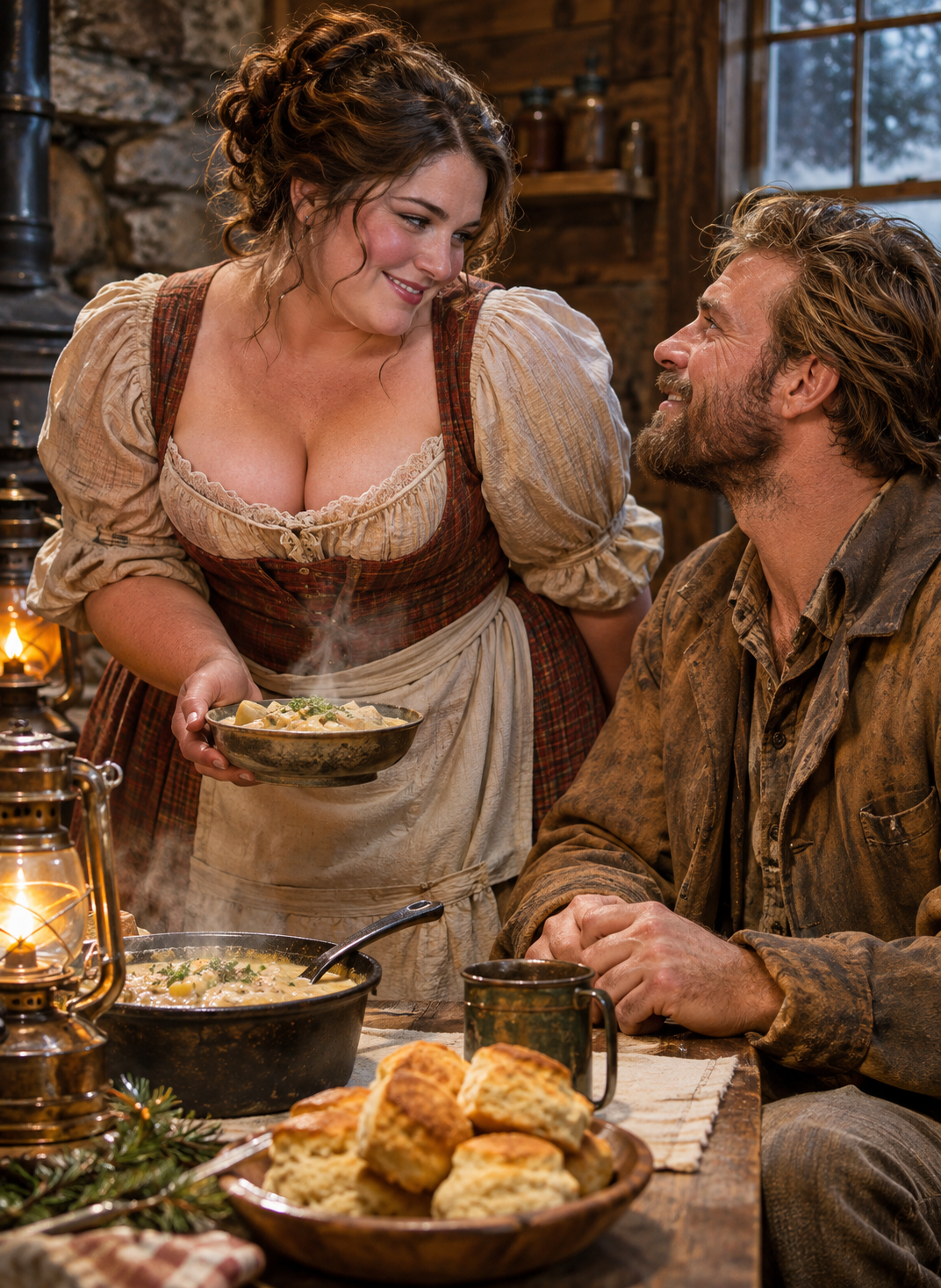
At Christmas supper, Beatrice served chicken, potatoes, biscuits, preserved apples, and a small cake made with precious sugar.
I raised my coffee cup.
“To eleven onions.”
She laughed.
“To fifteen fewer cattle.”
“That sounds terrible.”
“It saved the others.”
“Then to difficult decisions.”
She considered that.
“To difficult decisions.”
We drank.
Later, while I banked the stove, I found Beatrice studying the old photograph of her mother.
“Do you miss her?”
“Every day.”
“Did she ever speak about my father?”
“A little.”
I turned.
“What did she say?”
Beatrice hesitated.
It was the same hesitation I had noticed the morning she first saw the lower meadow.
“Beatrice.”
She folded the photograph into her hand.
“There is something else I haven’t told you.”
My stomach tightened.
“What?”
She looked toward the bedroom where her trunk stood.
“When I answered your marriage , Caleb, I didn’t choose it by accident.”
I stared at her.
“What do you mean?”
“I had seen dozens.”
“And?”
“I ignored them.”
“Why mine?”
Her eyes moved toward the photograph.
“Because it said Broken Spur Ranch.”
The room became very still.
“You knew exactly where you were coming.”
“Yes.”
“Before we exchanged a single letter?”
“Yes.”
“Why?”
Beatrice held the photograph against her chest.
“Because my mother made me promise something before she died.”
And suddenly, forty acres of land was no longer the largest secret she’d brought to Wyoming.
**–END OF PART 4–CLICK “NEXT” AT THE BOTTOM OF THE PAGE TO CONTINUE READING**
✓ Lynn R. Adams
### Part 4 – What Forty Acres Were Worth We rode into Oak Haven two days later. The deed traveled inside Beatrice’s coat. Neither of us spoke much during the twelve-mile journey. The silence wasn’…