PART 4: The Voice in the Crystal 052
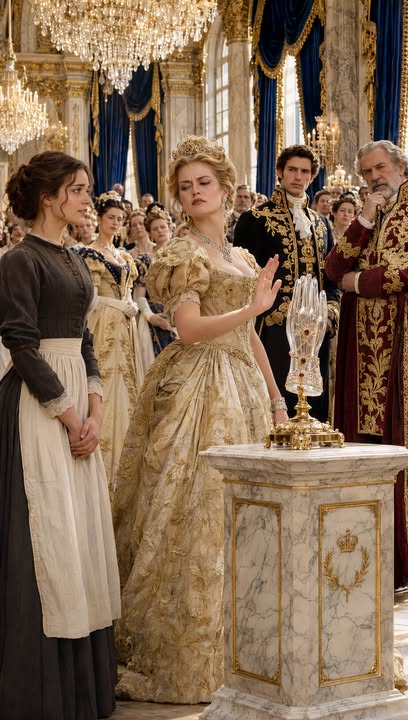
Part 4 – The Queen Who Was Erased
“Princess Anne Eleanor.”
Emily read the name again, but it did not become more familiar.
The letters seemed too grand to belong beside the small, worn pendant beneath her collar, or the memory of a mother who had sung lullabies in a modest home far from the palace.
Alexander leaned over the open volume.
“Are you certain that is the same Anne?”
Mr. Finch adjusted his spectacles.
“The transfer entry refers to Anne Bell, then gives this name in the margin. The handwriting is different, and the record is incomplete, but the two entries were filed together.”
Emily’s fingers closed around the pendant.
“My mother never told me she had been called that.”
King Edward had left only moments before, but the weight of his warning remained in the room.
Do not help her find what I have spent years trying to keep buried.
Alexander looked from the record to Emily.
“We should not draw conclusions from one line.”
“I know.”
Yet the king’s silence had already drawn one for her.
Mr. Finch turned another page, searching the adjoining records.
“The reference may lead us to the original transfer order,” he said. “It should be in the sealed family archive, though access is restricted.”
“Can you request it?” Alexander asked.
“I can request it,” Mr. Finch replied. “Whether the king permits it is another matter.”
Emily looked at the name again.
Princess Anne Eleanor.
If it belonged to her mother, then Anne had lived at court under a name that concealed something more than a simple change of household.
If it did not, the king had still recognized the record, and his fear had been unmistakable.
“I need to know what it means,” Emily said.
Alexander did not reach for the book or tell her what she ought to do.
Instead, he asked, “Would you like me to speak to my father?”
“He has already asked us to stop.”
“That doesn’t mean I must agree.”
“No,” Emily said. “But if he thinks the truth will endanger the kingdom, I want to understand why before we force a door open.”
Alexander’s expression softened.
“Then we will ask him again, carefully.”
Mr. Finch closed the ledger.
“There may be another way,” he said. “The former queen kept a private correspondence room. Some of her papers were catalogued separately after her death.”
“Can those records be searched?” Emily asked.
“Not without royal permission.”
The archivist paused, considering.
“But I have heard that one sealed cabinet was transferred to the old chapel when the west wing was renovated. The catalogue may have been overlooked.”
Alexander glanced at Emily.
“The chapel is no longer used for royal ceremonies.”
“Some of its archives are still kept there,” Mr. Finch said. “I cannot promise what we will find.”
“Nor should we,” Emily replied. “We have to be certain we are not turning a suspicion into a story.”
Mr. Finch bowed his head, visibly relieved by her caution.
“I will examine the catalogue first.”
When he had gone, Alexander remained beside the table.
The late-afternoon light fell over the open record, making the old ink appear almost black.
“Do you think my mother was a princess?” Emily asked.
“I don’t know.”
“Do you think my father knew?”
Alexander took a breath before answering.
“I think he knew something about her.”
“That is not quite the same.”
“No,” he said. “It isn’t.”
Emily looked toward the closed door.
The king had not denied that he knew of an attendant named Anne.
He had not said the name in the margin was a mistake.
What he had offered instead was a warning, and warnings often concealed as much as they protected.
“Your father seemed afraid,” she said.
“He did.”
“Not afraid of me.”
“No. I don’t think so.”
“Then what?”
Alexander considered the question.
“Perhaps he fears what the truth could do to people who have lived with the consequences of a lie.”
Emily was quiet for a moment.
She had spent years thinking of her mother’s silences as the ordinary silences of grief and poverty, the things adults kept from children because they believed them too difficult to explain.
Now she wondered whether Anne had been silent because the truth was dangerous, or because she had hoped Emily would never have to carry it.
“I don’t want to take anything from you,” she said.
Alexander’s brow creased.
“What do you mean?”
“If my mother truly belonged to the royal family, people may decide I have a claim here.”
“You would have no claim that I would expect you to accept.”
“That may not be enough to stop others from deciding what I should want.”
“No,” he admitted. “It may not.”
The honesty between them was beginning to feel like a fragile bridge, one they had to build without knowing whether it would hold.
Alexander offered his hand, palm open, and left the choice to her.
Emily looked at it before placing her fingers lightly in his.
His hand was warm, and for a moment the palace and its secrets seemed distant.
“I want the truth,” she said. “But I don’t want it to decide who I am.”
“It won’t,” he replied.
She wished she could believe that as easily as he said it.
The next morning, Mr. Finch returned with a slender catalogue and an expression of careful excitement.
“I found a reference to the former queen’s correspondence cabinet,” he said. “It was moved to the old chapel in 1801. The cabinet itself is still there, according to the inventory.”
“Has anyone opened it?” Alexander asked.
“Not in at least fifteen years, as far as the records show.”
“Then we should ask my father for permission.”
Emily nodded.
She had no desire to sneak into a locked archive while the king believed she had ignored his warning.
The request was made before noon.
King Edward received them in his private study, where a fire burned low beneath a carved mantel.
He listened without interrupting as Alexander explained the catalogue and the reference to the former queen’s papers.
When Alexander finished, the king looked at Emily.
“You understand that the records may contain private matters.”
“I do, Your Majesty.”
“And you understand that what you read may not be what you hope to find.”
“I am not hoping for a particular answer.”
King Edward’s gaze drifted to the pendant at her throat.
“Your mother gave you that?”
“Yes.”
“Did she ever tell you where it came from?”
“No.”
“Did she speak of the palace?”
“Only once, when I was very young. She said she had known a place where every promise seemed to belong to someone else.”
The king’s eyes lowered.
“Those are her exact words?”
“Yes.”
A long silence filled the study.
Alexander shifted slightly, but did not speak over his father.
At last, King Edward stood and went to a desk by the window.
He opened a drawer and removed a narrow key.
“You may examine the correspondence cabinet,” he said. “Only the cabinet. You will not take any papers from the chapel, and Mr. Finch will remain with you.”
“Thank you, Your Majesty,” Emily replied.
“Do not thank me yet.”
His voice was weary, not unkind.
“There are truths that feel like answers until you learn what they cost.”
“Then I would rather know the cost,” Emily said, “than spend my life guessing.”
The king studied her face, and something like recognition passed through his expression.
For a brief instant, Emily thought he might say more.
Instead, he placed the key in Alexander’s hand.
“Bring me anything that may affect the crown.”
Alexander accepted it.
“And if it affects Emily?”
“Then she must decide what she wishes to know.”
It was the first time King Edward had spoken as though the choice belonged to her.
That small change unsettled Emily more than an order would have.
The old chapel stood at the end of a quiet passage in the palace’s oldest wing.
Its stone walls were pale with age, and high windows let in a soft gray light that gathered beneath the beams.
The room no longer held services, but a few wooden benches remained along one wall, polished by generations of use.
At the far end stood a narrow cabinet of dark oak.
Mr. Finch unlocked it with the key.
The hinges gave a faint creak as he opened the doors.
Inside lay bundles of letters tied with ribbon, a handful of ledgers, and a small wooden box marked with the former queen’s initials.
Alexander glanced at Emily.
“Would you like to open the box yourself?”
She hesitated, then nodded.
The lid lifted easily.
Inside were several folded papers, all carefully arranged.
The topmost bore a wax seal shaped like a vine curling around a star.
Emily recognized the pattern from her pendant.
Her breath caught.
“This is the same design.”
Mr. Finch leaned in to inspect the seal.
“It appears so.”
Alexander set the box on the broad stone ledge beneath the window.
Emily unfolded the first letter.
The handwriting was elegant and familiar from the inscription in the pendant, though she had seen it only in the old note her mother had left.
The letter began, “To my beloved daughter, Anne.”
Emily’s vision blurred.
She lowered the page for a moment and pressed her lips together.
Alexander stood beside her, close enough to offer comfort, but he did not touch her without invitation.
After a breath, Emily continued reading.
“My dearest Anne, I have failed you in the one duty no crown can excuse. I allowed fear to speak where love should have spoken, and I let the council believe that silence could preserve peace.”
Emily paused.
The chapel seemed to grow very still around them.
She read on.
“You were born my child, and nothing the court decrees can make that less true. Your father was a healer, a man of uncommon patience and modest means, who came from across the ocean before you were born. I chose him freely, and I would choose him again.”
Emily’s hand trembled.
Alexander’s face had gone pale.
The letter continued.
“The lords feared that a marriage between the heir’s sister and a common-born American would unsettle the succession. They called it a threat to the kingdom, though it was only a truth they could not control. I believed I could protect you by permitting them to erase your name. I see now that I protected the throne at the cost of my own child.”
Emily lowered the page.
“My mother was the queen’s daughter.”
No one answered.
The words did not sound real when spoken aloud.
They seemed to belong to another person, someone with a portrait in the palace gallery and a place in the history books.
But the letter lay in Emily’s hands, written by a woman who had called Anne her beloved daughter.
Alexander’s voice was low.
“Then we are cousins.”
Emily looked at him.
The discovery shifted something between them, not because it changed what they had chosen to feel, but because it made the court’s old rules suddenly crowd into the room.
She turned back to the letter.
“Does it say why my mother left?”
Mr. Finch carefully lifted another sheet from the box.
“This may be a reply.”
The second letter was written in a different hand, one Emily did not recognize.
The paper was creased and worn, as though it had been folded and unfolded many times.
She read the name at the top.
Anne.
“My mother wrote this?”
“Most likely,” Mr. Finch said.
Emily began to read aloud.
“Grandmother, I cannot come back while the court believes my child must be made into a symbol. Emily is not a correction to your family’s history, nor a remedy for the choices made by those who came before her.”
Her voice faltered at her own name.
Alexander’s eyes lifted to hers.
Emily read on.
“She is my daughter, and I want her to grow without being told that she owes the palace a life because of the blood in her veins. If the truth must remain hidden for her safety, let it remain hidden until she is old enough to choose what it means.”
Emily stopped.
Her mother had known.
She had known the name, the secret, and perhaps the very possibility that Emily might one day be brought into the palace’s orbit.
The pendant was no longer just a keepsake.
It was the remnant of a choice Anne had made to protect her daughter from a history that had already taken too much from her.
Mr. Finch read the final lines in silence before speaking.
“Your mother refused to return.”
Emily folded the letter, careful not to crease it again.
“She did not want me to be used as proof that the court had been right.”
“Or as a means of repairing what the court had done,” Alexander said.
She looked at him, and saw that he understood the same danger she did.
The palace might welcome her now, but only because the truth could serve a purpose.
For the first time, the mystery felt less like a treasure waiting to be claimed and more like a burden someone had tried to lay down.
“Did she know about the glove?” Emily asked.
Mr. Finch began examining the remaining papers.
“There may be another letter.”
He found a folded sheet beneath the correspondence and opened it.
The page was in the former queen’s hand.
It described the crystal glove as a safeguard created after the scandal surrounding Anne’s marriage.
Emily read slowly.
“The glove was never intended to name a bride by blood, rank, or beauty. It was made to answer only the one who approaches without ambition, and to speak when the promise made to the crown is freely kept.”
Alexander looked at the line twice.
“So the legend was not what the court said it was.”
“It was never a test of who deserved to become queen,” Emily replied.
The queen’s letter explained that the glove had been designed to resist those who sought to use marriage as a bargain.
Its narrow opening would not yield to force, nor would wealth or noble birth alter its response.
It was meant to remind the royal family that a promise made under pressure was not a promise at all.
The voice in the crystal had not named a bride.
It had challenged the court.
Emily felt the truth settle over her, heavy and clear.
The glove had not chosen her because she belonged to the royal line.
It had answered because she had approached it without expectation, asking only for the same chance everyone else had been given.
The blood in her veins explained her mother’s name, but it did not explain the light.
That belonged to her own choice.
“Why did my father order the glove sealed away?” she asked.
King Edward’s voice came from the chapel doorway.
“Because I knew the words it would speak.”
Everyone turned.
The king stood with one hand resting against the open door.
He had followed them there, though none of them had heard his steps.
His face was tired, and the measured authority he wore before the court had fallen away.
“You knew about my mother,” Emily said.
“I knew she had been hidden under another name.”
“You knew she was the queen’s daughter?”
The king closed his eyes briefly.
“Yes.”
Alexander stepped toward him.
“Why was she erased?”
“Because I was young, and the nobles were powerful, and I believed that keeping the peace was the same as doing what was right.”
The king entered the chapel.
“My mother had married Anne’s father in secret before I was born. When the council discovered it, they threatened to withdraw their support for the succession. They claimed the kingdom could not accept a princess with a common-born father.”
“So you agreed to hide her,” Alexander said.
“I agreed to let her leave the court under another name. I told myself it would protect her from the people who wished to use her marriage as a political weapon.”
“But it also removed her from the history books,” Emily said.
King Edward lowered his gaze.
“Yes.”
“And my mother believed the same thing might happen to me.”
“I believe she did.”
Emily’s fingers tightened around the letter.
“You knew she had a daughter?”
“I learned of you years later.”
The words came carefully, as if each one had to be weighed before he allowed it into the room.
“Why didn’t you find us?”
“I wanted to.”
“But you did not.”
“No,” the king said. “I told myself that finding you would expose you to the very danger your mother had escaped. I also feared what the nobles would do if they discovered the truth.”
His admission did not erase the years of silence.
It did, however, make his fear understandable in a way his commands had not.
Emily looked at him.
“Did you know the glove would speak?”
“I knew the old promise behind it. I did not know whether the crystal still remembered.”
“Then why seal it away?”
“Because I heard the voice and understood that I had spent my life guarding the wrong thing.”
The king’s expression shifted as he looked at the letter in Emily’s hands.
“I thought I was protecting the kingdom from a scandal. In doing so, I helped preserve the injustice that created it.”
Alexander’s voice softened, but its question did not.
“Why keep the legend alive?”
“Because the court wanted the glove to choose a bride, and I let them believe it did. It was easier than explaining that the object existed to prevent a forced promise, not to authorize one.”
Emily thought of the nobles gathered beneath the chandeliers, each waiting for the glove to tell them who would stand beside Alexander.
The relic had not failed them.
The people had failed to hear what it was saying.
“Did my mother leave the pendant for me because she expected me to return here?” Emily asked.
“I cannot know what she expected.”
The king looked at the golden vine engraved on its face.
“But I believe she wanted you to have a way to learn the truth if you chose to seek it.”
Emily glanced down at the open letter.
Her mother had tried to protect her from being turned into a symbol.
Now the truth itself threatened to do exactly that.
Alexander stood beside her, but neither of them spoke of what the discovery meant for their affection.
The knowledge that they were cousins had changed the shape of the future in a way neither could yet understand.
They had not made promises to each other, but the possibility of a life together had begun to feel real.
Now it was surrounded by questions of family, duty, and the stories the palace had told about both of them.
King Edward seemed to sense the weight settling between them.
“This truth belongs to you as much as it belongs to the crown,” he said to Emily. “I will not ask you to become anything you do not choose.”
Emily looked at him.
“Will you tell the court what happened?”
“Yes.”
“Even if they are angry?”
“Especially then.”
The king’s voice was firmer now, though grief remained beneath it.
“Anne’s name will be restored to the royal history. Her marriage will be acknowledged, and the false story surrounding her departure will be corrected.”
Emily wanted to feel relief.
Instead, she wondered how long it would be before the nobles tried to make use of her name.
The king had spoken of restoring Anne’s history, but the court would see a living descendant standing before them.
Would they see a daughter, a servant, or a claim to be managed?
“Your Majesty,” Emily began, “I don’t want the truth to become a reason for anyone to decide my future.”
“It will not.”
“You cannot promise what every noble will do.”
“No,” the king said. “But I can promise what I will do.”
Emily studied his face, searching for the frightened ruler who had ordered the glove locked away.
She still saw him there, but something in him had shifted.
He no longer seemed determined to bury the past.
He seemed willing, at last, to stand in front of it.
When they left the chapel, Alexander walked with Emily through the quiet passage.
The king remained behind with Mr. Finch to gather the papers safely.
Neither Emily nor Alexander spoke for several steps.
At last he said, “I am sorry.”
She looked at him.
“For what?”
“For thinking that I could help you uncover the truth without considering what it might change for us.”
“You did not know.”
“I knew there was something between us before I knew what it was.”
Emily’s heart tightened.
“So did I.”
He stopped beneath one of the high windows.
For a moment, the gray daylight outlined his face, making him look less like the prince the court expected and more like the young man who had stood up for her in the ballroom.
“I won’t pretend the discovery means nothing,” he said. “But I will not tell you what you should feel.”
“I don’t know what I feel yet.”
“Then you do not have to decide today.”
Emily was grateful he had said it.
She had enough decisions waiting for her already.
The palace bells rang in the distance, marking the hour.
Their sound carried through the stone passage and faded into the older wing.
“I wish my mother had been able to tell me herself,” Emily whispered.
“So do I.”
“She gave me the truth, but only enough for me to find it.”
“Perhaps she wanted the choice to remain yours.”
Emily touched the pendant beneath her collar.
For the first time, she understood that its worn surface held more than a royal secret.
It held her mother’s refusal to let a crown claim her child.
That evening, King Edward summoned his chief secretary and began preparing a formal statement.
The truth would be entered into the royal record, and the former queen’s letters would be preserved rather than hidden.
Alexander remained with him for part of the meeting, asking that the court hear the facts before anyone could shape them into rumor.
Emily did not attend.
She returned to the servants’ quarters and sat at the small window of her room, looking out at the garden where the last light rested on the bare branches.
She thought of Anne’s voice, of the lullaby she had half-forgotten, and of the line the glove had spoken.
The promise must be freely kept.
For the first time, the words did not feel like a mystery.
They felt like a request.
A servant knocked and said the king wished to speak with her in the morning, before the public council.
Emily agreed.
After the servant had gone, she took the pendant from beneath her blouse and opened its hidden seam.
The small drawing of the glove was still there.
She turned the paper over, searching for another mark.
At first, she saw only the faded fibers.
Then the last light from the window touched a line at the bottom, so faint she had never noticed it before.
Her mother’s handwriting emerged in the warm glow.
“Do not let them make your name a promise you never gave.”
Emily read the sentence twice.
A quiet knock came at her door.
She folded the paper and hid it as Alexander’s voice sounded from the corridor.
“Emily? My father has received a message from the council.”
She opened the door.
Alexander’s expression was troubled.
“They know about the archive,” he said. “And they have asked that you attend tomorrow’s public council as a member of the royal family.”
Emily looked down at the words in her hand.
Before she could answer, he added, “They want the court to recognize you as a princess—and they expect you to marry me.”
**–END OF PART 4–CLICK “NEXT” AT THE BOTTOM OF THE PAGE TO CONTINUE READING**
* * *
[PREVIOUS: PART 3](https://storyly.idolsgift.com/blog/part-3-the-voice-in-the-crystal-052) | [NEXT: PART 5](https://storyly.idolsgift.com/blog/part-5-the-voice-in-the-crystal-052)
✓ Lynn R. Adams
Part 4 – The Queen Who Was Erased “Princess Anne Eleanor.” Emily read the name again, but it did not become more familiar. The letters seemed too grand to belong beside the small, worn pendant bene…