PART 4: The Village Beneath the Paper 056
Part 4 – The Promise Beneath the Map
The prince’s question remained unanswered in the chamber, caught between the torn edge of the paper and the snow-dark windows.
The protagonist held the strip carefully by its corners, afraid that a careless touch might break the line of writing that remained.
“Households removed from public roll pending settlement,” Adrian read again.
His voice was quiet, but the words had altered the room.
The noblewoman had stopped at the doorway.
She turned back, her face pale beneath the careful composure she had worn all evening.
“Martin Voss,” she said. “That is the same surveyor whose name appeared in my family’s papers.”
“Could he have written this?” the protagonist asked.
“I can’t be sure. The hand is similar to the notes on one of his maps, but I would need to compare them.”
Adrian looked toward the door through which the steward had gone.
“Mr. Vale said he knew the name had disappeared from the current records.”
“He may have known about the removal without knowing who ordered it,” the protagonist said.
“Or he may know more than he has told us.”
The prince did not sound angry.
That made his concern feel heavier.
The noblewoman stepped closer to the table, her attention fixed on the paper strip.
“If my family’s boundary was revised after the flood, this may explain why,” she said. “But it does not tell us whether the village was moved, abandoned, or simply left off the map.”
“No,” the protagonist replied. “It tells us the removal was tied to a settlement that had not yet been resolved.”
The word settlement seemed to hold several meanings at once: people finding new ground, officials disputing a line, and a promise waiting to be recorded.
Adrian gathered the papers into a careful stack.
“We need the older maps, the survey, and the queen’s full correspondence.”
“I can ask the estate office to send the Voss survey at first light,” the noblewoman said.
“Ask them to send the surrounding documents as well, not only the final map.”
She nodded.
The protagonist noticed the difference in her expression.
Earlier, the noblewoman had treated the map as proof that the land was empty.
Now she looked at it as a piece of evidence that might reveal what her family had misunderstood.
“I’ll send the request before I leave,” she said.
The prince gave her a grateful look.
“Thank you.”
She hesitated, then glanced at the torn strip.
“If my family’s records contradict what I’ve been taught, I won’t hide them.”
“I believe you,” Adrian said.
The noblewoman’s eyes moved to his.
The answer seemed to unsettle her more than suspicion would have.
She gathered her gloves and left, moving quickly but without her earlier stiffness.
The chamber grew quiet again.
The protagonist laid the strip beside the queen’s receipt and tried to imagine the hands that had written each line.
Her mother’s signature had been steady.
The note about households being removed had been written with sharper pressure, as if its author had wanted the ink to stay.
“Do you think your mother knew they had been removed from the public roll?” she asked.
Adrian looked down at the queen’s seal.
“I don’t know.”
“Her supplies continued after the flood.”
“For a time.”
“Maybe she knew they were still there.”
“Or she knew they had nowhere else to go.”
He spoke without certainty, and the uncertainty seemed to cost him.
The protagonist had once thought royal history was made of decisions written in formal rooms and carried out by people who never had to meet those affected.
Now she saw how easily a decision might be scattered among notes, receipts, and a map someone had folded away.
“Your mother tried to keep them in mind,” she said.
“She did.” Adrian looked toward the dark window. “But remembering them did not keep them on the map.”
The words brought no self-pity with them.
Instead, he seemed to be looking directly at the inheritance he had been given, including the parts that had been hidden from him.
A soft knock sounded at the chamber door.
The chief clerk entered with a small packet tucked beneath one arm.
“Your Highness, the archivist has found a map in the old northern survey cabinet.”
Adrian straightened.
“Is it the map we requested?”
“He believes it may be. It was catalogued under the river flood, not under the villages.”
The clerk placed the packet on the table.
The paper wrapping was tied with plain string and marked with a date from several years before the current map had been printed.
The prince looked at the protagonist.
“Shall we?”
She nodded.
The string loosened beneath his fingers.
Inside was a rolled map on thin, yellowed paper, its edges worn but carefully mended.
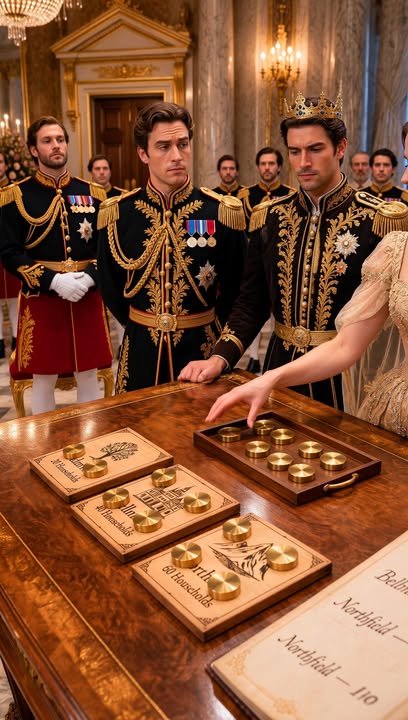
The chief clerk helped unroll it across the oak table, holding the corners down with the brass counters.
A blue line marked the river as it had run before the flood.
A darker line showed its altered course.
Between them, in the bend where the old river had widened into a marshy inlet, a small settlement had been drawn.
Reedbank.
The name appeared in a clerk’s neat hand, accompanied by thirty tiny marks grouped in rows.
“Thirty households,” the protagonist said.
The prince bent over the map.
“It is here,” he said. “North of Northfield, along the old river road.”
A faint road curved from Northfield toward the settlement, then continued beyond it to a patch of higher ground.
The map was not merely a record of where Reedbank had been.
It showed where its people might have gone.
The protagonist traced the route in the air, following the line toward the raised land.
“Is this the same road the riders will take?”
“The beginning is,” the clerk said. “The rest has not been marked on the newer maps.”
Adrian looked closely at the high ground.
“Whose land was this?”
The clerk studied the boundary lines.
“The map doesn’t say.”
The protagonist leaned nearer.
A series of small marks stood beside the upper road, too faint to read at first.
The prince moved the nearest candle closer, careful not to bring the flame near the brittle page.
Under the light, the marks resolved into a short note.
“Families transferred above flood line by royal leave.”
No one spoke.
The protagonist felt the words enter her slowly.
“Transferred,” she said. “Not abandoned.”
The prince’s eyes stayed on the map.
“By royal leave.”
The clerk looked over his shoulder.
“That wording usually meant the crown had approved a temporary relocation.”
“Temporary?” Adrian asked.
“Unless another document made it permanent.”
The map offered no such document.
The prince’s jaw tightened.
“Was there another map made after this one?”
“Possibly. The archive holds several surveys from the years after the flood.”
“Bring them here.”
The clerk bowed and hurried out.
The protagonist studied the two river lines.
The old course crossed the land where Reedbank had stood.
The new course cut through it, leaving the settlement vulnerable to each rise in the water.
The mark beside the higher ground suggested that the families had been given a place beyond the flood line, but the boundary there remained faint and unfinished.
The village had not disappeared all at once.
It had been moved, and then the records had changed around it.
Adrian put one finger beside the words royal leave.
“My mother’s deliveries were for families who had moved to this higher ground.”
“Most likely,” the protagonist said.
“And someone kept their account separate while the boundary was settled.”
The prince looked toward the strip of paper.
“Then the settlement may have been about who owned that land.”
The noblewoman returned before the clerk did, a folded note in her hand.
“I sent the request,” she said. “The estate office will look for the original survey.”
She saw the map and came to the table.
Her expression changed when she recognized the river lines.
“That is older than the map at our house,” she said.
“Your family’s copy shows the current boundary?” Adrian asked.
“Yes. It places the upper ground outside the royal territory.”
“But this map says the families were transferred there by royal leave.”
The noblewoman leaned toward the note.
“May I?”
Adrian stepped back so she could read it.
She did not touch the paper.
Her gaze followed the route from Reedbank to the higher ground, then stopped at the boundary marks.
“My grandfather’s records say the land was already part of our estate when he inherited it,” she said.
“Do they say how it became part of the estate?” the protagonist asked.
“Not in the copies I have seen.”
“Could it have been granted to the families, then claimed by your family later?”
The noblewoman’s face tightened.
“I don’t know.”
The admission was not defensive.
It sounded like a door she had never tried before had opened onto a dark room.
“The records should say,” she added. “If they don’t, that is also something we need to understand.”
The prince nodded.
“We will not decide what happened from a single map.”
The noblewoman looked at him.
“Nor from a family copy.”
“No.”
She seemed to appreciate that he had not used the map as an accusation.
The chief clerk returned with two more rolled documents.
The first showed the river’s altered course in greater detail.
The second was a boundary survey, signed by Martin Voss and dated several months after the flood.
The clerk unrolled it beside the older map.
The drawing was precise, with measured distances and careful notations.
A new line had been drawn around the high ground.
The noblewoman leaned in.
“That is the boundary my family uses,” she said.
The protagonist compared it with the earlier map.
The high ground that had held the relocated families now sat on the estate side of the line.
In the margin, Voss had written a note in small script.
“Temporary occupation to remain until the crown confirms the promised holding.”
Adrian read the words aloud.
The noblewoman closed her eyes briefly.
“Then the land was not simply empty,” she said.
“No,” the protagonist replied. “And the families were not simply gone.”
The chief clerk pointed to a line near the foot of the survey.
“There is a reference number here. It might lead to a royal grant.”
Adrian followed it with his eyes.
“Can you find the matching document?”
“I’ll search the grant register.”
“Please.”
The clerk gathered the two maps carefully.
“Leave the boundary survey,” the prince said. “We may need to compare it with the ledger.”
The clerk nodded and withdrew with the older map.
Adrian turned to the noblewoman.
“You were taught that the residents left the valley.”
“Yes.”
“Your family may have believed that sincerely.”
“Perhaps,” she said. “But sincerity does not tell us whether the land was promised to them.”
Her voice had grown firmer.
The protagonist felt a quiet respect for the change.
The noblewoman was still protecting her family from an accusation she could not yet prove, but she was no longer protecting herself from questions.
The prince studied the Voss survey.
“Did Martin Voss sign the public boundary copy?”
“I believe so,” the noblewoman answered. “He prepared the survey. My family’s version carries his name.”
“And the royal copy?”
“We have not seen it.”
Adrian’s gaze settled on the altered line.
“Then we need to find out whether the royal copy ever included the promise.”
The protagonist thought of the message pressed into the old folder flap: Keep the northern account separate until the boundary is settled.
“Someone expected a settlement to be written down,” she said. “But the note we found says households were removed from the public roll while it was pending.”
“Perhaps as an administrative measure,” Adrian said. “Perhaps not.”
“Either way, the people became invisible in the meantime.”
He looked at her, and she saw that he understood the difference between an explanation and an excuse.
A single measure could begin as temporary and become permanent when no one returned to finish it.
The chief clerk came back with the grant register, a heavy volume bound in dark green leather.
He set it down and turned to the reference number.
The pages were crowded with grants of roads, mills, and pastureland.
At the place the number should have led, there was a gap.
Not a torn page, but a narrow space between two entries where an index slip had once been inserted.
“There is no grant recorded under this reference,” the clerk said.
“Could the number be incorrect?” Adrian asked.
“It could.”
The protagonist looked at the survey again.
The number had been written twice, once by Voss and once by a royal clerk.
“Can we search by the date?”
The clerk turned several pages.
A note in the margin directed them to a separate volume of temporary permissions.
He found it in a second book.
There, near the end of the winter entries, was a short account.
“Relocation of the Reedbank households to the north rise, pending boundary settlement.”
The words appeared in formal ink, with no mention of a land grant.
Beside them, a later hand had written: “No permanent claim established.”
Adrian read the notation twice.
The noblewoman’s face had gone still.
“That would be the record my family relied on,” she said.
“Did your family have this exact notation?” the protagonist asked.
“I don’t know. They may have had a copy of the newer boundary map and a statement that no permanent claim had been established.”
“Which would sound as though the families had no right to remain.”
“Yes.”
The prince leaned over the register.
“Who wrote the later note?”
The clerk examined the ink.
“I cannot identify the hand from this page.”
“Can you compare it with other entries?”
“I can ask the archive staff to look.”
“Do that.”
The protagonist’s attention had returned to the older papers.
The queen’s letter had been written after the flood, asking that the households at R.B. not be forgotten when the roads returned.
If the households had been moved by royal leave, the queen might have known the promise was unfinished.
Perhaps she had sent supplies while the council delayed.
Perhaps she had believed the grant would be completed.
“Your mother may have been trying to keep the families present in the records,” the protagonist said.
Adrian’s expression softened with grief.
“Or she may have known they had been left waiting.”
“Those can both be true.”
He looked down at the seal.
“Yes.”
A quiet settled over the table.
The story was no longer that a village had vanished after a flood.
Its people had survived, moved to higher ground, and waited while officials argued over a boundary.
The official record had treated the unresolved promise as if the people themselves were unresolved.
The noblewoman touched the edge of the survey with one gloved finger.
“My family may have inherited land that was meant for them,” she said.
“May have,” Adrian replied.
“I need to see the original estate papers before I say more.”
“You should.”
She looked at the prince, perhaps searching for impatience.
He gave her none.
“Whatever the papers say,” he added, “we’ll need to understand how the decision was made.”
“And whether it was ever changed.”
The protagonist nodded.
“If the families stayed on the higher ground, someone must have known.”
The chief clerk looked up from the temporary register.
“Not necessarily. A settlement could remain after the official account was closed.”
“But the delivery receipt proves someone from the palace was bringing supplies,” the protagonist said.
“Your mother,” Adrian murmured.
“And mine,” she replied.
The prince looked at her.
There was tenderness in his expression, but also something like wonder.
“Our mothers were trying to keep them alive while the records kept them waiting.”
The words made her throat tighten.
She could almost picture her mother in the snow, lifting bundles into a cart, certain that a practical task needed no story around it.
She wondered whether her mother had known the land was disputed.
Whether she had seen the families’ temporary homes and understood that a promise had not been kept.
The protagonist had inherited the receipt without knowing it.
The prince had inherited his mother’s seal and her unfinished sentence.
The noblewoman had inherited a boundary line that may have been drawn over somebody else’s hope.
The past had not belonged to one family alone.
It had been divided among them.
The prince turned to the chief clerk.
“Send the riders with the old route, not the current map. Tell them to look for the settlement on the north rise as well as the original riverbank.”
“I will.”
“Ask them to speak with the oldest residents they find. They may remember the relocation.”
The clerk wrote the instruction on a fresh page.
“And the blankets?” the protagonist asked.
“The reserve stays in place until the riders report,” Adrian said. “But if they find families in need, they are to distribute the first bundles immediately.”
“Good.”
The prince’s answer was firm, but his gaze remained troubled.
He knew that finding Reedbank would not resolve the boundary.
It would only bring the people back into view.
A messenger arrived with a sealed note from the archive, delivered by a young attendant who looked as though she had been searching through the palace all evening.
The note was addressed to Adrian.
He opened it and read silently.
“What is it?” the protagonist asked.
“The archivist found the royal copy of Voss’s survey,” he said. “It was filed under flood repairs.”
The noblewoman drew a breath.
“Does it include the temporary occupation?”
“It includes more than that.”
The prince passed the note to her.
She read the few lines, then lowered it.
“The royal copy says the crown agreed to grant the north rise to the households of Reedbank once the boundary was confirmed.”
The chamber seemed to hold its breath again.
The protagonist looked toward the blank space on the newer map.
A promise had not merely been implied.
It had been written down.
Adrian stood very still.
“Is there a copy of the grant?”
“The archivist says the survey references a sealed letter from the royal household,” the noblewoman replied. “The letter may contain the final terms.”
“Where is it?”
“The note does not say.”
The prince looked at the chief clerk.
“Search the flood-repair records and the queen’s correspondence. Find every reference to the sealed letter.”
The clerk bowed and hurried away.
The protagonist looked at the temporary register, the Voss survey, and the receipt bearing her mother’s signature.
The scattered pieces now formed a clearer picture.
Reedbank’s people had been moved to safety.
The crown had agreed to grant them the land where they settled.
The boundary had never been confirmed, and the public record had been altered to make the unresolved claim disappear.
But the sealed letter might explain why.
Adrian’s gaze returned to the older survey.
“My family’s promise was never entered into the permanent register,” he said.
“Not yet,” the noblewoman corrected softly. “We don’t know whether it was deliberately withheld.”
He gave a slight nod.
“You’re right.”
The distinction mattered.
They had evidence of failure, but not yet of intention.
The protagonist appreciated that the prince could hear the correction without treating it as a defense of the crown.
A second attendant appeared at the doorway.
“Your Highness,” she said, “Mr. Vale has returned with the boundary records.”
Adrian looked toward the steward.
“Bring him in.”
The steward entered carrying a narrow ledger and several loose maps.
His face was composed, though his eyes moved at once to the Voss survey.
“Did you find these in the archive?” he asked.
“Yes,” Adrian replied. “We found the royal copy, the temporary register, and the note of a promised grant.”
Mr. Vale set his papers down.
For a moment, he seemed to weigh whether to speak.
Then he opened the narrow ledger to a marked page.
“I knew Reedbank had been removed from the public count,” he said. “I did not know the promise had been recorded in this survey.”
The prince studied him.
“When did you learn the village had been taken out of the ledger?”
“Years ago, while reviewing the northern boundary accounts.”
“And you did not restore it.”
“No.”
The admission was plain.
The protagonist watched him closely.
“Why not?”
“The council was preparing to settle a dispute over the land,” the steward said. “I was told the village had been removed from the register to avoid making a claim before the boundary was decided.”
“Who told you?”
“My predecessor.”
“Did you ask what happened to the people?”
“I asked whether the households had left.”
“And what were you told?”
“That they had.”
The protagonist thought of the new map, clean and quiet over the place where the village should have been.
“Did you verify it?”
“No.”
The steward did not look away.
“I should have.”
The prince’s voice stayed level.
“Why did you keep the omission in place?”
“Because the boundary dispute remained unresolved, and I believed restoring the name could complicate the council’s work.”
“Was that your decision?”
“It was my responsibility to challenge the instruction. I did not.”
The answer was neither an excuse nor a confession of some hidden design.
It was a man acknowledging that he had chosen caution over inquiry, and that the choice had protected the record more than the people.
The protagonist felt the room grow quieter around him.
“Do you know where the sealed letter is?” she asked.
“I do not.”
“Did your predecessor?”
“I believe he knew there was a letter. I never saw it.”
Adrian looked down at the ledger.
“Could it have been removed from the archive?”
“It may have been kept with the queen’s private papers.”
The noblewoman studied the maps Mr. Vale had brought.
“This one shows the boundary after the flood,” she said.
The steward turned it toward her.
A thin red line ran along the north rise, marking the edge of the estate.
Beside it, in a hand matching the old note, were the words: “Claim pending royal confirmation.”
The noblewoman drew her hand back.
“That is the land my family has treated as part of the estate.”
“It may be,” the steward said. “The map does not show when the claim became final.”
“Does it show the households?”
“No.”
The protagonist searched the margin.
There, almost hidden beneath a fold, was a tiny notation.
“Families in residence.”
She looked at the noblewoman.
“They were still there when this map was made.”
The noblewoman’s face changed.
Her certainty about abandonment had not simply been wrong.
It had been contradicted by a document her own family may have held.
She bowed her head, absorbing the weight of it.
“I need to see the estate’s original copy,” she said.
“You should,” Adrian replied.
“And if it contains the same notation, I will tell you.”
The prince nodded.
“Thank you.”
The steward placed one more paper on the table.
It was a register entry from a later year.
The line for Reedbank had been crossed through, and beside it someone had written: “Not within royal jurisdiction.”
The protagonist felt the explanation sharpen into a wound.
The village had not vanished because its people abandoned it.
It had been placed on land the crown had promised them, then described as outside the kingdom when the promise became inconvenient.
Adrian read the line.
“Who wrote this?”
Mr. Vale studied the handwriting.
“Not my hand. It may belong to my predecessor.”
“Do you recognize it?”
“I cannot be certain.”
The prince’s expression had gone still.
“Then we will compare it with the other records.”
He did not raise his voice.
He did not need to.
The protagonist looked at the newer map, with its neat boundaries and empty land.
The map had not simply failed to show Reedbank.
It had made the village seem impossible.
The noblewoman stood beside the table, her family’s boundary records in front of her and the royal omission beside them.
“We have all been looking at different pieces,” she said.
“My mother’s receipt,” the protagonist replied. “The queen’s letter. Your family’s survey. The public register.”
“And each piece made a different part of the truth visible,” Adrian said.
The prince turned to Mr. Vale.
“Find every record you can about the relocation, the promised grant, and the change to the royal boundary.”
“I will.”
“And this time, do not separate the northern account from the rest.”
The steward met his gaze.
“No, Your Highness.”
There was no absolution in the exchange, but there was a beginning of accountability.
Mr. Vale left to continue the search.
The chief clerk returned with a list of the papers found so far, and the protagonist helped him order them by date.
As the documents gathered on the table, the story became easier to read and harder to bear.
The flood had forced Reedbank’s families from their original homes.
The crown had moved them to higher ground and promised the land would be theirs.
The promise had remained incomplete.
Then the village had been removed from the count, its residents described as absent even while a map marked them in residence.
The old royal seal lay beside the blank space where the grant should have been.
Adrian picked up his mother’s letter.
“For the households at R.B., whose need must not be forgotten when the roads return.”
He read the sentence without speaking aloud.
The protagonist thought of the years that had passed while the road returned and the promise did not.
“What if your mother knew the records were being changed?” she asked.
“I don’t know,” he said. “But the sealed letter may tell us.”
The archive attendant came back just as the prince finished speaking.
She carried a small wooden case bound with faded blue cord.
“The archivist found this among the queen’s personal papers,” she said. “It was marked for the northern accounts, but never entered in the public catalogue.”
Adrian’s eyes fixed on the cord.
“Is it locked?”
“No, Your Highness. The archivist said it appeared to have been sealed and reopened once before.”
The attendant placed the case on the table and withdrew.
No one reached for it immediately.
The noblewoman stood close to the Voss survey.
The protagonist stood beside the receipt bearing her mother’s name.
And the prince looked at the case as if he could already feel the weight of the words hidden inside.
At last, he loosened the cord.
The lid lifted with a faint creak.
Within lay a single envelope, its wax seal broken but still attached to the flap.
The prince recognized his mother’s hand on the outside.
“To be opened only if Reedbank is ever found upon the record again.”
The protagonist looked at the crossed-out village name.
The village had been found.
And someone had known, long ago, that one
**–END OF PART 4–CLICK “NEXT” AT THE BOTTOM OF THE PAGE TO CONTINUE READING**
* * *
[PREVIOUS: PART 3](https://storyly.idolsgift.com/blog/part-3-the-village-beneath-the-paper-056) | [NEXT: PART 5](https://storyly.idolsgift.com/blog/part-5-the-village-beneath-the-paper-056)
✓ Lynn R. Adams
Part 4 – The Promise Beneath the Map The prince’s question remained unanswered in the chamber, caught between the torn edge of the paper and the snow-dark windows. The protagonist held the strip car…