PART 4: The Thread Beneath the Hem 069
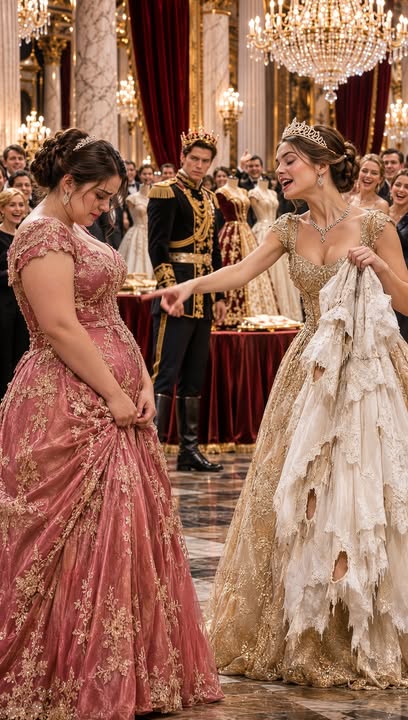
Part 4 – The Message in the Sleeve
“Return only when the prince is ready.”
The words rested on the page like a hand laid gently across an old wound.
Adrian read them again, though nothing about the faded ink had changed.
Mara watched him from across the table, aware that every person in the archive was waiting to learn what those words meant.
“I don’t remember being told anything about a dress,” he said at last.
“You were a child when the gown disappeared,” Master Vale replied. “The instruction may have been meant for a future day, not for you to understand at the time.”
Adrian’s gaze shifted to the wooden box.
“Then perhaps this is what my mother wanted me to find.”
“Perhaps,” Mara said. “But we should learn what we can about the box before opening it.”
The caution felt difficult to voice.
She could see how strongly he wanted to lift the clasp, and how carefully he kept himself from doing so.
Mrs. Rowe examined the box without touching its lid.
“The carving is worn, but the emblem is consistent with Queen Elara’s personal mark,” she said. “It may have been made for her.”
“Can we establish when it was placed in the cabinet?” Adrian asked.
“Not precisely,” Master Vale answered. “But the wood has been protected from damp. It could have rested there for many years without being disturbed.”
Mara looked again at the faint line in the ledger.
“Could the box have been left by my grandmother?”
“It’s possible,” Mrs. Rowe said. “The transfer record names her as the temporary custodian of the garments. It does not mention a box, but she may have stored it separately.”
“Or someone placed it here later,” Celestine said.
She had returned to the room with her mother, though Mara had not heard them come in.
Her tone held none of yesterday’s cutting certainty.
It was a careful question, offered as a possibility rather than an accusation.
Master Vale gave a thoughtful nod.
“That is also possible. We should document the cabinet and its contents before opening it.”
Adrian turned to the archive keeper.
“Do what you need to do.”
Mrs. Rowe made a record of the box’s position, its carving, the condition of the clasp, and the papers found beside it.
Mara stood near the worktable, her thoughts returning to her grandmother’s sewing basket.
The blue thread.
The listening knot.
The small compartment that her grandmother had never let her open.
She had always assumed it held needles too fine for a child’s hands.
Now she wondered whether her grandmother had been keeping a piece of the queen’s history within reach.
When Mrs. Rowe finished her notes, Master Vale examined the clasp.
“It is not locked,” he said. “But the wood may have settled around the lid.”
“Can it be opened without damage?” Adrian asked.
“With patience.”
Master Vale worked the clasp loose and lifted the lid by a fraction.
The box gave a soft, dry creak.
Everyone leaned closer, then stopped themselves from crowding the table.
Inside lay a folded square of linen, a small blue silk spool, and a flat packet wrapped in translucent paper.
Mara drew in a quiet breath.
The spool was the same shade as the thread hidden in the gowns.
Its paper label had darkened, but a few words remained legible: palace sewing rooms, restricted supply.
“The thread came from this spool?” Adrian asked.
Master Vale examined it carefully.
“Most likely. The color and twist match.”
“Then it could have been used by anyone who had access,” Celestine said.
“Yes,” Mara replied. “But it tells us where the thread came from, not who used it.”
Celestine nodded, accepting the distinction.
Mrs. Rowe wrote down the contents before Master Vale lifted the packet.
The thin paper around it had been folded into a narrow rectangle, then secured with a strand of white thread.
No seal marked its surface.
Adrian glanced at Mara.
“Would you recognize the knot?”
She leaned closer but did not touch it.
“It’s small enough that I can’t tell from here.”
Master Vale set the packet on a clean cloth.
Mara studied the knot through the magnifying glass.
The loops formed a tight, balanced crossing.
Her heart gave an unexpected, painful tug.
“My grandmother tied it that way.”
Adrian’s eyes met hers.
“You’re certain?”
“I’m certain she taught me the pattern. I can’t say who tied this particular one.”
“Could the same knot have been used to close the seams?”
“Yes. It keeps a fastening secure without pulling the surrounding fabric.”
“Would it be all right to open it?” Mrs. Rowe asked.
She looked to Adrian, but he did not answer immediately.
Mara understood the pause.
The packet might contain the explanation he had sought for years, or it might contain a private message his mother had never meant for him to read.
“Do you want to?” Mara asked.
He looked at the folded paper.
“I do,” he said. “But wanting to know is not the same as having the right to take something apart.”
The admission quieted the room.
Master Vale considered the wrapping.
“If we loosen the knot, we can preserve it. Nothing needs to be cut.”
Mara nodded.
“I can do it.”
She put on clean gloves and took up a slender wooden pick.
The blue spool rested beside the packet, its thread catching the daylight in a deep, soft glimmer.
Mara slipped the pick beneath the first loop and eased it loose.
The knot opened with barely a sound.
She unfolded the paper one layer at a time.
Inside was a narrow strip of fine cream silk, its surface covered in handwriting.
The ink had faded, but not beyond reading.
Adrian stepped closer.
Mara lowered the magnifying glass over the first line.
“To the person who finds this, I ask that the gown be preserved, not hidden from the world.”
She stopped.
Adrian’s fingers tightened against the edge of the table.
“Keep going,” he said, his voice low.
Mara read on.
“Let it be returned to my son when he is old enough to understand that a queen’s worth is not measured by the gown she wears, the family she joins, or the admiration she receives.”
The room was silent.
Mara continued, slowly, giving each word its full weight.
“Let him know that a title can open doors, but only judgment and compassion can make him worthy to stand within them.”
Adrian bowed his head.
For a moment, the prince vanished, leaving only a boy who had lost his mother and an adult who had spent years searching for the truth of her last wishes.
The message went on.
“I have asked the first seamstress of the palace, whose hands I trust, to keep the gown safe until it may be returned. She will know how to conceal this note within the sleeve, where it will remain protected from careless hands.”
Mara lowered the strip.
Her throat felt too tight to speak.
“My grandmother hid it in the dress,” she whispered.
“Then she carried out my mother’s request,” Adrian said.
The words sounded almost like a question.
“Or tried to,” Master Vale replied gently. “The transfer appears to have gone wrong after the wardrobe was moved.”
Mara looked at the old wedding gown resting in its covered case.
A sudden tenderness rose in her, mixed with sorrow.
Her grandmother had not been hiding a stolen dress.
She had been keeping a promise.
“She may have meant to tell someone,” Mara said. “Then the gown was moved, the record was lost, and the chance passed.”
“Perhaps she thought it had been safely returned,” Mrs. Rowe said.
“Or she could not find it after the move,” Master Vale added. “The old inventory was incomplete. Some pieces were entered by number only.”
Adrian read the message again.
“My family believed a servant had taken it.”
The pain in his voice turned every face toward him.
Mara could not offer an answer that would soften the truth.
He looked at the line naming the first seamstress.
“Your grandmother kept the gown because my mother trusted her.”
“Yes,” Mara said. “She must have.”
“And still, we searched for a thief.”
The words did not accuse Mara.
They accused the story that had grown around the missing dress, and the people who had repeated it without asking whether it was true.
Adrian turned away from the table and walked to the tall window.
Outside, the palace garden lay under a pale morning sky.
The last leaves of autumn clung to the branches, gold and russet against the gray stone.
Mara watched him stand with his hands clasped behind his back.
She knew the feeling of discovering that an old fear had been built on an assumption.
It did not vanish simply because the truth had been found.
Sometimes it left behind the question of what else one had mistaken.
“My mother wrote that I should be old enough to understand,” Adrian said. “But the message does not say how I am meant to know when that is.”
“Perhaps she could not know what your life would be like,” Mara said.
He turned from the window.
“Then what did she expect me to understand?”
Mara considered the words on the silk.
“That being admired isn’t the same as being worthy. And that people should not be judged by the family they come from or the clothes they wear.”
The prince held her gaze.
“Or by their place in the palace.”
“Perhaps.”
Celestine stood quietly beside her mother.
She had listened without interruption, her hands folded loosely now rather than held in a rigid clasp.
“I thought this challenge was about choosing the woman who could best represent the crown,” Adrian said.
“It may have begun that way,” Mara replied.
“And now?”
“Now it seems your mother wanted you to look past appearances before you made a choice.”
Celestine’s eyes fell to the silk message.
“My family has spent years teaching me that appearances are how people decide whether you belong,” she said.
Her mother touched her arm but did not speak.
Celestine glanced at Mara.
“I suppose we both learned the wrong lesson from the court.”
Mara thought of the day before, of the laughter in the ballroom and the old gown thrust into her arms.
“I don’t think we learned the same lesson,” she said. “But maybe we can choose what to do with them now.”
Celestine accepted that without asking for more.
Master Vale asked Mrs. Rowe to secure the message in a protective sleeve.
Mara offered to help, and the archivist showed her where the preservation paper had been prepared.
They worked carefully, giving the silk enough support that its own weight would not pull at the weakened fibers.
When the note was safely placed between the protective sheets, Adrian returned to the table.
He read his mother’s words once more.
Then he set the note beside the old ledger.
“Her gown was not stolen,” he said.
“No,” Master Vale replied. “It was misplaced during the wardrobe transfer, then misidentified as damaged property.”
“Could we confirm that?” Adrian asked.
Mrs. Rowe opened the transfer list again.
“The gown’s number appears here beside the phrase bridal collection, but a later copy lists it as worn silk, unsuitable for formal storage. The record does not explain why.”
“Someone made an error,” Mara said.
“Or copied an earlier error,” the archivist replied.
Adrian looked at the old pages.
“An error became an accusation, and the accusation became a family truth.”
No one contradicted him.
The archive room seemed smaller now, the walls closer around the accumulated papers and histories.
Mara thought of the people who had handled the gown over the years, each one seeing a damaged object without knowing the promise folded inside it.
Her grandmother had trusted the palace to keep a record.
The palace had kept the record, but not carefully enough.
The trust had survived only in the hidden seam.
“Your mother’s message was meant for you,” Mara said.
“It was also meant for anyone who might be tempted to think a person’s value could be measured by what they wore or who they married.”
Adrian looked at the note.
“Then I should not treat it as private.”
Mara hesitated.
“What do you mean?”
“I mean the court should know what the challenge has uncovered. The gown, the record, and the message all matter to the contestants and to the people who work in this palace.”
Master Vale’s expression grew thoughtful.
“The note is personal. We should be careful with how much of it is shared.”
“I won’t read it aloud without considering that,” Adrian said. “But the truth of the gown’s history cannot remain tucked away simply because it is inconvenient.”
His resolve was quiet, yet Mara heard the shape of a decision beginning.
Celestine’s mother looked toward him.
“Some of the nobles will be embarrassed by the old accusation,” she said. “They may prefer to call the gown’s disappearance a theft rather than admit the palace mishandled it.”
“Then they may be embarrassed,” Adrian replied. “That does not make the old story true.”
Mara saw Celestine study him.
Perhaps she had expected a prince to protect the court from discomfort.
Perhaps she had expected him to protect his own image first.
His willingness to let the truth unsettle the room seemed to trouble and impress her in equal measure.
Mrs. Rowe gathered the remaining records.
“I’ll prepare a full account of the transfer and compare the original lists with the later copies.”
“Please do,” Adrian said.
“Master Vale and I will also inspect the inside of the gown’s sleeve,” Mara added. “The note may not be the only thing hidden there.”
Adrian nodded.
“Only if it can be done safely.”
The words took Mara back to the first seam she had examined beneath the ballroom lights.
The blue thread had opened a path toward an answer, but the old gown could still contain other traces of its history.
They returned to the preservation room, where the queen’s wedding dress lay on a padded table.
Master Vale lifted the cloth cover.
Mara washed her hands again, put on clean gloves, and leaned toward the sleeve.
With the note now accounted for, she could see the hidden layers more clearly.
The blue thread guided her to a narrow pocket between the lining and the outer silk.
It was not large enough to hold another letter.
It might have been made to protect the note, with the folded message tucked along the inside of the sleeve.
Mara traced the seam without opening it.
“There is room here for the silk strip,” she said. “The note must have been folded very small.”
“Can we tell whether it was removed?” Adrian asked.
“I think so.”
She moved the magnifying glass along the seam.
The upper edge had been opened and resewn with the old blue thread.
Near the underarm, the blue line stopped at a cluster of tiny stitches.
The fabric there had been handled more recently than the rest, though still long ago.
Mara’s pulse quickened.
“This part was opened twice.”
Master Vale leaned closer.
“The first repair is older.”
“Yes. The second is newer, but not recent enough to be from the current restoration.”
Adrian studied the seam.
“Could the note have been put back after the gown was found?”
“It could have,” Mara said. “But I don’t think it was.”
“Why?”
“Because the blue thread follows the edge of the original pocket. The later stitches are visible from inside, but they do not cross the opening. Whoever resewed it was trying to secure the lining without disturbing what remained beneath.”
“Was the note inside when the gown was misplaced?” Celestine asked.
Mara thought carefully before answering.
“The note was folded to fit the pocket. I can’t say when it was placed there, but the seam was closed after the note went in.”
“Then someone must have known it was there,” Adrian said.
“Or followed your mother’s instructions,” Master Vale replied.
Mara examined the opposite side of the sleeve.
A small ridge beneath the lining ran toward the cuff.
“There’s another thread here.”
She turned the magnifying glass.
This one was not blue.
It was a pale, almost colorless silk thread, looped around a tiny piece of cloth at the edge of the sleeve.
Mara’s breath caught.
“Is it part of the construction?” Adrian asked.
“No.”
She leaned closer.
“It’s a thread used to secure something small. Not the message. Something else.”
Master Vale’s brow furrowed.
“Could it be a fragment of the lining?”
“Perhaps.”
Mara adjusted the light until the cloth beneath the seam became visible.
It was no larger than the nail of her smallest finger, folded once and caught beneath the stitches.
Its surface bore a faint mark in dark ink.
Mara looked at Adrian.
“I can’t read it through the fabric.”
“Can the seam be opened without damage?”
“Not today,” Master Vale said. “The old silk needs to rest before we touch it again.”
Adrian nodded, though disappointment passed across his face.
“Then we wait.”
The room’s calm returned by degrees.
Mara finished recording the details, noting the blue line, the later repairs, and the tiny folded cloth.
She felt a strange satisfaction in having found another clue, though it was accompanied by the unease of not knowing what it might reveal.
The door opened.
A young clerk entered carrying a tray of sealed letters and a folded notice bearing the royal crest.
“Your Highness,” he said, bowing. “The council asks whether the evening’s bride competition will proceed as planned.”
Adrian took the notice.
“Who has requested a decision?”
“The members of the royal council, Your Highness. Several guests are asking whether the final selection will take place tonight.”
Adrian looked at the old gown, then at the silver dress, whose hidden seam had connected it to the same mysterious thread.
He glanced at Mara.
She could tell he was thinking about the challenge, the contestants, Celestine’s family, and his mother’s instruction.
The competition had started as a measure of who could identify a deliberately altered dress.
Now the dresses revealed that the premise itself might have been wrong.
Mara wanted him to stop.
She also knew what that decision could cost him.
The nobles had gathered expecting a bride to be chosen.
Celestine’s family had spent years believing the court’s expectations pointed toward her.
If he halted the challenge without a clear explanation, people might call it impulsive or unfair.
If he continued, he might ask the contestants to compete inside a story built on false assumptions.
Adrian unfolded the notice.
“The council is waiting for an answer,” the clerk said.
“I know.”
The prince looked once more at his mother’s message, preserved beneath the clear protective sheet.
“Then I must give them one.”
Mara set down the magnifying glass.
“What will you tell them?”
“That the gown was not stolen, and that the contest may have begun with a false accusation.”
Celestine’s mother drew a slow breath.
“Your Highness, if you say that publicly, some will take it as a judgment against the people who arranged the challenge.”
“It is a judgment on the truth of the matter, not on their intentions.”
“And the competition?” Celestine asked.
Adrian did not answer at once.
He looked at each of them in turn, as though he wanted to understand not only what he believed, but whom his decision would affect.
“I won’t decide before I know what the last clue means,” he said. “But I won’t pretend the challenge is ordinary when it is not.”
Mara felt the importance of his words settle around them.
The young clerk still waited by the door.
Adrian handed him a short note to deliver to the council: the evening’s gathering would proceed, but no selection would be made until the archive findings were presented.
The clerk bowed and left.
The prince let out a breath.
“That buys us time,” he said.
“Not much,” Master Vale replied.
“Enough to examine the sleeve carefully,” Mara said.
Adrian looked at her.
“Then we’ll do that.”
The afternoon passed in patient work.
Mrs. Rowe compared the inventory copies and found several garments whose descriptions had changed between one catalogue and the next.
Master Vale confirmed that the blue spool matched the hidden thread.
Celestine helped her mother arrange the original records in chronological order, taking care not to touch the most fragile pages.
Mara was surprised to find her asking sensible questions about how the garments had been stored.
Celestine did not become warm all at once, nor did Mara forget what had happened in the ballroom.
But the sharpness between them had eased into a wary respect.
When the evening gathering began, Adrian stood before the assembled court without the easy confidence he had worn the night before.
The contestants gathered near the restoration table.
Mara stood beside Master Vale, dressed again in her deep-rose gown.
The queen’s old wedding dress rested nearby beneath its protective cover.
Adrian did not begin with the challenge.
He began with the truth.
“The gown we believed had been stolen from the royal archive was entrusted to the palace’s first seamstress by Queen Elara herself,” he said. “It was misplaced during a wardrobe transfer and later misidentified as damaged property.”
A ripple of surprise moved through the room.
“The dress contains a message from my mother, preserved according to her instructions. We also found records connecting it to other garments in the archive.”
Celestine’s gaze lowered to the floor.
Adrian continued.
“The facts do not support the accusation that anyone stole the gown. I will not allow the old story to stand simply because it has been repeated for years.”
Mara saw the prince’s shoulders settle as he spoke.
He was not looking for applause.
He was accepting the discomfort of being heard.
“I will share the full account when the archive’s work is complete,” he said. “For now, the challenge is paused. No one will be declared its winner tonight.”
The court stirred.
Some guests looked relieved.
Others exchanged glances, already weighing what the announcement might mean for the royal match.
Adrian lifted a hand, and the room quieted.
“This delay is not a punishment for any contestant. It is an acknowledgment that we asked you to judge a question before we understood its history.”
His eyes briefly met Mara’s.
“A future queen should recognize truth before making accusations,” he added. “That standard must apply to the crown as well.”
The words landed with a weight the ballroom could not ignore.
Celestine’s mother stood near the edge of the gathering, her expression proud and troubled at once.
Celestine looked toward Mara.
Mara did not know whether the other woman wanted to speak, but she gave her a small, respectful nod.
Celestine returned it.
After the announcement, guests broke into quiet conversations.
No one laughed at Mara’s gown.
No one called her unfit for the room.
Still, she could feel the court rearranging itself around the news.
Adrian came to stand beside her.
“Was that what your mother wanted?” she asked.
“I don’t know,” he said. “But it is what I should have done.”
He looked toward the covered gown.
“I spent years imagining that someone had stolen it. I thought finding the culprit would return something to me.”
“And now?”
“Now I know that the story itself was the thing we lost.”
Mara thought of the hidden message and the tiny folded fragment beneath the sleeve.
“Maybe there’s still more to find.”
“There is.”
He followed her gaze to the dress.
The evening ended without a winner, and the court dispersed under a sky the color of wet slate.
In the preservation room, the old gown was placed safely in its case.
Mara remained with Master Vale to finish the notes for the next day’s inspection.
Adrian stayed as well, seated at the end of the worktable with his mother’s message before him.
When the others had gone, he looked up at Mara.
“I’m sorry you had to stand alone in that ballroom while people judged you.”
“You came to my side.”
“After the dress was already in your hands.”
“You came before the room decided what the dress meant.”
He considered that.
“I should have stopped Celestine sooner.”
“Yes,” Mara said.
She could see him take the answer in without defending himself.
“I won’t pretend otherwise,” he replied.
That honesty made it easier to say what she had been holding back.
“I was afraid you would believe I had taken the gown.”
“I did wonder whether you knew more than you had said.”
Mara’s expression tightened.
“But I was wrong to let suspicion shape my questions.”
She looked at the prince, seeing the effort it took him to say the words without placing any excuse between himself and the mistake.
“Thank you for telling me.”
“I’m grateful you stayed to help.”
“I stayed because the gown deserved to be understood.”
“And because you wanted your grandmother’s name cleared.”
Mara felt a sting behind her eyes.
“Yes,” she said. “That too.”
Adrian lowered his gaze to the message.
“My mother trusted your grandmother with something precious.”
“My grandmother must have trusted your mother, too.”
“I wish I could remember more of her.”
Mara thought of her grandmother’s humming.
“Sometimes the little things are the part that lasts.”
He looked up.
“Like what?”
“The way she folded a finished hem inward before handing it back. She said a person should not see the rough work when they were looking at the part meant for them.”
Adrian’s expression softened.
“She sounds like someone who understood how to care for people.”
“She did.”
Mara placed the magnifying glass beside the case.
“Tomorrow, we should open the second seam.”
Adrian glanced toward the small, folded fragment beneath the lining.
“Yes.”
The following morning, they gathered again in the preservation room.
The cloth fragment remained tucked beneath the sleeve, its dark mark barely visible through the fabric.
Master Vale prepared a narrow support board and a pair of fine tools.
Mara examined the seam in daylight, tracing the line with the tip of a wooden pick.
The thread loosened at the edge with almost no resistance.
She worked slowly, pausing whenever the silk shifted.
At last, the hidden fragment came free.
It was a tiny square of linen, no larger than a fingernail, folded in half.
The ink on its surface had faded to brown.
Mara opened it beneath the magnifying glass.
The mark was not a word.
It was a number, followed by a short letter: E—17.
Mrs. Rowe leaned over the table.
“That looks like a wardrobe shelf reference.”
“Could it identify where
**–END OF PART 4–CLICK “NEXT” AT THE BOTTOM OF THE PAGE TO CONTINUE READING**
* * *
[PREVIOUS: PART 3](https://storyly.idolsgift.com/blog/part-3-the-thread-beneath-the-hem-069) | [NEXT: PART 5](https://storyly.idolsgift.com/blog/part-5-the-thread-beneath-the-hem-069)
✓ Lynn R. Adams
Part 4 – The Message in the Sleeve “Return only when the prince is ready.” The words rested on the page like a hand laid gently across an old wound. Adrian read them again, though nothing about the…