PART 4: The Song He Had Never Forgotten 053
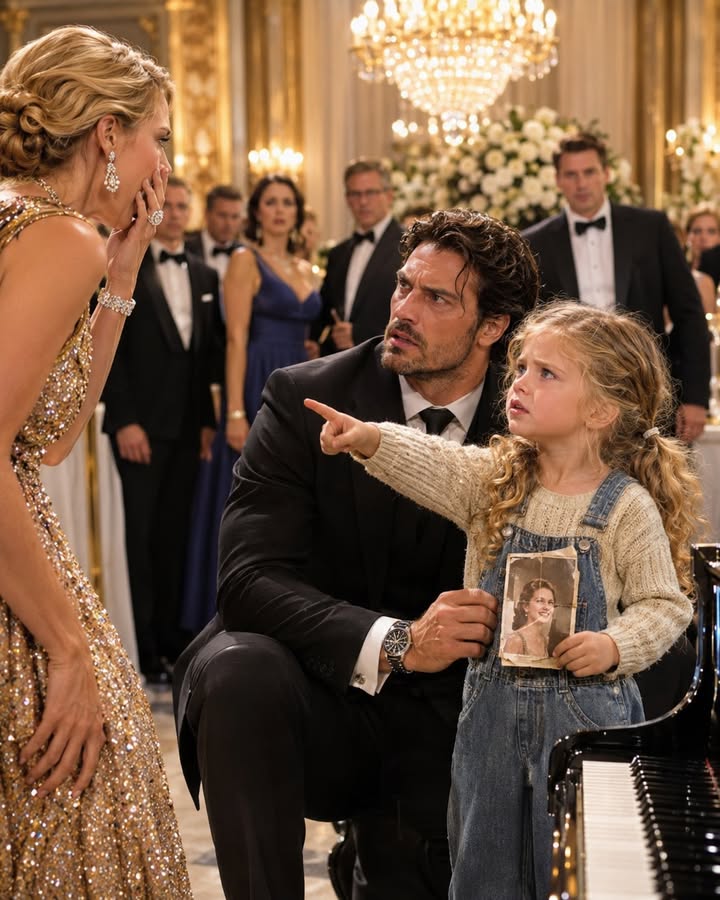
Part 4 – The Letters That Came Home
The initials were unmistakable.
Adrian turned the music box once beneath the lamp, then set it down without opening the lid.
“V.A.,” Lily repeated, sounding out the letters. “Like the ones on the letter?”
Isabella’s face had gone still.
Adrian kept his voice measured. “They could mean something else. I won’t draw a conclusion from two initials.”
“But they’re the same,” Lily said.
“Yes,” he replied gently. “They are.”
Isabella looked from the music box to the envelope on the table.
“Vivienne gave me that box,” she said.
Adrian’s gaze lifted.
“When?”
“Before Lily was born. She came by the apartment while you were away. She said you’d asked her to bring it.”
“Did she say why?”
“She said you’d made it for me.”
Adrian looked down at the painted lid, its blue surface worn pale where small fingers had turned it over and over.
“I never gave her a music box.”
“I know that now.”
Her words carried no accusation, only the weary caution of someone who had learned that certainty could be dangerous.
“Why did you keep it?” he asked.
“Because it played your melody.”
Isabella brushed one fingertip across the chipped corner.
“Even after I began to wonder whether she had been telling the truth, I couldn’t throw it away. Lily loved it. She’d fall asleep listening to it, and I could pretend, just for a moment, that the song had reached us from you.”
Lily leaned into her mother.
“I thought it was from Daddy.”
“It was his melody,” Isabella said. “But the box came from Vivienne.”
Adrian felt the distinction settle heavily in the room.
He had not yet learned what Vivienne had done, or why, but the scattered marks of her presence were beginning to form a pattern.
He did not want the pattern to become a verdict before they understood it.
“Isabella, may I make a copy of the letter and photograph the inscription?”
She studied him.
“You may copy the letter. The box stays here.”
“Of course.”
“And you won’t take it to her.”
“I won’t.”
“And you won’t ask Lily questions about what she remembers from that visit.”
“I won’t.”
Isabella’s expression eased by the smallest degree.
Adrian took out his phone and photographed the envelope from several angles, careful not to disturb the seal.
Then he copied the faint routing code and the initials beneath it.
Lily watched him work.
“Are you going to find out what happened?”
“Yes,” he said.
“Even if it’s hard?”
Adrian glanced at Isabella before answering.
“Especially if it’s hard.”
The doctor had left a card on the table, along with his recommendation that Isabella be examined soon.
Adrian noticed it, but did not reach for it.
“Would you like me to arrange transportation for your appointment?” he asked. “You can choose the clinic, and I can pay the driver if that would help.”
“I’ll decide tomorrow,” Isabella said. “Tonight I need to rest.”
“Then tomorrow.”
Lily looked toward the window, where evening had gathered in the glass.
“Will you go now?”
Adrian’s eyes met hers.
“Would you like me to stay a little longer?”
She glanced at Isabella.
Her mother answered for herself.
“Not tonight.”
Adrian nodded.
“Then I’ll go.”
Lily’s mouth tightened, but she did not ask him to ignore her mother’s choice.
He crouched beside her.
“I’ll call tomorrow, if your mother says that’s all right.”
Isabella considered it, then nodded once.
“You may call.”
Lily gave him the photograph.
“You should take this with you,” she said. “You have the other one in your phone.”
“I’d rather you keep it.”
“It belongs to Mommy.”
Isabella held out her hand, and Lily placed the photograph in it.
“Then it stays here,” Adrian said.
He rose and paused by the door.
“I’m sorry for every day you both had to carry a story that wasn’t true.”
Isabella’s eyes were tired and bright.
“You can be sorry,” she said. “But we still have to learn what happened.”
“I know.”
He left without asking for more.
On the stairs, the building’s narrow hallway seemed to close around him, its old paint and dim lights a world away from the ballroom he had left behind.
His driver waited at the curb.
Adrian climbed into the car and stared at the photographs of the envelope on his phone.
The V.A. routing mark was faint, but clear enough.
He opened his contacts, stopped at Vivienne’s name, and closed them again.
A confrontation would satisfy his anger, but it would not establish the truth.
He needed someone who understood how the family office had handled correspondence in those years, someone who might recognize the code and explain how a letter addressed to him could have been returned unopened.
He knew exactly whom to call.
The next morning, Adrian arrived at the former Vale family office before the first appointments of the day.
The building had changed hands years ago, but the upper floors still housed a records department that maintained old corporate and personal archives.
He asked the archivist on duty for a retired assistant named Martin Shaw.
Martin had served Adrian’s father for decades, then stayed on as Adrian’s assistant until his retirement.
He was one of the few people Adrian remembered as kind without being cautious, and discreet without being distant.
The archivist made the call.
Martin arrived an hour later, carrying a leather satchel and wearing the same silver-framed glasses Adrian remembered from his childhood.
“Mr. Vale,” he said, offering his hand. “You sounded as if you’d found something important.”
“I may have.”
Adrian showed him the photograph of the envelope.
Martin studied the image in silence.
“That is the old family-office routing code,” he said at last.
“Do you recognize the initials?”
Martin looked more closely.
“Vivienne Ashford.”
“She worked in the office during that period.”
“She did.” Martin turned the phone slightly, as if a different angle might change what he saw. “She handled incoming personal correspondence when you were traveling.”
“Did she have authority to redirect it?”
“Only if a letter was addressed incorrectly, or if the recipient had asked for an alternate address.”
“Did I ever ask her to redirect Isabella’s letters?”
“Not that I remember.”
“Could you check the archives?”
Martin lowered the phone.
“I can try. Some of the records were boxed when the office moved.”
“Please do.”
Martin’s gaze rested on Adrian’s face.
“Is Isabella alive?”
“Yes.”
“And the child?”
“Lily is five.”
For a moment, the older man looked as if he had forgotten the busy corridor around them.
“I’m glad,” he said quietly. “I’m very glad.”
Then his expression grew solemn.
“I’m sorry, Adrian.”
“You don’t know what happened.”
“No, but I know what I saw. You were given a report that said they had died, and you were not yourself for months afterward.”
Adrian remembered the thin folder placed before him in a hotel suite far from New York.
He remembered the neat pages, the official wording, and the stillness that had followed the news.
He had asked to see the records again and had been told the local authorities had handled everything.
He had believed what he was shown because the person presenting it had been someone he trusted.
“Who brought me the report?” he asked.
Martin’s answer came slowly.
“Vivienne.”
“Did she say where it came from?”
“She said it had been confirmed through the family office. I remember asking why the details were so limited.”
“And what did she say?”
“That it was a courtesy report, not a formal investigation. She told us there had been a private burial.”
Adrian’s jaw tightened.
“There was no burial.”
“No,” Martin said. “There wasn’t.”
The words might have sounded like an accusation if he had raised his voice.
Instead, Martin sounded like a man looking back at a decision he had once accepted and now wished he had questioned.
“I want the records,” Adrian said. “Not an interpretation.”
“Understood.”
They went down to the archive level, where boxed correspondence stood on metal shelves behind a locked door.
Martin signed them in and led Adrian to a table beneath a row of old fluorescent lights.
The work took most of the afternoon.
They found travel schedules, office logs, and ledgers documenting the handling of letters and calls.
At first, nothing seemed unusual.
Then Martin stopped at a narrow box marked with a year and a department code.
“I remember this label,” he said. “Personal correspondence. It was created after your father asked us to keep your mail organized while you traveled.”
Inside were bundles of envelopes tied with cotton string.
Some bore postmarks from places Adrian had visited.
Others were marked returned, undeliverable, or held for review.
Martin lifted one bundle and began reading the labels.
Adrian stood beside him, his hands braced against the table.
“Here,” Martin said.
The envelope lay between two business letters, its edges yellowed with age.
Adrian recognized Isabella’s handwriting before he read his own name.
He had never seen this one.
The address was his office in London, where he had been staying for several weeks.
A red line crossed out the destination.
A handwritten note beside it read: Return—recipient has requested no contact.
Adrian felt the words enter him slowly, as if his mind were refusing to accept the shape of them.
“Did I request this?” he asked.
Martin shook his head.
“Not to my knowledge.”
The envelope had been slit open.
Its contents were missing.
Adrian stared at the empty fold.
“Who logged it?”
Martin scanned the ledger.
“V. Ashford.”
A second envelope appeared in the same bundle, addressed to his New York residence.
It had been opened and resealed, with a note indicating that Adrian had asked to receive no further messages from Isabella Bennett.
A third carried a different instruction.
“Return unopened,” Martin read. “Sender advised that Adrian Vale does not wish to be contacted.”
The handwriting on the notes was neat and slanted.
Adrian knew it.
Vivienne’s.
Martin turned away to give him a moment.
The archive room seemed colder than before.
Adrian had spent years believing Isabella had died before he could reach her.
Now he was looking at her attempts to reach him, each one altered into a rejection he had never spoken.
“Can you tell whether these were the only letters?” Adrian asked.
“I can’t promise that,” Martin said. “There may be another box.”
“Search every record you can find.”
“I will.”
Adrian picked up one envelope, then set it down without breaking what remained of its old seal.
“Did the office keep copies of what was inside?”
“Sometimes. It depended on who handled the mail.”
Martin searched another folder and found a thin paper ledger folded into thirds.
Several entries had been written in the margin.
He read them silently, then turned the page toward Adrian.
A note referred to a message from Vivienne: Isabella had chosen to leave and did not want Adrian contacted.
Another, dated several weeks later, said a notice had been received confirming a fatal accident involving Isabella Bennett and her infant daughter.
The source was listed as “private report.”
There was no police department, hospital, or newspaper named.
Adrian looked up.
“Was there any verification?”
“Not in this ledger.”
“Who approved it?”
Martin scanned the page.
“Vivienne.”
Adrian’s hands curled against the table.
He thought of the years after the report.
He had visited the family plot where his father had arranged two names to be placed on a memorial stone, because there had been no bodies to bury.
He had stood alone in front of it and told himself grief did not require a grave.
He had believed Isabella was gone because the records said so, because her silence seemed to confirm it, and because the people around him insisted that reopening the wound would not bring her back.
But the silence had not been hers.
The office phone rang in the corridor.
Martin stepped out to answer it.
When he returned, he carried a small box with a dust-streaked lid.
“The archivist found this in the overflow room,” he said. “It was stored under correspondence that had been returned to sender.”
He placed it on the table.
Adrian opened the lid.
Inside were more envelopes, a folded carbon copy of a typed memo, and a sheet with the letterhead of a private medical transport service.
Martin read the memo first.
“It says a family member was informed that Isabella and the newborn had been involved in an accident outside the city.”
“Who signed it?”
“Vivienne.”
Adrian’s pulse beat hard beneath his collar.
He unfolded the transport sheet.
It was not a medical report, only a booking form for a car from the family office to a small town several hours north.
The date matched the week Isabella had given birth.
“Why would she travel there?” he asked.
Martin looked through the papers.
“I don’t know.”
A note clipped to the sheet read: Visit arranged. Confirmed no further contact.
There was no signature beneath it.
Adrian felt the room narrow around the words.
He turned the memo over.
On the back, in blue ink, someone had written: Tell her he has accepted the arrangement. She must not come back to the city.
The handwriting was Vivienne’s.
Martin set the paper down.
“Adrian, this is more than a routing error.”
“I know.”
“It could be evidence of deliberate interference.”
“It is evidence that requires proper review.”
Martin nodded.
“I’ll preserve everything and make a formal inventory.”
“Do not contact Vivienne.”
“I won’t.”
Adrian gathered the copies but left the originals in the archive.
He would not give anger the chance to damage what could finally tell the truth.
Before he left, Martin found one more item in the box: a narrow envelope marked with the name of the private transport service.
Inside was a printed receipt and a handwritten note confirming that a woman had been taken to Isabella’s temporary address.
The note did not name the woman.
But the final line read: She believes Adrian has chosen not to see her. She has agreed to remain away.
Adrian read it twice.
“Who wrote this?” he asked.
Martin examined the pen strokes.
“It appears to be Vivienne.”
Adrian closed his eyes for a moment.
The implications were becoming impossible to avoid.
Vivienne had not merely handled letters.
She had carried a story from one of them to the other, changing its meaning each time, until each believed the other had turned away.
Still, he would not decide what it meant without hearing her.
That evening, he returned to Isabella’s apartment with copies of the records and the envelope she had kept.
He did not bring Lily into the conversation at first.
She was asleep on the sofa, one hand resting beside the blue music box, the other tucked beneath her cheek.
Isabella sat at the small table, a blanket around her shoulders.
“How did it go?” she asked.
Adrian laid the copied records between them.
“I found several letters from you that never reached me.”
Her fingers tightened around the blanket.
“Several?”
“At least three. There may be more.”
“Did you read them?”
“Some were opened before they were returned. The contents were missing.”
She looked down at the pages.
“And the notes?”
“They say I asked not to be contacted.”
Her face drained of color.
“I never received that message.”
“I know.”
“You can’t know that.”
“You’re right,” he said. “I can’t know what you received. But I know I never asked anyone to send you that message.”
Isabella stared at the first page.
For a long time, she said nothing.
Then she read the handwritten note on the back of the transport form.
Tell her he has accepted the arrangement. She must not come back to the city.
“Who wrote this?” she asked.
“Vivienne.”
The name seemed to empty the room of air.
Isabella pushed the paper away, then drew it back toward herself.
“She came to see me once,” she said. “After Lily was born.”
Adrian remained still.
“What did she tell you?”
“That you knew about the baby.”
He waited.
“She said you had decided you couldn’t be a father then. She said you were overwhelmed by your family’s expectations and wanted a clean break.”
Adrian’s throat tightened.
“I never said that.”
“I know.”
The words came out before she could stop them.
She closed her eyes.
“I know now. I didn’t know then.”
“What happened after she told you?”
“She said you had asked her to make sure I didn’t return to New York. She said you believed I’d been keeping you from your future.”
“I never said that.”
Isabella pressed her hand against her mouth.
“I believed her because she brought the music box. She said you wanted me to have something you’d made.”
Adrian looked at the small blue box beside the sleeping child.
“She used my song to make the lie feel kind.”
“She didn’t say it was a lie.”
“I know.”
Isabella’s eyes shone.
“I had just had Lily. I was sick, frightened, and alone. When the letter came back, I thought it meant you truly wanted nothing to do with us.”
“I’m sorry.”
“I know you are.”
She touched the returned envelope with one finger.
“I kept this because I needed to remember that I had tried.”
Adrian sat across from her but did not reach for her hand.
“I believed you were dead.”
“And I believed you had chosen to abandon us.”
“Neither of us knew what was true.”
“No,” she said. “But we both lived inside the lie.”
The words were not absolution.
They were a recognition of shared loss, and Adrian accepted them as the most honest thing she could offer.
A soft sound came from the sofa.
Lily stirred, then opened her eyes.
“Mommy?”
“I’m here.”
“Daddy?”
“I’m here too,” Adrian said.
She sat up, sleep-clouded and confused.
“Did you find out why the letter came back?”
Isabella looked at Adrian.
He answered slowly.
“It appears someone at the family office changed what your letters said and what I was told.”
“Who?”
Adrian did not want to frighten her with more than they knew.
“The records point to Vivienne.”
Lily’s sleepy expression became serious.
“The lady who came to our house?”
“Yes,” Isabella said.
Lily looked at the music box.
“Did she make the song?”
“No,” Adrian said. “I wrote the melody. She gave your mother the box.”
“So she didn’t make it up.”
“No,” Isabella said softly. “The song was real. What she said about your father wasn’t.”
Lily leaned against her mother’s side.
“Why would she do that?”
No one answered at once.
Adrian could have told her it was complicated, or that grown-ups sometimes made fearful choices they could not undo.
Instead, he said, “We’re going to ask her.”
Isabella looked at him sharply.
“Not tonight.”
“Not tonight,” he agreed. “And not without making sure you’re comfortable.”
“I don’t know if I’ll ever be comfortable speaking to her.”
“That choice is yours.”
Lily’s eyes moved between them.
“Will you be mad at her?”
“I’m angry,” Adrian said. “But I won’t make you responsible for what I do with that anger.”
She nodded, then touched the photograph beside the music box.
“Does this mean Daddy didn’t leave?”
Adrian felt the question enter the room and settle beside all the others.
“It means I didn’t choose to leave you,” he said. “I believed something that wasn’t true, and I should have questioned it more carefully.”
Isabella looked at him.
“That matters,” she said. “But it doesn’t give us those years back.”
“No.”
“And you can’t ask us to forget them.”
“I won’t.”
Lily reached for his hand.
Adrian placed his palm on the sofa cushion, leaving her free to decide whether to touch him.
She put her fingers over his.
“Can we still sing the song?”
“Yes,” he said.
Isabella began the melody quietly, her voice rough with tiredness.
Lily joined her, then Adrian added the harmony beneath them.
For a few notes, the small apartment held all three voices together.
When the song ended, Isabella’s eyes remained closed.
Adrian thought she might have fallen asleep, but then she opened them.
“There’s something else,” she said.
He waited.
“After Vivienne visited me, she told me she would send word if you ever changed your mind.”
Adrian’s pulse quickened.
“She never did?”
“No.”
“Did you ever see her again?”
“Once, outside a clinic. She told me not to contact you, that you had a new life and I would only hurt you by bringing Lily into it.”
Adrian’s jaw tightened, but he kept his voice low.
“When was this?”
“Two years after Lily was born.”
The visit described in the transport note had happened shortly after the birth.
The second meeting had not appeared in the office records.
“Did she say anything about the accident?”
“She said you had seen the report and accepted that we were gone.”
Adrian looked down at the copied memo.
There was no accident report in the archive, only a statement Vivienne had written herself.
A false account presented as a fact.
The truth was no longer a collection of suspicious marks.
It was a deliberate sequence of choices: letters redirected, messages altered, a false report of death, and visits meant to keep Isabella away.
Adrian felt grief rise alongside the anger, but beneath both was a hard, quiet certainty.
He would not let this remain hidden.
“I’m going to report what we found,” he said. “The records can be reviewed independently.”
Isabella’s eyes held his.
“I don’t want you using your name or your money to make this a spectacle.”
“I won’t.”
“I don’t want Lily interviewed by strangers.”
“Then we’ll ask what is necessary and protect her privacy as much as we can.”
“I don’t want you deciding what punishment she deserves.”
“I won’t decide for you.”
She looked down at their joined hands.
“I don’t know what I want to happen to her.”
“You don’t need to know tonight.”
Lily yawned.
“Can we have breakfast together tomorrow?”
Adrian looked at Isabella.
“If your mother wants to.”
Isabella’s answer came after a pause.
“We’ll see how I feel in the morning.”
Lily accepted this, then curled against her mother again.
Adrian stayed until Isabella’s breathing grew easier and Lily had drifted back to sleep.
Before he left, he placed the copies of the archive records in a folder on the table.
“I’ll take the originals to the proper authorities,” he said. “The copies stay with you.”
Isabella nodded.
“Thank you for bringing them back.”
He stood at the door, uncertain whether to say more.
There were apologies he could offer, promises he could make, and questions that had waited a decade.
None of them belonged to this moment.
“Goodnight, Isabella.”
“Goodnight, Adrian.”
He had taken only a step into the hallway when his phone vibrated.
The screen showed a message from Martin.
I found one final document in the box. It appears to be a statement in Vivienne’s handwriting, dated the day the accident report was presented to you.
Adrian stopped.
A second message followed.
It says she met Isabella in person before the report reached you.
Then a third.
The statement reads: “I told her he had chosen to abandon them. She asked me to make sure he never learned Lily had survived.”
Adrian looked back through the narrow doorway.
Inside, Isabella had opened her eyes.
He did not know whether to shield her from the words or tell her the truth at once.
Then his phone vibrated again.
Martin’s final message was only a photograph of the document’s lower edge, where a second sentence had been written in faded ink.
“She believed me—but she kept the letter I gave her.”
**–END OF PART 4–CLICK “NEXT” AT THE BOTTOM OF THE PAGE TO CONTINUE READING**
* * *
[PREVIOUS: PART 3](https://storyly.idolsgift.com/blog/part-3-the-song-he-had-never-forgotten-053) | [NEXT: PART 5](https://storyly.idolsgift.com/blog/part-5-the-song-he-had-never-forgotten-053)
✓ Lynn R. Adams
Part 4 – The Letters That Came Home The initials were unmistakable. Adrian turned the music box once beneath the lamp, then set it down without opening the lid. “V.A.,” Lily repeated, sounding out …