PART 4: The Six Words That Stopped the Palace 058
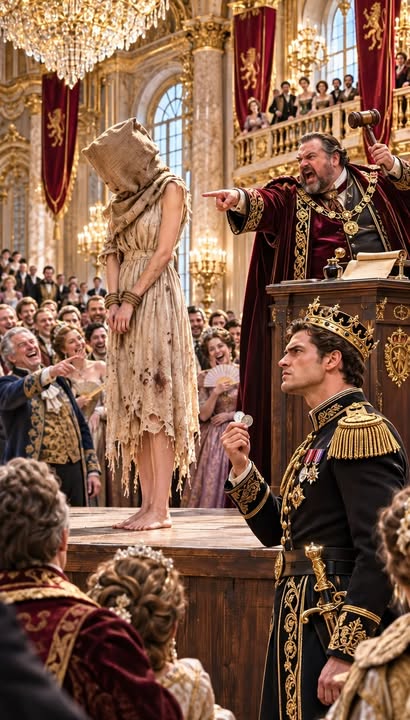
Part 4 – The Compass Beneath the Seal
“Did you order the bridge cut?”
The king’s question remained in the council room after he had spoken, hanging above the table like a note held too long.
Lord Garrick did not answer at once.
He glanced at the scrap in the physician’s hands, then at the open inventory ledger, as if the truth might be written more neatly somewhere else.
“I did not,” he said at last. “I had no reason to.”
Caleb watched him carefully.
“Then you won’t object to a full review of the records.”
“I would welcome one.”
The answer was smooth, but not effortless.
The king reached for the sealed report, then stopped before touching it.
“Before anyone reads this, I want the original inventory and every related document brought from the archive.”
“They are here,” the clerk said, indicating the leather folio.
“Every document,” Edric repeated. “Not only the ones selected for this room.”
Garrick inclined his head.
“Of course.”
Josephine stood beside the physician, one hand resting over the hidden compass.
She had said little since the name on Adrian’s note was read aloud.
Caleb could not tell whether she was frightened, angry, or simply tired of hearing men discuss the night that had shaped her life as though it were an old matter of state.
He turned toward her.
“Would you like to leave?”
“No,” she said. “Not yet.”
The king looked at her with a new solemnity.
“Josephine, I owe you an apology.”
She did not move.
“I have not yet learned the truth,” Edric continued, “but I accepted a report that ended the search for my sons without asking enough questions about how it had been prepared.”
“You were told they were dead,” she said.
“I was told there were no survivors.”
“You chose to believe it.”
“Yes.”
The simplicity of his answer seemed to cost him more than a defense would have.
“I should have asked for the officers themselves,” he said. “I should have continued the search, even if the report said it was hopeless.”
Caleb looked at his father.
The king’s voice had lost its practiced certainty, and with it the distance that usually separated a monarch from everyone in the room.
“I thought ending the search was the only way to prevent more people from dying,” Edric added. “That does not make my choice right.”
Josephine lowered her hooded head by a fraction.
“Adrian helped me because he believed someone would still be looking.”
“I should have been,” the king said.
The physician set Adrian’s compass on the table beside the folded note.
“Your Majesty, before we examine the report, may I ask to see Josephine’s compass once more?”
She hesitated.
“Why?”
“There may be something inside it beyond the bearing mechanism.”
Caleb glanced at the brass case.
“Did you notice something?”
“The lid is thicker than it needs to be.”
The king leaned forward.
The physician did not reach for the compass.
“I can show you where,” he said. “You can decide whether I examine it.”
Josephine drew the cord from beneath her dress and placed the compass in her palm.
She held it toward the light.
The physician pointed to a narrow groove running along the inside rim.
“It is easy to mistake for wear,” he said. “But it continues around the hinge.”
Caleb turned Adrian’s compass over.
The same groove ran beneath its cracked glass face.
“Could the case be opened?” he asked.
“With a proper instrument,” the physician replied. “Though forcing it could damage what is inside.”
Josephine closed her fingers around the lid.
“Adrian gave it to me,” she said. “He told me to keep it safe.”
“He may have meant more than the compass itself,” Caleb said.
“Or he may have wanted me to keep the compass.”
“He may have.”
The physician did not press her.
For a moment, the room seemed to shrink around the small brass object and the fragile trust required to open it.
Then Josephine placed the compass on the table.
“You may examine it,” she said. “But I want to see everything you do.”
“Of course,” said the physician.
He asked the clerk for a small set of tools from the archive kit.
While they waited, Caleb looked at the sealed report.
“May I open it?” he asked his father.
Edric studied the packet.
“It was opened before. The seal is only a ribbon now.”
“Then we should read it together.”
The king untied the ribbon and unfolded the pages.
The paper had yellowed at the edges, but the writing remained clear.
Edric read the first lines silently, then passed the report to Caleb.
The document stated that the expedition’s lower bridge had been lost in the storm, that the northern trail was impassable, and that no prince or party member had been located after a search lasting four days.
It listed the names of the officers who had examined the mountain camp.
Adrian’s name appeared among those presumed dead.
Caleb read the report again.
“Where does it say the bridge was destroyed by the storm?”
“It says it was lost during the storm,” the king replied.
“That isn’t the same thing.”
“No.”
“Who signed it?”
A name appeared at the bottom, beneath a careful seal.
Captain Voss.
The king frowned.
“I remember the captain. He was one of the officers assigned to the expedition.”
“Was he the one who delivered the report?”
“I don’t remember.”
Garrick rested his palms on the table.
“Captain Voss was among the survivors. He may have sent it through the military office.”
“May have,” Caleb repeated.
The king’s gaze returned to the page.
“Why was there no direct account from him?”
“Perhaps he was injured,” Garrick said.
“Perhaps,” Edric answered. “But the report does not say.”
Caleb turned another page.
The document included a list of recovered equipment, but Adrian’s compass was not named.
There were two other brass compasses, one cracked and one missing its lid.
“This inventory doesn’t match what we found in the archive,” he said.
The clerk leaned over the page.
“Those entries are from the expedition’s field list,” he said. “The archive inventory was prepared after the items were returned.”
“Then bring both records,” the king said. “And find out who entered Adrian’s compass into the archive.”
The clerk bowed and left.
Garrick remained still.
The physician returned with the archive tools and set them beside Josephine’s compass.
He chose a slender pick and studied the groove before touching it.
“May I?” he asked her.
She nodded.
He worked the point carefully along the seam, pressing neither too hard nor too quickly.
A soft click sounded.
The lower plate loosened.
The physician placed the tool down and lifted the thin brass disk away.
Beneath it lay a folded scrap of paper, pressed flat against the inner casing.
Caleb felt the room change.
Josephine’s hand moved toward the table, but she stopped before reaching for it.
The physician lifted the paper with a pair of narrow tweezers and set it on a clean cloth.
“It has been protected from moisture,” he said. “The ink may still be legible.”
“Can you read it?” Caleb asked.
“I’ll open it slowly.”
The physician unfolded the scrap one crease at a time.
The writing was cramped, but unmistakably Adrian’s.
Caleb knew the slant of the letters from old maps and letters written in the years when they had shared a room.
His throat tightened.
The physician read the first line under his breath, then turned the page toward the light.
“What does it say?” Josephine asked.
The physician looked to Caleb.
He read the words aloud himself.
“Garrick ordered the bridge cut before the storm reached the pass.”
No one spoke.
Caleb looked at the magistrate.
Garrick had not stepped away from the table, but his face had gone pale beneath its careful composure.
The king stood very slowly.
“This is a serious allegation,” he said.
“It is a note in a hidden compartment,” Garrick replied. “Its writer is not here to explain it.”
“Adrian wrote it,” Caleb said.
“You cannot know that from a few lines.”
“I know his hand.”
“You knew him as a brother, not as a clerk comparing documents.”
The remark found a small opening in Caleb’s certainty.
Josephine had not moved.
The physician examined the paper closely.
“The ink and paper appear consistent with the expedition period,” he said. “I cannot establish authorship from that alone, but there is no sign it was recently placed in the casing.”
Garrick looked at him.
“That is not proof.”
“No,” the physician said. “It is evidence.”
The king’s gaze remained on the note.
“Why would you have ordered the bridge cut?” he asked Garrick.
“I did not.”
“What was the purpose of the bridge?”
“It was the only crossing over the lower gorge.”
“Then why would someone cut it?”
“To keep the expedition from using it during the storm, perhaps.”
Caleb’s eyes narrowed.
“Who would have reason to stop the expedition?”
“I cannot answer for someone who may have acted without my knowledge.”
The king looked again at the note.
“You were named twice.”
“By whom?” Garrick asked. “One time on a loose scrap hidden inside a compass, and once on the back of a second paper found in an archive ledger that no one can explain.”
Caleb thought of the note in the ledger.
Ask Father who ordered the bridge cut.
The name on its reverse had been faint and incomplete.
Garrick.
“Adrian was trying to leave a trail,” Josephine said.
Her voice was quiet, but the room turned toward her.
She had lifted her hooded face toward the table.
“He gave me the compass and told me to find someone who would believe me,” she continued. “He had already written a warning. He wanted the truth to survive even if he didn’t.”
“You did not mention this message before,” the king said.
“I didn’t know it was there.”
“Did Adrian tell you anything about the bridge?”
“He said the men outside the cave had cut it. He said we couldn’t follow the road back to the camp.”
“Did he name Garrick?”
“No.”
“Did he say who had ordered the men?”
“No.”
The king’s expression remained grave.
“Then we have a hidden note and a memory of men arguing in a storm. We cannot condemn anyone on that alone.”
“I’m not asking you to condemn him,” Josephine replied. “I’m asking you to find out what happened.”
The physician set the compass beside the recovered scrap.
“If the second compass contains a matching compartment, it may hold another part of the message.”
The king looked at the cracked glass casing.
“Can you open it without damaging the face?”
“With care.”
Edric nodded.
The physician began to work.
This time, the hinge was more difficult.
The cracked glass shifted slightly, and he paused to stabilize it before continuing.
At last, the brass plate lifted.
A narrow strip of paper lay inside.
It had been folded twice and marked with a faint blue line.
The physician unfolded it.
The strip contained a simple drawing of the mountain pass, with the lower bridge marked by a small cross.
Beside it were a few lines in Adrian’s hand.
Caleb read them aloud.
“Garrick cut the bridge to stop us reaching the east storehouse.”
The king’s eyes rose to Garrick.
“What was in the east storehouse?”
“I don’t remember.”
“You were responsible for the expedition’s financial records,” Caleb said.
“I oversaw several departments.”
“The storehouse held the supplies and accounts for the northern route.”
“That is possible.”
“Was anything missing from it?”
Garrick folded his hands.
“Not that I recall.”
The physician turned the strip over.
There were more words on the reverse, written in a smaller hand.
He read them in silence.
“What is it?” Josephine asked.
The physician passed the paper to Caleb.
The added message was a list of supply charges, several marked with the same initials.
At the bottom, Adrian had written: “Numbers altered. Voss found it.”
The king leaned over Caleb’s shoulder.
“Voss,” he said. “The captain who signed the report.”
“Adrian thought he found evidence of altered accounts,” Caleb said.
“Or someone wanted us to think that,” Garrick replied.
Caleb looked down at the matching halves of the compass.
They had begun as keepsakes from a lost expedition.
Now they held a record of the bridge, the storehouse, and an accusation that reached into the kingdom’s accounts.
“You told me the expedition belongings were inventoried under your supervision,” Caleb said.
“That is true.”
“You said you knew nothing about this note.”
“I did not.”
“You signed off on the review.”
“I signed off on the inventory, not every object recovered in the mountains.”
The king turned toward him.
“Garrick, were the expedition accounts audited after the search?”
“Yes.”
“By whom?”
“By the treasury.”
“Do we have the audit?”
“The records are in the archive.”
“Then we will examine them.”
Garrick nodded.
“I will arrange it.”
“You will not be the one to arrange the records concerning your own conduct,” the king said.
For the first time, the magistrate’s calm expression faltered.
Edric looked to the clerk, who had returned with another stack of ledgers.
“From this moment, the archive materials will be copied and witnessed by the royal physician and the treasury comptroller. No page is to be removed or altered.”
The clerk bowed.
Garrick gave a small nod, but his attention had shifted to Josephine.
Caleb stepped between them without thinking.
Then he caught himself and moved to her side instead.
The distinction mattered.
He would not make a wall of his body and call it protection if she had not asked for one.
Josephine remained facing the table.
“Does the note say Adrian survived?” she asked.
Caleb looked at the narrow paper.
“No.”
“Does it say where he went?”
“No.”
The hope that had briefly entered the room seemed to retreat.
The king picked up the first scrap, the one discovered in the ledger.
“Ask Father who ordered the bridge cut,” he read quietly. “This was meant for me.”
“Yes,” Caleb said.
“Did Adrian think I knew who ordered it?”
“Perhaps he wanted you to investigate.”
“Or he believed I had allowed it,” Edric said.
No one contradicted him.
The king looked at the sealed report.
“I believed the expedition had been lost in a storm,” he said. “I did not know a bridge had been deliberately cut.”
“But you ended the search after reading a report that did not explain the bridge,” Caleb replied.
“I did.”
“You trusted the report.”
“I did.”
“And Garrick reviewed the evidence.”
“Yes.”
The king’s face had tightened, but not with anger.
It was the expression of a man seeing the outline of his own failure.
“I should have asked more,” he said.
Josephine’s fingers touched the edge of the table.
“You might have found Adrian.”
The king lowered his eyes.
“Yes.”
Caleb had imagined their father’s guilt in many forms, but not this quiet willingness to accept a truth that could diminish him.
It did not erase the years.
It did not restore what the search might have found.
But it made the room feel less like a courtroom and more like the place where a family’s grief had finally been allowed to speak.
A soft knock came at the door.
The steward entered with a second clerk.
“Your Majesty, the treasury comptroller has arrived,” he said. “He asks whether he may begin reviewing the expedition accounts.”
“Bring him in,” Edric replied.
The comptroller entered carrying a narrow ledger and a bundle of loose sheets.
He set them on the table and bowed to the king.
“I was told to find the northern expedition’s final accounts,” he said. “This is what remains in the treasury archive.”
Caleb opened the ledger.
The entries were orderly, their columns ruled in dark ink.
He found charges for ropes, food, lamps, horses, and bridge repairs.
One item appeared repeatedly: a large payment to a contractor named Bell and Sons, recorded for work on the lower crossing.
The dates did not match the expedition schedule.
“Why were repairs paid for after the bridge was cut?” Caleb asked.
The comptroller checked the ledger.
“Those payments were entered after the search ended.”
“Were the repairs completed?”
“I cannot tell from the treasury copy.”
“Who authorized the payments?”
The comptroller traced the margin.
“The authorization bears the magistrate’s seal.”
Garrick’s expression hardened.
“Many payments were processed with my seal.”
“Were they authorized by you?” the king asked.
“I would need to inspect the original vouchers.”
The comptroller opened the bundle.
Most of the papers were copies, but one folded document was marked with the royal expedition crest.
He laid it beside the ledger.
“This is the only original voucher I found.”
The paper bore the contractor’s mark and a line of authorization.
Below it, in a smaller hand, was a notation: “Paid in full for bridge work completed before departure.”
Caleb looked at the date.
It was three weeks earlier than the expedition’s arrival at the crossing.
“The bridge repairs were paid for before the expedition reached the pass,” he said.
The comptroller nodded.
“According to this voucher.”
The king looked at Garrick.
“You said the bridge was lost during the storm.”
“I said I did not order it cut.”
“Then why was the contractor paid for work completed before the party arrived?”
“I cannot explain that from a copy.”
“Can the original be found?”
“The treasury’s original payment book may still exist,” the comptroller replied. “It is stored in the western archive.”
“Bring it here.”
The comptroller bowed and left with a guard.
Josephine stood quiet beneath her hood, listening to the ledger pages turn.
Caleb had begun to understand that the truth would not arrive as one clean revelation.
It would come in scraps, dates, and names that had been forgotten on purpose or misplaced by carelessness.
And each fragment seemed to ask whether they were prepared to follow it even when the answer implicated the crown.
The king set the report aside.
“Garrick, until this review is complete, you will have no access to the expedition files.”
“I understand.”
“You will remain available to the inquiry.”
“I will.”
Caleb studied the magistrate.
The obedience was exact, but the pause before each answer was new.
“You may go,” the king said.
Garrick bowed and turned toward the door.
At the threshold, he stopped.
“Your Majesty, I urge caution. The monarchy’s authority rests on the court’s confidence that its judgments are sound.”
“Then we should make certain this judgment is sound,” Edric replied.
Garrick bowed again and left.
The door closed behind him.
For several moments, no one spoke.
Then the king looked toward Josephine.
“If this investigation continues, your account may become part of the public record. You will not be compelled to speak before you are ready.”
“I have already been displayed in front of the court,” she said.
Edric accepted the rebuke without flinching.
“You should never have been.”
Caleb felt the words settle inside him.
He had signed a decree to stop an auction.
The decree had been meant as an interruption, not a solution.
Yet even now, the paper that called Josephine his bride stood in the same palace where her own testimony might be treated as a matter of royal convenience.
“We need to discuss what happens to the marriage decree,” he said.
The king looked at him.
“We can annul it.”
“I know.”
Josephine turned slightly toward Caleb.
He continued carefully.
“I won’t ask you to stay because of a document I signed in front of a room full of people. You owe me nothing.”
“You said that before,” she replied.
“I mean it now.”
“Do you want the marriage annulled?”
Caleb took a breath.
“I want you to be free to decide without the auction, without the court, and without me making the choice for you.”
“And if I decide to leave?”
“I will help you leave safely.”
“And if I stay?”
“Then you stay because you choose to.”
Josephine’s hand found the compass beneath her collar.
“I don’t know what I’ll choose.”
“You don’t have to know today.”
The king stood by the window, giving them space.
Caleb had spent years believing that if he could understand what happened on the mountain, he might finally put the past away.
Now he understood that the past had not been waiting to be buried.
It had been waiting for someone to ask the right questions.
The physician gathered the two compass halves and their recovered notes, laying them together in the wooden case.
“I recommend these be kept in a secure place, with Josephine’s consent,” he said. “The papers are fragile, and the compass is evidence.”
“I’ll keep mine,” Josephine said.
The physician nodded.
“Then I suggest the matching half and the notes remain with the king’s clerk, with copies made in your presence.”
“That is acceptable,” she said.
The king looked to the clerk.
“Prepare a copy of every document found today. Josephine will receive one, and Caleb will receive another. The originals will remain in the archive under witness.”
The clerk bowed.
Caleb saw Josephine’s shoulders relax by a small measure.
Not because the danger had passed.
Because, for once, the terms of what happened next had been spoken aloud.
A knock came at the door again.
The treasury comptroller returned sooner than expected, his face drawn.
He carried a single document in a protective sleeve.
“I found the original payment book,” he said. “There is a notation that does not appear in the copy.”
The king took the book and opened it to the marked page.
The original entry showed the payment to Bell and Sons, then a second line in darker ink.
The bridge was not repaired.
The contractor had been paid to remove its central supports.
Caleb read the words twice.
Below them was a signature.
Garrick.
The king held the ledger without moving.
For a long moment, no one in the room spoke.
Then Josephine’s voice came softly from beneath the hood.
“That still doesn’t say why.”
The comptroller turned another page.
“There is an attached account,” he said. “It lists the work as a temporary safety measure, but the funds were charged to the eastern storehouse.”
Caleb stared at the altered account.
Adrian’s note had said the bridge was cut to keep the expedition from reaching that storehouse.
The payment had been charged to the same place.
“Did Garrick take the money?” the king asked.
“The account is incomplete,” said the comptroller. “But there are several entries for supplies that were never delivered.”
The king’s face had gone pale.
The bridge had not been cut merely to strand the expedition.
Someone had wanted the party away from the storehouse long enough to hide what had been taken from it.
“Who else had access to the original accounts?” Caleb asked.
The comptroller turned to the final page.
“Only the treasury clerk, the expedition office, and the magistrate’s office.”
A thin slip of paper had been folded into the binding.
The comptroller eased it free.
It was a receipt dated the morning after the storm, signed by Captain Voss.
The final line was written in a hand that was not his.
“Report both princes dead. Search to be closed by order of the crown.”
The king stared at the words.
“I never gave that order.”
Caleb looked at the receipt, then at his father.
The report had not merely ended the search.
Someone had written the king’s authority into it.
The comptroller turned the slip over.
On the back, beneath the date, someone had added a brief note.
“Josephine Rourke alive. At the palace.”
Caleb looked up sharply.
The words could not have been written three years ago.
The ink was fresh, the paper clean.
Someone had placed it inside the old ledger after the inquiry began.
And whoever had written it knew Josephine’s name—and knew exactly where she was.
**–END OF PART 4–CLICK “NEXT” AT THE BOTTOM OF THE PAGE TO CONTINUE READING**
* * *
[PREVIOUS: PART 3](https://storyly.idolsgift.com/blog/part-3-the-six-words-that-stopped-the-palace-058) | [NEXT: PART 5](https://storyly.idolsgift.com/blog/part-5-the-six-words-that-stopped-the-palace-058)
✓ Lynn R. Adams
Part 4 – The Compass Beneath the Seal “Did you order the bridge cut?” The king’s question remained in the council room after he had spoken, hanging above the table like a note held too long. Lord G…