PART 4: The Signature No One Expected 041
Part 4 – The Debt Beneath the Signature
The name on the receipt belonged to Richard’s assistant, Paul Avery.
Vincent read it once, then again, while the evening light drained from the room.
The receipt proved only that Paul had taken the blazer to the cleaner the day after Elena wore it.
It did not prove why.
Still, the timing sat beside the copied signature like a question no one could politely ignore.
Daniel had asked them not to disturb the blazer or its remaining contents until he could arrange a proper review.
Vincent sent him the photograph and asked him to preserve the original receipt.
Then he called Elena.
She answered quietly, with the sound of a car indicator ticking in the background.
“Paul took the blazer to the cleaner,” Vincent said.
“Richard’s assistant?”
“Yes.”
“Do you know why?”
“No.”
“Neither do I.”
“I’m not saying you do.”
“I know. But I can hear the question you’re trying not to ask.”
Vincent looked at the receipt on his screen.
“Did you notice anything unusual when you wore it?”
“No.”
“Did you leave it somewhere?”
“I took it off at the end of the dinner and left it in the garment bag you brought.”
“Who had access to the bag?”
“Staff at the venue, perhaps. You. Marco, if he carried it. Rosa when she hung it up.”
“And Paul afterward.”
“If he took it to the cleaner, yes.”
Neither of them spoke for a moment.
The list was ordinary, which made it more troubling.
There was no secret room, no impossible intrusion, only the familiar movement of a garment from one person to another.
Vincent had spent years believing that careful people could keep uncertainty outside the door.
He was beginning to see how easily it could be carried in with the everyday things they trusted.
“I’ll ask Daniel to include Paul in the review,” he said.
“Don’t make him a suspect because his name is on a receipt.”
“I won’t.”
“Richard may have asked him to handle the cleaning. Or Paul may have done it as a favor. There are plenty of explanations.”
“I know.”
“I’m not defending Richard.”
“I know that too.”
Elena sighed.
“I’m trying to keep us from deciding who did this before we understand how.”
“You’re better at that than I am.”
“Only because I’ve had more practice being doubted.”
The words landed quietly between them.
Vincent closed his eyes for a moment.
“I’m sorry I gave you so much practice.”
“I believe you.”
That did not erase what had happened, but it allowed them to continue.
They agreed to meet at Daniel’s office the next morning, with the relevant records and no one else present until the document review was complete.
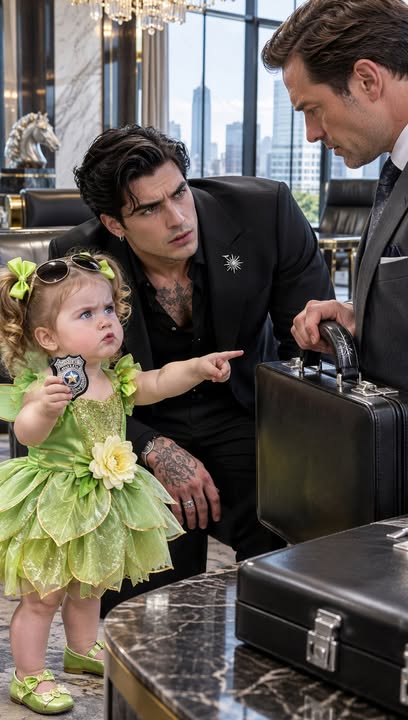
When Vincent ended the call, he found Mia sitting on the rug beside Rosa, fastening her toy badge to the skirt of her fairy dress.
The plastic clasp kept slipping.
Mia’s brow furrowed with grave concentration.
“Need help?” Vincent asked.
She held the badge toward him.
He crouched and fastened it securely.
“There.”
“Good,” she said.
“Thank you, Officer.”
Mia patted the badge, satisfied, and reached toward the silver starburst pin Vincent had set on the side table.
He moved it beyond her reach.
“That one stays with me.”
“Star.”
“Yes.”
She looked from the pin to his face, then leaned into his shoulder.
For a few minutes, the office, the signature, and the receipt seemed far away.
Then his phone vibrated.
Daniel had written that the forensic examiner could speak with them the following morning.
Vincent set the phone aside and held his daughter close.
He wanted to believe that the next answer would bring clarity.
He was learning that answers often arrived with more questions attached.
At Daniel’s office the next day, the examiner laid two documents side by side beneath a desk lamp.
The disputed agreement was on the left.
An older property contract bearing Elena’s genuine signature was on the right.
Elena sat very still beside Vincent.
The examiner, a reserved woman named Dr. Shah, pointed to the signature on the newer agreement.
“This is not consistent with a natural, contemporaneous signature,” she said. “The line quality and spacing show that the writer was following a model.”
“Copied by hand?” Vincent asked.
“That is the most likely explanation. It was not simply cut from another page and pasted here. The pressure changes, but the forms closely reproduce the exemplar.”
Elena leaned closer, careful not to touch either sheet.
“Which exemplar?”
“We cannot identify the exact document from the signature alone,” Dr. Shah replied. “But the older contract beside it contains several matching features.”
Vincent looked at his sister.
“You signed this one?”
“Yes. It was a property agreement from years ago.”
“Do you remember when?”
“Before Dad died. I signed it at the family office.”
Dr. Shah indicated the start of the last letter.
“The copy follows the older signature’s unusual turn here, including a small hesitation. It also repeats a slight upward stroke that is less apparent in Elena’s more recent signatures.”
Elena’s mouth tightened.
“So someone used an old contract.”
“It appears likely,” Dr. Shah said. “I would not say this examination identifies who copied it, or where they obtained the source.”
Vincent kept his hands flat on the table.
“Could the signature have been made from a photograph?”
“Possibly. A clear image or a photocopy could provide a usable model. The pen pressure on this document is real, but the writing itself appears to have been carefully imitated.”
Elena looked down at the two pages.
She did not seem relieved.
“Does the blazer matter?” Vincent asked.
“Not to the signature analysis,” Dr. Shah said. “It may be relevant to access or timing, but the document itself points to an older source.”
The finding changed the shape of Vincent’s suspicion.
The silver-starburst blazer had been an intriguing coincidence, but it was not the source of the signature.
Someone had used a contract signed years earlier.
Someone had known where to look, or had possessed a copy.
The old document had been part of the family business, stored in the ordinary stream of records that passed through their offices.
“Can we establish when this agreement was prepared?” Elena asked.
“The paper and ink do not give us a precise date,” Dr. Shah replied. “The document’s date is consistent with the surrounding materials, but a printed date is not proof of when it was created.”
Vincent glanced toward Daniel.
“What about the payment trail?”
Daniel opened a folder.
“We have more than the first transfer. Northstar received three payments from separate property accounts over six months.”
“Who owns it?” Elena asked.
“Officially, a registered agent manages the company,” Daniel said. “The beneficial ownership records are incomplete in the filings we’ve obtained. We’ve requested additional information through counsel.”
“Do the payment amounts match the agreement?”
“One payment does. The others predate it.”
Elena folded her hands.
“So Richard may have been using the company before the agreement existed.”
“Or someone else was,” Daniel said. “We need records that establish control.”
Vincent’s eyes moved between the documents.
The forged signature had been made to look as if Elena had approved the agreement.
The payments had begun months before the document was dated.
Richard had carried the briefcase containing it.
Each fact strengthened the suspicion around him, but none yet showed the full design.
“What was the agreement meant to do?” Vincent asked.
Daniel opened the document to its first page.
“It would have assigned a portion of the acquisition proceeds to a separate entity and given that entity a standing role in future property decisions.”
“Northstar?”
“That is one possibility. The agreement names a holding company, not Northstar directly.”
“Who controls the holding company?”
“We don’t know yet.”
Elena studied the page.
“If this had gone through, would it have changed who could approve the acquisition?”
“It could have created a conflict in the approval process,” Daniel said. “Depending on how it was interpreted, it might also have allowed someone to challenge the existing decision structure.”
“Which would create leverage,” Vincent said.
Daniel nodded.
“That is a reasonable concern. It is not yet a complete explanation.”
Vincent heard the warning in his tone.
He had spent the past day trying to keep facts separate from the story forming around them.
He would not turn a reasonable concern into a verdict simply because it felt satisfying.
“What else do we have?” he asked.
Daniel opened another folder.
“Richard’s written response says Elena gave him verbal authorization and that the agreement was prepared afterward to reflect their understanding.”
Elena looked at him.
“He told you that?”
“He told the company’s counsel.”
“Did he explain why he had my signature copied from an old contract?”
“He said the signature was provided to him with the paperwork.”
“By whom?”
“He did not specify.”
“Did he say who prepared it?”
“No.”
Elena’s expression remained composed, though color had risen along her cheekbones.
Vincent saw how carefully she was holding herself still.
“He has shifted the responsibility without naming anyone,” she said.
“That is how his statement reads,” Daniel agreed.
Vincent looked at the copy of the agreement.
“Could the person who prepared it have had access to our old records?”
“Many people had legitimate access to the archive,” Daniel said. “There were scanned copies in the property files, and older originals in storage. We are reviewing access logs, but some of the records were maintained before the current system.”
“Can the date of access be reconstructed?”
“Not completely.”
The answer left the room with no single person to accuse and no clean route to certainty.
Elena turned toward Vincent.
“I want to show you something from Dad’s old files.”
“What?”
“A ledger I found while tracing Northstar.”
“Why didn’t you bring it yesterday?”
“I wasn’t sure it was relevant. I wanted to check the dates first.”
“Is it about the payments?”
“Not directly.”
“Then what is it about?”
“Our father’s debt.”
Daniel’s attention sharpened.
Vincent leaned back.
“What debt?”
Elena looked at him as if she had expected the question, but still wished she did not have to answer it.
“Dad told us the property company had struggled after the recession,” she said. “He said he sold part of his stake and paid off the loans.”
“That’s what I remember.”
“It wasn’t the whole story.”
For a moment, Vincent heard only the faint hum of the office’s ventilation.
Their father had been gone for five years.
His memory had settled into the family like a familiar portrait: proud, stubborn, generous in private, difficult in business, but always the person who had kept the company standing.
“What did he hide?” Vincent asked.
“Not a crime,” Elena said quickly. “A debt he had personally guaranteed and a series of transfers he made to keep one of the properties from defaulting.”
“Why would he conceal that from us?”
“Because he thought he was protecting us. He used a reserve account to cover the payments, then recorded the transfers under a broader category. He planned to replace the money after a sale closed.”
“Did he replace it?”
“Yes.”
“Then what is the problem?”
“The records were incomplete. He kept the details in a separate ledger, not in the main accounts. When I found it, I thought the transfers might be connected to Northstar.”
Vincent looked at her.
“You thought Dad had used the same method?”
“I didn’t know. The descriptions were similar. That is why I kept investigating.”
“Why didn’t you tell me about the ledger?”
“Because I wasn’t sure what it meant, and because I knew how it would sound.”
“How would it sound?”
“Like I was accusing Dad of dishonesty.”
“You were protecting him?”
“I was trying to understand what he had done before I made his choices part of someone else’s story.”
The answer stilled Vincent.
Their father had kept the business alive through a difficult period.
Vincent knew that much.
He had not known about a personal guarantee, a reserve account, or the quiet rearrangement of the records.
“Did Richard know about this?” he asked.
Elena nodded.
“He worked with Dad closely during that period. I found emails where Dad explained the debt to him.”
“So Richard knew there had been concealed transfers.”
“He knew the reason for them. He also knew Dad had eventually paid them back.”
Vincent felt the pieces draw closer, though they still did not form a complete picture.
“Could Richard have used the old records to make his own transfers look like Dad’s?”
“That’s what I was afraid of.”
“Why didn’t you tell me that part?”
Elena looked at him steadily.
“Because I didn’t want to accuse Richard without evidence, and I didn’t want to turn Dad into the explanation for anything Richard might have done.”
“You thought I would dismiss it as family loyalty.”
“I thought you might hear only the part about Dad and decide the records were too sensitive to examine.”
Vincent lowered his eyes.
He could not honestly tell her she was wrong.
“What did Dad say about the debt?” he asked.
“I found a note in the ledger. He wrote that the transfers were temporary and should be disclosed once the property sold. It seems he believed the money would be restored before anyone needed to know.”
“Did he tell you that himself?”
“No. I found it in his handwriting.”
“And the reserve was repaid?”
“Yes. I traced the payments. The balance was restored two months after the sale.”
Vincent sat quietly, holding two truths at once.
Their father had concealed a legitimate debt to protect the company and, in doing so, had created records that could be mistaken for something more troubling.
He had intended to repay the money.
He had done so.
But he had still hidden the trail from his children and from the people responsible for the accounts.
The family’s past was neither clean nor villainous.
It was complicated, shaped by fear, responsibility, and decisions made in rooms where no one had invited the next generation.
“Was the debt disclosed to the board?” Vincent asked.
“Not fully,” Elena said. “The guarantee was recorded, but the transfers were not explained in detail.”
“That means Dad made a choice the company should have known about.”
“Yes.”
“Even if it was repaid.”
“Yes.”
She did not soften the answer to make it easier for him.
Vincent appreciated that, though it hurt.
Daniel closed the folder in front of him.
“This is why we need to preserve the records as they are,” he said. “We should not alter, remove, or reclassify anything.”
“I agree,” Elena replied.
Vincent looked at her.
“Did Dad’s old ledger mention Northstar?”
“No. The company did not exist then.”
“Did Richard refer to the debt when he spoke about the agreement?”
“No. But he told me once that Dad had kept the business alive by making difficult decisions without explaining them to everyone.”
Vincent remembered Richard saying something similar years earlier, after their father’s funeral.
At the time, it had sounded like a tribute.
Now it sounded like something that could be used as permission.
“Did Richard know the old contract had Elena’s signature?” Daniel asked.
“Anyone who worked with the property files could have seen it,” Vincent said.
“That leaves a wide circle.”
“Yes.”
Elena touched the edge of the ledger copy.
“I kept this from you because I was afraid you would see it as a reason to stop looking.”
Vincent met her eyes.
“I might have.”
“That’s why I waited.”
“I understand why you did it. I don’t want us to keep making decisions alone because we think the other one won’t understand.”
Elena’s expression shifted.
“Neither do I.”
For a brief moment, the two of them sat on the same side of the table, looking at the same difficult inheritance.
Not just a company.
Not just a signature.
A history of private choices that had protected the family until those choices became useful to someone else.
Daniel gathered the documents and promised to preserve the ledger’s chain of custody.
He also advised them not to confront Richard until they had the company records and the ownership information for Northstar.
“His statements may change once he knows what we have,” he said. “It’s better to give him a fair opportunity to respond when the facts are complete.”
Vincent agreed.
Elena did too.
They left Daniel’s office together and rode the elevator down in silence.
Outside, the city was bright and unsettled, its traffic moving in slow lines past the courthouse and the stone buildings nearby.
Elena held the folder against her chest.
“I’m sorry about Dad,” she said.
“Which part?”
“That he left us a secret that can be used to make something worse look familiar.”
Vincent watched the reflection of passing cars in the glass doors.
“He thought he was protecting the company.”
“He did.”
“He paid the money back.”
“He did.”
“And still, he should have explained it.”
“Yes.”
The plainness of her answer helped him more than reassurance would have.
“I wish he’d trusted us with the truth,” Vincent said.
“So do I.”
They reached the curb.
A car waited for Elena, but she did not get in immediately.
“Do you think Richard knew what Dad had hidden?” she asked.
“You said he did.”
“I mean, do you think he understood the difference between Dad’s temporary debt and these transfers?”
Vincent thought about the agreement, the shell-like company, and the old signature copied with care.
“I think he understood enough to make the past look useful.”
“That isn’t the same as knowing what he did.”
“No.”
Elena opened the car door, then paused.
“Call me before you make any decision about the business.”
“I will.”
“And not after.”
“I’ll try.”
“Don’t try, Vincent. Do it.”
He almost smiled.
“All right.”
She got into the car.
Vincent remained on the sidewalk until it pulled away.
When he returned to the office, Daniel had left him a secure message from the accounting team.
The records showed that Northstar had paid part of its proceeds to a second company.
That company had made a payment to an account associated with a vendor the Moretti business had used for years.
It was not enough to identify the owner.
It was enough to show that the money had not simply vanished.
Vincent asked Daniel to continue tracing it through lawful channels and to provide the same records to Elena.
Then he called Paul Avery.
Paul answered from his desk, sounding surprised.
“Mr. Moretti?”
“I have a question about a garment-cleaning receipt.”
A pause.
“The blazer?”
“Yes.”
“Richard asked me to take it in after the foundation dinner,” Paul said. “He said you’d left it in his office and that he was returning it to your house.”
Vincent’s eyes narrowed.
“Why would Richard have my blazer?”
“I don’t know. He said it had been in the conference room after the event. I assumed he’d picked it up with the other things.”
“Did he ask you to remove anything from the pockets?”
“No.”
“Did you?”
“No. I put it in the garment bag and took it to the cleaner. They gave me a receipt, which I tucked into the outer pocket.”
“Did you see Elena’s signature on any document that day?”
“No.”
“Did Richard give you the agreement?”
“No, sir.”
Paul sounded uneasy, but not evasive.
Vincent thanked him and ended the call.
The blazer had passed through Richard’s hands after the event, then through Paul’s, then back to the house.
The receipt’s date had seemed suspicious because it matched the agreement.
But the cleaner had handled the garment, and the signature had come from an older contract.
The blazer was no longer a likely source.
It was simply one more object that had moved through too many hands to tell its own story.
Vincent forwarded Paul’s account to Daniel and asked him to document it without treating the assistant as responsible.
After that, he sat alone with the copied signature and the old contract side by side on his screen.
One belonged to the present scheme.
The other belonged to a decision their father had made years earlier.
Both carried Elena’s name.
He thought of Mia’s drawing, two briefcases beside a starburst, and of the small voice that had called every case “Dada’s.”
The child had not understood the documents or the money.
She had simply noticed the case she recognized.
Vincent would not confuse that with proof.
But he could not forget that adults had missed what she saw because the case looked ordinary.
His phone rang.
Elena’s name appeared.
“I found another page in Dad’s ledger,” she said.
“What does it say?”
“He wrote that the old debt had to remain private until the acquisition was complete.”
Vincent went still.
“Which acquisition?”
“I don’t know yet.”
“Is the note dated?”
“Yes. It was written years before the current deal.”
“Could he have meant a different acquisition?”
“That’s possible.”
A pause followed.
Then Elena said, “But the last line mentions a payment schedule that matches the one Richard has been using for Northstar.”
Vincent looked at the documents on his screen.
The room seemed to narrow around him.
“Read it to me.”
Elena’s voice dropped.
“‘If Richard needs the old schedule, give him the copy, but not the account key.’”
Neither sibling spoke.
The ledger did not say what Richard had done with the schedule.
It did not say why their father had given him a copy, or what an account key meant.
But the old secret had not merely resembled the new scheme.
Their father had once placed a piece of it directly into Richard’s hands.
**–END OF PART 4–CLICK “NEXT” AT THE BOTTOM OF THE PAGE TO CONTINUE READING**
* * *
[PREVIOUS: PART 3](https://echoesofstories.idolsgift.com/blog/part-3-the-signature-no-one-expected-041) | [NEXT: PART 5](https://echoesofstories.idolsgift.com/blog/part-5-the-signature-no-one-expected-041)
✓ Lynn R. Adams
Part 4 – The Debt Beneath the Signature The name on the receipt belonged to Richard’s assistant, Paul Avery. Vincent read it once, then again, while the evening light drained from the room. The rec…