PART 4: The Shortcut No One Was Meant to See 057
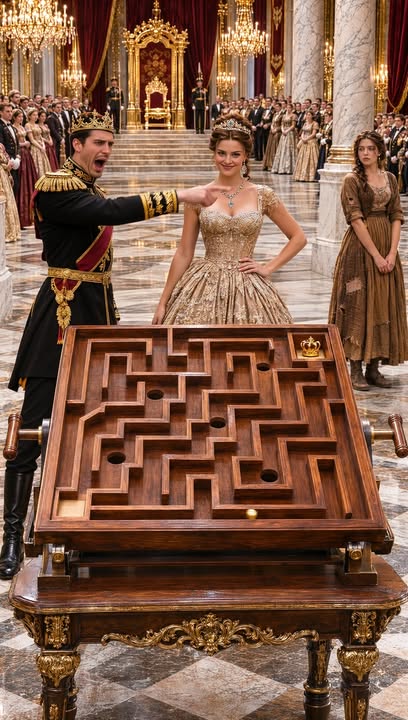
Part 4 – The Queen’s Unfinished Test
Adrian turned toward the north gallery.
Elara gathered her father’s drawings, while Celestine’s aunt wrapped the old ledger again in its linen cloth.
The palace archivist led them through a quiet corridor, past portraits whose painted eyes seemed to follow the company as they moved.
At the end stood a narrow door with a brass lock darkened by years of disuse.
“I have the key,” Adrian said, taking it from a small ring at his belt.
The lock resisted at first, then gave with a dry click.
The room beyond was modest, especially for a royal gallery.
Dust filmed the tall windows, and pale rectangles on the walls showed where pictures had once hung.
A writing desk stood beneath the far window, its surface covered by a linen cloth.
Adrian paused at the threshold.
“My mother kept this room for private papers,” he said. “After she died, the household sealed it while the family was in mourning.”
Mistress Rowe stepped inside first and checked the shelves without disturbing anything.
“Nothing appears to have been moved,” she said.
The prince crossed to the desk and lifted the linen.
A neat row of document boxes lay beneath it, each labeled in a careful hand.
Elara noticed the labels were not arranged by date.
Some bore names, some subjects, and one simply read: “For the one who asks why.”
Adrian stared at that last box.
“I’ve never seen it before.”
“Perhaps it was placed here before the room was sealed,” Mistress Rowe said. “The household may have followed an instruction not to catalogue it.”
She examined the box for a seal, but found only a narrow ribbon tied around its lid.
Adrian looked at the others before turning back to it.
“Could it be opened without damaging anything?”
“Yes,” Mistress Rowe replied. “The ribbon is not part of a formal seal.”
The prince untied it carefully.
Inside lay a folded letter, a small wooden token, and a packet of papers bound with faded blue thread.
The token was shaped like a little crown, though its points were worn smooth.
Elara felt her breath catch at the sight of the wood.
The grain and the tiny beveled edges reminded her of her father’s work.
Adrian lifted the letter, but did not unfold it.
“My mother’s handwriting,” he said.
His voice had changed, carrying a tenderness that made the room feel more private than its locked door could.
He passed the letter to Mistress Rowe.
“Would you read it aloud?”
She opened it with care.
The paper gave a soft crackle as she unfolded it, and then the archivist began.
“To whoever finds this, I ask that you first look for the route that appears to have no purpose.”
Elara glanced at the wooden token.
The letter continued.
“If you have found the quiet passage, then you have already learned that a path can be overlooked without being closed.”
Mistress Rowe paused.
No one moved.
“My purpose in commissioning this maze was not to discover who could force a ball through the fastest route,” she read.
“It was to discover who would take time to understand the whole board, who would notice that a narrow way could be safer than a grand one, and who would ask whether every player had been given a fair chance.”
Adrian lowered his eyes.
The words did not sound like a court proclamation.
They sounded like his mother speaking across a distance she had never expected to be so long.
Mistress Rowe continued.
“Thomas Vale helped me design the frame and its hidden passage.”
Elara gripped the edge of the table.
The name she had heard in ledgers and spoken aloud among strangers now sat plainly in the queen’s letter.
“His skill was matched by his care,” the archivist read. “He understood that a good structure should invite discovery without making failure the only lesson.”
Elara shut her eyes for an instant.
She heard her father’s voice as clearly as if he were beside her, reminding her not to hurry a door that had not yet been understood.
Celestine’s aunt drew a slow breath.
The prince stood very still.
Mistress Rowe continued.
“I asked Thomas to leave one safe route difficult to see, not impossible to find. It was meant to be discovered by observation, not by privilege.”
She turned the page.
“The exercise was intended for the young heir and for any who might advise him. A future ruler should learn that skill is not the same as judgment, and that identical instructions do not always make a contest fair.”
Adrian’s face had grown pale beneath the morning light.
“This was meant for me,” he said.
Mistress Rowe looked up.
“The letter says it was meant for the young heir, Your Highness.”
“But I never saw it.”
The archivist lowered her gaze to the page and continued.
“I asked that the test remain unfinished until the heir was old enough to understand its question. The answer was never meant to be a name. It was meant to be a choice: whether to reward only the person who reached the crown, or to ask who had been allowed to see the path.”
The quiet that followed was deeper than silence.
Elara stared at the letter.
For years, her father’s place in the palace had been reduced to a name in an old ledger and a mark on a brace.
Now she understood that he had not merely built a maze.
He had helped create a lesson meant to shape the person who would one day rule the kingdom.
Adrian took a step back from the desk.
“My family turned it into a contest for choosing a queen.”
No one rushed to answer.
The prince looked down at the papers, then toward the window where the gardens lay in muted winter light.
“Did my mother know they would do that?”
The question hung in the room.
Mistress Rowe read farther.
“There is no way to know,” she said gently. “The letter does not say.”
Celestine’s aunt leaned closer to the page.
“Is there anything about the records being sealed?”
Mistress Rowe checked the remaining lines.
“Not in this letter.”
“Could the papers have been separated after the queen’s death?” Celestine asked.
“They could have,” the archivist replied. “The household records were reorganized at that time.”
Adrian returned to the desk and picked up the small wooden token.
On one side, a faint three-pronged mark had been carved into the surface.
Elara recognized it as her father’s maker’s mark.
On the other side, in the queen’s handwriting, was a single word: “Listen.”
The prince turned the token in his fingers.
“She knew him well enough to trust him with this.”
“She trusted him with more than the construction,” Elara said.
Her voice was quiet, though her heart had begun to beat harder.
“She trusted him to understand what the test was supposed to mean.”
Adrian looked at her.
“Yes,” he said. “And we forgot that meaning.”
The words carried no attempt to defend the court or excuse the past.
That honesty made them harder to hear.
The prince placed the token beside the letter.
“My mother’s challenge has been used to decide who might stand beside me,” he said. “We have praised quickness, poise, and a perfect finish, while the reason for the test sat sealed in a room.”
Celestine’s aunt folded her hands.
“The court may not have known.”
“Some may not have,” Adrian replied. “But someone changed the story.”
Mistress Rowe turned to the packet tied in blue thread.
“Perhaps these papers will tell us when.”
She untied the thread and laid out three sheets.
The first was a rough plan of the maze, covered in measurements and small notes.
Elara recognized the slanted handwriting before she could read a single word.
Her father’s.
The second sheet showed the underside of the frame, with the quiet passage marked in pencil.
The third was a letter addressed to Princess Helena, signed by Thomas Vale.
Elara’s throat tightened.
She had seen her father’s hand in sketches, lists, and the brief notes he had left among his belongings.
She had never imagined finding it among the private papers of a queen.
Mistress Rowe did not open the letter.
“It appears to have been kept with the queen’s documents,” she said. “Would you like to read it yourself, Miss Vale?”
Elara looked toward Adrian.
He did not answer for her.
He only moved a chair closer to the desk.
She sat and took the letter with both hands.
The paper was thin, softened along the folds, and the ink had browned with age.
She read silently at first, then began aloud when she found her voice.
“Your Royal Highness, as requested, the inner route is complete.”
She stopped, unable to continue for a moment.
Her father had written “Your Royal Highness” as if he were speaking to someone he knew, not a distant figure in a painted portrait.
She read on.
“It is narrow, but a steady hand can follow it. I have left no mark to point it out, because you said the heir should have to look.”
Her eyes blurred.
She blinked and kept going.
“You asked whether the route could be found without being announced. I believe it can. It will not help the impatient, but it will not punish a careful player.”
The next lines were written more closely together.
“I have done as you asked and left the passage unfinished at the crown. The one who finds it should still have to decide what to do with it.”
Elara lowered the page.
“What does that mean?” Celestine asked.
Elara read the final lines again.
“I think he was supposed to leave something unfinished. Or leave the decision unfinished.”
Adrian leaned toward the letter.
“Could it mean the test was never intended to have a winner?”
“Not a winner in the usual sense,” Elara said.
She looked at the queen’s letter beside her father’s.
“It sounds as though my father was meant to build a question, not an answer.”
Celestine’s expression had softened, but uncertainty remained in her eyes.
“If the queen wanted the heir to find the passage, why was it never shown to him?”
Adrian looked at the sealed cabinet across the room.
“I don’t know.”
His answer was immediate, and the weight of it settled over everyone.
The prince’s mother had planned a private lesson for him.
The court had transformed that lesson into a public contest.
Thomas Vale’s name had disappeared from the story, and the route he built had become a secret that could be mistaken for a trick.
Elara thought of the people who had taken part in the trials before her, and the people who would have tried if they had known what the maze was truly asking.
“Could the queen’s letter explain when the maze became a contest?” Celestine asked.
Mistress Rowe examined the packet.
“These appear to be the original plans and the correspondence immediately related to them. There may be later records elsewhere.”
The archivist glanced at the phrase “the one who asks why.”
“This box was labeled for a future reader, but it was not an archive. Someone wanted these papers found only if a person looked beyond the obvious route.”
Adrian set the wooden token down.
“The phrase on the box sounds like my mother.”
“You remember her saying it?” Elara asked.
“I remember her telling me that the first answer is often only the answer someone expects you to stop at.”
He looked at the papers.
“I was young. I thought she meant riddles.”
“Perhaps she meant more than one thing,” Celestine said.
The prince looked at her, and she continued.
“The story everyone was given was that the maze tested skill. The letter says it tested whether someone would notice a safer route and question what fairness meant.”
Celestine’s voice grew more thoughtful.
“If the court changed the purpose, then it changed the question too.”
The aunt beside her seemed troubled.
“Why would anyone do that?”
No one offered an easy explanation.
There might have been fear of scandal, concern about the queen’s private intentions, or a belief that the kingdom needed a simpler story.
The papers gave them evidence of what had been lost, but not yet of who had chosen to lose it.
Mistress Rowe gathered the pages together in their original order.
“There may be a court record of the first contest,” she said. “If this exercise was presented publicly, the announcement should have been entered somewhere.”
“Could the old council register contain it?” Adrian asked.
“It might.”
“Then we should search it.”
Elara watched him look at the letter again.
He seemed to be seeing his mother not as the distant queen in portraits, but as a person who had asked a carpenter to help her make a lesson that could outlive her.
The realization appeared to pain him and comfort him at once.
“My mother wanted me to learn that a fair choice takes more than identical rules,” he said. “And I have spent years believing that simply applying the same challenge to everyone was enough.”
“You could not know what had been hidden,” Elara said.
“I could have asked why the challenge existed.”
“You did,” Celestine said. “You asked us to enter it.”
“That is not the same.”
“No,” she replied. “But it may be where you begin.”
Adrian met her gaze.
Celestine’s hands were folded at her waist, her expression solemn.
For the first time, her concern seemed less about her own lost attempt and more about the people whose efforts had been judged by a purpose they were never told.
“My family’s papers may hold another part of this,” she said. “If my relatives kept copies of the records, we may discover who changed the story.”
Her aunt watched her carefully.
“Celestine, do you know what you might find?”
“I know what I might lose.”
She glanced at the old letter.
“I don’t know whether the truth will cost my family its standing. I do know that continuing not to look has already cost us the truth.”
Her aunt lowered her gaze.
“I will help you search the papers at home,” she said. “We will read them before deciding what they mean.”
Celestine nodded, and for a moment the formal stiffness between them gave way to something more personal.
Adrian gathered the queen’s letter and the plans into a fresh archival folder.
“We’ll preserve these carefully,” he said. “No copies will be circulated until we understand the rest of the record.”
Mistress Rowe approved.
“That is sensible. The documents belong to the palace archives, but their preservation does not require an immediate public announcement.”
Elara felt a measure of relief.
The truth was important, but it was not a thing to be flung into a crowded hall without understanding whom it might harm or what it might repair.
She looked once more at her father’s letter.
His hand had been steady in the lines about the maze.
The final sentence, however, slanted downward more sharply than the rest.
“I have done as you asked and left the passage unfinished at the crown. The one who finds it should still have to decide what to do with it.”
The ball had reached the crown in the challenge.
But the test, Elara now understood, had not ended there.
The decision waited beyond the finish.
They spent the next hour inventorying the papers and recording their condition.
Outside, the palace had settled into the ordinary rhythm of servants carrying trays, messengers crossing corridors, and courtiers preparing for the afternoon audience.
Nothing in the building looked different.
Yet Elara felt as if every familiar passage had shifted slightly, revealing a door she had never noticed.
When they finally left the north gallery, Adrian walked beside her in silence.
Celestine and her aunt followed at a respectful distance, speaking quietly about the family records they would search together.
At the turn toward the workshop, Adrian stopped.
“I would like to speak with you again after the council register has been searched,” he said.
“Of course.”
“I don’t want the court to make you carry this simply because your father’s name is involved.”
Elara studied him.
“Then don’t let them.”
His expression was grave.
“I will try.”
“Trying matters,” she said. “But the way you do it matters too.”
He absorbed the correction without defensiveness.
“You’re right.”
The words were quiet, and she believed he meant them.
At the workshop, Master Pell had already cleared a shelf for the papers that could not safely remain in the north gallery.
Elara helped him place the maze drawings in a protective case.
As she turned the first page, she noticed a mark in the lower corner that she had not seen before.
A second hand had written a brief note beside her father’s sketch.
The ink was dark and the handwriting formal.
“Amended for public presentation by order of the household.”
Elara called the others back.
Adrian read the note, his jaw tightening.
Celestine leaned over the page.
“Could this be the change that turned it into a contest?”
“It could,” Mistress Rowe said. “But it does not identify who gave the order.”
“Or what was amended,” Elara added.
She pointed to the corner.
“The original plan has a route marked here. The note is beside it.”
The archivist examined the page with a magnifying lens.
“Something may have been written beneath this fold.”
The edge of the paper had been turned inward and pressed flat.
Mistress Rowe eased it open with a thin tool.
Underneath, hidden from view, was a narrow strip of writing.
Only a few words remained legible.
“After Her Majesty’s passing, the exercise is to be presented as…”
The rest had been cut away.
Adrian stared at the torn edge.
“Someone deliberately removed the rest.”
“Perhaps,” Mistress Rowe said. “Or the paper was damaged later.”
Celestine looked at the queen’s letter in its case.
“Can the missing words be found elsewhere?”
“We may find a copy,” the archivist replied. “The council register is our best hope.”
The prince turned toward the records wing.
“Then we’ll search it now.”
The old council register was kept in a locked cabinet beneath the east stair.
Mistress Rowe retrieved it, and they gathered again in the records room.
The book was large enough to require two people to lift, its dark cover worn smooth at the corners.
The archivist opened it to the date shown in the household ledger.
Rows of council decisions filled the page in precise handwriting.
There were entries about repairs, appointments, and the queen’s private household.
Near the bottom, Elara found her father’s name.
The entry was not under the heading for palace construction.
It was under “Matters of succession and education.”
Adrian leaned over the page.
Mistress Rowe read the line aloud.
“By direction of the royal household, the timber exercise commissioned by Her Royal Highness Princess Helena is to be retained for the instruction of the young heir.”
A second line followed.
“Following Her Majesty’s death, the exercise shall be recast as a public test of composure and skill, its private purpose omitted from formal accounts.”
The room fell silent.
Adrian’s hand rested flat on the table.
His mother had not been forgotten by accident.
Her purpose had been deliberately changed after her death.
Not necessarily to deceive the kingdom for gain, but to simplify a private lesson, preserve the court’s authority, and keep the queen’s unfinished intention from becoming an awkward question.
Still, the effect had been the same.
The truth had been buried, and a carpenter’s work had disappeared with it.
Celestine’s aunt closed her eyes briefly.
“This was entered by a council clerk from my husband’s family.”
Celestine looked at the record.
“Did he make the decision?”
“The register does not say,” Mistress Rowe replied. “It records the order, not who proposed it.”
Adrian’s voice was low.
“Then we know what happened, but not why.”
“We know the public version was not the queen’s purpose,” Elara said.
“And we know my father helped preserve a route meant to remain open.”
She looked at the entry again.
The words “its private purpose omitted” seemed especially stark.
Her father’s name appeared in the margin, written by a later hand.
“Design and joinery: Thomas Vale.”
It was the only public acknowledgment of his work.
Below it, a line had been crossed out.
Mistress Rowe leaned closer.
“Can you read that?” Elara asked.
“I can make out a few letters.”
The archivist angled the page toward the light.
“‘Trusted adviser to Her Royal Highness,’” she read.
Elara felt something loosen painfully in her chest.
Her father had been more than a hired carpenter.
The queen had trusted him with her thinking, not only with her plans.
Adrian looked at the crossed-out line.
“Why was this removed?”
“Possibly to keep the entry focused on the construction,” Mistress Rowe said. “Or because the council wished to separate a craftsman from the royal household’s private affairs.”
Celestine’s aunt touched the edge of the table.
“Or someone wanted the connection to disappear.”
No one disputed the possibility.
The evidence was not enough to name a culprit or assign a motive.
It was enough to understand that the story told afterward had concealed a relationship and changed the meaning of a test.
The prince straightened.
“We will not announce this until we have the full record,” he said. “But we will not pretend it never happened.”
He looked first at Elara, then at Celestine.
“Both of you have a right to know what the documents say before anyone else turns them into a story.”
Celestine’s answer came after a moment.
“And the people who took the trials?”
“We owe them an explanation,” Adrian said.
He sounded less like a prince defending a ceremony than a person beginning to understand what his family’s silence had cost.
Elara looked down at the register.
She had wanted to know whether her father built the maze.
Now she knew he had helped the queen create a test for the heir, and that the court had later hidden both the purpose and the trust between them.
Yet the reason for that change remained unclear.
The torn note had been removed.
The council entry named no one.
And the letter had ended by leaving the most important choice unfinished.
Mistress Rowe began copying the relevant entries into a separate record.
As she turned the final page, she stopped.
“There is a second reference here,” she said. “It was added later.”
Adrian moved closer.
The note was written in a different hand, beside the public version of the contest.
It read: “The original instruction is to remain sealed until the heir asks why the route was hidden.”
Celestine stared at the words.
“The heir had to ask?”
“That appears to be the instruction,” Mistress Rowe said.
Adrian looked from the note to the queen’s letter, then to Elara.
“I never knew there was a route to ask about.”
The archivist turned the page and found a final notation.
The seal had been broken only once, years after the queen’s death.
Beside it was the name of the person who had authorized the change.
Adrian read the name aloud.
“Lord Marlowe.”
Celestine’s aunt went very still.
Celestine’s face lost its color.
“My family’s secretary,” she whispered.
Then she looked at the date beneath the name.
“He made that change the year my grandfather died.”
**–END OF PART 4–CLICK “NEXT” AT THE BOTTOM OF THE PAGE TO CONTINUE READING**
* * *
[PREVIOUS: PART 3](https://storyly.idolsgift.com/blog/part-3-the-shortcut-no-one-was-meant-to-see-057) | [NEXT: PART 5](https://storyly.idolsgift.com/blog/part-5-the-shortcut-no-one-was-meant-to-see-057)
✓ Lynn R. Adams
Part 4 – The Queen’s Unfinished Test Adrian turned toward the north gallery. Elara gathered her father’s drawings, while Celestine’s aunt wrapped the old ledger again in its linen cloth. The palace…