PART 4: The Secret Beneath the Boat 057
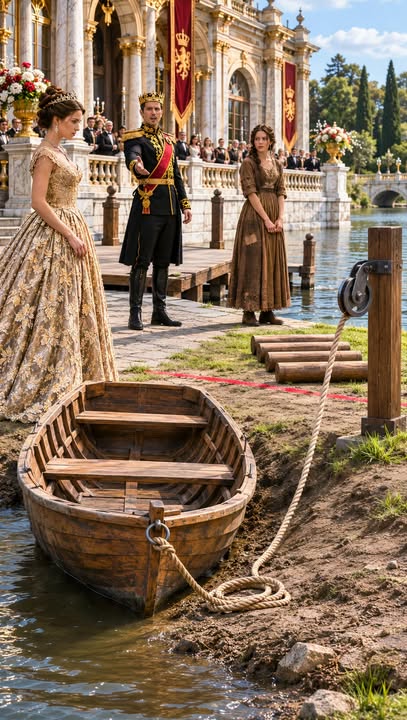
Part 4 – The Name Beneath the Ink
“Is there any possibility,” Seraphina asked, “that my father received the award for work he did not create?”
For a moment, no one answered.
The question seemed to have made the room larger and quieter at once.
Lina looked from Seraphina to the faded commission record, uncertain whether she had heard an admission, a fear, or simply the careful question of someone who had begun to doubt the story she had been raised to trust.
Prince Adrian rested one hand beside the open folder.
“That is what we are trying to establish,” he said.
Seraphina came farther into the archive.
Her gaze paused on the two brass tokens, then settled on the line bearing her father’s name.
“I have heard the family account all my life,” she said. “My father devised a better way to move boats from the dock to the repair yard. The crown recognized his work, and the award helped secure our family’s place at court.”
She spoke evenly, but her fingers had tightened around the edge of her sleeve.
“Did he ever mention Elias Vale?” Adrian asked.
“No.”
“Did he say he worked alone?”
“He said the design was his.”
The answer landed with a quiet finality.
Lina felt the old note beneath her hand through the fabric of her shawl.
Keep this safe until the truth is ready to be heard.
Her father had not left her many explanations, but the token, the records, and the sketch had begun to form a shape she could no longer ignore.
Master Pell adjusted his spectacles.
“The commission record is incomplete,” he said. “We should not reach a conclusion from a damaged page.”
“I agree,” Seraphina replied. “My father’s name is on the award. That does not make him guilty of anything, but neither does it prove he was the only person involved.”
The prince looked at her with respect.
“Thank you for saying so.”
Seraphina turned toward Lina.
“I want to understand this, too.”
Lina searched her face for the sharpness she had seen by the lake, but found only strain and uncertainty.
“Then we should look for the rest of the records,” Lina said.
Master Pell nodded.
“There may be a technical ledger in the engineering collection. Those volumes were kept apart from the dock accounts because they included measurements and working plans.”
He crossed to a row of cabinets and began checking the handwritten labels.
Adrian moved beside Lina.
“You said your father’s sketches are at home,” he murmured. “Would you be willing to bring them here?”
She hesitated.
The wooden box contained more than drawings.
It held the few pieces of her father’s life that had survived the years after his death, and the note whose meaning had changed with every discovery.
“I could bring them,” she said. “But I would like to stay with them while they are examined.”
“Of course,” Adrian replied. “They are yours.”
Seraphina heard him.
“Would it help if I came?” she asked.
Lina looked at her, surprised.
“I don’t know.”
“That is fair.”
Seraphina lowered her eyes to the table.
“I cannot promise what we will find. But I can promise I won’t ask you to hide it.”
The sincerity in her voice was cautious, as if even she did not know how much of her family’s history she could bear to question.
Lina thought of the warning Seraphina had given her at the dock: that people might decide what her story meant before they listened to her.
“I would rather go alone,” Lina said gently. “For the first time.”
Seraphina accepted that without protest.
“Then I will wait here.”
The prince arranged for the steward to excuse Lina from her remaining duties.
Master Pell made a careful record of the tokens and secured them in a small archival case.
Lina returned to her room beneath the eastern stair and took the wooden box from beneath her trunk.
The old sketches lay inside, tied with a faded ribbon.
She had not looked through all of them in years.
Some were only rough outlines of wheels and beams.
Others showed little carts, lifting arms, and counterweights, the work of a girl trying to solve problems she had only seen from a distance.
The boat drawing rested near the bottom.
She lifted it by its edges.
The pencil had faded, but the design remained clear: a heavy hull on rollers, a rope drawn through a wheel mounted above the bank, and a small figure standing on firm ground.
In one corner, she had written a few words in her father’s hand.
Steady pull.
Free the rear roller.
Set it ahead.
Her throat tightened.
She had remembered the ideas, but not those words.
Her father must have been beside her when she drew it.
Perhaps he had encouraged her.
Perhaps he had guided her hand.
For a moment, she could almost hear his voice, patient and warm, explaining why a clever design should make labor safer, not merely faster.
Lina gathered the sketches and the folded note, then tucked them into the box.
When she returned to the archive, the prince was waiting beside the long table.
Seraphina stood by the window, watching the courtyard below.
Master Pell had opened several more ledgers.
Lina placed the box carefully on the table.
“I brought them.”
“Thank you,” Adrian said.
She untied the ribbon herself.
The papers were yellowed, but the ink had held.
Master Pell approached with clean cotton gloves.
“May I examine them?”
“You may look,” Lina said. “But please let me turn the pages.”
“Certainly.”
They began with the boat drawing.
Master Pell studied it beneath a magnifying lens, then compared it with the commission record.
“This is remarkable,” he said.
“It’s only a child’s drawing,” Lina replied.
“Not only that.”
He pointed to the notes in the corner.
“These are technical instructions. They describe the order of the work and account for the movement of the rollers.”
The prince leaned over the table.
“Could a child have written them?”
“Possibly, with help,” Master Pell said. “But the notation is consistent with the marks in the dock record.”
Lina looked at the faint lines on the page.
The short arrows, circles, and angled strokes seemed suddenly familiar in a new way.
“These are the same kinds of marks we saw beneath the floorboard,” she said.
Master Pell nodded.
“They may be.”
Seraphina left the window and approached the table.
“Could the marks be Elias’s?” she asked.
“They could,” the archivist replied. “We would need a known sample of his handwriting or notation to compare.”
Lina unfolded the note her father had left.
Master Pell examined its careful script.
“Some features match,” he said. “The shape of the capital letters, and the way he forms the number three.”
Lina studied the page beside the sketch.
Her father’s handwriting had always seemed familiar because she had grown up seeing it.
Now the lines connected two parts of his life she had never known belonged together.
“He made the design,” she whispered.
Adrian did not answer at once.
He looked again at the sketch, at the commission record, and at the token that had been found beneath the boat’s floorboard.
“It appears he contributed substantially,” he said. “But we should learn what the missing records say before we decide more.”
Lina appreciated his caution, even as the truth seemed to gather around them.
Master Pell returned to the cabinets.
“Let me find the technical ledger.”
The search took longer than anyone expected.
Some volumes had been shifted during a renovation.
Others were bundled in boxes marked with dates rather than subjects.
As the afternoon light changed outside, the archivist moved from shelf to shelf, comparing his index with the faded labels.
Lina remained beside her sketches.
Seraphina stood nearby, silent.
At last Master Pell drew a narrow ledger from the back of a cabinet.
Its cover was plain, its spine cracked, and a brass clasp held it shut.
“This is the engineering register from that period,” he said.
Adrian moved closer.
“Does it include the transport commission?”
“I cannot tell until I open it.”
Master Pell placed the ledger on the table and carefully released the clasp.
The pages inside were lined with ruled columns.
Measurements, names, and brief notes filled the early entries.
Several pages had been damaged by moisture, but the writing remained legible.
The archivist turned through them slowly.
Then he stopped.
“There,” he said.
A heading in faded ink read: Royal Dock Transport Improvement.
Beneath it were two names.
Elias Vale.
Lord Varrick.
Seraphina’s shoulders drew back.
The ledger listed the work in stages.
Elias had made the initial drawings and tested the angle of the hauling line.
Lord Varrick had supplied timber, oversaw the construction of the pulley frame, and submitted the completed method to the palace.
The entries described a system that allowed dockworkers to move heavy boats without dragging them directly over mud or stone.
Pulley above.
Rollers beneath the keel.
A steady pull from firm ground.
Lina’s breath caught as the words confirmed what her hands had done by the lake.
The contest boat had not been moved by an accidental trick.
It had been moved by the design her father had devised.
Adrian read the ledger twice.
“Does it say who presented the design to the king?” he asked.
Master Pell turned to the next page.
“The formal report was signed by Lord Varrick.”
“And Elias?”
The archivist searched the margins.
“His name appears in the work notes, but not in the final report.”
Seraphina sat down slowly.
“My father told us he had invented the method.”
“Perhaps he did not understand what Elias contributed,” she said after a moment. “Perhaps he believed the idea belonged to the whole team.”
The prince did not challenge her.
“That may be true,” he said. “But the records should tell us.”
Master Pell continued reading.
“The final report describes the method as Lord Varrick’s original design. It says the improvement was developed independently in his workshop.”
Seraphina closed her eyes briefly.
When she opened them, her composure had not vanished, but something in it had softened.
“If this is correct,” she said, “then the report was wrong.”
Lina looked at the ledger.
The words seemed plain, almost ordinary.
Yet they changed everything.
Her father had not merely watched dockworkers.
He had been one of the people who had found a safer way to move boats.
He had designed the system that the palace had later used for years.
And Lord Varrick had received the royal reward in his place.
The family debt, the years of service, the sketches hidden in a box beneath her bed—all of it now seemed connected to a wrong that had begun before Lina was old enough to remember.
“What happened to my father?” she asked.
The question left her before she could soften it.
Master Pell searched the ledger again.
“The technical entries continue for several months,” he said. “Then there is a note that Elias Vale left the palace service.”
“Why?”
“It does not say.”
“Was he dismissed?” Adrian asked.
“No. The wording is simply that he departed the post.”
Lina turned to the wage roll Master Pell had shown them earlier.
Her father’s pay had ended in the same month the royal award was recorded.
“How old was I?” she asked.
“According to the family record you gave the palace, you were six,” Adrian said gently.
She remembered almost nothing from that year.
A cold house.
Her mother sewing late into the night.
Her father’s cough growing worse.
The memory of him carrying her to bed, his work coat smelling of rain and sawdust.
She had thought those recollections belonged to a different story.
“Could the award have affected him?” she asked.
“I don’t know,” the prince replied. “The records do not tell us.”
Seraphina looked down at her hands.
“My father never spoke of Elias Vale,” she said. “Not once.”
“Perhaps he thought the work was his,” Lina said, though the words hurt to say.
“Or perhaps he chose not to remember the part that was not.”
Seraphina’s voice was quiet.
No one rushed to defend Lord Varrick.
No one declared him guilty, either.
The silence was more honest than certainty.
Master Pell turned another page.
At the bottom of the entry, a small symbol had been drawn beside Elias’s name.
A circle crossed by two short lines.
Lina leaned closer.
“That is the same mark as the one in my sketch.”
“It appears so,” Master Pell said.
“Could it identify the designer?”
“Possibly. It may have been Elias’s personal mark, or a notation used for this particular project.”
The archivist searched the following pages.
A faint patch of discolored paper ran along the binding, and several lines had been torn away.
“There should be a supplementary note here,” he said. “The page was cut out.”
Adrian’s face tightened.
“Can you tell when?”
“Not from this volume. The cut is old.”
“Could it have contained a final report?”
“It might have.”
Seraphina looked toward the ledger.
“Would my family have had access to the engineering register?”
“Possibly,” Master Pell replied. “The dock commission was under my office’s predecessor, and copies could be requested by senior officials.”
“Could the missing page have been removed deliberately?” Adrian asked.
The archivist considered the question before answering.
“It could have been removed to repair another book, or lost during a transfer. There is no way to know from the cut alone.”
The explanation was reasonable, but it did not satisfy the room.
Lina felt the truth in her father’s name, yet the missing page left a space around it.
The evidence showed that he had designed the method.
It showed that the official report had named Lord Varrick alone.
It did not show whether Lord Varrick had known the full extent of Elias’s work when he accepted the award.
It did not show whether anyone had tried to correct the record.
And it did not explain why Lina’s family had fallen into debt.
“Do the records mention a payment to Elias?” she asked.
Master Pell checked the commission ledger.
“There is a separate entry for his wages. He was paid for his work as a contract carpenter and draftsman.”
“Only his wages?”
“The commission award went to Lord Varrick.”
“How much?”
The archivist found the figure.
It was a substantial sum, enough to change the life of a working family.
Lina’s eyes remained on the page.
“My mother said Father borrowed money after he became ill.”
“Do you know from whom?” Adrian asked.
“She never told me.”
“She may have been trying to spare you,” Seraphina said.
Lina looked toward her.
“Or she may have been ashamed.”
Seraphina’s expression grew thoughtful.
“Debt can make people quiet even when they have done nothing wrong.”
It was the first time Lina had heard Seraphina speak of poverty without the distance of a courtier.
The prince closed the ledger gently.
“We should verify the entries and search for the missing page. Then we can decide what the evidence supports.”
“And if the evidence supports that my father designed it?” Lina asked.
“Then the record must be corrected.”
Seraphina met his eyes.
“Even if the correction harms my family?”
“Especially if the record is wrong.”
The words were measured, not triumphant.
Adrian understood the cost of what he was saying.
A royal award given on false grounds would reflect not only on Lord Varrick, but on the crown that had granted it.
For the first time, Lina saw that the prince was not merely choosing between a maid and a noble family.
He was facing the possibility that the palace itself had helped preserve an injustice.
Seraphina rose from her chair.
“I need to speak with my father.”
“I understand,” Adrian said.
She looked at Lina.
“I won’t ask you to give up the sketches or the token. I won’t ask you to remain silent.”
Lina searched her face.
“Why not?”
“Because I don’t know yet what my father knew. And I don’t want to defend something I have not understood.”
There was grief in her voice, but also relief, as if saying the words had ended a struggle she had been carrying alone.
Lina nodded.
Seraphina turned toward the door, then paused.
“If the records are right, I will need to hear his answer from him.”
The door closed softly behind her.
Master Pell began copying the relevant entries.
Adrian remained beside Lina, studying the family name on the page.
“You were right to keep the sketches,” he said.
“I kept them because they were the last things Father left me.”
“Now they are also evidence.”
Lina looked down at the drawing.
She could not separate one meaning from the other.
“I don’t want my father to become only a name in a ledger,” she said.
“He won’t,” Adrian replied. “Not to me.”
The kindness in his voice moved her, but it also made her wary of what it might bring.
A prince’s attention had already turned her simple victory into court gossip.
If the court learned that her father’s work had been credited to another man, every conversation around her would change.
She would no longer be only the maid who moved the boat.
She would be the daughter of a man whose name had been removed from a royal achievement.
“What happens if the truth brings trouble to the palace?” she asked.
Adrian did not answer quickly.
“Then the palace must face it.”
The words settled between them.
Outside, the cloud cover had thickened, turning the lake gray.
A faint knock came at the archive door.
Master Pell opened it.
A young records assistant stood in the corridor, holding a narrow strip of parchment.
“I found this tucked inside the index cover,” he said. “It must have slipped there years ago.”
Master Pell took the strip and examined the faded writing.
His expression changed.
“What is it?” Adrian asked.
The archivist carried it to the table.
“This appears to be a reference to the missing page.”
He read the notation aloud.
“Supplementary statement concerning the dock transport method, prepared by Elias Vale, witnessed by Lord Varrick.”
Lina stared at him.
“There was a statement?”
“There was meant to be one,” Master Pell said.
He turned the strip over.
The reverse was blank.
“The reference says it was filed with the royal household’s private correspondence, not the engineering records.”
Adrian’s eyes narrowed with concentration.
“Where would that correspondence be kept?”
“The old family archive,” Master Pell replied. “Some of it was transferred to the palace library. Some may still be sealed under the late king’s papers.”
“The late king,” Lina repeated.
The prince looked down at the old commission record.
“My father commissioned the dock improvements,” he said. “If Elias wrote a statement, my father may have read it.”
Lina felt the room tilt around that possibility.
The royal reward had been granted during the reign of Adrian’s father.
The man whose portrait watched over the great hall might have known the truth.
Or the missing statement might have explained everything in a different way.
Master Pell folded the narrow strip inside a protective sheet.
“There is one more detail,” he said. “The reference notes that Elias’s statement was to be opened only if the design’s authorship was disputed.”
Adrian turned toward Lina.
“Then the palace anticipated this question.”
Lina looked at the token, the sketches, and the line naming Lord Varrick as the sole designer.
Her father’s truth had been hidden in pieces, scattered through records and woodwork.
Somewhere in the palace, a sealed statement waited beneath the papers of a dead king.
And no one in the room knew what it would say.
**–END OF PART 4–CLICK “NEXT” AT THE BOTTOM OF THE PAGE TO CONTINUE READING**
* * *
[PREVIOUS: PART 3](https://storyly.idolsgift.com/blog/part-3-the-secret-beneath-the-boat-057) | [NEXT: PART 5](https://storyly.idolsgift.com/blog/part-5-the-secret-beneath-the-boat-057)
✓ Lynn R. Adams
Part 4 – The Name Beneath the Ink “Is there any possibility,” Seraphina asked, “that my father received the award for work he did not create?” For a moment, no one answered. The question seemed to …