PART 4: The Secret Beneath the Bear’s Stitches 041
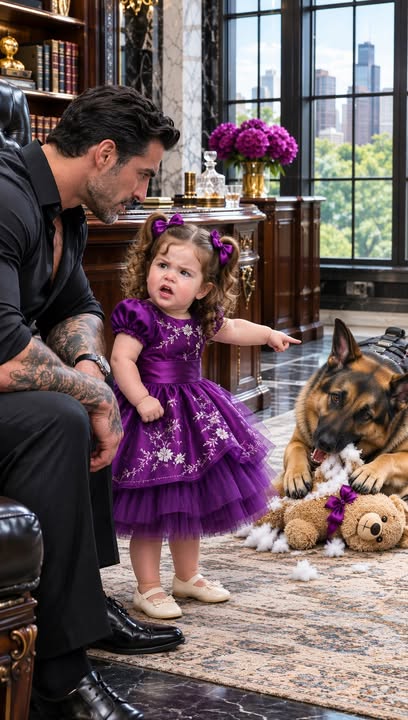
Part 4 – The Man in the Photograph
Sophie’s sleepy voice brought me back from the photograph and the records on my desk.
“Dante,” she said. “Mommy’s sad.”
I looked past her.
Anna stood at the end of the hall, one hand resting against the wall, her face turned toward the kitchen window.
She had tried to keep Sophie from seeing her worry, but small children noticed what grown-ups worked so hard to hide.
“Mommy’s thinking,” I said, lowering myself to Sophie’s height.
Sophie hugged Buttons tighter.
“Thinking is sad?”
“Sometimes.”
“Can we make her happy?”
I swallowed.
“We can try.”
She considered this, then held up the bear.
“Buttons help.”
“I think he does.”
Sophie walked past me and padded toward her mother.
Anna knelt to meet her, and Sophie pressed the bear into her arms.
“Here, Mommy. You hold.”
Anna closed her eyes for a moment as she hugged her daughter.
I stood in the doorway, watching the two of them, and understood that whatever Luca had hidden, Sophie had already inherited the cost of it.
Not the danger, perhaps.
Not the secrets themselves.
But the silence that had settled over the people who loved her.
Mara appeared beside me, her notebook open in one hand.
“The facility sent the surviving copies of the records,” she murmured. “There’s a detail you should see.”
I followed her into the office.
She had spread the paperwork across my desk: the lease, the payment receipts, the blurred copy of Anna’s license, and a page from the old access system.
At first, the papers looked like a collection of dead ends.
Then Mara placed the access log beside the lease.
“Look at the signature dates,” she said.
The lease had been signed eight years earlier.
The account’s final renewal had been made less than a month before Luca’s supposed death.
The unit had been opened on the night of the funeral.
And the name beside the access code was Anna’s.
“It still doesn’t prove she went there,” I said.
“No. But the person who cleared the unit did more than remove the boxes.”
Mara pointed to a small note in the lower corner of the inventory.
“‘Contents transferred to client representative by prior instruction.’”
“Who wrote it?”
“The employee who closed the account.”
“Can we reach him?”
“Ellis says he moved out of state. I found a number for him, but I haven’t called yet.”
“Why not?”
“Because I wanted to see this first.”
She turned over the final page.
A hand-drawn symbol had been made in blue ink beside the inventory.
A narrow tower with a little lantern at the top.
The lighthouse.
My gaze fixed on the sketch.
“Luca left a trail.”
“Or someone wanted us to think he did,” Mara said.
“Do you think Sloane cleared the unit?”
“I don’t know.”
“Could Anna have done it and forgotten?”
Mara met my eyes.
“Dante, you already know she says she never went there.”
“I know what she says.”
“And you believe her.”
I glanced toward the sitting room, where Anna was holding Sophie against her shoulder.
“Yes.”
“Then stop asking the same question as though the answer changes when you dislike it.”
I looked down at the drawing again.
Mara was right.
I had been searching for a way to make Anna’s secret fit neatly into the story I wanted, one where Luca had trusted her and I had been left out for a reason I could understand.
The truth might be less orderly.
“Call the former employee,” I said. “Ask if he remembers who collected the contents.”
Mara made the call from the office and put it on speaker.
The man on the other end sounded tired but alert.
He remembered the unit, though he did not remember Anna.
“What do you remember about the collection?” Mara asked.
“A man came in late,” he said. “He had the account documents and knew what was stored in there.”
“Did he give you a name?”
“He signed the release as the renter’s representative.”
“Do you remember his face?”
A pause followed.
“Not clearly. It was years ago.”
“Did he say anything that stood out?”
“I remember he asked where the items would be taken if the unit was emptied.”
“Why?”
“He didn’t want the contents sent to the donation place. He said there was a family member who needed them.”
The words brought a familiar heaviness to my chest.
“Did he say which family member?” I asked.
“He said the older brother.”
Mara’s eyes met mine.
My throat tightened.
“Did you see him again?” she asked.
“No.”
“Did you keep any copy of his identification?”
“The file had a copy. It was badly blurred.”
“Was there anything else?”
The man paused.
“He had a small scar on his left hand.”
I felt the room turn still.
Luca had a thin scar across his left thumb, from the time he cut himself on the edge of a broken glass when we were children.
He had been showing off, waving a glass around to make me laugh.
I had laughed too hard to warn him.
The cut had been shallow, but he had kept it for the rest of his life.
“Are you sure?” I asked.
“I think so.”
“Was there anything distinctive about the way he spoke?”
“He sounded like he’d been awake for a long time.”
The call ended with no further certainty.
Mara lowered her phone.
“It could have been Luca,” she said.
“It could have been someone who knew him.”
“Exactly.”
I wanted to believe the first answer.
Hope, I had learned, was only another way the mind made itself vulnerable.
The former employee had described a scar, a tired voice, and a family member who needed the contents.
That was not proof.
But it was more than I had had the morning before.
“Can we find where the boxes went?” I asked.
“Possibly. The records say the employee arranged a delivery to a private address.”
“Which address?”
“It was removed from the copied file.”
“Could the original still exist?”
“Ellis is checking.”
I leaned back in my chair.
“If Luca cleared the unit on the night of the funeral, he may have taken everything himself.”
“Or someone took it for him.”
“And left the lighthouse drawing.”
“Or copied a mark Luca had used.”
Mara was careful not to let me turn possibility into certainty.
It was one of the reasons I trusted her.
The door opened, and Anna stepped inside after settling Sophie in the sitting room with a picture book.
“Is there news?” she asked.
“Someone cleared the unit on the night of the funeral,” I said. “He claimed to be acting for you.”
“I wasn’t there.”
“I know.”
Her eyes searched mine, looking for more than the words.
I stood.
“I believe you.”
Something in her face eased, then tightened again.
“Do you believe Luca was the person who went?”
“I don’t know.”
“He would have had the key.”
“He would have.”
“Then maybe he took whatever was inside before anyone else could find it.”
“Maybe.”
Anna glanced at the lighthouse sketch.
“That symbol was on the note he gave me with the bear.”
“What note?”
She went very still.
“You had a note?”
“I didn’t think it mattered.”
“Where is it?”
“I kept it in the box with the bear.”
“Anna.”
“I’m sorry. It was just a scrap of paper. I didn’t realize the drawing mattered.”
I let out a breath and forced myself to soften my voice.
“Do you have it now?”
“I brought the box downstairs when Sophie was small. It should still be in the cupboard under her bed.”
She left to look.
When she returned, she carried a small cardboard box with a faded ribbon tied around it.
Inside lay a few old photographs, a hospital bracelet, two cards written in cheerful, unfamiliar handwriting, and a folded slip of paper.
Anna held it out.
Mara unfolded it carefully.
A tiny lighthouse had been drawn in the corner.
Below it were five words in Luca’s handwriting.
*When the water is quiet.*
I read the line again.
“What does that mean?” Anna asked.
“I don’t know.”
Mara turned the slip over.
There was a date on the back.
August twelfth.
The same date fragment from the memory card.
“What happened that day?” Anna asked.
I had no answer.
Mara tapped the paper with one finger.
“We need a reliable timeline. The date might refer to a meeting, a payment, a property record, or something else entirely.”
“Could the lighthouse have been the meeting place?” I asked.
“Maybe. But the note doesn’t say to go there.”
“When the water is quiet,” Anna repeated.
The phrase sounded like something Luca might have said to a child.
A promise of a walk along the lake.
A game.
A way to tell someone to wait.
It could mean anything, which made it impossible to ignore.
That evening, I took the note to my office and compared it with the handwriting on the photograph card.
The same slant.
The same sharp loop in the letter *h*.
The note had come from Luca.
The memory card had come from him too.
There was no longer any reason to doubt that he had intended someone to find the lighthouse.
Mara returned just after nine with a call from the former storage employee.
He had found the delivery address in an old backup file.
It belonged to a disused archive building on the southern edge of the city, once used by a small accounting firm.
The property had changed owners twice and was now part of a redevelopment project.
“The address is real,” she said. “But the building has been empty for years.”
“Were the ledgers sent there?”
“The delivery receipt says they were.”
“Who received them?”
“The signature is unreadable.”
“Can we go there?”
“We can check the exterior tonight,” she said. “If it’s secure, we’ll come back in the morning and ask the current owner for access.”
I looked toward the hallway.
Sophie had gone to bed.
Anna was in the sitting room, reading beside her while Buttons lay between them.
I had promised to keep Sophie safe.
That did not mean I could guarantee there would be no risk.
It meant I had to stop making decisions as though the people I loved were pieces I could move without asking.
“I’ll ask Anna if she wants to come,” I said.
Mara raised an eyebrow.
“That seems wise.”
Anna listened without interrupting as I explained the address and the possibility that the records had been taken there.
“I should go,” she said.
“You don’t have to.”
“I know. But if something bears my name, I want to see it.”
“I won’t take Sophie out of the house tonight.”
“I wouldn’t ask you to.”
She hesitated, then added, “I also don’t want her growing up believing that every adult in her life has to lie for her sake.”
The sentence stayed with me.
“Then we start by telling her the parts she can understand,” I said.
Anna nodded.
We left Sophie with two trusted caretakers and drove to the archive building with Mara.
It sat behind a chain-link fence, its windows dark and clouded.
The front door was secured with a heavy lock, but the side entrance had been boarded over.
No lights showed inside.
Mara walked the perimeter, looking for cameras and signs of recent activity.
“There’s a service entrance at the back,” she said. “The lock looks newer than the rest of the building.”
I studied it from a distance.
The lock had a bright metal sheen against the weathered door.
Someone had replaced it recently.
I did not touch it.
“Could the current owner be using the building?”
“Possibly.”
“Or someone has kept the contents inside.”
Mara took several photographs.
A light appeared briefly in an upper window.
We all stopped.
It blinked once, then vanished.
The building remained dark.
“Probably a reflection,” Mara said.
“Probably.”
But I had seen the light move.
We returned the next morning with the current property manager, a man named Rivas who wore a hard hat and carried a ring of keys.
He said the building had been vacant since the redevelopment project began.
“Has anyone had access?” Mara asked.
“Not since we took possession.”
“How long ago was that?”
“Two years.”
“Anyone else have keys?”
“No.”
He said it with confidence, but confidence had stopped impressing me.
Rivas opened the front door.
Dust lay thick over the lobby floor.
Old filing cabinets lined one wall, their drawers removed and stacked nearby.
The air smelled of plaster and damp paper.
We went room by room.
Most of the building was empty.
In the basement, Mara found a storage cage with a newer lock.
Rivas said he had never seen it before.
The lock was opened with his master key.
Inside were several cardboard boxes, a narrow metal cabinet, and a stack of ledgers wrapped in canvas.
Anna stepped forward, then stopped.
“Those could be the boxes from the unit.”
Mara put on gloves and checked the labels.
The handwriting on the top box was Luca’s.
One word had been written in blue ink.
*Accounts.*
The ledgers were old and carefully bound, their edges curled from years of handling.
The first pages listed dates, payments, and company names I recognized.
But the numbers did not match the records I had seen in the family office.
Mara began photographing each page while I studied the columns.
The entries were not random.
Money had been redirected from several family accounts into smaller transfers, then moved into separate accounts under different names.
The amounts were modest enough to escape notice when viewed one at a time.
Taken together, they represented years of careful work.
“What was he doing?” I murmured.
Anna came to stand beside me.
“I don’t know.”
“Did Luca tell you he was moving money?”
“No.”
“Maybe he wanted to hide it from Sloane.”
“Or from you,” she said quietly.
I looked at her.
She did not speak to wound me.
She was naming what the books seemed to say.
The ledgers showed payments to a law office in Milwaukee, a public records researcher, and a local accountant whose business had closed years ago.
There were references to copies of internal documents and transfers to a nonprofit legal clinic that handled financial disclosures.
Luca had been assembling something.
The question was whether he had been doing it to protect the family or to expose it.
Mara found a folded letter in the narrow cabinet.
The envelope had been addressed to me but never stamped.
My name was written in Luca’s hand.
I touched it, then withdrew my fingers.
“What if it’s a copy?” Anna asked.
“Then we’ll read it anyway.”
The letter was only three paragraphs long.
*Dante,*
*If you found these books, then I did not get to explain what I was trying to do.*
*The money in these accounts is not mine, and I have not taken it for myself.*
*I was trying to leave you a way out before the people around us decided there was no way out at all.*
I read the lines twice.
The words did not feel like an explanation.
They felt like a door that had been left ajar.
“Was he moving money away from the family business?” Anna asked.
“Some of it,” Mara said. “It looks like he was moving money away from accounts Sloane controlled.”
“That isn’t the same thing,” I said.
“No,” she agreed. “It isn’t.”
I continued reading.
*You’ll be angry that I didn’t trust you with this.*
*I would have been angry if you had done the same to me.*
*I was wrong about how much silence would protect you.*
The last line blurred.
I blinked and read it again.
For years, I had been angry that Luca had died without giving me a chance to help him.
Now I knew he had survived long enough to make choices, and that he had still kept me outside the door.
The difference was small.
The hurt was not.
I folded the letter carefully.
“Did he betray us?” Anna asked.
I looked down at the ledgers.
“He moved money without telling me.”
“That’s not the same as stealing it.”
“He was trying to hand evidence to investigators.”
Mara turned one page toward us.
“He had made copies of the transfers and marked which transactions had been changed in the official books.”
“Then he was dismantling what our family built,” I said.
“Or trying to keep the people responsible from using it to trap you,” Anna replied.
I met her eyes.
“You think he was protecting me.”
“I think that is what he believed he was doing.”
“And you think he was right?”
“I think he was afraid.”
That answer carried more mercy than I felt capable of offering.
I looked at the evidence again.
My family’s business had been built on secrets, but Luca’s ledger suggested that he had tried to make some of those secrets visible to people outside it.
He had been moving money away from us.
He had been gathering documents.
He had been asking someone to help him send them beyond the reach of Sloane.
All of it had happened while I believed he was dead.
“I want to know who received the copies,” I said.
“We’ll trace the names in the ledger,” Mara replied. “But we should do it carefully.”
Anna looked at the letter in my hand.
“If he sent anything to authorities, why didn’t they come for you?”
“Because the copies may never have reached them.”
“Or because Sloane blocked them.”
“Or because Luca was collecting evidence without making a report yet.”
The facts left too many possibilities open.
Mara photographed the remaining pages and sealed the letter in a protective sleeve.
While she worked, I checked the cabinet for a second envelope.
There was nothing.
No recording.
No final answer.
Only the records and the choices Luca had made without me.
Then Anna noticed a narrow compartment behind the cabinet’s lower drawer.
She pulled it open, revealing a small envelope with no name on it.
Inside was a photograph.
It showed Luca and Victor Sloane standing near the lighthouse.
The image was grainy and dated on the back.
August twelfth.
Beneath the date, Luca had written one sentence.
*The body was not mine.*
The room fell silent.
Anna lifted a hand to her mouth.
Mara leaned over the photograph but did not touch it.
I could barely breathe.
“The body they identified,” I whispered.
The words from the damaged recording returned with sudden clarity.
*The body they identified—*
The photograph could have been a fake.
The date could have been wrong.
The sentence could have been written by someone else.
But the handwriting matched Luca’s, and the man in the picture was standing in front of the lighthouse beside the attorney who had confirmed his death.
“Maybe Luca was trying to tell us he survived,” Anna said.
“Maybe.”
“But if he was alive, why didn’t he come back?”
I looked at the two men in the photograph.
Sloane’s hand rested on Luca’s shoulder, a gesture that might have been friendly or controlling.
Luca was thinner than he had been in the image from my office, and his face held the strained, watchful look of someone listening for a sound behind him.
The date on the back was three days after his funeral.
The same impossible date as the first photograph.
I had spent the week asking whether my brother had lived beyond the funeral.
Now the evidence suggested that he had stood beside the man who identified his body and watched me grieve from a distance.
“Did he choose not to return?” I asked.
No one answered.
I turned the photograph over again.
A second line had been written beneath the first, so faint I had not noticed it before.
The words were pressed into the paper with the point of a pen.
*If Dante sees this, tell him Sloane knows where I am.*
I stared at the sentence.
Then Mara lifted her eyes toward the doorway.
Someone had entered the basement above us.
A heavy step crossed the floor.
Rivas was still in the loading area, and our driver was outside.
The step came again, followed by the slow scrape of a key turning in a lock.
Anna reached for my sleeve.
“Dante,” she whispered.
I closed my hand around Luca’s photograph.
For six years I had believed Sloane was the man who helped bury my brother.
Now, standing over the evidence Luca had left behind, I understood that he may have been the man who watched him escape.
The door at the top of the stairs opened.
And a familiar voice called down into the dark.
“Dante, I think it’s time we stopped pretending Luca is dead.”
**–END OF PART 4–CLICK “NEXT” AT THE BOTTOM OF THE PAGE TO CONTINUE READING**
* * *
[PREVIOUS: PART 3](https://echoesofstories.idolsgift.com/blog/part-3-the-secret-beneath-the-bear-s-stitches-041) | [NEXT: PART 5](https://echoesofstories.idolsgift.com/blog/part-5-the-secret-beneath-the-bear-s-stitches-041)
✓ Lynn R. Adams
Part 4 – The Man in the Photograph Sophie’s sleepy voice brought me back from the photograph and the records on my desk. “Dante,” she said. “Mommy’s sad.” I looked past her. Anna stood at the end …