PART 4: The Secret Behind the Chime 069
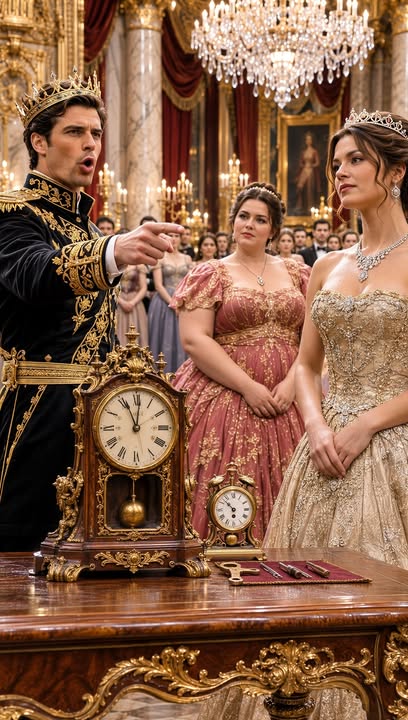
Part 4 – The Chime’s Message
Lord Vale.
For a moment, Adrian seemed unable to connect the name on the inventory with the man standing beside him.
Then he looked up.
“Did you sign this order?”
Vale did not answer at once.
The pause was brief, but it carried the weight of years.
“Yes,” he said at last. “I was the queen’s secretary.”
“You never told me you had countersigned an instruction to keep this clock silent.”
“I did not think it was relevant to the contest.”
“Was it relevant to my grandmother?”
Vale’s eyes settled on the old inventory.
“She asked me to preserve her wishes. I did.”
Adrian turned toward the clock, his jaw set but his voice controlled.
“Preserve them from whom?”
“I don’t know.”
Elara watched Vale’s face as he spoke.
He looked neither triumphant nor surprised by the document.
He looked like someone who had hoped the past would remain quiet because he had once been asked to keep it so.
Mistress Wren carefully laid the inventory beside the paper she had recovered from the clock.
“The date matches,” she said. “The clock was moved from the queen’s sitting room shortly after this order was made.”
“Why?” Adrian asked.
“That is not recorded here.”
Elara leaned closer to the papers, stopping before her sleeve could brush them.
The tiny mark on the old note seemed sharper now, the circle and three lines pressed into the paper with the same careful certainty she had seen in her father’s journal.
Her father had never spoken about royal secrets.
He had spoken about hinges, escapements, worn pivots, and the patience required to restore something without erasing the hands that had made it.
Yet his journal had held the same mark.
“May I look at the symbol again?” she asked.
Mistress Wren turned the note slightly beneath the lamp.
Elara studied the mark, then the edge of the inventory.
The paper from the clock had been written by someone with a narrow, forward-slanting hand.
Her father’s journal was waiting at home, but she remembered the way its old pages smelled of dust and oil, and the way he had shown her the mark beside a sketch of a striking mechanism.
“Your father’s journal may identify the maker,” Adrian said.
“It may,” Elara replied. “But I need to see the pages, not rely on memory.”
“Would you be willing to bring it here?”
“If you can spare a carriage.”
“I can.”
Lord Vale’s gaze moved from Elara to the note.
“Perhaps we should not draw conclusions from a workshop mark,” he said. “The same symbol could have been used by more than one craftsman.”
“That is possible,” Elara said. “We should check.”
Vale seemed to study her, perhaps expecting her to defend her father’s knowledge as though it were beyond question.
Instead, she kept her hands folded and her voice even.
Adrian noticed.
“Then we’ll verify it,” he said. “No guesses, and no one will be blamed for what the evidence does not show.”
Mistress Wren gathered the papers into her archival case.
“I’ll compare the handwriting and the mark with the palace records. There may be old invoices or repair notes.”
“Please do,” Adrian said.
The archivist left with the documents, accompanied by a guard who carried the case as carefully as if it held glass.
Elara watched the door close behind them.
The revelation had altered the room, but it had not yet explained anything.
The queen had ordered the clock silenced.
Lord Vale had signed the order.
The note had been hidden behind the mechanism.
And the clock, according to the inventory, had been made to say something.
Adrian stood with his gaze fixed on the dark face.
“My grandmother used to tell me that there were truths a person could only hear when he had learned to be quiet,” he said.
“Did you understand what she meant?”
“I thought she meant I should stop interrupting her.”
A faint, reluctant smile touched his face, then faded.
“She said it whenever I asked her to make a decision for me.”
Elara thought of her father at his workbench, listening for the faintest catch in a wheel before he loosened a single screw.
“Maybe she was teaching you to listen to more than the clock.”
“Perhaps.”
He looked at her.
“You are taking this calmly.”
“I’m not calm,” Elara admitted. “I’m trying not to let the next answer become the answer I want.”
“What answer do you want?”
“That my father’s mark is there for a simple reason. That your grandmother’s note explains itself. That no one has been hiding anything from you.”
“And what answer do you fear?”
“That the truth is more complicated than any of those.”
Adrian gave a quiet nod.
“I fear that too.”
The moment was interrupted by the sound of footsteps in the corridor.
A palace attendant entered, carrying a folded message.
“Your Highness, this was delivered from the palace archives.”
Adrian accepted it and opened the paper.
His eyes moved across the lines, then stopped.
“What is it?” Elara asked.
“A request from Mistress Wren,” he said. “She has found a reference to a repair journal kept by my grandmother’s household clockmaker.”
Elara’s attention sharpened.
“Does it name the clockmaker?”
“Yes. Bellweather.”
The name felt like a small key turning.
Adrian handed her the message.
The note from the archivist explained that a series of repair accounts had been stored in a cabinet in the old household office.
One entry, made nearly twenty years earlier, described a visit from a clockmaker named Bellweather to the queen’s sitting room.
The work had been paid for by the crown, but the details were listed only as “adjustment to the striking spring and preservation of the queen’s private instruction.”
Elara read the words twice.
“Preservation,” she said. “Not repair.”
“Could it have been a code?” Adrian asked.
“Perhaps. But it might simply mean he was asked not to restore the spring.”
The prince looked at the message again.
“Would you come with me to the archive?”
“Of course.”
Lord Vale made a small movement, as though to speak.
Adrian turned to him.
“You will come as well.”
Vale bowed.
“Certainly, Your Highness.”
They left the ballroom together.
The corridor beyond was quieter, its tall windows reflecting the light of the chandeliers behind them.
Elara walked beside Adrian, aware of the careful space he kept between them.
He was not treating her as a contestant now.
He was treating her as someone whose judgment he valued, and the thought warmed her even as it unsettled her.
The household archive occupied a series of rooms in the older wing of the palace.
Unlike the ballroom, it smelled of leather, cedar, and paper that had been handled and returned to its place over generations.
Mistress Wren was waiting at a long table, with three ledgers open beneath weighted corners.
“I found the repair accounts,” she said. “The relevant entry is in this volume.”
She pointed to a line written in a neat, sloping hand.
Elara read it aloud, careful to sound out the faded words.
“‘Mr. M. Bellweather attended Her Majesty in the sitting room. Striking spring disengaged by request. Original assembly retained. Private message to remain undisturbed until His Highness is of age.’”
Adrian looked at the page.
“His Highness,” he repeated. “That means me.”
“Yes,” Mistress Wren said. “The date is from the year you turned eight.”
The prince’s expression softened with memory.
“I was in my grandmother’s sitting room every week then.”
“Did she ever ask you to listen to the clock?” Elara asked.
“No. She asked me to listen to people.”
He paused, looking down at the ledger.
“She said that a ruler who only listens to those closest to the throne will mistake the sound of a crowded room for the voice of a kingdom.”
Elara felt the meaning of the words settle over her.
It was not a confession, nor a complete explanation.
But it was the first glimpse of what the clock might have been meant to preserve.
Mistress Wren turned a page.
“There is a second entry, made a few months later. It refers to a paper packet stored inside the clock’s casing.”
“Was it this paper?” Adrian asked.
“I believe so. The record says it was sealed by the queen and witnessed by Mr. Bellweather.”
Elara studied the handwriting.
The same narrow, forward-slanting strokes appeared in the entry as on the note from the clock.
She opened her father’s journal, which she had brought from home in a canvas satchel, and placed it beside the ledger.
Her father’s journal was smaller, its corners softened from years of use.
She turned carefully to the pages she remembered.
There was the mark: a circle divided by three lines, with a crescent beneath it.
And beneath the symbol, her father’s note:
“Bellweather’s royal striking assembly was designed to carry a sequence, not merely a single hour. Preserve original teeth. Do not replace spring without understanding the order of the chimes.”
Elara’s pulse quickened.
“Look at this,” she said.
Adrian leaned toward the journal.
“The sequence?” he asked.
“My father wrote that the clock was designed to carry a pattern of chimes. He didn’t know what the pattern meant, only that the original teeth had to be preserved.”
Mistress Wren brought the old ledger closer.
“Could the striking pattern encode a message?”
“Not in the way a letter does,” Elara said. “But perhaps in a series of intervals. Long and short pauses, or groups of strikes.”
“Like a signal,” Adrian said.
“Yes. Or a reminder only someone who knew the pattern could understand.”
Lord Vale stood at the other end of the table, silent.
Adrian glanced toward him.
“You served my grandmother when this was written. Did she ever explain the pattern?”
“I never heard it,” Vale said.
“Did she tell you what the message was?”
“No.”
“Did she tell you why she wanted it kept from me until I was older?”
“She said you would understand when you were ready.”
“And you decided when that was?”
“I was asked to keep the order until you reached the proper age.”
“I have been of age for years.”
Vale lowered his gaze.
“The queen did not leave a date for when I should reveal it. She said the clock would be ready when the prince had learned to listen.”
Adrian’s expression tightened, but he did not raise his voice.
“And you thought I had not.”
“I did not know whether you had.”
The answer seemed to cost Vale something.
For the first time, Elara saw the uncertainty beneath his formal composure.
He had not been merely guarding a secret.
He had been deciding, in the queen’s absence, whether the prince was ready to hear it.
That did not make his silence harmless.
But it made it human.
Adrian looked at the journal.
“Can you work out the pattern?”
“I can study the mechanism,” Elara said. “But the striking spring was deliberately disengaged. If we reconnect it without knowing how the assembly was meant to move, we could damage the original teeth.”
“Can the spring be inspected without being engaged?”
“Yes. If we have the right tools and enough light.”
“Then we’ll do that,” Adrian said. “No one will force it.”
They returned to the ballroom with the ledgers and journal.
The clock awaited them beneath the chandeliers, unchanged except for the missing screw and the exposed opening behind the mechanism.
Elara set her father’s journal on the table.
The palace clock seemed suddenly less like a challenge and more like a message whose sender had waited twenty years for its recipient.
She asked for a narrow lamp, fine tweezers, and a small wooden support.
The tools were brought without fanfare.
Lord Vale stood back as Elara inspected the striking assembly.
Adrian remained beside her, holding the lamp as she directed him.
“Here, please.”
He lowered the light.
“Is that better?”
“Just a little to the left.”
He adjusted it, then held perfectly still.
Elara traced the path of the spring with her eyes.
There it was: a small catch, carefully disengaged from the striking wheel and secured with a thin pin.
No part had been broken.
No metal had been forced.
Whoever had silenced the clock had done so deliberately, preserving the mechanism for a future day.
Elara leaned closer.
“The spring is intact,” she said. “It was held in place, not damaged.”
Adrian’s fingers tightened around the lamp.
“So it can be restored.”
“Possibly. But the pattern matters. If we activate it without understanding the order, the chime could tell us nothing useful—or the mechanism could catch.”
“Then we wait until you understand it.”
His answer came without hesitation.
Elara looked up at him, surprised by the trust in his voice.
“Thank you.”
“Why?”
“For not asking me to make it strike just because everyone is waiting.”
A trace of a smile appeared in his eyes.
“I think we have waited long enough to give the clock another few hours.”
They examined the assembly piece by piece, comparing it with the drawings in Elara’s journal.
The mechanism had been designed to release the hammer in measured intervals.
Three short teeth on one wheel were followed by a broader space, then two more teeth, then a final gap.
The pattern was not random.
Elara sketched it on a sheet of paper, marking each interval.
Her father’s journal contained a similar diagram, but the final line had been left unfinished.
“He knew there was a sequence,” she murmured. “But he never saw the original wheel.”
“Can the gaps tell us anything?” Adrian asked.
“Not yet.”
The archivist returned with a second bundle of records.
Among them was a letter from the late queen, kept in a sealed household file.
Mistress Wren read it privately first, then offered it to Adrian.
He unfolded it with care.
The letter was brief, written in the queen’s own hand.
It said that the clock was not to be restored until Adrian was old enough to understand that a kingdom’s strength could not be measured by the wishes of its most powerful families.
She had asked that the chime be preserved as a reminder of a promise she had made to the people of the kingdom.
The final sentence had been underlined.
“Let him hear what those who stand farthest from the throne have been trying to tell us.”
Adrian read the sentence again.
Then he sat down.
For a long moment, he said nothing.
Elara felt the ballroom fall away around them.
The late queen had not hidden a treasure or a private scandal.
She had hidden a lesson.
The clock was meant to speak when the prince had grown old enough to understand that listening was not a courtesy granted to ordinary people.
It was a duty.
Adrian held the letter loosely in his hands.
“She wanted me to learn this from the clock.”
“She wanted you to hear it,” Elara said. “That may be different.”
He looked at her.
“How?”
“You can be told that people deserve to be heard. Hearing the clock might make you feel what it means to wait for someone to listen.”
The prince lowered his eyes to the letter.
“When I was young, I thought the people around my grandmother were always telling her what she ought to do. I assumed she could hear them all.”
“Perhaps she could,” Elara said. “But hearing isn’t the same as understanding.”
Adrian nodded slowly.
“And I have spent years believing that if a room is quiet, I have done my work.”
Elara looked at the clock’s motionless pendulum.
“Sometimes people are quiet because they trust you. Sometimes they are quiet because they believe you will not listen.”
The words came from her father, though she had not known she remembered them.
Adrian absorbed them without defensiveness.
“Do you think I’ve mistaken silence for agreement?”
“I don’t know you well enough to answer that.”
“Fair.”
“But your grandmother may have been trying to make sure you asked the question.”
He drew a slow breath.
“I wish she had been here to answer me.”
“So do I,” Elara said.
The confession surprised her as much as it seemed to surprise him.
She had never met the queen, yet the old woman’s careful message had begun to feel like a hand reaching across the years.
Adrian folded the letter along its original creases.
“Then we should find out what the chime says.”
Elara returned to the clock.
She compared the pattern of the wheel with the note in her father’s journal, then with the queen’s letter and the repair ledger.
The pieces did not yet form a complete answer.
But she could see how the mechanism might work.
“The spring can be reattached,” she said. “The clock is still intact, and the original assembly has been preserved.”
“Will it strike once?”
“It may strike a sequence. I can’t promise how many notes or how long they’ll take.”
“Then we’ll let it speak in its own time.”
Lord Vale stood by the edge of the table, looking at the old mechanism.
“You have your grandmother’s patience,” he said to Adrian.
“I hope I have more than her patience.”
Vale gave a small, tired smile.
“She had a way of making people believe their words mattered.”
“Did she make you believe that?”
For the first time, Vale’s composure faltered.
“Yes,” he said. “She did.”
“Then why did you keep this from me?”
“I believed I was honoring her order.”
“And now?”
Vale looked toward the folded letter.
“Now I believe I may have honored the words and missed their purpose.”
Adrian’s expression softened, though the question between them remained unresolved.
Elara began preparing the small spring for careful reattachment.
She did not lift it immediately.
Instead, she checked the pin, the catch, and the teeth of the striking wheel, comparing each part to her father’s drawing.
When she was satisfied, she looked at Adrian.
“I’m ready to try.”
He took the lamp and held it steady.
Mistress Wren watched from the other side of the table.
Lord Vale remained silent.
Elara eased the spring back into its original position.
The mechanism gave a gentle, dry whisper as the catch settled.
Nothing else moved.
She paused, listening.
Then she turned the brass screw only enough to secure the concealed latch, careful not to tighten it beyond its old setting.
The clock did not strike.
Adrian did not urge her to continue.
Elara checked the alignment again and found that the pendulum, stopped earlier when Celestine had turned the key, needed to be set in motion before the striking pattern could begin.
She looked to the prince.
“May I?”
He nodded.
Elara gave the pendulum a small, controlled push.
It swung once, twice, then settled into a steady rhythm.
The gears began to turn.
A soft ticking filled the ballroom.
It was the first sound the clock had made in twenty years.
No one spoke.
The pendulum crossed the face of the clock, and the minute hand trembled as the mechanism took up its motion.
Elara watched the striking wheel.
One tooth advanced.
Then another.
The first hammer lifted, hesitated, and fell.
A single clear note rang through the ballroom.
It was not loud, but it seemed to reach every corner.
The guests who had been waiting in the adjoining salon fell silent beyond the closed doors.
Adrian’s eyes shone in the candlelight.
The clock’s wheel advanced again.
A second note sounded after a measured pause, followed by three more, each separated by a different interval.
Elara counted them under her breath.
One.
Two.
Three.
A pause.
Then two quick notes.
The final tooth moved into place, but the hammer did not fall.
The clock continued ticking.
Elara leaned closer to the mechanism.
“Is it stuck?” Adrian whispered.
“I don’t think so.”
The striking wheel held, poised at the edge of its final movement.
The pendulum crossed once.
Twice.
Then the hammer rose.
A last note rang out, deeper than the others.
The sound faded beneath the chandeliers.
For a moment, the ballroom seemed to be listening even after the clock had fallen quiet.
Elara looked down at her sketch.
The pattern of the chime matched the intervals she had recorded, but the final pause had not been part of the ordinary striking sequence.
It had been deliberate.
“Did you understand it?” Adrian asked.
“Not yet.”
Mistress Wren stepped closer, holding the queen’s letter.
“Perhaps the pattern was only meant to tell us when the clock had been restored.”
Elara shook her head.
“There are too many deliberate intervals. And the final pause is part of the sequence.”
Adrian looked at the notes she had written.
“Could your father’s journal explain it?”
“It might.”
She searched the old pages, careful not to rush.
Near the back, beneath a sketch of the striking wheel, her father had written a sentence she had not noticed before.
She read it aloud.
“‘The Bellweather pattern is not a tune. It is a count, set to be understood by those who know what was promised.’”
The words chilled her.
“Promised by whom?” Adrian asked.
“I don’t know.”
She turned the page.
A second note had been tucked into the binding, almost hidden beneath a loose strip of leather.
It was not in her father’s handwriting.
Elara eased it free.
The ink was faded, and the paper was the same age as the queen’s message.
Adrian moved closer, but did not reach for it.
Elara unfolded the note.
Three lines appeared, written in a hand she recognized from the paper found inside the clock.
The first line read: “The first five chimes name the districts.”
The second read: “The long pause marks the place whose petition was refused.”
The final line was incomplete, torn through the middle.
Elara lifted her eyes to Adrian.
“The clock is not only repeating a promise,” she said. “It is pointing to something that happened.”
Mistress Wren studied the torn edge.
“Can you read what remains?”
Elara tilted the paper toward the light.
Beneath the tear, only a few words survived.
“Find the petition in the—”
The rest was gone.
Adrian’s gaze moved from the note to Lord Vale.
“Where would my grandmother have kept a petition?”
Vale looked at the old clock, then at the closed door leading toward the palace archives.
“Her private correspondence,” he said. “But the queen’s papers were moved after her death.”
“Moved where?” Adrian asked.
Vale’s answer came slowly.
“To the west archive.”
Mistress Wren’s face changed.
“That room was cleared years ago.”
“Not all of it,” Elara said.
Everyone turned toward her.
She remembered her father’s journal, the mark beneath the unfinished note, and the words he had written about understanding what had been promised.
Then she looked at the clock.
The chimes had named five districts.
The long pause had marked the sixth.
“What if the petition was never filed with the queen’s letters?” Elara asked. “What if it was hidden where the clock’s pattern points?”
Adrian glanced toward Lord Vale.
“Do you know what was in the west archive?”
Vale’s face had gone pale.
“I know what my grandmother told me was there,” Adrian said. “A collection of petitions she had promised to answer.”
The steward did not respond.
Elara held the torn note carefully between her fingers.
The clock had spoken once, not to announce the hour, but to tell them where the queen’s unfinished promise might still be waiting.
And somewhere in the palace, beyond the ballroom’s golden light, lay a petition the royal household had never answered.
**–END OF PART 4–CLICK “NEXT” AT THE BOTTOM OF THE PAGE TO CONTINUE READING**
* * *
[PREVIOUS: PART 3](https://storyly.idolsgift.com/blog/part-3-the-secret-behind-the-chime-069) | [NEXT: PART 5](https://storyly.idolsgift.com/blog/part-5-the-secret-behind-the-chime-069)
✓ Lynn R. Adams
Part 4 – The Chime’s Message Lord Vale. For a moment, Adrian seemed unable to connect the name on the inventory with the man standing beside him. Then he looked up. “Did you sign this order?” Val…