PART 4: The Room That Had Waited 056
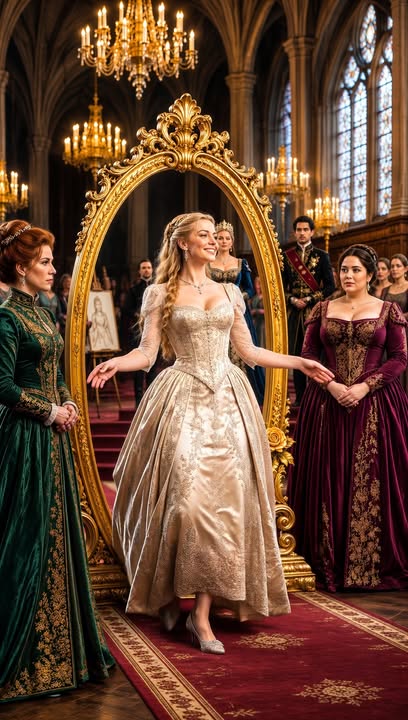
Part 4 – The Passage Beneath the Gold
Lord Veyne’s return was announced before anyone moved.
The folded fragment lay in the open rim of the Queen’s Frame, its two lines of writing exposed to the gallery’s pale light.
Elara stood very still beside it, while Adrian watched her with an expression Lucía could not read.
“Your Majesty,” Veyne called from the doorway, “the committee has asked for an update.”
The Queen looked toward the entrance.
“Tell them they will have one when I have something true to say.”
Veyne entered, followed by a palace clerk carrying a narrow case of papers.
His gaze went first to the opened panel, then to the fragment within it.
“I see the frame has yielded another secret.”
“It has yielded a letter fragment,” Lucía said. “It is not yet clear how it came to be here.”
“Or who placed it there,” Veyne added.
His tone was measured, almost sympathetic.
Adrian’s eyes remained on his mother.
“The Queen says she knew Isolde wanted to leave.”
Veyne’s attention shifted to Elara.
The Queen did not turn away.
“I knew my daughter wanted to escape the engagement being arranged for her,” she said. “I did not know where she went.”
“And the court was told she disappeared in the storm,” Veyne said.
“That was the account given at the time.”
“An account you allowed to stand.”
Elara’s hands folded before her.
“Yes.”
The clerk opened his case as if preparing to make a record.
Veyne glanced at him, then closed the case with a quiet tap.
“Perhaps this is not the moment for a formal statement.”
“No,” Elara said. “It is not.”
Lucía looked at the fragment.
Its torn edge had darkened with age, and the missing section might have held only a few words or a full explanation.
She could see no sign that the break was recent.
“May I lift it from the rim?” she asked.
Elara nodded.
Lucía slid a thin support beneath the paper and eased it onto a clean sheet.
The frame remained open, its hollow space dark beneath the carved gold.
“Is there anything else inside?” Adrian asked.
“I can’t tell without examining the cavity,” Lucía said. “I won’t reach in blindly.”
Veyne moved nearer, but kept his hands behind his back.
“I must remind you that the frame is a royal object and the contents are palace property.”
“They will remain in the palace,” Lucía replied.
“Until the appointment committee decides who is responsible for them.”
The Queen’s gaze settled on him.
“Lady Vale has my authorization to examine the frame.”
“That is not the same as appointment to the office.”
“No,” Elara said. “It is not.”
Lucía heard no reassurance in the distinction.
Her family’s contract remained unsettled, and Veyne knew it.
He did not need to raise his voice to make the danger plain.
“I will continue only with the Queen’s permission and in the presence of the Prince,” Lucía said.
“And a clerk to document each step,” Veyne added.
Adrian looked at him.
“If it helps preserve the record, then yes.”
Veyne seemed faintly disappointed that Adrian had not resisted.
The clerk opened his case again and prepared a sheet of paper.
Lucía returned to the frame.
Under the lamp, she examined the exposed hollow with a small mirror.
The cavity was deeper than the rim appeared from outside, but its far end narrowed toward the upper curve.
A dark line ran along the interior surface.
At first she thought it was a shadow.
Then she recognized the edge of another panel.
“There is a second section,” she said.
Adrian bent beside her.
“Another compartment?”
“It may be part of the same hollow space. There’s a seam at the back.”
Veyne leaned closer.
“Can you open it?”
“Not yet.”
Lucía adjusted the light, then studied the seam through the mirror.
It was sealed with old wax and a layer of thin paper, both hidden beneath the inner rim.
The paper had been painted to match the dark interior, making the join nearly invisible.
A careful restoration could separate it, but the material was fragile.
“Someone sealed this after the frame was repaired,” she said.
The Queen’s attention sharpened.
“How do you know?”
“The wax sits over a later layer of varnish. It was added after the old join was closed.”
Veyne glanced at the register notes Lucía had brought from the archive.
“Could that have been done during the restoration forty years ago?”
“The records do not say.”
“Then perhaps we should stop until the committee can examine it.”
“If we stop here, the seal may dry further and become more difficult to lift without damage,” Lucía said.
She kept her voice calm, though the consequences seemed to gather around every word.
“I can loosen the paper in small sections and stop if it resists.”
The Queen nodded.
“Proceed.”
Lucía worked with a fine brush, applying a trace of moisture to the edge of the paper.
She waited for it to soften before lifting it with a narrow wooden tool.
The clerk recorded the time and the condition of the seal.
Adrian stood close enough to see, but he did not crowd her.
Veyne remained on the far side of the table, his expression composed.
The paper lifted in a thin strip.
Beneath it, the wax seal was not stamped with the royal crest, but with a small rose.
The carved shape matched the golden rose on the frame.
Elara’s breath caught.
“You recognize it?” Adrian asked.
“It was Isolde’s personal seal,” she said. “She used it on letters and sketches.”
Lucía paused.
“Then she sealed this compartment herself.”
“Or someone used her seal,” Veyne said.
Adrian looked at him.
“Is there a reason to doubt it?”
“There is a reason to establish what we know before we decide what it means.”
The clerk wrote down the words.
Lucía softened the edge of the wax and lifted it away intact.
The small seal left a clear impression in the red-brown material.
Beneath it lay a narrow folded packet, wrapped in oilskin and tied with a faded blue thread.
The gallery seemed to draw inward around it.
The Queen sat down in the nearest chair.
Adrian did not take his eyes from the packet.
“Is that the rest of the letter?”
“I don’t know,” Lucía said.
She placed a sheet of clean paper beside it and lifted the packet out with both hands.
The oilskin had protected it from most of the damp, though its edges were stained.
A second, smaller piece of paper had been tucked beneath the thread.
On it, in Isolde’s handwriting, were the words: For my mother, if she still remembers.
Elara covered her mouth.
Adrian’s gaze moved from the note to the Queen.
Lucía did not open the packet.
“Your Majesty, would you like to read it?”
The Queen lowered her hand.
“I should not be the first to touch what she left.”
“Then Adrian can open it,” Lucía said. “If he wishes.”
Adrian’s fingers flexed at his side.
For a moment he seemed to be standing again in the east tower, holding the letter that ended before it could explain where Isolde had gone.
Then he reached for the packet.
He untied the blue thread.
Inside lay several folded sheets, a narrow strip of parchment, and a small pressed flower whose petals had faded to the color of old tea.
The flower had been a rose.
Adrian looked at Lucía.
“Should I read it aloud?”
“If you want to.”
He unfolded the first page.
The handwriting was unmistakably Isolde’s, but firmer than the lines in the letter to him.
He read silently for a few moments.
Then he stopped at the top of the second page.
“Mother,” he said, and held the pages out to the Queen.
Elara accepted them.
Her fingers trembled as she read.
She took a slow breath and began.
“Mother, when you read this, I hope I am already somewhere the court cannot send for me without asking whether I wish to come.”
The clerk stopped writing.
Veyne’s face had lost its practiced ease.
Elara continued.
“I do not want to leave you in fear, and I do not want Adrian to believe I chose to leave him.”
The Queen’s voice thinned, but she kept reading.
“I asked you to help me because the engagement has stopped being a promise and become a decision made around me. They speak of the future as though my consent were a small detail that can be added afterward.”
Adrian lowered his eyes.
Lucía felt the familiar ache of being spoken for by people who thought their authority made the speaking harmless.
The Queen turned the page.
“I will travel under my own name, and I will earn my way where I go. I do not need a title to tell me who I am, and I cannot learn what I want while every answer is chosen for me.”
A pause opened between the lines.
Elara looked up from the paper.
“This is not the page I found in the frame before,” she said.
“What did that fragment say?” Adrian asked.
“Your wish to leave is understood. I will keep your confidence until—”
“Until what?” he asked.
“I don’t know.”
She returned to the letter.
“I asked you to arrange a safe departure, not to choose my destination. Please let the court believe I was lost in the storm if that is the only story that will keep them from searching for me.”
Adrian’s face tightened.
“You agreed to that?”
“I agreed to protect her from being brought back against her will.”
“You allowed everyone to think she was dead.”
“I allowed them to think she had vanished,” Elara said. “I never said she was dead.”
“The court did.”
“Yes.”
“And you said nothing.”
The Queen lowered the pages.
“I did.”
For a moment, no one spoke.
Then Elara continued, quieter now.
“I told myself her safety mattered more than my name, and I believed that. I also believed that silence was the only way to protect her. I did not understand how much the silence would cost you.”
Adrian’s attention shifted to the page.
“Did she send this after she left?”
Elara searched the letter’s lower lines.
“It says nothing about when it was written.”
Lucía leaned toward the packet.
“May I examine the paper?”
Elara held it out.
Lucía checked the edges, the folds, and the old water stain.
The sheets appeared to have been stored together for a long time, but that did not establish when they had been placed in the frame.
The paper’s watermark belonged to a mill that had supplied the palace decades earlier.
The ink could not tell her the year without closer analysis.
“It may have been written before she left,” Lucía said. “I can’t date it precisely from here.”
Adrian pointed to the narrow parchment strip.
“What is that?”
Lucía lifted it onto the clean sheet.
It was not a letter, but a short list written in two different hands.
The first entries were in Isolde’s.
The others were in Elara’s.
There were no names, only details: a departure before dawn, a carriage without royal colors, a route toward the southern road, and a place to leave the horses before the border.
At the bottom, in Elara’s hand, was a single sentence.
“No one is to follow unless she asks.”
The Queen closed her eyes.
Adrian looked from the list to her.
“You planned it together.”
“I helped arrange the first part.”
“Not where she went?”
“No.”
“Did you meet her before she left?”
“Yes.”
“Did you say goodbye?”
Elara opened her eyes.
“No.”
The answer seemed to hurt her more than the question.
“I thought if I said goodbye, I would ask her to stay,” she said. “And if I asked her to stay, I would be doing to her what the court had already done.”
Adrian’s shoulders lowered a fraction, though the pain in his face remained.
“You let me search for her.”
“I thought she might write to you when she was ready.”
“And if she never was?”
“I did not know what to do.”
“That is not the same as not knowing what she wanted.”
“No,” Elara said. “It is not.”
The Queen looked down at the letter again.
“I kept the truth from you because Isolde asked me to keep her route and her helpers private. She feared that if the court knew she had left deliberately, the people who assisted her would be questioned, and she would be found.”
“Was that still true after the first year?” Adrian asked.
“I don’t know.”
“After the second?”
“I don’t know.”
“After nine years?”
Elara could not answer.
Lucía felt the old room around them, though they were standing in the gallery.
A sealed chamber, a hidden key, a letter that ended in the middle of a sentence.
All of it had been built from decisions made in the name of protecting someone, until protection became indistinguishable from silence.
The clerk had begun writing again, but his quill moved slowly.
Veyne looked toward the packet.
“Your Majesty, this is a private family matter, but it has also become a matter of state. The court will need to understand why the official account was allowed to stand.”
“The court will hear the truth when my children have heard it,” Elara said.
Adrian glanced at the Queen.
“Will you tell them the whole truth?”
“If I know it, yes.”
“That is not the same as telling them everything.”
“No,” she said. “It isn’t.”
The answer held no defense, only the shape of what remained unknown.
Lucía returned to the packet.
“May I see the last sheet?”
Elara handed it to her.
The page was folded twice, with a faint line of blue pigment near one corner.
Lucía examined it under the lens.
The pigment matched the kind that had gathered in Isolde’s chamber, though she could not yet prove that it came from the portrait’s frame.
A small mark had been drawn at the foot of the page: a rose with one petal left uncolored.
Beneath it, Isolde had written, If this reaches you, I have found a place to begin.
Adrian read the words over Lucía’s shoulder.
“She was alive when she wrote this.”
“Yes,” Lucía said.
“But we don’t know how long after she left.”
“No.”
The hopeful thought was tender, and therefore dangerous.
Adrian seemed to recognize that.
He stepped away from the table and looked up at the great windows.
“I spent nine years asking where she was,” he said. “All this time, the question she wanted answered was whether she could come back without being trapped again.”
The Queen set the letter down.
“I do not know whether she wants to come back.”
“Did she say she would write?”
“She said she would write when she could.”
“Did she?”
Elara looked at the pages.
“I received a note several years ago.”
Adrian turned.
Lucía felt the room change around the admission.
“From Isolde?” he asked.
“Yes.”
The Queen’s voice was low.
“It had no return address. She said she was safe, and that she needed more time. She asked me not to search for her and not to tell you until she was ready.”
Adrian looked at her as if the years between them had suddenly become visible.
“You received a letter from her, and you didn’t tell me.”
“I believed I was following her wishes.”
“She was my sister.”
“I know.”
“Did she mention me?”
The Queen’s face tightened.
“She said she missed you.”
Adrian turned away before the words could reach him fully.
Lucía saw him press his thumb against the side of his forefinger, the way he had held the old letter in the chamber.
“Where is the note?” he asked.
“I burned it after I read it.”
“Why?”
“I was afraid it could be found.”
“Or because you wanted no evidence?”
The question came quietly, without accusation in its tone, but Elara flinched as though he had raised his voice.
“I thought I was protecting her.”
Adrian’s anger did not vanish.
But something in it loosened, leaving sorrow where certainty had been.
The court clerk finished his notes and read them back in a careful voice.
He recorded that the frame had contained a sealed packet, that the Queen had acknowledged helping Isolde arrange a departure, and that the Queen had received a later note confirming her daughter was safe.
He did not record the private details of the letter.
Lucía watched the Queen listen to the account.
When the clerk asked whether she wished to correct anything, Elara said, “No.”
Veyne closed his folder.
“I will inform the committee that the frame’s contents are being held for the royal family.”
“They are being held here,” Lucía said. “Under the Queen’s authority.”
“Of course.”
Veyne’s gaze rested on the uncovered hollow.
“You may wish to have the panel sealed again until the matter is resolved.”
“No,” Adrian said.
The Queen looked at him.
“I don’t want another sealed door.”
“Then it will remain open,” she said.
Lucía placed the documents inside a shallow archival box lined with clean cloth.
The frame’s hollow remained visible beneath its gold rim, no longer a secret but not yet fully understood.
The last page of Isolde’s record offered neither a destination nor a promise.
It only showed that she had left by choice, and that her mother had helped her go.
A sudden sound came from the gallery entrance.
A young palace messenger stood there, out of breath from hurrying.
He carried a small envelope in both hands.
“Your Majesty,” he said. “This arrived at the eastern gate.”
Elara took the envelope.
It bore no seal and no return address.
Her name had been written on the front in a familiar hand.
Adrian stared at the handwriting.
The messenger glanced at Lucía, then at the open frame.
“I was told to bring it directly to the Queen,” he said. “The rider who delivered it asked that she read it without delay.”
The Queen’s fingers closed around the envelope.
“Was there any message?”
“Only that the writer hoped it would reach you.”
Elara looked at Adrian.
He did not ask her to open it.
She did not ask his permission.
For a moment, they stood together beneath the windows, separated by nine years and only an arm’s length.
Then the Queen broke the plain seal.
Inside was a single sheet of paper.
She read the first line, and all the color left her face.
Adrian stepped closer.
“What does it say?”
Elara lowered the page.
The familiar handwriting belonged to Isolde.
The message contained only one sentence.
“Mother, I am ready to come home—but I will not return to a court that still believes I disappeared.”
**–END OF PART 4–CLICK “NEXT” AT THE BOTTOM OF THE PAGE TO CONTINUE READING**
* * *
[PREVIOUS: PART 3](https://storyly.idolsgift.com/blog/part-3-the-room-that-had-waited-056) | [NEXT: PART 5](https://storyly.idolsgift.com/blog/part-5-the-room-that-had-waited-056)
✓ Lynn R. Adams
Part 4 – The Passage Beneath the Gold Lord Veyne’s return was announced before anyone moved. The folded fragment lay in the open rim of the Queen’s Frame, its two lines of writing exposed to the gal…