PART 4: The Rabbit with the Blue Thread 047
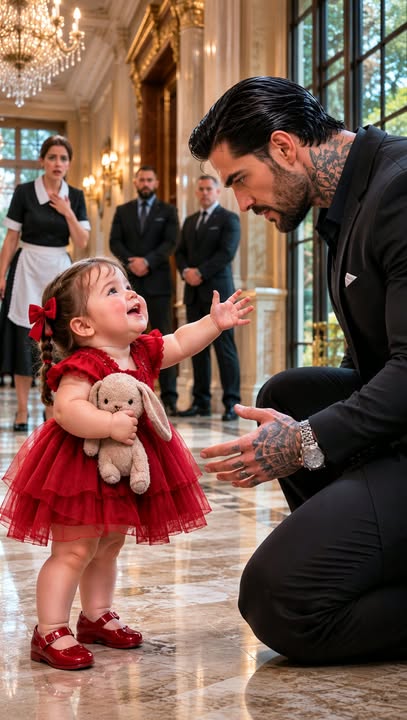
Part 4 – The Name Beneath the Seal
The envelope in my coat seemed to grow heavier with every step toward the car.
October 14.
I had seen the date before, though until that afternoon I had never thought it meant anything.
It had been written on a small envelope in my mother’s careful hand, tucked inside a box of old photographs and household papers.
When I found it months ago, I had set it aside, meaning to sort through it later.
Later had become a shelf in my closet and then a year of not knowing what I was looking for.
Now I couldn’t stop thinking about it.
The driver took us home in silence.
I kept one hand on the old photograph and the other wrapped around my phone, as though either might vanish if I let go.
At the apartment, Sophie was waiting with her sitter, wearing her coat over her pajamas and holding Mr. Buttons by the good ear.
“Mommy,” she said, hurrying toward me.
I crouched and caught her in my arms.
“You’re home.”
“I missed you.”
“I missed you too.”
She pressed her cheek against mine, then pulled back to inspect my face.
“Are you sad?”
“Not exactly.”
“Are you thinking?”
I smiled faintly.
“Yes.”
“About Mr. Buttons?”
“About the people who loved him before you did.”
Sophie seemed satisfied with that answer and returned to the rabbit.
After I thanked the sitter and walked her to the door, I put the photograph on the kitchen table.
Sophie climbed onto her chair, her small legs swinging beneath it.
“Is that the lady who made Mr. Buttons?”
“I don’t know,” I said.
“But I think she might be.”
“Is she Mr. Dominic’s sister?”
“Yes.”
Sophie leaned closer to the image.
“She looks nice.”
“I think she was.”
“Did she know me?”
I wanted to say no.
I wanted to say that people in old photographs belonged to the past, and the past was separate from the safe, ordinary life we were trying to build.
Instead, I let the question sit between us.
“I don’t know yet,” I said.
Sophie touched the photograph’s edge with one finger.
“I hope she did.”
When I tucked Sophie into bed that evening, she asked me to leave Mr. Buttons beside her pillow.
I placed him there and smoothed the blanket over her shoulder.
“Mommy?”
“Yes, sweetheart?”
“Do you think Mr. Dominic is lonely?”
The question caught me off guard.
“Why do you ask?”
“He looked like he wanted to cry, but he didn’t.”
I sat beside her, quiet for a moment.
“He’s lost someone he loved.”
“Like when Grandma went to heaven?”
“Yes.”
Sophie nodded, her eyelids growing heavy.
“Maybe he needs another hug.”
“I think he might.”
She curled one hand around the rabbit’s blue-stitched ear and drifted off.
I waited until her breathing settled before going to the closet.
The box was on the top shelf behind a stack of winter blankets.
I had meant to go through it after my mother died, but the first few weeks had been swallowed by funeral arrangements, paperwork, and the stubborn practicalities of continuing to live.
After that, I found reasons to wait.
I lowered the box to the floor and carried it to the kitchen table.
Inside were photographs, recipes, a little sewing tin, and several envelopes arranged in a bundle beneath a faded scarf.
The cream fabric had a narrow green edge.
I stopped breathing for a moment.
It was the scarf I had described to Dominic.
I lifted it carefully.
Underneath lay the envelope I remembered, its paper yellowed and sealed with a strip of old tape.
The date, October 14, was written in the corner.
My mother’s handwriting crossed the front.
For Claire, when she is old enough to ask.
I sat down.
I had no memory of my mother writing those words, and no idea what she had meant by old enough.
I was twenty-eight now.
My daughter was three.
For a long time, I only looked at the envelope.
Then I found a kitchen knife and slid its tip beneath the seal.
Inside was a folded letter and a smaller piece of paper.
The letter began with my mother’s name, but not in the way she signed her notes.
It began with a name I had never seen her use.
Dear Margaret.
The writing was unfamiliar, elegant and slanted, the ink faded at the edges.
Margaret,
I don’t know how to thank you for what you have done.
You gave me a safe place to sleep when I had nowhere I could go, and you never asked me to explain more than I was ready to tell.
You helped me through the hardest months of my life.
You stood beside me when I brought my baby into the world.
I looked up at the words, my hands beginning to shake.
My mother had helped someone through a pregnancy.
The letter continued.
I know you believe this is the right choice, and I trust you more than I trust anyone else.
I cannot keep her here.
I cannot tell Dominic.
If he knew she existed, the family would learn of her, and that would put her in danger.
Please let her grow up far from our name and far from the people who would use her to reach me.
I will come back for her when I can make the world safe.
Until then, please keep her hidden.
Tell her she was loved.
Tell her I never wanted to leave her.
The last lines blurred as my eyes filled.
I set the letter down and pressed both palms to the table.
For several seconds, the apartment made no sound except the refrigerator humming in the next room.
Then I read it again.
I cannot tell Dominic.
Dominic.
The name turned the letter from a family mystery into something that reached directly into the life we had walked into.
I called him.
He answered before the second ring.
“Claire?”
“I found the letter.”
There was a pause, followed by a soft shift of movement.
“Are you all right?”
“I don’t know.”
“Do you want me to come there?”
“No.”
“All right.”
“I need you to listen before you say anything.”
“I’m listening.”
I looked at the letter.
“It says my mother helped Elena through her pregnancy.”
The silence on the line deepened.
“She had a baby,” I continued.
“She says she couldn’t keep her there, and she couldn’t tell you.”
Dominic made no sound.
I knew he was hearing the words, but I could not tell what they were doing to him.
“Claire,” he said at last, “are you sure the letter is from Elena?”
“It isn’t signed yet.”
I unfolded the smaller piece of paper.
It was a photograph, printed on thin, aging stock.
A young woman stood beside my mother in front of a small house.
My mother looked scarcely older than I was now.
The woman beside her had one arm around a newborn bundled in a blanket.
It was Elena.
On the back, the same slanted writing read: Margaret, with all my gratitude. Elena.
I held the picture up to the kitchen light.
The baby’s face was mostly hidden by the blanket.
“Is there more?” Dominic asked.
“Yes.”
I returned to the letter, forcing myself to read slowly.
The baby’s father was Claire’s father, it said, a man named Thomas Bennett.
He and Elena had loved each other privately and briefly.
He had died before the baby was born.
Elena wrote that she had planned to tell Dominic after she understood what she wanted to do, but the family’s troubles had grown more dangerous, and she feared anyone connected to her would become a target.
My mother had helped her keep the pregnancy secret, then helped arrange for the baby to be placed with a family under a false name.
The arrangement, Elena wrote, was temporary.
The baby was to be protected until she could claim her openly.
But Elena never came back.
I pressed one hand to my mouth.
“She says the baby was my father’s,” I whispered.
“Your father’s?”
“Thomas Bennett.”
Dominic’s voice was scarcely audible.
“She says Elena had his child.”
I stared at the letter, trying to make sense of a past I had never known.
“My father died before I was born,” I said.
“My mother told me he was a good man, but she never talked about him much.”
“Was he called Thomas?”
“Yes.”
“Was he from Chicago?”
“I think so.”
The realization came in pieces, each one making the next harder to avoid.
My mother had kept a letter from Elena.
My father’s name was in it.
The newborn in the photograph had been born months before I was.
A daughter Elena had hidden from Dominic.
“What did Elena call the baby?” he asked.
The letter did not say.
I looked at the next paragraph.
“She says she chose a name but doesn’t write it here.”
“Why not?”
“I don’t know.”
My fingers tightened around the paper.
The next line was written more heavily, as though Elena had pressed hard enough to score the page.
I am leaving her with people who can keep her safe.
Margaret will see that the adoption is completed under another name.
The papers will not lead back to me or to Dominic.
The baby is my daughter.
She is Dominic’s niece, whether he ever learns it or not.
The words stood alone on the page.
I read them once.
Then again.
My daughter is Dominic’s niece.
I sank into the chair.
“Claire?” Dominic said.
I couldn’t answer immediately.
I looked toward the hallway, where Sophie slept behind a closed door.
The child Dominic had stared at as though he recognized her.
The little girl he had held while her worn rabbit lay between them.
The girl whose eyes had reminded him of Elena.
“How old was Elena’s baby?” he asked.
I found the date at the top of the letter.
The letter had been written several weeks after the photograph.
“Almost a year,” I said.
“Do you know what year?”
“Yes.”
It was the same year my mother and father had married.
The year before I was born.
For a moment, I could not bring myself to say what I already knew.
Dominic seemed to understand.
“Your mother didn’t write that she kept the baby,” he said.
“No.”
“She said the child was placed with another family.”
“That’s what the letter says.”
“So it may not be Sophie.”
“I know.”
But the words had already taken root.
The letter included a date, a name for the adoptive family, and a description of the infant’s blanket, but it gave no sign that the child had remained with that family.
My mother had preserved the letter and photograph with the rabbit.
She had kept them together, as if the truth mattered even if she never spoke it.
I turned to the last page.
Elena’s handwriting grew less steady there.
I have made a terrible choice because every choice seems terrible.
Please forgive me for leaving you with the burden of my silence.
If Dominic ever learns the truth, tell him I wanted to tell him myself.
Tell him I was afraid, not ashamed.
Tell him she was loved by both her parents, even if one of them never had the chance to hold her.
I stopped reading.
The telephone line remained open.
Dominic did not ask me to continue.
After a long moment, I said, “She wanted you to know.”
“Yes.”
“She was afraid to tell you.”
“I understand that.”
“Do you?”
“I think I do.”
His voice had changed.
The man who usually measured every word sounded suddenly uncertain, as if the truth had taken away the ground he had spent years learning to stand on.
“My sister had a daughter,” he said.
“She did.”
“And she died before she could come back for her.”
I could not tell whether he was asking me to confirm it or trying to accept it himself.
“Yes.”
For several seconds, neither of us spoke.
Then he asked, “Does the letter say what happened to the child?”
“No.”
“Does it name the family?”
“It gives a name, but not an address.”
“Can you read it to me?”
I looked at the line.
The writing was faint, and the name had been partly rubbed away.
“Briar,” I said.
“Maybe.”
“Briar?”
“It could be a surname, or the name of the place. I’m not sure.”
“Could your mother have known what happened afterward?”
“I don’t know.”
“Did she keep anything else?”
“There’s the rabbit. The scarf. The photograph.”
“What about the adoption papers?”
“Not here.”
I searched the box again, moving the photographs aside, then opening the small sewing tin and checking beneath its loose buttons.
There were no documents.
Only the thread, the scarf, and several more old pictures.
“I don’t see anything else,” I said.
“Would you let me read the letter?”
I looked at the page.
I did not want him in my apartment.
I did not want his world entering my home and rearranging what I knew about my family.
But I also understood that the letter belonged to his sister as much as it belonged to my mother.
“I’ll bring it tomorrow,” I said.
“You don’t have to.”
“I know.”
“Claire, I don’t want you to feel you owe me access to anything.”
“I don’t.”
“Then only bring it if you want to.”
“I’ll decide in the morning.”
“That’s fair.”
I heard a quiet breath on his end, followed by a pause.
“Thank you for telling me.”
“I haven’t told you everything.”
“I know.”
“I need to understand what this means for Sophie before I let anyone else decide.”
“I wouldn’t ask you to do otherwise.”
“Your sister’s letter says the baby was adopted under a false name.”
“Then we need to verify it before we assume anything.”
“I agree.”
“And until we know, Sophie’s life stays ordinary.”
“I want that.”
“She should not have to carry our questions.”
“Exactly.”
The agreement between us felt fragile but real.
I lowered my voice.
“Dominic, there’s something else.”
“What?”
“My mother didn’t just keep the letter.”
I looked at the rabbit, resting on the couch where Sophie had left him.
“She kept Mr. Buttons, too.”
“Was it Elena’s?”
“I think so.”
“She said the rabbit was made from fabric she loved.”
“The letter doesn’t mention it, but the photograph shows a scarf with a green edge.”
I glanced at the scarf on the table.
“It’s the same one.”
Dominic inhaled slowly.
“Then your mother may have kept everything connected to Elena.”
“Or everything she was able to keep.”
“I’m sorry I wasn’t there to ask her.”
The words carried no blame, only regret.
I had spent most of my life thinking my mother’s silences belonged to her.
Now they seemed to stretch between people who had never been allowed to speak to one another.
“I don’t know what she knew about you,” I said.
“She may not have known I was looking for Elena’s child.”
“Were you?”
“Not at first.”
He paused.
“After Elena died, I tried to find out whether she had left anything behind. I was told there was no child, no official record, nothing to suggest one existed.”
“And you believed that?”
“I wanted to.”
The admission was quiet and painful.
“Why?”
“Because I thought I had already failed my sister.”
I looked down at the photograph of Elena holding the baby.
“I don’t think she believed you had failed her.”
“I hope not.”
For the first time, I could hear how much the question mattered.
The conversation ended without either of us knowing what to say next.
I promised to call him in the morning.
Then I returned the letter to its envelope and placed it inside the box, beneath the scarf.
I did not sleep well.
Every time I closed my eyes, I saw the photograph of Elena holding a baby.
I saw Dominic’s hand trembling over Mr. Buttons’ blue thread.
And I saw Sophie looking up at him, asking for a hug from a man she had never met.
The next morning, I called the adoption agency listed in the letter’s faint handwriting.
It had closed years ago.
The number had been reassigned, and the address belonged to a small accounting office.
I called the county records department and learned that sealed adoption files could not be searched without a court order or identifying information.
The woman on the phone was kind, but she had no way to tell me whether a child had been adopted under a false name.
I set the phone down and rubbed my forehead.
My mother’s silence had protected someone.
I did not know whether it had protected me, Elena’s daughter, or both of us.
At noon, I drove to the mansion with the letter in my bag.
Dominic met me in the study, where a fresh pot of coffee sat untouched on the desk.
“I brought it,” I said.
He stood but did not reach for the envelope.
“Thank you.”
“I want to read it aloud.”
“All right.”
“I need to hear it as my mother’s story, not just Elena’s.”
He nodded.
I unfolded the pages and read from the beginning.
As I reached the lines about my father, Dominic lowered his eyes.
When I read that Elena’s child was his niece, he closed them for a brief moment.
He did not interrupt once.
Afterward, I placed the letter between us.
“The baby was placed with another family,” I said.
“Under a false name.”
“Yes.”
“But we still don’t know whether that baby was Sophie.”
“No.”
“Or whether the family kept her.”
“No.”
The room seemed to hold its breath around us.
Dominic finally reached for the letter, but only after I gave a small nod.
He read the last page again, his face turned away from me.
When he finished, he folded it along the old creases.
“She wanted me to know she wasn’t ashamed,” he said.
“That she was afraid.”
“I’m sorry she had to be afraid alone.”
“You didn’t know.”
“I should have asked more questions.”
“You said you were told there was no child.”
“I was told there was no child anyone could find.”
“That isn’t the same thing.”
“No,” he said.
“It isn’t.”
I watched his expression.
Grief sat close to the surface now, but so did something else, something like hope restrained by fear.
“I need to ask you something,” I said.
“Ask.”
“Do you think Sophie could be Elena’s daughter?”
“I don’t know.”
“You do think it.”
“I think the rabbit is connected to Elena, and your mother helped her. I think Elena had a daughter. I think we need to find out what happened to that child.”
“But you don’t know if it’s Sophie.”
“No.”
“If the baby was adopted under another name, how would we prove it?”
“The letter may help. So might the photograph, the date, and any records your mother kept.”
“What if there are no records?”
“Then we keep looking without asking Sophie to be part of it until we know what we’re looking for.”
I studied him.
“You’re not going to tell her she’s your niece?”
“Not unless we can establish that it’s true.”
The answer loosened something in my chest.
“Thank you.”
“I know what it would mean if she were.”
“So do I.”
He folded his hands on the desk.
“Whatever the truth is, she is your daughter first.”
“She’s my daughter, period.”
“Yes.”
“And I decide what happens to her.”
“Yes.”
He said it without hesitation.
I wanted to believe him.
I wanted to believe that the tenderness Sophie had found in him could survive the fear and the unanswered questions.
For now, I could only let the possibility remain open.
“We need to find my mother’s adoption papers,” I said.
“Do you know where they would be?”
“She kept legal documents in the little desk she had before she died.”
“Do you have it?”
“Yes, but it’s in storage.”
“We can arrange a search if you want.”
“I’ll do it myself.”
“Of course.”
“I’ll tell you if I find anything.”
“Thank you.”
The quiet that followed was not comfortable, but it was no longer hostile.
Dominic looked at the letter, then at me.
“Claire, if this is true, I don’t know how to make up for the years I didn’t know she existed.”
“You don’t have to make up years.”
“I would still want to be there.”
“For Sophie?”
“For her, if she wants me. For you too, if you’ll allow it.”
I held his gaze.
“I’m not ready to answer that.”
“You don’t have to.”
The words sounded familiar now, but they had not lost their weight.
I picked up my bag.
“I have to get back to Sophie.”
“I’ll walk you out.”
As we reached the entrance, a woman in a pale coat was waiting beside the reception desk.
She looked to be in her late sixties, with silver hair pinned neatly at the nape of her neck and a leather folder held against her chest.
When she saw Dominic, she rose.
“Mr. Valenti?”
“Yes.”
“My name is Ruth Ellis. I worked at the Lakeside adoption office before it closed.”
Dominic stopped.
The woman glanced at me, then back at him.
“I heard you were asking questions about Elena’s child,” she said.
Neither of us spoke.
“I’m sorry to arrive without an appointment,” she continued.
“I wasn’t sure how else to reach you.”
Dominic’s voice remained calm.
“Where did you hear that?”
“Someone from the county records office called me. They said a woman had asked about a closed case connected to a family named Bennett.”
My stomach tightened.
“I called about the agency listed in the letter,” I said.
“I didn’t tell anyone why.”
“Perhaps the date was enough,” Mrs. Ellis replied.
She opened her folder and drew out a photocopy of an old form.
“I recognized the name when they told me,” she said.
“Margaret Bennett was listed as the emergency contact on one file.”
I stepped closer.
“What file?”
Mrs. Ellis looked down at the page.
“The child was placed with a couple who lived outside the city. I can’t release identifying information without authorization, but I can tell you the baby’s birth name.”
Dominic’s hand tightened at his side.
“What was it?” I asked.
“Eleanor.”
The name seemed to fill the entrance hall.
“Are you certain?” Dominic asked.
“I am.”
“Was she adopted?”
“Yes.”
“Under that name?”
“No.”
Mrs. Ellis turned the paper around so we could see the date.
The placement had happened months after the photograph.
The child’s new name was typed beneath a redacted line, but the ink had faded around the first letters.
I leaned closer.
“Can you read it?”
Mrs. Ellis hesitated.
“Only part of it.”
“What part?”
She looked at me, and her expression softened with something that might have been sympathy.
“Bennett.”
I stared at the page.
“My mother didn’t adopt the baby?”
“No,” Mrs. Ellis said.
“She acted as an intermediary. She kept Elena’s identity confidential and helped place the child with a family who had agreed never to contact Elena.”
Dominic’s voice was low.
“Did Elena ever come back for her?”
Mrs. Ellis lowered her eyes.
“I don’t know.”
“Was the placement permanent?”
“The original file says temporary, but the legal adoption was completed the following year.”
My thoughts tangled around the word temporary.
“Why would Elena let that happen?”
“Because she believed she could bring her daughter home later,” Mrs. Ellis said.
“Your mother told me Elena intended to return once she was safe.”
“And she never did,” Dominic said.
“I’m afraid not.”
I held the photocopy at the edges.
The child had been given another name, another family, another life.
The records suggested the baby had disappeared into that life.
But the name beneath the faded ink was not the adoptive couple’s name.
It was Bennett.
My own surname.
“Does the file say who the child became?” I asked.
Mrs. Ellis shook her head.
“Not on this copy.”
“Do you have access to the full record?”
“I don’t anymore. The original files were transferred to the state archive.”
“Can we request it?”
“With the right authorization, perhaps.”
Dominic looked at me.
“I won’t do anything without your consent.”
I looked down at the photocopy again.
The date matched the year before I was born.
The baby had been named Eleanor.
My mother had been listed as the contact.
And the new name began with Bennett.
A cold, dawning thought moved through me.
“Could my mother have taken her in?” I asked.
Mrs. Ellis gave no answer.
Dominic did not either.
I turned the page over, but there was nothing on the back.
The truth we had uncovered seemed to open onto another question, larger and more personal than the first.
Had my mother only helped Elena place her baby?
Or had she brought Elena’s daughter home—and raised her as her own?
**–END OF PART 4–CLICK “NEXT” AT THE BOTTOM OF THE PAGE TO CONTINUE READING**
* * *
[PREVIOUS: PART 3](https://echoesofstories.idolsgift.com/blog/part-3-the-rabbit-with-the-blue-thread-047) | [NEXT: PART 5](https://echoesofstories.idolsgift.com/blog/part-5-the-rabbit-with-the-blue-thread-047)
✓ Lynn R. Adams
Part 4 – The Name Beneath the Seal The envelope in my coat seemed to grow heavier with every step toward the car. October 14. I had seen the date before, though until that afternoon I had never tho…