Part 4 – The Quiet Between Hoofbeats-039
### Part 4 – What Our Mothers Had Planned
For several minutes, Cole and I sat beneath the cottonwoods without speaking.
The paper lay between us.
Our names seemed impossible there.
Lila Ruth Dawson.
Coleman Edwin Bennett.
I touched the ink.
“We were children.”
“I was eight when your father took the loan,” Cole said.
“I would have been five.”
“Then this must be older.”
The declaration proved him right.
It had been signed seventeen years earlier.
Our mothers had signed as witnesses.
Our fathers had signed beneath them.
The document did not give either Cole or me outright ownership.
Instead, it described something stranger.
The spring and one hundred acres surrounding it were to be protected from sale, division, or private development until both named children reached adulthood.
Afterward, the land was to be administered jointly.
For what purpose was explained on the second page.
A school.
A meeting house.
Access to clean water during drought years.
A place where neighboring families could gather without paying any fee to either ranch.
I stared at the words.
“They wanted to make this public.”
“Not public exactly,” Cole said. “Shared.”
“My father wanted this?”
“It has his signature.”
The man I remembered had spent his final years worrying about every dollar.
Yet once, before drought and debt and grief had reduced his world, he had imagined a place where nobody would have to ask permission for water.
I had never known that version of him.
Cole seemed equally unsettled.
“My father hated shared boundaries.”
“Maybe he didn’t always.”
Cole gave me a strange look.
It was easy to forget our parents had possessed entire lives before we knew them.
Dreams could disappear so completely that children mistook what remained for the whole person.
“Why did it stop?” I asked.
“Something happened.”
“The loan?”
“Possibly.”
We read every letter.
Gradually a story emerged.
Margaret Bennett and Ruth Dawson had been close friends. They had met during a church sewing circle and discovered that both believed the scattered ranch families north of town needed somewhere for children to learn during months when weather made the journey to town difficult.
Their husbands had reluctantly agreed.
Edwin Bennett supplied lumber and money.
Thomas Dawson supplied land and spring access.
A teacher was even interviewed.
Then came three years of drought.
Cattle died.
Banks tightened credit.
Thomas borrowed heavily.
Edwin helped.
At first their letters remained warm.
Then something changed.
Pride entered the correspondence.
Thomas refused additional assistance.
Edwin insisted.
Thomas accused him of trying to purchase what had begun as friendship.
Edwin withdrew.
The school was never built.
My mother’s letters became sadder.
Not angry.
Sad.
“All this because two men couldn’t speak plainly?” I asked.
Cole stared at the papers.
“It appears so.”
I looked at him.
He understood immediately.
“We’re not them,” he said.
“No.”
But we could have been.
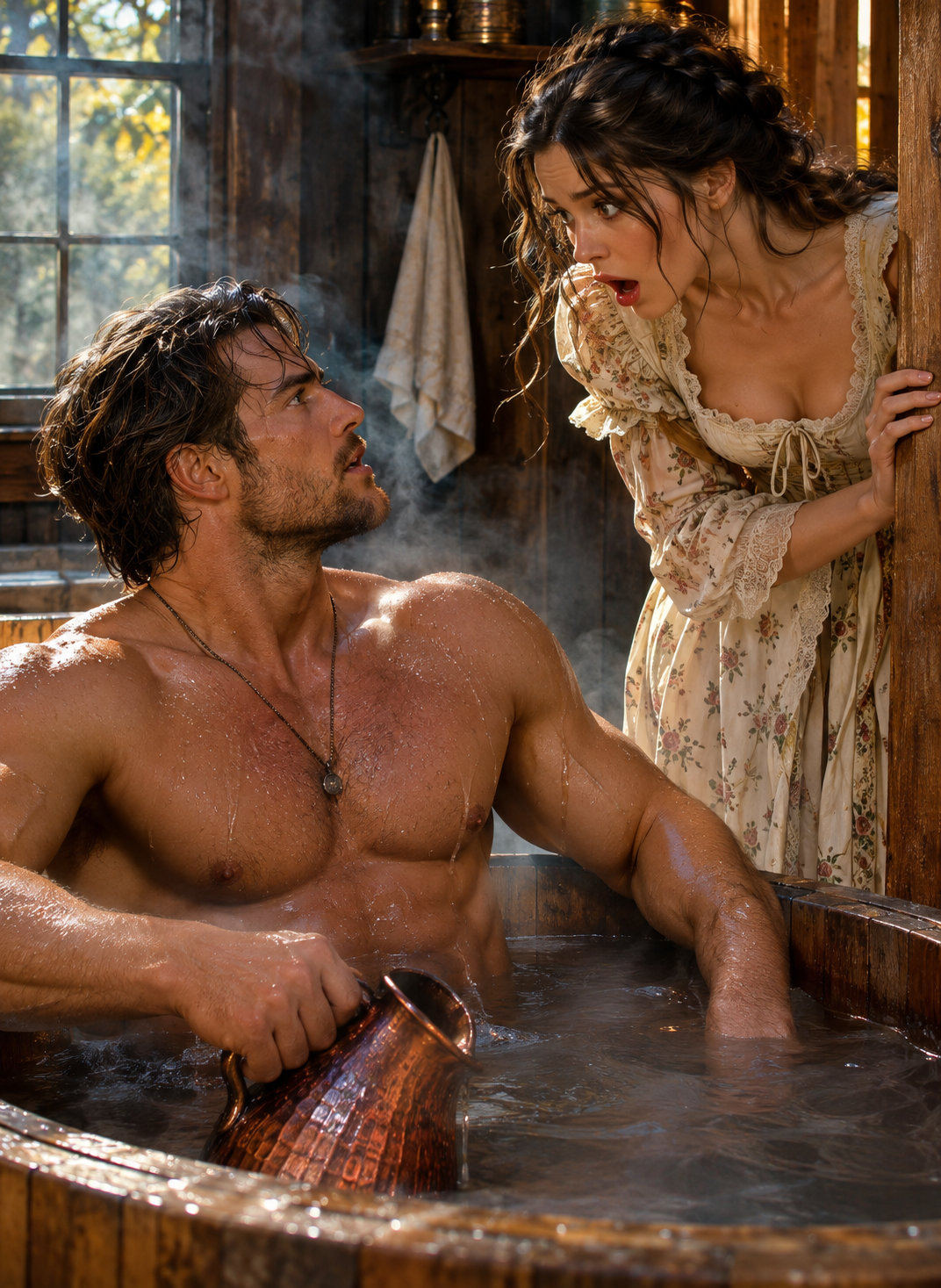
Only two nights earlier, I had nearly lied to him in the bathhouse because telling the truth frightened me.
Silence did not always look like silence.
Sometimes it looked like politeness.
Sometimes pride.
Sometimes protection.
Sometimes a man investigating your inheritance without telling you because he feared disappointing you.
Cole picked up another letter.
“This one’s from my mother.”
The date was only weeks before her death.
His hands became very still.
“You don’t have to read it.”
“Yes,” he said. “I do.”
He unfolded it.
Dear Ruth,
Edwin believes Thomas will recover financially if given time. Thomas believes Edwin pities him. I believe two stubborn men have confused being needed with being diminished.
Cole exhaled slowly.
I continued reading over his shoulder.
I have placed copies of the trust declaration in the springhouse so the children’s claim cannot disappear merely because ours has become difficult.
If anything happens to either of us, the land must eventually bring Lila and Cole together—not romantically, of course; they are children, and I am not writing one of those dreadful novels you lend me—
A laugh burst from me.
Cole stared.
“Your mother had a sense of humor.”
“Apparently.”
“She disliked my mother’s novels.”
“Apparently.”
We continued.
Let them decide what the land becomes. But do not let bitterness decide for them.
The words sat quietly on the page.
Cole folded the letter with extraordinary care.
“How did your mother die?” I asked.
His gaze moved toward the creek.
“Fever. I was twelve.”
“I’m sorry.”
“I remember adults lowering their voices every time I entered a room. I remember my father becoming very busy afterward.”
“Busy?”
“He expanded the ranch. Bought cattle. Bought land. Worked until midnight.”
Cole rubbed his thumb across the letter’s fold.
“He stopped laughing.”
There was no self-pity in his voice.
That made it harder to hear.
“And you?”
“I learned not to need anyone to.”
My heart ached.
“That’s a terrible lesson.”
“It was useful.”
“Those aren’t the same thing.”
His eyes lifted.
For a moment, neither of us looked away.
Then Cole said, “No. I suppose they’re not.”
We remained at the Dawson tract until evening.
Before leaving, I walked alone to the creek.
The water moved around smooth stones.
I remembered a boy retrieving a wooden boat.
I wondered how many moments were stored inside us without permission, waiting for the right sight or sound to return.
Cole approached but stopped several steps away.
“May I join you?”
“You don’t usually ask permission to stand beside creeks.”
“I’ve become cautious around you.”
“Good.”
He sat.
For a while we watched the water.
“What do you want to do with the land?” he asked.
“I don’t know.”
“Mercer’s opinion is that the original trust is probably enforceable.”
“And the other two hundred and twenty acres?”
“Likely yours once the old loan is formally resolved.”
“How much do I owe?”
“Nothing.”
I looked at him.
“Cole.”
“The repayment option expired financially when your father died. The hereditary extension concerns ownership, not debt.”
“That makes absolutely no sense.”
“Old legal agreements often don’t.”
“Could you make a claim against it?”
“Yes.”
I waited.
He stared at the water.
“But I won’t.”
“Because of us?”
Cole turned.
“No.”
The answer almost offended me until he continued.
“I wouldn’t make it if we’d never spoken outside the general store.”
“Why?”
“Because a promise doesn’t become optional simply because the person owed has less money than the person who owes it.”
I studied him.
“Is that how you became feared?”
He laughed quietly.
“By returning property?”
“You know what I mean.”
He picked up a stone and turned it between his fingers.
“I don’t socialize much.”
“I noticed.”
“I don’t drink in town. I don’t gamble. I don’t argue publicly.”
“All terrible faults.”
He ignored that.
“When someone tries to renegotiate a cattle contract after shaking my hand, I refuse.”
“So people call you ruthless.”
“Sometimes.”
“What else?”
Cole looked mildly uncomfortable.
“I once purchased a ranch at auction.”
“Whose?”
“Daniel Foster’s.”
I knew the story.
Everyone did.
“People said you took it after he failed.”
“He did fail.”
“So that part is true.”
“Yes.”
“What happened to him?”
“He still runs it.”
I frowned.
“What?”
“I bought the debt from the bank and gave him twenty years to repay me.”
“Nobody says that.”
“I didn’t see any reason to announce it.”
I stared at him.
“Cole Bennett.”
“What?”
“You may be the single worst manager of your own reputation I’ve ever met.”
“I don’t require a good reputation.”
“Everyone requires one.”
“No. I require people to honor contracts and leave my cattle alone.”
I laughed.
Then he did too.
It felt almost miraculous.
The following week changed the rhythm of the ranch.
Cole and I spent evenings sorting letters.
Mrs. Avery joined us after supper, squinting through spectacles and contributing information no document contained.
“Oh, certainly your mother came here,” she told me. “You used to chase Cole around the kitchen with a wooden spoon.”
Cole nearly choked on his coffee.
“I did not.”
“You absolutely did.”
I stared at him.
“You remember?”
“No.”
Mrs. Avery smiled wickedly.
“He cried once because you wouldn’t let him hold your kitten.”
“I was eight.”
“You cried.”
“I had allergies.”
I laughed so hard I nearly fell out of my chair.
Later, when Mrs. Avery left, Cole pointed at me.
“Not one word of this leaves the house.”
“Of course.”
“Lila.”
“I would never betray your confidence.”
“You are smiling.”
“I’m thinking about the kitten.”
He groaned.
The house had changed.
Or perhaps we had.
One evening Cole opened his mother’s sitting room.
He stood in the doorway for almost a minute before crossing the threshold.
Dust lay across the piano.
A shawl still rested on the back of a chair.
“I haven’t entered here in eleven years,” he said.
I did not tell him what that meant.
He knew.
We cleaned it together.
Not dramatically.
Not tearfully.
We opened windows.
Beat dust from cushions.
Sorted books.
Found three dried flowers pressed inside a poetry collection.
Cole carried the piano bench outside and repaired a broken leg.
Grief, I discovered, did not always require ceremony.
Sometimes healing looked remarkably like housework.
Two days later, Mr. Mercer arrived from San Antonio.
He was a small energetic man who seemed delighted by paperwork in a way I considered suspicious.
“The trust document changes matters substantially,” he said.
“Good or bad?” I asked.
“Interesting.”
“Attorneys should be forbidden from using that word.”
Cole covered a smile.
Mercer spread maps across the dining table.
“The spring parcel belongs neither solely to Miss Dawson nor solely to Mr. Bennett. It remains jointly administered under the original agreement.”
“And the rest?”
“Most of the northern tract should revert to Miss Dawson.”
My stomach fluttered.
I owned land.
The thought still felt absurd.
“But,” Mercer said, “there is another matter.”
Of course there was.
He produced a sealed envelope.
“This was discovered yesterday in a locked drawer inside the Bennett family records held at the First Bank of Mason County.”
Cole’s face changed when he recognized the handwriting.
“That’s my father’s.”
“Yes.”
The envelope bore only five words.
For Cole, when he is ready.
Cole stared.
I touched his hand.
“You don’t have to open it now.”
His fingers curled around mine.
Then he broke the seal.
Inside was one page.
He read silently.
Color drained from his face.
“Cole?”
He handed it to me.
The letter began:
Son,
If you are reading this, then the Dawson land has finally forced you to confront the mistake I spent half my life hiding.
I read further.
Then stopped.
Because the final paragraph changed everything we thought we understood.
I did not allow Thomas Dawson to lose that land because he owed me money.
Thomas did not borrow the money for himself.
He borrowed it for me.
And I let everyone believe the opposite.
**–END OF PART 4–CLICK “NEXT” AT THE BOTTOM OF THE PAGE TO CONTINUE READING**
✓ Lynn R. Adams
### Part 4 – What Our Mothers Had Planned For several minutes, Cole and I sat beneath the cottonwoods without speaking. The paper lay between us. Our names seemed impossible there. Lila Ruth Dawso…