PART 4: The Question Behind the Royal Chair 069
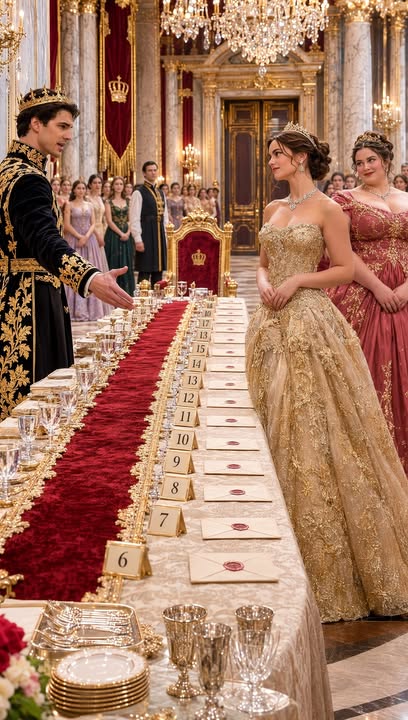
Part 4 – The Story Beneath the Record
Mara could not answer.
The half-erased word on the envelope seemed to hover between them, more question than clue.
The prince folded the paper carefully, taking care not to touch the wax.
“We should not draw conclusions from a partial impression,” he said. “But we should find out whose name it was.”
Edwin nodded.
“I’ll contact Mr. Hales and ask him to come to the palace.”
“Please do,” the prince said. “And ask the archive to bring the original record for the charity banquet.”
Mara’s gaze stayed on the envelope.
“My mother has the records my father kept,” she said. “I can bring them tomorrow.”
“If you’re comfortable doing that,” the prince replied. “You owe the palace nothing.”
The words might have comforted her, if the palace had not already taken so much from her family without ever naming it.
“I’m not bringing them for the palace,” she said. “I’m bringing them because I want to know what happened.”
The prince accepted the correction with a quiet inclination of his head.
“Then we’ll examine them together.”
Celestine stood beside the trays of returned glassware, her champagne-gold gown catching the dimming light.
“Would it help if I came with you?” she asked.
Mara looked at her for a moment.
“You said your family attended the banquet.”
“My grandmother did. She might remember more than the story she repeated.”
“Would she speak with us?”
“I can ask.”
Celestine’s voice held none of the certainty she had worn at the beginning of the challenge.
Mara could see the effort it took her to make the offer without turning it into a demand for forgiveness.
“Thank you,” Mara said. “Let’s see what the records show first.”
The prince returned the marked envelope to the evidence tray.
“Until we know more, I would ask everyone here not to repeat speculation as fact.”
No one objected.
The contestants began to depart in small groups, their conversation subdued.
The ballroom, so recently alive with competition and candlelight, was left with the soft clink of dishes and the quiet work of the staff.
Mara watched Elias rise from the royal chair.
He set the plain glass gently on the table.
“May I take this with me?” he asked.
Mara glanced at the glass.
“Would you like to?”
“I think I’d like to remember that someone asked.”
The prince looked at him, then nodded.
“Take it, Elias.”
Elias wrapped the glass in a clean cloth and carried it out with both hands.
Mara watched him go, thinking of the story he had told about his mother, and of how easily one person’s silence could become another person’s official version of events.
When the last contestant had left, the prince remained by the table.
His crown sat on the sideboard beside the ledger.
Without it, he seemed less distant, but not less responsible.
“Are you all right?” he asked Mara.
She considered the question.
“I don’t know.”
“That’s fair.”
“I came here thinking I understood why my father’s career ended.”
“And now you’re not sure.”
“I’m not sure whether I ever understood it at all.”
The prince lowered his eyes.
“I’m sorry the challenge brought you into this without warning.”
“You didn’t know about the envelopes?”
“I knew they were prepared by the household office. I did not know they carried an old seal or that some numbers had been changed.”
“Would you have stopped the test if you had known?”
“Yes.”
The answer was immediate.
Mara wanted to believe him.
She also knew that sincerity could not change what had already happened.
“Then I hope you find out why no one checked,” she said.
“So do I.”
He did not try to make a promise larger than the evidence he had.
That, more than any grand apology, helped her stay in the room.
The next afternoon, Mara returned to the palace with a wooden document box tucked beneath her arm.
The sky was low and gray, and the courtyard smelled of rain on stone.
Her mother had given her the box reluctantly, though not because she wanted to keep the truth from the palace.
She had simply asked Mara to be careful with their father’s papers.
“He kept them because they mattered to him,” she had said. “Not because he expected anyone to believe him.”
Mara had carried those words all the way to the palace gates.
The prince was waiting in a small records room rather than the ballroom.
A long table stood beneath a narrow window, and shelves of ledgers lined the walls.
Edwin was there, as was Lady Celestine, who had arrived with a folded letter from her grandmother.
The prince rose when Mara entered.
“Thank you for coming.”
Mara set the box on the table.
“I brought what my mother was willing to lend.”
“I’ll make sure it is handled carefully.”
Celestine held out the letter.
“My grandmother wrote down what she remembers. She says her memory may be imperfect, but she wanted to help.”
Mara accepted it.
The writing was neat and deliberate.
A short note accompanied it: I remember the confusion, but I do not remember who caused it.
Mara read the sentence twice.
It was not much, but it was more honest than the family story Celestine had described.
“Thank her for me,” Mara said.
Celestine nodded.
The prince opened the document box only after Mara gave permission.
Inside were folded menus, receipts, seating charts, and a bundle of instructions tied with faded blue ribbon.
Her father’s handwriting appeared on the top sheet, familiar in the same way his voice was familiar, even after years of silence.
Mara felt her throat tighten.
“He wrote everything down,” she said.
“He wanted to make sure the staff were paid on time,” her mother had told her once, when Mara was too young to understand why a stack of bills could matter.
Now, in the quiet records room, the papers looked less like routine accounts and more like a record of a life that had been reduced to one accusation.
The prince did not touch the documents until Mara untied the ribbon.
The first few pages were ordinary.
A list of deliveries.
A note about a missing serving tray.
A reminder that one of the musicians needed a chair with a firm back.
Then came the seating chart.
Mara leaned over it.
Several numbers had been written in her father’s hand, then crossed out and replaced.
The changes were careful, not hurried.
Beneath the chart was a small note in the margin.
“Revised per Hales, p.m.”
Edwin leaned closer.
“That is the same Mr. Hales we discussed yesterday.”
The prince traced the note without touching the paper.
“Does your father’s writing match the rest?”
“It does.”
“Could he have changed the numbers himself after speaking with Hales?”
“He could have written the note,” Mara said. “But that doesn’t tell us why.”
She lifted the next sheet.
It was a list of guest requests, each written beside a name and a numbered place.
One line had been circled in red ink.
“Seat twelve: move to seat seven. Keep near the garden doors.”
The red ink was not her father’s.
Mara knew it because the letters were tall and narrow, while her father’s handwriting leaned gently to the right.
The same red ink had been used to change the number on the envelope from the previous day.
“Could that be Hales’s writing?” the prince asked Edwin.
“I can’t say for certain,” Edwin replied. “But it resembles his note in the delivery ledger.”
The prince asked for the archive copy.
An attendant had brought it that morning, along with a thin folder containing the official report from the old banquet.
Mara had not yet asked to see the report.
She did not want to read the same accusation in another format.
But now she looked at the folder.
“May I?”
The prince slid it toward her.
The report was brief.
The banquet had suffered from “significant confusion in the placement of guests and meal service.”
Thomas Vale, responsible for coordinating the arrangements, had been “unable to maintain an accurate seating plan despite repeated corrections.”
The household regretted that his service had ended.
There was no mention of the guest requests.
There was no mention of who had issued the corrections.
Mara’s fingers rested on the edge of the page.
“He was blamed for the changes he recorded,” she said.
The prince’s face had gone still.
“It appears that way.”
“Not appears,” Mara said, though her voice remained controlled. “This report says he made the errors.”
“I’m sorry.”
She looked at him.
“You weren’t there.”
“No, but the report bears my family’s seal.”
The room fell quiet.
Celestine looked down at the open box.
“My family repeated this report as a story about poor service,” she said. “We never asked who had changed the instructions.”
Mara found herself wanting to comfort her, though she was the one who had been hurt.
She did not.
Celestine did not ask her to.
The prince read through the report again, then compared it with the handwritten chart.
“Why would Hales instruct your father to revise the seating plan?”
“Maybe he was correcting something,” Edwin said.
“Then why does the official account say the corrections were my father’s fault?”
Edwin had no answer.
Mara unfolded the next page.
It was a message written in her father’s hand, addressed to someone named Hales.
“Mr. Hales, the revised arrangement leaves Mrs. Wetherby’s guests separated from the main table. I have followed your instruction, but I ask that the original plan be restored before the doors open.”
Mara read it silently, then passed it to the prince.
The prince read it once.
Then he read it again, slower.
“Who was Mrs. Wetherby?” Celestine asked.
The prince turned to Edwin.
“Do you know?”
Edwin took a moment to think.
“I believe she was a donor. A powerful one, at the time.”
“Why would her guests be separated?”
The prince looked through the pages.
“I don’t know.”
Mara turned to the next sheet.
A seating plan, this one marked with the original positions, showed Mrs. Wetherby’s party placed near the head of the table.
A second plan, written in red ink, moved several other guests into those seats.
The new arrangement pushed a group of local charity organizers away from the center and left two elderly guests in a drafty passage near the doors.
Her father had written a small mark beside one of their names: “needs warmer place.”
The prince read the note.
“He was trying to protect the guests who had less influence,” he said.
“He was trying to give them the places they had asked for,” Mara replied.
The truth settled into the room with the quiet weight of something long delayed.
Her father had not lost track of the seating chart.
He had followed a change he disagreed with, recorded who gave it, and asked that the original plan be restored.
When the banquet went wrong, the record had preserved the result but erased the reason.
The prince sat down.
“Someone altered the instructions to give Mrs. Wetherby’s party the places they wanted,” he said. “Then the official report blamed the person who had followed the order.”
“Was Mrs. Wetherby the powerful guest whose demand they were hiding?” Celestine asked.
“Perhaps,” Edwin said. “But the records don’t prove that yet.”
Mara looked at the crossed-out numbers.
“Do they say who changed the instructions?”
The prince turned over the page.
At the bottom, beneath the list of revised seats, was a line in red ink.
“Per Hales. Special arrangement approved.”
The room became very still.
Edwin’s face had paled.
“If Mr. Hales approved the changes, why was he not named in the report?”
The prince looked at the archive copy.
The report had been signed by the household secretary and the prince’s grandfather, who had ruled at the time.
A second signature, faint and cramped, appeared in the margin.
“Hales,” Mara said.
The prince leaned closer.
“He countersigned the report.”
“He recorded the changes,” Celestine said, “then signed a report that blamed Mara’s father for them.”
Edwin lowered his gaze.
“I’m sorry,” he said. “I should have remembered his name when I first saw the seal.”
“You can’t be expected to remember every person connected to an old record,” Mara said.
“I could have asked questions.”
The prince looked at him.
“So could many people.”
The words held no accusation, but they carried responsibility.
Mara could feel anger rising in her, but it had nowhere simple to land.
Her father had been made into a careless man in the public record.
The people who made the decisions had remained within the same household, their names tucked into margins and old ledgers.
The prince stood.
“We need to speak with Mr. Hales.”
“Will he tell you the truth?” Mara asked.
“I don’t know,” the prince replied. “But he will be asked to explain the documents.”
“Privately?”
“If that is what you prefer while we verify them.”
The prince’s answer was measured, and Mara could see he understood that privacy might protect her family from further rumor.
It might also keep the truth from the people who had lived by the false version.
She was not ready to decide.
“First, I want to know what happened,” she said.
The prince nodded.
“I will arrange that.”
An hour later, Mr. Hales arrived at the records room.
He was a lean, silver-haired man with a careful manner and a dark green coat buttoned to the throat.
He greeted the prince, then Edwin.
When he saw Mara, he paused.
“Miss Vale,” he said.
“Mara Vale.”
“I remember your father.”
“Do you remember what happened at the charity banquet?”
Hales glanced toward the papers on the table.
“I remember the confusion.”
“Do you remember changing the seating instructions?”
His hands settled together in front of him.
“I remember assisting with the arrangements.”
“That isn’t the same as answering.”
The prince’s gaze remained on Hales.
“Mr. Hales, these records indicate that you issued revisions to the seating plan, and that the report later blamed Thomas Vale for errors resulting from those revisions.”
Hales looked down at the papers.
“The household was under considerable pressure at the time.”
“Why?” the prince asked.
“A principal donor had made certain requests.”
“Requests to be moved to the head of the table?”
“Requests that her party be seated together and near the royal family.”
“Was that Mrs. Wetherby?”
Hales did not answer at once.
“It was.”
Mara felt the words settle against the old report.
“Did my father refuse to follow the request?”
“He followed the written instructions,” Hales said. “But he objected to the changes.”
“Because they pushed other guests into poor seats,” Mara said.
“He thought the arrangement was unfair.”
“Was he wrong?”
Hales’s eyes moved to hers.
“I was young. I thought I was protecting the banquet from a public disagreement.”
“By changing the plan?”
“By accommodating an important guest.”
“And then blaming my father when the arrangement failed?”
The question was quiet.
Hales looked as though he had been expecting anger and had not prepared for stillness.
“I did not write the report alone,” he said.
“But you signed it.”
“Yes.”
“Did you correct it later?”
“No.”
“Did you tell anyone my father had followed your changes?”
Hales lowered his eyes.
“No.”
Mara’s breath caught, not with surprise but with the familiar ache of confirmation.
The prince stood beside the table, his expression closed.
“Why not?”
Hales looked at him.
“The donor had influence over several royal projects. I was told that a public dispute could cost the household her support.”
“So you let the record say my father was careless,” Mara said.
“I told myself the matter would be forgotten.”
“It wasn’t.”
“No,” he said. “It wasn’t.”
The room was silent except for the faint rattle of rain against the window.
Hales did not offer a defense.
He did not ask Mara to forgive him.
Perhaps he understood there was nothing he could say that would make the years of silence smaller.
The prince turned toward the old report.
“My family accepted this account without checking the underlying records.”
“Yes,” Hales said.
“And the household benefited from keeping the donor satisfied.”
Hales took a slow breath.
“Yes.”
The prince’s face had changed.
Not with anger alone, but with the dawning recognition that the story he had inherited had been comfortable because it had not asked anything of him.
Mara looked at the documents spread across the table.
Her father’s handwriting appeared again in the margin of a final page.
“If the original arrangement cannot be restored, please do not place the guests with mobility needs by the east doors. The draft is severe.”
A small note had been added in another hand.
“Approved.”
There was no name beside it.
The prince noticed the line.
“Who approved it?”
“I can’t remember,” Hales said.
“Could it have been the royal secretary?”
“Possibly.”
“Could it have been my grandfather?”
“Possibly.”
“Then we need to find out.”
Hales nodded.
“I will answer any questions the archive requires.”
Mara looked at him.
“Why did you let the false story be repeated for so long?”
His shoulders lowered.
“Because correcting it would have meant admitting why I changed the plan. And because, after your father had been dismissed, I told myself there was no point reopening the matter.”
The honesty did not make the answer easier.
It made the truth more complete.
Mara turned away from the table and looked through the window.
The palace gardens were blurred by rain.
For years, she had thought her father had carried shame because he had made a mistake.
Now she understood that he had carried the consequence of another person’s decision, while those who knew the truth remained silent.
The prince came to stand at a respectful distance.
“I am sorry,” he said.
Mara did not answer right away.
“What you’re sorry for matters,” she said at last.
He took in the words.
“I am sorry that my family’s household accepted an account that blamed your father without examining the records, and that the institution I represent benefited from keeping the matter quiet.”
“That is closer.”
“I know it does not repair what happened.”
“No.”
“I will make sure the record is corrected.”
Mara looked at him.
“Will you make sure everyone who was told the old story hears the correction?”
The prince hesitated.
It was only a moment, but she saw it.
“A public correction would draw attention to the palace,” he said. “I need to be certain of every detail before making one.”
“Of course.”
“I don’t mean to delay.”
“I know you may not mean to.”
The distinction mattered.
A delay could still be a choice, even when no one intended harm.
Celestine stood by the table, holding her grandmother’s letter.
“My family repeated the false account too,” she said. “If there is a correction, we will support it.”
Mara was grateful, but the offer did not make her uncertainty disappear.
The prince began to gather the documents into their original order.
“We should give the archive time to authenticate them.”
“Yes,” Mara said. “But I want copies of everything before they leave this room.”
“That can be arranged.”
“And I want my father’s original papers returned to my mother.”
“Of course.”
The prince said it without hesitation.
For the first time since the challenge, Mara believed he understood that her family’s records were not merely evidence for a royal inquiry.
They were the remains of a story her father had never been able to tell in public.
The conversation continued into the evening.
Edwin took notes.
Hales answered questions about the banquet office and the old seal.
Celestine compared the report with her grandmother’s letter, carefully noting where the two agreed and where memory failed.
The prince listened more than he spoke.
When the meeting ended, the rain had stopped.
Mara gathered the document box.
The prince offered to have an attendant carry it, but she declined.
“I can manage.”
He stepped aside.
“Thank you for helping us understand what happened.”
“I helped because I wanted the truth.”
“I know.”
She reached the door, then paused.
Behind her, the prince had opened the official report one last time.
He was studying the faint signature at the bottom, where his grandfather’s name appeared beside the household secretary’s.
A third mark, almost hidden beneath the fold, had been uncovered by the damp air.
It was a small handwritten note.
The prince leaned closer.
“Wait,” he said.
Mara turned back.
“What is it?”
He lifted the report so the others could see the newly visible line.
The writing was faded, but the words could still be read.
“Instruction issued by the prince’s office.”
Everyone went still.
The report had named Thomas Vale as responsible for the errors.
But this note suggested the changes had not come from a donor alone, nor from Hales acting on his own.
They had been issued in the name of the prince’s office.
Mara looked at the old signature, then at the prince.
“Your grandfather knew?”
The prince’s face was pale beneath the lamplight.
“I don’t know.”
The note had no signature, only a final initial pressed into the paper.
A capital R.
Edwin took one step closer.
“Your Highness,” he said, “that was not your grandfather’s initial.”
The prince stared at the letter.
Mara’s fingers tightened around the box.
“Then whose was it?” she asked.
No one answered.
And in the silence, the old report seemed to become something more than a record of one man’s injustice.
It had become a question about who, inside the royal household, had ordered it.
**–END OF PART 4–CLICK “NEXT” AT THE BOTTOM OF THE PAGE TO CONTINUE READING**
* * *
[PREVIOUS: PART 3](https://storyly.idolsgift.com/blog/part-3-the-question-behind-the-royal-chair-069) | [NEXT: PART 5](https://storyly.idolsgift.com/blog/part-5-the-question-behind-the-royal-chair-069)
✓ Lynn R. Adams
Part 4 – The Story Beneath the Record Mara could not answer. The half-erased word on the envelope seemed to hover between them, more question than clue. The prince folded the paper carefully, takin…