PART 4: The Promise Hidden in the Music 041
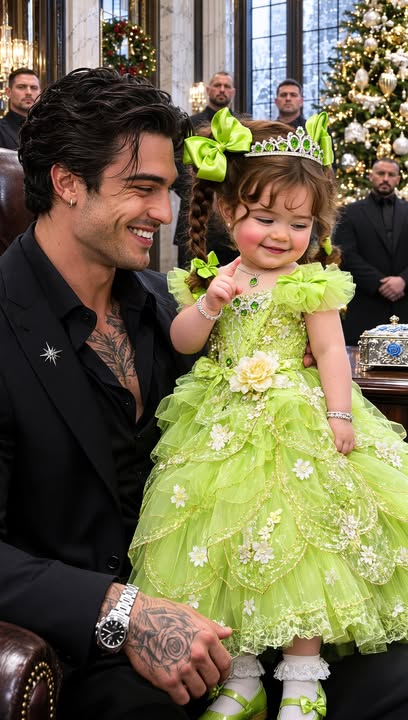
Part 4 – The Doctor’s Record
The music box began to play from somewhere down the hall.
Vincent pushed back from the desk so quickly that the chair scraped against the floor.
Mrs. Bennett was already moving toward the door.
They reached the guest room together, where Mia sat propped against a pillow, her small hands resting beside the open music box.
“I wanted the song,” she said, her voice drowsy but pleased.
Vincent knelt beside the bed.
“It’s all right, sweetheart.”
He glanced at the box’s winding key.
It had not been turned since he closed it in the office.
Mrs. Bennett leaned closer to Mia, studying her face.
“Did you open the music box yourself?”
Mia shook her head.
“It opened.”
“Did someone come in?”
“No.”
Vincent looked around the room.
The window was latched from the inside, and the door stood open to the empty hall.
The music box played the last few notes, then fell quiet.
Mia yawned and laid her cheek against the pillow.
“Your mama song,” she murmured.
“Yes,” Vincent said. “It is.”
He lifted the box carefully and carried it back to the office.
The key was still wound, though the mechanism should have stopped after its short tune.
When he opened the lid, the tiny blue rose inside seemed to catch the lamplight.
Mrs. Bennett remained in the doorway, her gaze fixed on it.
“Could it have been wound more than once?” she asked.
“Possibly.”
“Could Mia have touched the key?”
“She says she didn’t.”
“I believe her.”
Vincent ran a thumb over the silver edge.
He could not explain what had happened, and he did not want to turn a child’s sleepy mistake into another clue.
Still, the music had started at the exact moment they found the words on the back of the photograph.
Keep our promise, even if Carlo asks you not to.
He closed the lid.
“Tomorrow I’m going to see Dr. Whitaker’s records.”
“Do you know where his clinic was?”
“I found an address in the cabinet. It became a medical archive years ago.”
Mrs. Bennett studied him.
“If there’s a record, it may not tell you what you want.”
“I know.”
“And if there isn’t?”
“Then I’ll have to keep looking.”
She nodded.
“That sounds like your mother.”
The remark stayed with Vincent long after Mrs. Bennett returned to Mia.
He sat at his desk until the Christmas lights outside the windows dimmed, the old photograph beside him and the letter folded beneath his hand.
He thought about the woman partly cropped from the picture, the blue-stone ring, and the promise his mother had made someone keep.
He thought about his father’s careful answers, each of them plausible and incomplete.
Most of all, he thought about the unsent letter to Dr. Whitaker.
I need to know whether my illness can still be treated.
When dawn came pale and cold over the city, Vincent placed the papers in a folder and left the music box locked in his desk.
He asked one of his drivers to take him to the medical archive.
Mrs. Bennett came downstairs before he left.
Mia was asleep again, one small hand curled around the plush reindeer.
“I’ll stay with her,” Mrs. Bennett said. “You go find out what you can.”
Vincent paused at the front door.
“If my father calls, don’t tell him where I am.”
“I won’t.”
“I’m not asking you to hide anything.”
“I understand.”
He looked at her carefully.
“If you remember something about the ring, or the promise, call me.”
“I will.”
After a moment, he added, “And if you’re worried, call me for that too.”
Her eyes softened.
“I’ll try.”
The archive occupied a renovated brick building on a quiet side street.
A young archivist led Vincent to a reading room with tall windows and a long oak table.
The old clinic’s records had been transferred there years earlier, but medical files were restricted unless the person requesting them was a patient, a close relative, or an authorized representative.
Vincent presented his identification and explained that Isabella was his mother.
The archivist studied the forms, then disappeared into the back office.
He returned with a small archival box sealed with a paper band.
“Some of the clinic’s records were damaged when they were transferred,” he said. “I can’t promise the file is complete.”
“I understand.”
“You may take notes, but please don’t remove anything from the box.”
“I won’t.”
The archivist set the box down and left him alone.
Vincent broke the seal.
The first file contained appointment schedules and billing statements.
Several pages listed visits by Isabella Moretti in the year before her death.
The dates ended abruptly.
He turned the pages slowly, checking each one for a note about her condition or treatment.
Near the back, a folded sheet had been tucked inside an envelope marked Dr. Elias Whitaker — Private correspondence.
Vincent recognized the doctor’s name from the unsent letter.
He opened it carefully.
The note was dated three days after Isabella’s final listed appointment.
Dr. Whitaker had written that her condition was serious but treatable, provided she continued the prescribed course of care.
There was no promise that she would recover completely.
There was, however, no indication that treatment had become futile.
Vincent read the sentence twice.
Her condition was serious but treatable.
The words did not turn the past into something simple.
They did not tell him whether Isabella’s illness could have been cured, or whether the course of treatment would have succeeded.
But they made one thing painfully clear.
Someone had led her to believe that stopping care was the only safe choice.
Vincent looked again at the date.
The note was addressed to Isabella.
In the lower margin, Dr. Whitaker had added a short line.
The family has advised that Mrs. Moretti will not be returning.
Vincent felt his jaw tighten.
He set the paper down before his grip could crease it.
The next document was a clinical summary written several months later.
It noted that Isabella’s appointments had been discontinued at the family’s request.
The reason entered into the file was concern that travel might expose her young son to danger.
Vincent leaned back.
His mother had not imagined the warning.
His father had told her he was worried about Vincent’s safety.
The record did not say whether Carlo had believed the danger was real.
It did not say whether he had understood how much the warning would frighten her.
It did not say whether the family doctor had known the full circumstances when the appointments stopped.
The file contained another page, a copy of a letter from Dr. Whitaker to Carlo.
It was brief and formal.
He had asked Carlo to reconsider the interruption of Isabella’s treatment and to arrange a safe way for her to return.
Beside the sentence, someone had written in the margin: Mr. Moretti states that his wife refuses further treatment.
Vincent closed his eyes for a moment.
His mother had written that she did not know whether she was refusing care by choice or because she had been frightened into it.
The record showed how the doctor had been told to understand her decision.
It did not show what Carlo had said to her.
It did not show what Isabella would have chosen if she had been given the whole truth.
A voice from the far side of the room interrupted his thoughts.
“Vincent?”
He looked up.
Mrs. Bennett stood in the doorway, her coat still buttoned against the cold.
“What are you doing here?”
“I came after you.”
“Is Mia all right?”
“She’s with the neighbor’s daughter. I stayed until she woke, and then I brought her to my daughter’s place.”
“You should have called.”
“I did.”
Vincent checked his phone.
There was a missed call and a short message from Mrs. Bennett, but he had silenced the device inside the reading room.
“I’m sorry,” he said.
“I’m not here to scold you.”
She pulled out the chair opposite him.
“What did you find?”
He turned the clinical summary so she could read it.
She read slowly, her lips pressed together.
When she reached the note about travel and danger, she looked up.
“Carlo told her that?”
“The record says the family advised that she would not return because of concern for my safety.”
“Did he say that directly to her?”
“I don’t know.”
“Did she believe him?”
“She believed there was a risk.”
Mrs. Bennett looked back at the page.
“Did the doctor say she could have recovered?”
“He said treatment was still possible. He didn’t promise it would work.”
“That’s not the same as a cure.”
“No.”
“Then we still don’t know whether she would have lived.”
“No.”
The answer came out rougher than he intended.
Mrs. Bennett covered the edge of the paper with her hand, as though she could keep it from shifting.
“Your mother was already ill,” she said. “She may have died even if she continued.”
“I know.”
“But this shows she didn’t stop because the doctor said nothing could be done.”
“No.”
“It shows someone told her to stop.”
Vincent looked down at the record.
“It shows someone gave the doctor that explanation.”
Mrs. Bennett withdrew her hand.
“You’re right. We need to be precise.”
He was grateful that she did not ask him to call it anything more than he could prove.
He copied the file numbers and dates into his notebook.
The archivist returned to explain that one more box had been found under Isabella’s married name, filed separately from the clinic records.
It had arrived with the papers from a small private practice that Dr. Whitaker had maintained before his retirement.
Vincent signed the necessary forms.
The second box contained appointment cards, correspondence, and a paper envelope with his mother’s name handwritten across the front.
The envelope had been opened and resealed.
Inside was a single page, written in Dr. Whitaker’s hand.
He had addressed it to his own office rather than to a family member.
The note recorded a conversation he had with Isabella shortly before her final hospitalization.
Mrs. Moretti believes she must stay away from treatment to protect her child.
She says her husband warned her that someone intended to use her appointments to reach Vincent.
She is afraid to ask the family to escort her, and she does not trust the information being given to her.
I advised her that the clinic could arrange confidential transport and that I would speak with her husband directly.
A second paragraph had been added beneath it.
Mr. Moretti declined the arrangement.
He says his wife is too unwell to make further decisions and has asked that all communication go through him.
Vincent read the note again.
The doctor’s words were measured, cautious.
They still could not tell him whether Carlo had been acting from genuine fear, from a desire to control the family, or from both.
But they showed that Carlo had been given another option.
The clinic had offered safe transport.
He had declined it.
Vincent looked up at Mrs. Bennett.
“He could have let her continue treatment.”
Her eyes shone, but she did not look away.
“Yes.”
“He could have told her the doctor was willing to help.”
“Yes.”
“He told her she was in danger, and then let the doctor believe she refused care.”
Mrs. Bennett drew a slow breath.
“That’s what the records say.”
Vincent’s hands were flat on the table.
For years, he had imagined his mother’s illness as a tragedy that had arrived without warning and ended before anyone could prepare.
Now he saw that there had been a narrow, uncertain path toward more time.
No one could know whether his mother would have taken it.
No one could know whether she would have survived.
But she had not been given a clear choice.
The grief he had carried did not lessen.
It changed shape.
It became threaded with a new anger, quiet and heavy, directed at the decisions that had closed around her while she was frightened and sick.
He wanted to call Carlo.
He wanted to ask why he had done it.
He wanted to hear a reason that would explain how a man could love his wife and still make the choice that helped cost her life.
Instead, he copied the doctor’s note and put the original back in its sleeve.
“We need to speak with Dr. Whitaker if he’s still alive,” he said.
The archivist returned with an address from a later directory.
“He retired twelve years ago,” the man said. “The records list a forwarding address, but I can’t confirm whether he still lives there.”
Vincent took the note.
Mrs. Bennett stared at the name.
“I remember him,” she said. “He visited your mother at the house once.”
“Why didn’t you tell me?”
“I didn’t know he was the same doctor. At the time, I was told he was consulting on her care.”
“By Carlo?”
“Yes.”
The name made the silence between them feel suddenly wider.
Vincent folded the address into his notebook.
Outside, the winter sun had climbed above the roofs, though it gave little warmth.
He and Mrs. Bennett stood on the steps of the archive for a moment, neither quite ready to leave.
“Do you think my father wanted her to die?” Vincent asked.
Mrs. Bennett looked at him with sadness rather than surprise.
“I don’t know.”
“Do you think he wanted her weak enough not to question him?”
“I don’t know that either.”
“But he knew treatment might help.”
“The record says he was told.”
“And he stopped it.”
“The record says he declined the doctor’s offer.”
Vincent stared down at the folded address.
The language was careful, each fact kept within its boundary.
That care was necessary.
It did not make the facts easier to bear.
When they returned to the house, Mia was sitting on the floor in the sitting room, fitting wooden blocks together while Mrs. Bennett’s daughter watched nearby.
She looked up when Vincent entered.
“Vincent!”
He crouched, and she toddled over to him with a block in each hand.
He picked her up.
“How are you, princess?”
“Build house.”
“Show me.”
She brought him to the blocks and placed them in his palm one at a time.
He sat on the rug beside her, still holding the doctor’s note in the pocket of his coat.
Mia arranged the blocks in a crooked little row and declared it a castle.
“Who lives there?” Vincent asked.
“Me. Nana. You.”
The answer landed gently, but it settled somewhere deep.
He glanced toward Mrs. Bennett.
She had heard it, too.
For a while, they helped Mia build a second wall around the castle.
When she knocked it down by accident, she laughed and started again.
Vincent let her hand his blocks one at a time, listening to her explain which rooms belonged to whom.
The small, ordinary work steadied him.
Later, after Mia had fallen asleep, Mrs. Bennett joined him in the office.
The music box sat on the desk where he had left it.
Beside it lay the photograph of Isabella holding infant Vincent.
Vincent showed her the doctor’s note.
She read it carefully.
“I should have been there,” she whispered.
“You were gone by then.”
“Because I left.”
“Because my father told you to leave.”
“I could have tried to come back.”
“He threatened you.”
“I still could have tried.”
Vincent took the paper from her hands.
“You had a daughter to protect.”
“I know.”
“You made the choice you thought would keep her safe.”
“I wish I’d made a different one.”
He understood the regret in her voice.
He understood it because it was his own.
He had spent years thinking he had no unfinished conversation with his mother, because he had no memory of one.
Now he knew that people could be left with questions even when they had done nothing wrong.
He placed the doctor’s note beside the photograph.
“The records changed what we know,” he said. “They still don’t tell us everything.”
“What else do you need?”
“Dr. Whitaker. My father’s account books. The rest of the letter, if it exists.”
“And the promise.”
He looked at the small note, still tucked inside the music box.
“Keep the Christmas Eve promise.”
Mrs. Bennett watched the blue rose drawn beneath the words.
“Your mother may have made the promise to the person in the photograph.”
“Whoever they were.”
“Someone she trusted.”
“Or someone she was afraid of disappointing.”
Mrs. Bennett considered that.
“Both could be true.”
Vincent turned over the photograph.
Keep our promise, even if Carlo asks you not to.
He had spent the day trying to understand his father’s role in his mother’s death.
The evidence pointed toward a decision made in fear and kept in silence.
It did not tell him whether Carlo had thought of himself as a protector or as a man guarding his own interests.
Perhaps he had been both.
A knock sounded at the front door.
Vincent stood.
One of his guards came to the office.
“Your father is here,” he said. “He asked to speak with you alone.”
Mrs. Bennett’s face tightened.
Vincent looked toward the desk, where the copied records, the photograph, and the old letter lay in a neat line.
He had planned to call Carlo himself.
He had not expected his father to come before he had decided what to say.
“Bring him in,” Vincent said.
The guard left.
A moment later, Carlo entered the office without removing his coat.
His gaze fell on the paper beside the photograph.
“You found Dr. Whitaker’s file,” he said.
Vincent did not ask how his father knew.
“Did you already know what it said?”
“I knew what happened.”
“That isn’t the same as knowing what the file says.”
Carlo glanced at Mrs. Bennett.
“I can wait until we’re alone.”
“She stays.”
Carlo accepted the answer with a small nod.
Vincent pushed the doctor’s note across the desk.
“Dr. Whitaker offered safe transport for Mother.”
“I remember.”
“He said her treatment was still possible.”
“Yes.”
“He said she was afraid I would be targeted if she continued.”
“She was afraid of that.”
“Were you?”
Carlo looked down at the page.
“I thought there was a risk.”
“Was there?”
“There was always risk around our family.”
“That’s not an answer.”
“No,” Carlo said. “It isn’t.”
Vincent waited.
Carlo removed his gloves one finger at a time, then placed them on the edge of the desk.
“I was trying to keep your mother away from anyone who might use her to get to me.”
“Or you were trying to keep her from finding out what you were doing.”
Carlo did not answer at once.
When he did, his voice was low.
“I was afraid she would leave, and I was afraid the people around us would take advantage of her weakness.”
“Those fears don’t cancel each other out.”
“No.”
“Did you know the treatment could help her?”
“I knew the doctor believed it might.”
“Why did you tell her she had to stop?”
“I told her she should stop for a while.”
“Until when?”
“Until I could be sure it was safe.”
“Did you ever make it safe?”
Carlo looked toward the silver music box.
“No.”
The admission hung between them.
Vincent’s anger did not vanish, but it shifted, becoming more precise.
“You let the doctor believe she refused treatment.”
“I thought it would be temporary.”
“You declined the transport he offered.”
“Yes.”
“You told Mother she was protecting me by staying home.”
Carlo’s eyes closed briefly.
“Yes.”
“And then you told me she died because the illness had become too severe.”
“That was true.”
“It wasn’t the whole truth.”
“No.”
For a moment, no one spoke.
Mrs. Bennett remained still beside the desk, one hand resting near the letter.
Carlo looked at Vincent.
“I thought I was buying time.”
“For whom?”
“For all of us.”
“You were wrong.”
“Yes.”
The word came without excuse.
Vincent had expected denial, or a defense shaped around the uncertainty of the records.
He had not expected his father to accept the question so plainly.
It did not repair anything.
It did not make his mother’s last months less frightening, or give Vincent back the years he had spent believing there was nothing to question.
But it changed the shape of his father’s silence.
“Why did you tell me she had no choice?” Vincent asked.
“I didn’t say it that way.”
“You let me believe the doctors had done everything they could.”
“I believed they had.”
“You knew you had stopped the appointments.”
“I believed I was stopping them until the danger passed.”
“And when it didn’t?”
Carlo’s face seemed to age in the space between them.
“By then, she was too weak to travel.”
“Would the treatment still have helped?”
“I don’t know.”
“Would she have survived?”
“I don’t know.”
“Did you tell her the clinic could send someone for her?”
“No.”
“Why?”
Carlo looked at the photograph of Isabella with their infant son.
“Because I thought the people who wanted to hurt me would follow her there.”
“You could have told her the truth and let her choose.”
“Yes.”
“Instead, you decided for her.”
“Yes.”
The admission was quiet, but it reached every corner of the office.
Vincent lowered his eyes to the photograph.
His mother’s expression was full of trust.
The partly cropped figure stood beside her, one hand resting on the music box, the blue stone of a ring catching the light.
Vincent turned the picture around and placed it before his father.
“Who is this?”
Carlo’s gaze stopped on the image.
The stillness in him changed.
It was not surprise now.
It was recognition.
For a long moment, he did not speak.
Then he looked at the handwritten words on the back.
Keep our promise, even if Carlo asks you not to.
“Who is it?” Vincent asked again.
Carlo’s hand hovered over the photograph but did not touch it.
“Your mother made me promise I would never tell you.”
“Why?”
“Because she believed that person could help you if something happened to her.”
“What was the promise?”
Carlo looked at the music box, then back at his son.
“I promised to keep them away from you.”
The room seemed to narrow around the sentence.
“You promised Mother you would keep this person away?”
“I promised I would protect you from them.”
“Why?”
Carlo’s eyes were full of something Vincent had not seen there before.
Not anger.
Not regret alone.
Fear.
“Because the person in that photograph,” Carlo said, “was the one who arranged for Isabella’s treatment to stop.”
**–END OF PART 4–CLICK “NEXT” AT THE BOTTOM OF THE PAGE TO CONTINUE READING**
* * *
[PREVIOUS: PART 3](https://echoesofstories.idolsgift.com/blog/part-3-the-promise-hidden-in-the-music-041) | [NEXT: PART 5](https://echoesofstories.idolsgift.com/blog/part-5-the-promise-hidden-in-the-music-041)
✓ Lynn R. Adams
Part 4 – The Doctor’s Record The music box began to play from somewhere down the hall. Vincent pushed back from the desk so quickly that the chair scraped against the floor. Mrs. Bennett was alread…