PART 4: The Portrait in the Forgotten Wing 053
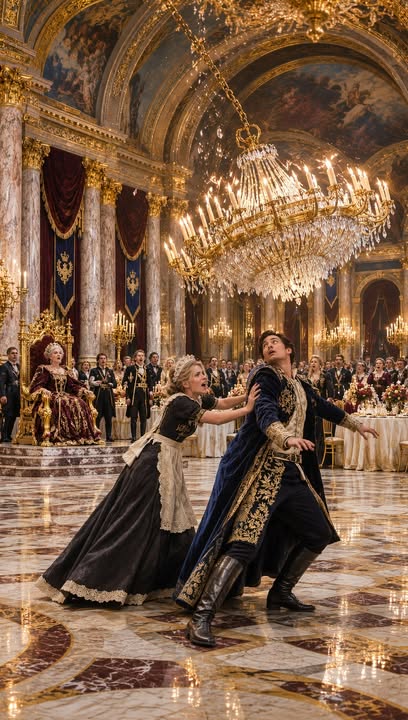
Part 4 – The Fire’s True Purpose
The initials at the bottom of the ledger seemed to darken beneath my gaze.
E. W.
Edward Whitmore.
I had pictured the late king as a distant figure in a gilded frame, not a man whose hand had once directed the course of my life.
The council chamber had gone quiet.
Beyond the half-open door, I heard the Queen Mother draw a careful breath.
“Those initials do not prove what you think they prove,” she said.
Alexander’s voice came next, low and deliberate.
“Then tell us what they do prove.”
No answer followed.
I looked at Mrs. Bell.
She had gone pale, her eyes fixed on the writing.
“You knew?” I whispered.
“No,” she said. “I knew Margaret carried you away. I never knew your father had arranged it.”
The word father landed differently now.
Not the king who had raised Alexander, but the man who had once held a choice over my life.
Through the doorway, the council began to stir.
A minister asked that the ledger be brought before them.
Another suggested the meeting be adjourned until the records could be authenticated.
The Queen Mother’s voice remained composed, but the strain beneath it had become unmistakable.
“There is no reason to make a private family matter the concern of the entire council.”
Alexander answered before anyone else could.
“When the matter concerns the succession, the council has every reason to hear it.”
I closed my hand around the locket inside my cloak.
Until that moment, I had believed the king’s signature might reveal where I had been sent, or whether he had known I was alive.
Now it seemed to reveal something more personal.
He had chosen someone to take me.
He had known I was a child, not a line in a ledger.
He had put my life into another person’s hands.
And he had done so without leaving me a name I could trust.
The chamber doors opened.
Alexander stepped into the corridor with the ledger in his hand.
His eyes found mine at once.
“The council has asked to examine the original,” he said. “They also want to hear from Mrs. Bell.”
“I will tell them what I know,” she replied.
The Queen Mother emerged behind him, followed by two ministers and a clerk.
Her gaze settled on me, and for the first time since the ballroom, I did not feel the urge to hide my wrist beneath my sleeve.
I still covered it.
But I did so because I chose to, not because someone else had ordered me.
“Emily,” she said, “you should not be here.”
“I have heard that before.”
Her expression tightened.
“This is a difficult matter, and the council will need time to understand what these records mean.”
“They have had twenty-seven years.”
A quiet murmur passed through the corridor.
The Queen Mother looked toward the ministers, then back at me.
“Your identity has not been established beyond dispute.”
“No,” I said. “But the page says my name. The ledger says my name. And Mrs. Bell says she carried me.”
Mrs. Bell stood beside me.
“I can confirm that the infant named Emily was Princess Eleanor’s daughter,” she said. “I saw her born, and I held her during the weeks that followed.”
The Queen Mother’s face grew still.
“You are certain?”
“I have never been more certain of anything.”
One of the ministers asked Mrs. Bell to enter the chamber.
She did so without hesitation.
Alexander waited for me to follow, but I looked first at the Queen Mother.
“Did you know my father was alive after the fire?”
“I did not.”
“Did you know the king released me into someone’s custody?”
“I knew there was an order relating to the child.”
“That is not what I asked.”
Her gaze shifted to the page in Alexander’s hand.
“I did not know the full terms of the order.”
“Then who did?”
For the first time, the Queen Mother had no answer ready.
The council chamber was larger than it seemed from the corridor, its high windows pale with morning light.
The members sat around a long oak table, and the old ledger lay open in the center beneath the clerk’s careful hands.
No one looked at me as a servant now.
That did not mean they knew what to call me.
I took the seat Alexander left empty beside him.
Mrs. Bell remained standing until the council’s oldest minister invited her to sit.
The Queen Mother stayed at the head of the table.
She had spent decades occupying that place, and even now she carried herself as though the room had been built around her certainty.
The senior minister folded his hands.
“Mrs. Bell, you have said the child was Princess Eleanor’s daughter.”
“Yes.”
“Was the princess alive when the child left the palace?”
“She was.”
“Did she consent to the child being taken away?”
Mrs. Bell looked at me before she answered.
“She asked Margaret Parker to carry the baby beyond the palace walls.”
The Queen Mother closed her eyes briefly.
The minister continued.
“Did she tell you why?”
“She said there were people looking for the child.”
A hush fell over the table.
Alexander leaned forward.
“Who were they?”
“I do not know their names,” Mrs. Bell said. “I only know Eleanor was frightened by the questions being asked about the succession, and by the papers kept in the royal archives.”
The Queen Mother sat straighter.
“That is an interpretation offered years later.”
“It is what Eleanor told me,” Mrs. Bell replied. “She said the child was in danger because of what the records would prove.”
The minister turned to the Queen Mother.
“Your Majesty, do you know which records she meant?”
“I was not in charge of the archives at that time.”
“Were you aware that Princess Eleanor believed her daughter’s claim to the throne was threatened?”
“I was aware of no such claim.”
The answer sounded measured, but I noticed how carefully she avoided looking at the ledger.
The clerk turned back several pages.
“Your Highness,” he said to Alexander, “the entry for the child is followed by the note ‘removed to royal protection.’ The line on the loose page states, ‘Infant released to the custody of—’ and ends before the name.”
He glanced at the initials.
“The signature appears to be King Edward’s.”
Alexander sat very still.
“Could the rest of the page have been deliberately removed?”
“It could,” the clerk said. “The torn edge is old, but the damage does not tell us when or why it was done.”
The Queen Mother lifted one hand.
“Then we should not build accusations upon a fragment.”
“I agree,” Alexander said. “But we should not dismiss a fragment simply because it is inconvenient.”
His voice held none of the softness he had shown me in the old nursery.
It was not anger.
It was the sound of a man choosing to look at something he would rather have avoided.
The senior minister turned to Mrs. Bell.
“Where was the infant taken?”
“To Margaret Parker.”
The name passed around the table.
A few members seemed to recognize it.
“She served in the household for many years,” the clerk said. “She retired before the palace fire.”
“She did not retire,” Mrs. Bell replied. “She disappeared from the palace shortly afterward.”
“Did the late king know she had taken the child?”
“I cannot answer that.”
The Queen Mother’s fingers tightened around the arm of her chair.
“Mrs. Bell, you have had many years to decide what you believe happened.”
“I have had many years to remember what happened,” she said. “That is not the same thing.”
No one interrupted.
I turned the locket over in my pocket.
Its scorched silver edges pressed against my palm.
The chapel inventory had called it a relic, but I could not stop wondering whether it had been left behind deliberately.
The senior minister noticed the movement.
“What is it you are holding?”
I brought out the locket and placed it on the table.
A murmur ran through the chamber as the clerk recognized the engraved E.
The Queen Mother looked at it, and for an instant I saw something flash across her face.
Not surprise.
Recognition.
“You have seen it before,” I said.
“I have seen many objects from the old palace.”
“Did you know it belonged to Eleanor?”
“I knew it was associated with her.”
“Did you know it was found in the nursery after the fire?”
The Queen Mother did not answer.
The clerk carefully opened the locket.
Inside, soot stained the metal around the empty center.
One of the council members leaned closer.
“There is something beneath the hinge.”
The clerk examined it with a small magnifying lens.
A folded sliver of paper had been pressed into the narrow seam.
The paper was so thin it nearly broke when he eased it free.
He laid it flat beneath the window light.
The ink had faded, but several words remained legible.
If this is found, the records must be moved from the nursery before—
The sentence stopped at a torn edge.
The council members exchanged glances.
The Queen Mother stood.
“That paper proves nothing. It may have been written years later.”
“Do you know the handwriting?” Alexander asked.
“I said it may have been written later.”
“You did not answer.”
She looked at him for a long moment.
Then she turned toward the senior minister.
“I ask that the council recess while the paper is examined.”
The minister did not move.
“We will decide when we have heard the remaining evidence.”
For a moment, I thought the Queen Mother might insist.
Instead, she sat down again.
Her composure had not broken, but it had become a thing she had to hold in place.
The clerk carried the locket and the paper to the side of the room.
An archivist was summoned to inspect the ink and the old folds.
While they waited, Alexander leaned toward me.
“Are you all right?”
“I don’t know.”
“You don’t have to decide anything today.”
“That’s what everyone keeps saying.”
“I’m not asking you to decide who you are,” he said. “Only whether you want to hear what the records say.”
I studied him.
“Do you believe your father released me to Margaret?”
“I believe the page says he did.”
“That is not the same as believing it was right.”
“No,” he said. “It isn’t.”
He looked down at his hands.
“When I was young, I thought my father’s decisions were always guided by what was best for the kingdom. I’m beginning to understand that sometimes he may have believed those were the same thing.”
I thought of the portrait in the forgotten wing: Eleanor holding her daughter beneath the painted stars.
“Could he have been protecting me?” I asked.
“He could have been.”
“Could he have been protecting you?”
His gaze returned to mine.
“He could have been.”
Neither possibility comforted me.
The Queen Mother heard us, though she pretended not to.
The archivist returned with a narrow folder of reference samples and a careful expression.
“The handwriting on the paper is likely from the same period as the fire,” she said. “I cannot confirm the author from this fragment alone.”
The senior minister nodded.
“And its meaning?”
“It appears to be a warning about records in the nursery. The paper may have been hidden inside the locket before it was scorched.”
“Could it have survived the fire?”
“If the locket was closed, possibly.”
The Queen Mother looked toward the windows.
“Then the fire may have destroyed the rest of the message.”
“Or someone removed it,” Alexander said.
The archivist returned the paper to the table.
The senior minister asked that the council record the discovery.
As the clerk began writing, Mrs. Bell leaned toward the page.
“The chapel archives,” she said.
The others turned to her.
“What about them?” Alexander asked.
“Eleanor kept some of her private correspondence there. She told me that if anything happened, the letter she left for her daughter would be placed near the old chapel register.”
The Queen Mother’s eyes sharpened.
“You never mentioned a letter.”
“I did not know whether it had survived.”
“Why speak of it now?”
“Because the paper in the locket mentions records, and because the chapel register was never part of the nursery collection.”
The council’s senior minister exchanged a glance with the clerk.
“Do you know where the letter might be?”
“There is a cabinet behind the old altar screen. It was used for devotional books and sealed family papers.”
The Queen Mother rose again.
“That cabinet was searched after the fire.”
“By whom?” Alexander asked.
“By the royal household.”
“Which members?”
She held his gaze.
“The king and I.”
“Did you find Eleanor’s letter?”
“No.”
The answer came too quickly.
I saw Mrs. Bell notice it, too.
The senior minister stood.
“We should inspect the cabinet before this meeting proceeds.”
The Queen Mother’s expression remained still.
“That is unnecessary.”
“Your Majesty, the council has been presented with evidence relating to the succession and the late king’s actions. We cannot ignore a possible letter from Princess Eleanor.”
The Queen Mother looked to the other ministers for support.
None offered it.
The chapel had changed since the night we fled through its side aisle.
Morning light now fell across the stone floor, revealing pale marks where years of candle smoke had darkened the walls.
The council members gathered near the old altar screen while the archivist examined its joints.
Mrs. Bell stood close to me.
“Did Eleanor write a letter to me?” I asked.
“She told me she had written something for you,” she said. “She never said what it contained.”
“Did she expect me to find it?”
“I believe she hoped you would, if you grew old enough to ask the right questions.”
The archivist slid a narrow tool beneath the cabinet’s inner panel.
A small section of wood loosened.
Behind it was a shallow compartment no larger than a book.
Inside lay a folded letter wrapped in a strip of faded blue ribbon.
My breath stopped.
The Queen Mother had gone very still.
The archivist lifted the bundle carefully and gave it to the senior minister.
He examined the outside.
The envelope bore no seal, only a single word written in a delicate hand.
Emily.
My name looked too small for the weight it carried.
The minister offered the letter to me.
I looked to Alexander.
He did not nod or urge me.
He simply waited.
I took the letter.
For a moment, the paper seemed warmer than the air around it.
Then I unfolded it.
The handwriting was slanted and graceful, the ink browned with age.
My dearest child,
If these words have reached you, then the people I feared have failed to keep you from the truth.
I read the first lines silently.
The room receded until there was only the letter and the sound of my own heart.
“Will you read it aloud?” the senior minister asked gently.
I looked at the Queen Mother.
She stood at the far end of the chapel, her hands folded tightly before her.
I began.
“My dearest child, if these words have reached you, then the people I feared have failed to keep you from the truth.”
My voice trembled, but I continued.
“You were born into a family that has mistaken inheritance for ownership. Your father’s place in the line of succession was not secured by the old council’s record, and mine was never meant to replace his.”
Alexander frowned.
The letter continued.
“The papers proving this were kept in the nursery archive, where the earliest agreements of Aurelien’s ruling house were stored. I learned that they were to be destroyed before the council could examine them.”
A murmur moved through the chapel.
The Queen Mother stepped forward.
“That letter is incomplete.”
The senior minister lifted a hand, asking her to wait.
I kept reading.
“The fire was set to destroy the records that would establish the rightful heir. I do not know who gave the order, but I know the person who arranged it believed the child would be safer if she were thought dead.”
I looked up.
The Queen Mother’s face had turned pale.
The letter did not name her.
It did not name anyone.
But its next lines changed the way I understood everything.
“Your father, King Edward, helped Margaret carry you from the palace before the smoke reached the nursery. He signed the transfer order because there was no safe way to keep you within the court.”
Alexander’s lips parted.
I read on.
“He chose to let the kingdom believe he had failed to protect his sister’s child. He believed that if he accepted the blame for your disappearance, those seeking the records would stop searching for you.”
The chapel had fallen silent.
I could no longer hear the city outside or the council members shifting behind me.
The king’s signature no longer looked like an order from a distant ruler.
It looked like a promise made by a man who had chosen to be misunderstood so I could live.
Then I reached the final paragraph.
“The fire was ordered by the Queen Mother, who believed that the succession could not survive the truth. I asked Edward not to punish her. I asked him only to protect you, and to let you grow beyond the reach of those who saw your name as a threat.”
I stopped reading.
The blue ribbon slipped through my fingers.
Every face in the chapel turned toward the Queen Mother.
She did not deny it.
“Eleanor believed she understood the council better than she did,” she said, her voice soft and controlled. “She thought the kingdom could bear a succession crisis without consequence.”
“You ordered the fire,” Alexander said.
“I ordered the records destroyed.”
“The letter says the fire was set to destroy the records.”
“That is true.”
“And you knew Eleanor was in the palace?”
“I believed she had already left the eastern wing.”
“Did you know the baby was still there?”
The Queen Mother looked at me.
“I knew the child had been taken.”
“By the king?”
“Yes.”
“Then why tell the court I had died?”
“Because the truth would have endangered the kingdom.”
The senior minister’s voice was firm.
“You are saying the princess’s claim was concealed to preserve the succession.”
“I am saying I believed a young country could not survive a contested heir and an unstable council.”
“You decided that alone?” Alexander asked.
“I did what I believed would prevent a civil conflict.”
“You burned records that proved who had the stronger claim.”
“I destroyed records that threatened to divide the nation.”
The explanation did not make her sound heartless.
That was what unsettled me.
She sounded like someone who had made a terrible choice and built the rest of her life around believing it had been necessary.
“You said I should have died,” I said.
Her gaze lowered.
“I said what I thought would keep the guards from hesitating.”
“You told them I should have died before I remembered who murdered my mother.”
“I said that because I was afraid.”
“Afraid of what?”
“Of you being brought into a room like this before you understood what it would cost.”
I looked down at the letter.
“You could have told me the truth.”
“You would have asked for your place in the succession.”
“Would that have been wrong?”
“No,” she said. “But it might have divided the kingdom.”
Alexander stood beside me.
“You cannot keep calling a lie peace.”
The Queen Mother’s expression shifted.
For the first time, she looked less like the ruler who had commanded the ballroom and more like a woman who had spent years guarding a decision no one else was allowed to question.
“I thought I was protecting your father’s line,” she said.
“You protected the line by hiding my existence,” I replied.
“I thought the realm needed stability.”
“And what did I need?”
She did not answer.
I held Eleanor’s letter against my chest.
My mother had known that I might grow up beyond the palace walls.
She had known I might never learn her face except through a portrait.
She had chosen that life for me, not because she did not want me, but because she wanted me to have a life at all.
That knowledge did not erase the years of uncertainty.
It did not make the housekeeper’s silence painless or the court’s story less cruel.
But it gave the silence a different shape.
My mother had not abandoned me.
She had let me go.
The Queen Mother glanced toward the council.
“You cannot ask me to answer for this in a chapel, before the letter has been fully examined.”
“The letter is not the only evidence,” the senior minister said. “We have the ledger, the transfer order, and Mrs. Bell’s testimony.”
“You have fragments.”
“We have a pattern.”
The Queen Mother looked at Alexander.
“And what will you do now? Denounce your grandmother before the council? Put your father’s memory on trial?”
“I won’t defend what I don’t understand.”
His voice softened, but his resolve did not.
“I loved my father. I love you. Neither of those things can make the evidence disappear.”
The Queen Mother turned away.
For several seconds, no one spoke.
Then a clerk entered the chapel through the side door, carrying a small sealed packet.
He whispered to the senior minister, who opened it and read the note inside.
“What is it?” Alexander asked.
“The royal archive has located a second page from the nursery ledger,” the minister replied. “It was found this morning among the chapel records.”
Mrs. Bell looked startled.
“I did not know it had been moved there.”
The minister unfolded the page.
The paper bore the same torn edge as the ledger sheet we had found, though the ink at the bottom was smudged.
“Can it be matched?” I asked.
“The archivist believes so.”
The page was carried to the council table and laid beside the ledger.
The torn edges met.
The missing line reappeared, though part of the ink had faded.
Infant released to the custody of Margaret Parker by order of King Edward Whitmore.
A second note had been written beneath it in a smaller hand.
The child’s identity shall remain concealed until Eleanor’s claim can be presented safely to the council.
The senior minister looked up.
“Whose hand is this?”
The archivist bent over the page.
“I cannot say yet.”
The Queen Mother stared at the words as though they had appeared in a language she had never learned.
“Until Eleanor’s claim can be presented,” Alexander said. “The king meant for the truth to come out.”
“Or someone wanted it to appear so,” the Queen Mother replied.
It was the first doubt she had offered that did not sound like an excuse.
The senior minister folded the page carefully.
“The council will need to verify every document before taking any formal action.”
“I understand,” I said.
The words surprised me as much as anyone.
For years, I had thought the truth would be a single door: once opened, everything behind it would become clear.
Instead, the truth had given me new questions, along with the names of people who had tried to protect me and people who had decided what protection should mean.
The council began to disperse into smaller conversations.
Alexander remained beside me.
“Your mother wanted the claim presented safely,” he said.
“She also wanted me hidden until then.”
“Yes.”
“Do you think she expected it to take twenty-seven years?”
“No,” he said. “I don’t think anyone expected that.”
Mrs. Bell came to my other side.
“Margaret did not know what the king planned after she left the palace,” she said. “She only knew Eleanor had asked her to take you.”
“I need to see her.”
“We will find her,” Mrs. Bell promised.
The Queen Mother remained by the altar screen while the council members filed out.
I started toward the door, then paused.
“Why did you come to the ballroom yourself?” I asked her.
She looked at me.
“When you exposed the mark, I could have let the guards speak for me. Instead, you came forward.”
“I wanted to know what you would do.”
“And now?”
“I still want to know.”
For a moment, the Queen Mother seemed ready to answer.
Then the senior minister returned with the archivist and placed the newly matched page on the table between them.
The archivist had found another line written along its lower edge, partly hidden by the binding.
“Your Majesty,” she said, “I believe there is an additional note.”
The Queen Mother turned.
The archivist read the words aloud.
“The first page was not removed by the king.”
Alexander looked at the page.
“Who removed it?”
The archivist tilted it toward the light.
A name had been written beneath the note in the same small hand.
My mother’s letter had named the Queen Mother as the person who ordered the fire.
The ledger said King Edward had arranged my escape.
But the hand that had hidden the page belonged to someone who had meant for my claim to remain concealed.
The archivist read the name.
“Eleanor Whitmore.”
**–END OF PART 4–CLICK “NEXT” AT THE BOTTOM OF THE PAGE TO CONTINUE READING**
* * *
[PREVIOUS: PART 3](https://storyly.idolsgift.com/blog/part-3-the-portrait-in-the-forgotten-wing-053) | [NEXT: PART 5](https://storyly.idolsgift.com/blog/part-5-the-portrait-in-the-forgotten-wing-053)
✓ Lynn R. Adams
Part 4 – The Fire’s True Purpose The initials at the bottom of the ledger seemed to darken beneath my gaze. E. W. Edward Whitmore. I had pictured the late king as a distant figure in a gilded fram…