PART 4: The Photograph That Shouldn’t Exist 041
Part 4 – The Name Beneath the Photograph
Elena’s face had gone pale.
Sophie held the hospital bracelet in both hands, careful not to bend the yellowed plastic.
“I remember this,” she said. “It was in my baby box.”
Vincent looked from the bracelet to the wooden box Elena had brought the day before.
“You’re sure?”
Sophie nodded.
“Mommy showed me once when I was little.”
“You were little yesterday,” Elena said, but there was no warmth in the attempt at teasing.
“I was littler then.”
Vincent kept his voice gentle.
“What else was in the box, sweetheart?”
“A little hat. A picture of Mommy holding me. And this.”
“Did Mommy tell you where it came from?”
Elena lowered herself beside Sophie.
“I told you that the bracelet was yours, didn’t I?”
“You said it was from when I was born.”
“That’s right.”
“But it was in your picture box too.”
Elena closed her eyes briefly.
“It was.”
Sophie looked between them, sensing the change in the room without understanding its cause.
“Did I wear it?”
“I don’t know,” Elena said.
“You don’t know?”
“I thought I did.”
Sophie rested the bracelet on the desk beside the copied note.
The small band seemed to make the words feel newly personal.
Keep the child safe until he can know.
Vincent looked at Elena.
“Why would Sophie’s bracelet be in Lucia’s box?”
“I don’t know.”
“But you recognized it.”
“I thought it was familiar. I didn’t know why until she said it.”
Sophie pressed closer to her mother.
“Is something wrong?”
“No, sweetheart.” Elena smoothed a curl away from her forehead. “We found a piece of your baby story. That’s all.”
“Do I have more pieces?”
“Yes,” Elena whispered. “You do.”
Vincent felt the old urge to demand answers rise in him, but Sophie was watching them, her trust offered without caution.
He forced himself to wait.
“We can talk tomorrow,” he said. “When Sophie isn’t here.”
Elena met his eyes, surprised by the restraint.
“Tomorrow,” she agreed.
Sophie was satisfied with the answer.
She opened the cookie tin and placed one on a napkin for Vincent, then chose a second for herself.
“Now everybody has to eat,” she declared.
They did.
Vincent tasted the cookie without really noticing it, his thoughts circling the bracelet and the note.
When Elena and Sophie left, he did not follow them to the garden gate.
He stayed at the study door and watched them cross into their home next door.
The next morning, Elena arrived alone, carrying the wooden box and a thin folder.
She had not slept well.
Vincent could see it in the shadows beneath her eyes, and in the way she kept one hand wrapped around the folder as though it might open itself.
“I found something,” she said.
He stepped aside to let her into the study.
“Something you remember, or something in the box?”
“Both.”
They sat at the desk, the same place where Sophie had set down the bracelet.
Elena put the folder between them and drew out an old photograph.
It showed a young woman standing on the steps of a hospital, one hand resting protectively over her abdomen.
Her face was turned toward the camera.
Vincent recognized it at once, though only from the family albums Lucia had kept in the old house.
“Anna,” he said.
Elena nodded.
The name seemed to cross the years and fill the room.
Vincent had believed his younger sister died as an infant.
He remembered the small framed portrait his mother kept on her dressing table, the story told in fragments, and the sorrow that seemed too old to question.
He had been seven when Lucia said Anna had not survived.
He remembered asking once whether he could have held her.
His mother had told him he had been too young.
He had accepted that answer for years.
“Where did you get this?”
“It was in the picture box, tucked behind the lining.”
“Why didn’t you show me yesterday?”
“I only found it after I went home. I looked again when Sophie mentioned the bracelet.”
“Why was there a picture of Anna in Lucia’s box?”
“I think you know.”
Vincent stared at the photograph.
The young woman’s expression was composed, but her eyes held a familiar softness.
He had seen that look in the mirror once or twice, when he was too tired to hide what he felt.
“How long have you known she was alive?” he asked.
Elena did not answer immediately.
“I learned the truth after she was gone.”
“What truth?”
“That Anna was your sister.”
The words landed so quietly that for a moment he did not seem to hear them.
Then he stood.
“No.”
Elena remained seated.
“Vincent—”
“No. My sister died.”
“Your mother told you she died.”
“That’s what happened.”
“That’s what you were told.”
He looked at the photograph again, as though it might change if he stared hard enough.
“Don’t do this unless you’re certain.”
“I wouldn’t.”
“Anna died when she was a baby.”
“She didn’t.”
“She was buried.”
“There was a family burial, but no public record I could find that proves Anna was in the casket.”
The distinction was too measured, too careful to be comforting.
Vincent’s hands curled at his sides.
“Are you saying my mother staged her death?”
“I’m saying she hid your sister’s survival.”
“From me?”
“Yes.”
“Why?”
“I don’t know everything she feared.”
“Then tell me what you do know.”
Elena took a breath.
“Your mother placed Anna with my family when she was very young.”
Vincent looked at her sharply.
“With your family?”
“My parents lived outside the city. Lucia knew my mother through her work at the house, and she trusted her.”
“She gave my sister to your family?”
“She asked them to care for Anna.”
“Why?”
“Your family was caught in a dangerous feud. Your mother believed Anna could be used to reach the people she loved.”
Vincent’s jaw tightened.
“Who was going to use her?”
“I don’t know all the names. Lucia never gave them to me.”
“Did she tell you I had a sister?”
“Not at first.”
“When?”
“When Anna was older. I was working for Lucia then, and my mother sometimes helped with the household. She told us only what we needed to know.”
“And what did you need to know?”
“That Anna was Lucia’s child, that she was alive, and that she needed to remain outside the Moretti home.”
He moved away from the desk, pacing toward the window.
The garden was bright with morning light, and the little house beyond it looked ordinary, its curtains drawn and its path scattered with fallen leaves.
For years he had thought of Anna as a brief, private sorrow belonging to his mother.
Now that sorrow had a face, a life, and a history from which he had been excluded.
“Why didn’t my mother tell me?” he asked.
“Lucia believed your enemies watched you closely. She thought that if you knew Anna was alive, someone would learn it from you.”
“I was a child.”
“You were a child who lived in a house where adults listened at doors and men watched the gates.”
He turned.
“You think I would have betrayed her?”
“No. I think Lucia was afraid someone would make you betray her without your knowledge.”
The answer did not absolve his mother.
It did, however, sound like her.
Lucia had treated safety as something that had to be built from small, hidden choices.
She had also lived with a fear Vincent had never understood.
“How did you know Anna was my sister?” he asked.
“Lucia told me before she died.”
“Why tell you?”
“She wanted someone to remember what happened. She wanted Anna’s life kept separate from the family conflict.”
“And then she gave you the box.”
“Yes.”
“What did she say about me?”
Elena lowered her gaze.
“She said you would have to know someday, when the danger had passed and when the truth could be proven.”
“Was the danger still there when she died?”
“I don’t know.”
“Did she say why I had to wait?”
“She said that telling you too soon could put Anna in danger, and telling you too late could make you feel betrayed.”
Vincent let out a breath that did not ease the tightness in his chest.
“And you decided to wait.”
“I did.”
“You knew I thought she was dead.”
“Yes.”
“You let me mourn someone who was alive.”
“I’m sorry.”
The words were plain, and they carried no defense.
Vincent turned back to the photograph.
“When did Anna die?”
Elena picked up another picture from the folder.
It showed a young woman seated at a kitchen table, her hands wrapped around a mug.
Her face was thinner than in the hospital photograph, but the eyes were the same.
The date written on the back was several years later.
“She died after Sophie was born,” Elena said. “There were complications.”
Vincent’s breath caught.
“Where?”
“At the same hospital as the bracelet.”
“How long after?”
“Less than a year before Lucia died.”
“Lucia knew?”
“Yes.”
“And I didn’t.”
“No.”
He sat down again, suddenly tired.
The photograph of Anna seemed to hold him in place.
“Who was Sophie’s father?”
Elena shook her head.
“That isn’t the truth you’re asking for, and it isn’t part of why Lucia hid Anna.”
“Was he involved in the feud?”
“No.”
“Was he involved in anything dangerous?”
“No.”
“Then why did Anna need protection?”
“The danger was connected to the Moretti name, not to the man who became Sophie’s father.”
Vincent studied the picture of Anna at the table.
He tried to remember the last time he had seen his sister as a baby.
He could not separate memory from what Lucia had told him.
A small blanket.
A quiet room.
His mother’s hand on his shoulder.
Had he made those images from a few moments, or had the story been given to him so early that he had mistaken it for memory?
“Did I meet her?” he asked.
“You met her when she was a baby.”
“Not later?”
“No.”
“You’re certain?”
“I’m certain you held her once.”
His eyes went to the silver-framed photograph on the desk.
The one of him holding Sophie.
For a moment, the two pictures seemed to overlap.
The young Vincent with a baby in his arms.
His mother beside him.
Elena near the doorway.
He remembered Lucia saying there was someone he should hold.
He had believed she meant Sophie.
“She brought Anna to the house,” he said.
Elena nodded.
“She arranged the photograph.”
“I think so.”
“How did Sophie end up in it?”
“Anna had just given birth. Lucia brought the baby to you during the brief visit she arranged.”
Vincent stared at her.
“So I held my niece.”
“Yes.”
“And I never knew.”
“No.”
“Did my mother tell me who she was?”
“She told you the baby was connected to someone you had lost.”
He remembered those words from Elena’s earlier account.
His mother had given him a truth shaped like a riddle.
A way to love the child without knowing why.
“Why did Anna die?”
“After Sophie’s birth, she became seriously ill. Lucia took her to the hospital.”
“And the bracelet?”
“It may have been Anna’s. Or Sophie’s. I don’t know which.”
“Couldn’t the hospital tell us?”
“Perhaps, if we had the right records.”
“Did Lucia keep a birth certificate?”
Elena opened the folder again and removed a folded document sealed in a clear sleeve.
“I found this behind the photographs.”
Vincent’s fingers trembled as he unfolded it.
It was an old family birth record, stamped with an official seal.
The name Anna Moretti appeared at the top.
Beneath it, a later entry recorded the date of her death.
The document confirmed the identity of Lucia’s daughter, but it did not confirm where Anna had lived or who had cared for her.
“Is this enough?” he asked.
“I thought it might be.”
“Enough to prove she was alive?”
“It proves she was born.”
“I already knew that.”
“Look at the second page.”
Elena turned the paper over.
A note in Lucia’s hand had been added below the official record.
Anna was placed with the Varela family for her safety.
She is to remain hidden from Vincent until the feud has passed.
His mother’s signature rested beneath the sentence.
Vincent read it twice.
Then he sat very still.
“I was her brother,” he said.
“Yes.”
“I should have known.”
“Yes.”
Elena reached across the desk, then stopped before touching his hand.
He noticed the restraint.
He was grateful for it.
“I’m sorry,” she said again.
“Did Anna know about me?”
“She knew she had a brother.”
“Did she want to meet me?”
“She did.”
“Why didn’t she?”
“She believed your life was dangerous enough without bringing her back into it.”
“And when she was grown, she could have contacted me.”
“She was afraid that any connection between you would lead someone to her.”
Vincent looked at the official record.
“So she stayed hidden from me to protect me.”
“And to protect herself.”
“And Lucia let us both believe the other was gone.”
“She thought it was the only way to keep the danger from finding her.”
“Was it?”
“I don’t know.”
He closed his eyes.
Anger came first, hot and clean.
Then grief, more difficult to contain.
He grieved for the sister he had never known, for the years she had spent nearby in the world yet unreachable to him, for the chance to hear her voice or learn what she was like when she laughed.
And beneath it all was a smaller grief: the certainty that Lucia had loved him and still decided he could not be trusted with the truth.
“I held Sophie,” he whispered.
“Yes.”
“I held my sister’s child.”
“Yes.”
“Did Anna see me?”
Elena nodded.
“She watched from the doorway while you held her.”
“Why didn’t she come in?”
“She was afraid that someone might recognize her.”
Vincent’s hands closed around the birth record.
“What was she like?”
Elena’s expression softened.
“Kind. Stubborn. She read everything she could find. She used to ask my mother to teach her recipes, then change them as soon as she’d learned.”
A small, unwilling smile touched his face.
“That sounds like Lucia.”
“It did.”
“What else?”
“She loved music, but she was shy about singing. She had a way of remembering little things people told her.”
He looked at the photograph of Anna at the table.
“Did she know Sophie would be safe with you?”
“She asked my parents to care for the baby if anything happened to her.”
“And they agreed?”
“They loved her.”
“Why did Sophie become your responsibility?”
“Because my parents were gone by then, and Anna asked me to raise her if she couldn’t.”
The answer settled into place.
Elena had not simply inherited a promise from Lucia.
She had accepted one from Anna.
“Why did you never tell me?” he asked.
“Because Lucia asked me to keep Anna hidden while she lived. After Anna died, I was left with Sophie and a promise to protect her from the same world that had taken Anna away from her family.”
“I wouldn’t have hurt her.”
“I know.”
“But you were afraid I might bring danger to her.”
“I was afraid the danger already around you would follow her once you knew she existed.”
Vincent looked toward the window.
The guards were nowhere in sight, as he had promised.
For the first time, he understood why Elena had kept her distance from his home.
She had not feared his temper.
She had feared what his presence could draw toward Sophie.
“I’m not asking you to trust me today,” he said.
“Good.”
“I’m asking you to let me know her.”
Elena’s eyes shone.
“She already knows you.”
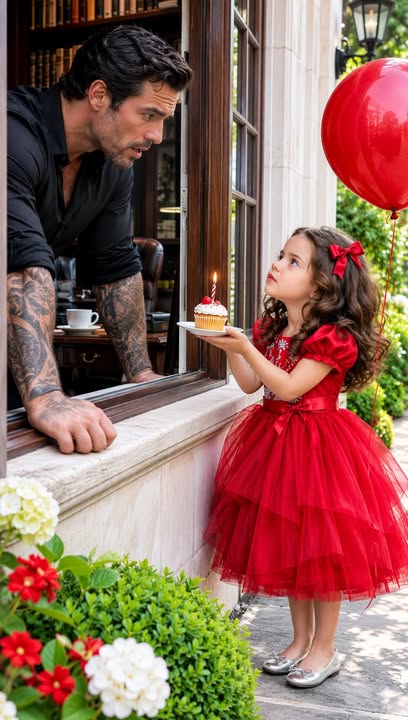
“She knows the man who eats a cupcake and lets her keep a balloon.”
“That matters.”
“It isn’t enough.”
“No,” Elena agreed. “It isn’t.”
He placed the birth record carefully back on the desk.
“Can I see the rest of the box?”
“Yes.”
“Can I speak to Sophie about Anna?”
“Not yet.”
He accepted the answer.
“Tell me when she’s ready.”
“I will.”
Elena gathered the photographs, but left the birth record between them.
“Take it,” Vincent said.
“It belongs to you.”
For a moment, neither of them moved.
Then Elena pushed the document toward him.
He took it with both hands.
The paper was thin, its edges worn from years in the box, and yet it seemed heavier than anything he owned.
When Elena left, Vincent remained in the study with the birth record, the note, and the photographs.
He had spent years grieving a sister who had been alive.
Now he was grieving the life they might have shared.
Near sunset, a small knock sounded at the garden door.
Sophie stood outside with a red balloon in one hand and a cupcake in the other.
“Mommy said I could bring you this,” she announced.
Vincent opened the door.
“Thank you.”
“Are you sad?”
He looked at the little girl who had been a baby in his arms, his sister’s daughter, the only person who had ever wished his loneliness away without knowing what it meant.
“A little.”
“Because you miss your mommy?”
“Yes.”
Sophie thought about that.
“Do you miss somebody else too?”
Vincent’s eyes moved to Elena, waiting at the garden gate.
“Yes.”
“Then you can have cake with us.”
“That’s a very generous invitation.”
“I know.”
Elena approached, holding the wooden box against her side.
She stopped at the threshold.
“Vincent,” she said, “there’s one more thing I found in the box.”
He glanced at the box.
“What?”
“A letter from Anna.”
His heart seemed to pause.
“Why didn’t you tell me inside?”
“Because I haven’t read it.”
“Then let’s read it together.”
Elena looked down at Sophie.
“She wrote it for you.”
Vincent’s gaze fixed on the folded envelope tucked beneath the box’s lining.
His name was written across it in a hand he had never seen, but somehow already recognized.
Elena turned the envelope over.
“It was sealed,” she said.
“Was?”
She looked at the tiny paper seam.
“It’s already been opened.”
“By whom?”
Elena’s face tightened with uncertainty.
Sophie pointed toward the doorway.
“Mommy, is it the letter with the little picture?”
Elena turned to her.
“What picture?”
“The one you showed me in my baby box.”
Sophie reached toward the envelope, then stopped before touching it.
“The one where Mommy said Aunt Anna was holding me.”
Vincent felt the world narrow to the small space between Sophie’s words and the old envelope.
He looked at Elena.
“You told her about Anna?”
“Only that she was someone Sophie had lost.”
Sophie frowned.
“Mommy said she was my first mommy.”
**–END OF PART 4–CLICK “NEXT” AT THE BOTTOM OF THE PAGE TO CONTINUE READING**
* * *
[PREVIOUS: PART 3](https://echoesofstories.idolsgift.com/blog/part-3-the-photograph-that-shouldn-t-exist-041) | [NEXT: PART 5](https://echoesofstories.idolsgift.com/blog/part-5-the-photograph-that-shouldn-t-exist-041)
✓ Lynn R. Adams
Part 4 – The Name Beneath the Photograph Elena’s face had gone pale. Sophie held the hospital bracelet in both hands, careful not to bend the yellowed plastic. “I remember this,” she said. “It was …