PART 4: The Pawn That Could Not Be Saved 052
Part 4 – The Hand Beneath the Ink
Eleanor stared at the mark beside the withdrawn record, unable to reconcile the careful hand she remembered from her father’s old notes with the accusation written in the ledger.
“My father did not alter royal records,” she said.
Her voice was quiet, but it did not waver.
The king closed the book as though the page had become too difficult to face.
“I did not say that he did.”
“You said he was accused.”
“Yes.”
“And then you ordered the record withdrawn.”
The king’s eyes lowered.
“I did.”
The prince moved nearer to Eleanor, though he did not touch her.
“Father, why was the entry hidden?”
The king looked toward the guests beyond the circle, many of whom had begun to notice the solemn gathering around the chess table.
“This is not a conversation for the middle of a ballroom.”
“It concerns my father,” Eleanor replied. “And a puzzle you have placed before the whole court.”
The old king flinched at the calmness of her words.
The chief adviser glanced toward the surrounding nobles.
“Your Majesty, we could continue this privately.”
Eleanor saw the prince’s jaw tighten.
“Privately is where the record was kept hidden,” he said.
The king regarded his son for a long moment, then turned to the chief adviser.
“Ask the guests to give us the room.”
The adviser bowed and spoke discreetly with the other officials.
No one was ordered away, and no one was made to feel unwelcome, but the curious crowd gradually drifted toward the far side of the ballroom, leaving the chess table surrounded only by the king, the prince, Eleanor, the chief adviser, and the secretary.
The secretary kept one hand on the ledger.
“Should I return this to the archive, Sire?”
“No,” the king said. “Bring it with us.”
He looked at Eleanor.
“You may come too, if you wish.”
“I do.”
The prince gave her a small, reassuring nod.
Together, they left the ballroom and crossed into a quieter gallery lined with portraits of the royal family.
The evening light had faded from the tall windows, and the lamps cast a soft gold over the polished floor.
At the end of the gallery, the king led them into a modest study whose shelves were crowded with books, maps, and old documents.
It was not the grand chamber Eleanor had imagined a king would use for private matters.
The room felt more like a place where someone might sit alone with a difficult memory.
The king remained standing beside the desk.
“Thomas Vale was an excellent archivist,” he began. “Precise, patient, and far more perceptive than most men who served near the throne.”
Eleanor listened without sitting.
“Then why was he dismissed?” the prince asked.
“Because a record appeared to have been altered, and Thomas was responsible for keeping it.”
“Did you believe he had done it?” Eleanor asked.
The king’s silence lasted just long enough to become an answer.
“I believed what I was advised to believe.”
The prince’s expression hardened, but his voice remained controlled.
“By whom?”
“By men who said the matter threatened the dignity of the Crown. They insisted the original account was unreliable and that a quiet dismissal would prevent needless speculation.”
The king looked at the closed ledger.
“I accepted their judgment without asking to see all the evidence.”
Eleanor felt her fingers curl against her palms.
“My father lost his position because you did not look?”
“I let others look for me.”
It was the first time the king had spoken without defending himself.
The admission did not lessen the hurt, but it changed its shape.
Eleanor had expected excuses, perhaps even denial.
Instead, the king seemed to be standing before a truth he had avoided for years.
“What was the record about?” she asked.
The king looked toward the prince.
“The chess position.”
The prince’s gaze shifted to the ledger.
“The puzzle?”
“The original arrangement, and the reason I created it.”
The secretary opened the register again, searching the pages with care.
“Your Majesty, the entry here only mentions the restoration of the set. The withdrawn record may have been filed separately.”
“Look for an index reference,” the king said.
The secretary turned several pages, tracing columns of faded handwriting.
At last, he found a small notation in the margin.
“West archive, cabinet three, drawer six,” he read. “Restricted correspondence.”
The king’s face tightened.
“That cabinet has not been opened in years.”
“Would you like me to retrieve the papers?” the secretary asked.
“Yes.”
The secretary rose and left.
While they waited, Eleanor remained beside the desk, her attention fixed on the king.
“Did my father ever tell you he had a daughter?”
The king’s expression softened.
“He did.”
Eleanor had not expected that answer.
“He spoke of you often when you were small,” the king continued. “He said you asked more questions than the royal historians.”
A painful tenderness stirred in her chest.
“He never told me that.”
“He may have wanted to spare you the burden of knowing how close his work brought him to the court.”
“Or perhaps he wanted me to have a childhood that was not about the palace.”
“That is also possible.”
The prince leaned against the side of the desk.
“Was Thomas the one who designed the position?”
The king drew in a slow breath.
“Yes.”
Eleanor’s eyes lifted sharply.
“You knew?”
“I knew he had helped me shape it.”
The room seemed to contract around the words.
“Then the puzzle was never yours alone.”
“No,” the king said. “It was ours.”
The prince looked from his father to Eleanor.
“What was it meant to prove?”
The king did not answer immediately.
He passed a hand over his brow, and the years seemed to gather visibly upon him.
“When I was younger, I believed a ruler had to win every contest put before him,” he said. “I thought strength meant forcing the world to accept my judgment.”
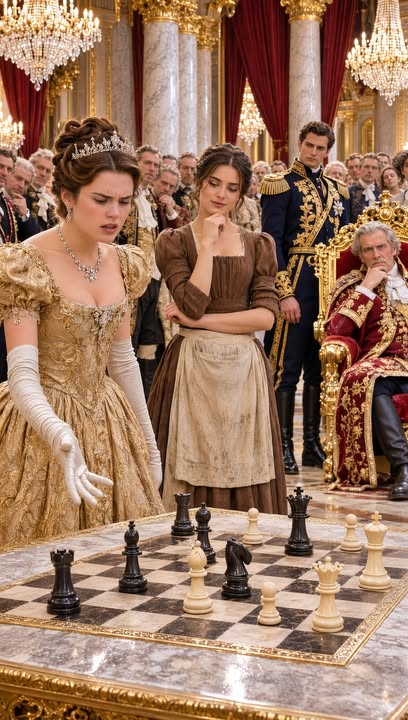
Eleanor remembered the board in the ballroom, the white king surrounded by black pieces, and the quiet line she had begun to uncover.
“My father taught you otherwise?”
“Thomas taught me to question the premise.”
The king moved to the window.
“I had asked him to devise a position that would test whether the advisers around me could recognize a draw when they were certain that only victory mattered.”
“Why?” the prince asked.
“Because they were urging me toward a decision that would have divided the court. They called compromise a weakness and insisted that a ruler must choose one side to defeat the other.”
The king’s gaze rested on the dark glass.
“I wanted a proof that restraint could be wiser than conquest.”
“And Thomas made the puzzle,” Eleanor said.
“He devised the position and recorded the intended line. The white side could not win. But it could force stalemate, provided the player understood that saving the king was not the same as saving the position.”
Eleanor thought of her father’s worn chessboard, of the scraps of paper filled with pieces and arrows, and of his insistence that a problem should be questioned before it was answered.
The connection was so clear that it hurt.
“Why was his name removed?” she asked.
“Because the advisers who opposed the test argued that the position had no valid solution. They said Thomas had created a flaw in the records to make the puzzle appear profound.”
“Did they prove it?”
“No.”
“Did you ask them to?”
The king’s shoulders slumped.
“I asked them to settle the matter quickly.”
The prince turned away from his father, visibly troubled.
“You let them blame him.”
“I did.”
The answer was quiet, but it filled the room.
Eleanor felt an ache rise in her throat.
Her father had never spoken bitterly about the palace.
He had simply told her that he was no longer needed there.
She had been too young to understand why he kept his old papers wrapped in cloth, or why he sometimes stopped in the middle of a story when she asked about the king.
“He accepted the accusation?” she asked.
“He signed a statement saying he had made an error in the record.”
“Why?”
The king looked at her.
“I asked him to.”
The prince stared at his father.
“You asked Thomas to take the blame?”
“I told him the dispute would damage the Crown if it became public. I promised that the matter would be corrected once the court had settled.”
“Was it corrected?”
The king looked down.
“No.”
The secretary returned before anyone could answer for him.
He carried a narrow wooden box with a brass clasp, its surface dulled by years in the archive.
“I found the drawer as noted,” he said. “The contents were wrapped in linen.”
The king took the box.
For a moment, he did not open it.
Eleanor watched his hands, noticing a faint tremor in them.
“You do not have to hide anything from me now,” she said.
The king met her eyes.
“I know.”
He opened the clasp.
Inside lay several folded sheets, a small bundle of correspondence, and a narrow strip of paper marked with the same symbol carved beneath the old pawn.
The secretary carefully lifted the top document and laid it on the desk.
The handwriting was precise and familiar.
Eleanor knew it at once.
Her father had written her name in the same hand on the few books he had left her.
She leaned closer but did not touch the page.
The first line read: “At His Majesty’s request, I have prepared a position whose proper conclusion is not victory, but a draw by stalemate.”
Eleanor’s breath caught.
The prince read the sentence over her shoulder.
“He wrote the solution down.”
The king nodded.
“Then the advisers must have seen this,” the prince said.
“They saw the position,” the king replied. “I do not know whether they saw this page.”
The chief adviser, who had followed them in, examined the document from a respectful distance.
“Your Majesty, this appears to be an original annotation.”
“It is.”
The king’s voice was low.
The secretary turned over the sheet.
On its reverse was a series of moves written in neat columns, each accompanied by a short note explaining the squares that remained available to the white king.
Eleanor recognized the logic before she could follow every detail.
It was the same calm, patient way her father had taught her to read a board: not as a contest between strength and weakness, but as a map of choices.
“He documented the intended draw,” she said.
“Yes.”
“And the mark was his way of identifying the position.”
The king nodded again.
“Thomas used that symbol on his private notes and on any piece he had altered or repaired.”
The prince looked at the page.
“So the record was not changed to deceive anyone.”
“No,” the king said. “It was changed because the court refused to accept what the original record showed.”
The words made the room still.
Eleanor’s gaze moved to the second sheet.
It contained a list of proposed moves and the names of the advisers who had reviewed them.
At the bottom, a later hand had written, “Solution rejected. Position to be preserved as an unsolved trial.”
“Who wrote this?” she asked.
The secretary examined the ink and the flourish at the end.
“It appears to be the hand of Lord Bellamy, who served as chief adviser at the time.”
The present chief adviser, an older man, glanced toward the king.
“My predecessor.”
“Was he among those who said my father had altered the record?” Eleanor asked.
The king nodded.
“He was.”
The chief adviser’s face darkened with concern.
“Then the accusation was made by the very man who rejected the solution.”
The king’s expression revealed that he had only now fully grasped the weight of that connection.
The prince turned the page carefully.
“There is more here.”
A short letter lay beneath the move list, folded into thirds.
The king reached for it, then stopped.
“Would you read it?” he asked Eleanor.
She hesitated.
The document belonged to the palace, but the handwriting belonged to her father.
“Is that proper?”
“It is his writing,” the king replied. “And the letter concerns what was done to him.”
Eleanor unfolded the paper.
Her father’s voice seemed to return through the measured lines.
“Your Majesty,” she read, “I have agreed to accept responsibility for the disputed record because you believe that an open inquiry would harm the Crown. I do so on the understanding that my notes will be preserved and my name restored when the matter is no longer dangerous to the kingdom.”
Her voice faltered briefly, then continued.
“The position has not been altered. Its purpose is to test whether those in counsel can see the difference between victory and a just conclusion. If they refuse the draw because they have been promised a contest of triumph, then it is not the record that has failed them.”
No one spoke.
Eleanor read the final lines.
“I ask only that my daughter never be taught that a person’s worth is measured by the station they occupy or the reward they receive. She should be free to make her own choices, even when those choices are inconvenient to the powerful.”
The paper shook slightly in Eleanor’s hands.
She lowered it before the tremor could become visible to everyone.
The prince stood beside her, his face full of sorrow.
“Your father knew,” he said softly. “He understood what might happen.”
“He understood the risk,” the king said. “I should have ensured that the cost did not fall on him.”
Eleanor placed the letter on the desk.
“Did you ever try to restore his name?”
“I intended to.”
“That is not the same as doing it.”
“No,” the king said. “It is not.”
The chief adviser studied the old note.
“The record says the original position was to remain unexamined. That suggests the Crown did not merely delay the correction. It prevented anyone from confirming it.”
The king closed his eyes briefly.
“My advisers told me an unsolved puzzle would be seen as a test of brilliance. They said the court would remember the mystery, not the dispute that created it.”
“And you allowed them to present it that way,” the prince said.
“Yes.”
“Even though you knew Thomas had solved it.”
“I knew he had found the intended draw. I told myself the distinction did not matter.”
The king looked toward Eleanor.
“I was wrong.”
She met his gaze, but her anger had not disappeared.
“I am glad you understand that now.”
The king accepted the words without asking her to soften them.
The secretary lifted another folded document from the box.
“This one is dated several weeks after Mr. Vale’s dismissal.”
The king’s face grew pale.
“What does it say?”
The secretary unfolded the page.
“It is a memorandum from the late Lord Bellamy. He writes that the king’s ‘private request for a test of judgment’ should not be entered into the official record, since the advisers have agreed to preserve the puzzle as a measure of intellectual distinction.”
The prince’s brows drew together.
“They turned a lesson in judgment into a contest of brilliance.”
“They thought it would strengthen the Crown,” the king said. “And when Thomas objected, they called his account a deliberate alteration.”
Eleanor looked at the old chess pieces in her mind’s eye.
A pawn with her father’s mark had crossed more years than she had known, carrying a truth no one had wanted to read.
“Why did my father not tell me?” she asked.
The king had no answer.
Perhaps Thomas had believed the matter would be corrected.
Perhaps he had hoped to keep his daughter from carrying a grievance that was not hers to repair.
Perhaps he had simply been tired of the palace and all the decisions made behind closed doors.
The absence of an answer hurt more than any of those possibilities.
The prince moved closer.
“Eleanor, you should not have to decide what this means tonight.”
“I have spent all evening being asked to prove that I can see clearly,” she said. “Now I know why the board looked familiar to the king, and why my father’s name made him afraid.”
The king did not contradict her.
“I was afraid,” he said. “Not of you, but of what your presence might bring back.”
“And now?”
“Now I am afraid that I have waited too long to tell the truth.”
The prince’s gaze moved between them.
“Then do not wait longer.”
The king turned toward the shelves.
For a moment, he looked like he might reach for another document, one that could settle the matter completely.
Instead, he rested his hand on the edge of the desk.
“The court must hear this,” he said.
The chief adviser nodded.
“If the archive supports the letter, the record can be corrected.”
“Not merely corrected,” Eleanor said. “My father’s name must be restored openly.”
The king looked at her.
“Yes.”
“And not as a reward for solving the puzzle.”
“No.”
“Not as a favor to me.”
“No.”
She held his gaze.
“Then make the truth public because it is true, whether or not I finish the solution.”
The king bowed his head.
“You are right.”
The prince looked at Eleanor with quiet admiration, but did not speak.
She wondered whether he understood that she could not yet be grateful to him, or to the king, simply because the truth had finally been found.
There was still the matter of the public contest, the promised reward, and the court that had watched her enter the ballroom in a servant’s gown and treated her knowledge as a curiosity.
There was also the puzzle itself.
Her father had left a solution in the archive.
She had begun to uncover it without knowing that the board belonged to him.
The thought filled her with grief, pride, and a strange sense of closeness that she had not felt since his death.
The king gathered the papers into a neat stack.
“I will speak to the court tomorrow,” he said. “I will explain what happened and clear Thomas Vale’s name.”
“Why tomorrow?” the prince asked.
The king looked at him.
“Because the ballroom is crowded, the guests are waiting, and I will not turn a long history into a careless announcement.”
Eleanor considered the answer.
It was reasonable, but the old habit of delay still haunted it.
“Then the papers stay here tonight,” she said. “No one takes them away, and no one changes them.”
The king nodded.
“They will remain under my personal seal.”
The chief adviser offered to witness the arrangement.
The secretary found a clean sheet, and together they recorded which documents had been retrieved and where they would be kept.
Eleanor watched as the king signed his name beneath the inventory.
It was a small act, but it felt more meaningful than another promise.
When they returned to the ballroom, the gathering had thinned.
The chess table remained under the chandeliers, the white pawn still waiting where Eleanor had left it.
Victoria stood near the entrance, her fan closed in one hand.
She looked from the king to Eleanor, then to the prince.
“Has the puzzle been solved?” she asked.
“Not yet,” the king replied.
Victoria’s gaze rested on Eleanor.
“And the old record?”
The king’s face sharpened.
“How did you hear of it?”
A brief silence followed.
Victoria lowered her eyes to her fan.
“I heard that the archive had been searched. I thought it might concern the contest.”
The prince studied her.
“Who told you?”
“I do not remember.”
Her answer came too quickly.
Eleanor did not accuse her.
She only looked at Victoria and saw, for the first time, something more complicated than envy: a woman who had come to the palace believing that rank and reputation were the only paths to being valued, and who now feared she had lost both.
The king turned to his advisers.
“We will continue the examination tomorrow. Until then, the old papers are to remain untouched.”
The chief adviser bowed.
“Of course, Your Majesty.”
The prince approached the board.
“Would you like to look at the position again before you go?” he asked Eleanor.
She studied the pieces, then the pawn bearing her father’s mark.
“Yes.”
The advisers reset the board using the moves preserved in Thomas Vale’s notes.
Eleanor compared the arrangement to the line she had begun earlier.
The first moves matched.
The black rook’s choices matched.
The narrowing escape squares matched.
Her father had found the same quiet route she had sensed, and he had recorded it with care.
The chief adviser reached the point where the line had grown uncertain.
“Here,” he said. “The notes continue, but the notation is smudged.”
The secretary tilted the page toward the lamp.
A faint number appeared beneath the blur.
“Perhaps it reads this way,” the prince suggested.
Eleanor leaned closer.
“No,” she said softly. “The mark is not a number.”
She traced the air above the faded ink.
“It is a symbol for a second board.”
The king came to stand behind her.
“What do you mean?”
“My father sometimes drew two positions side by side, so I could compare what a move changed.”
The chief adviser examined the paper.
“There is another sheet in the box.”
The secretary retrieved it, but the page appeared blank except for a watermark and a narrow strip of writing along one edge.
Eleanor turned it toward the light.
A series of faded squares emerged, followed by a line written in her father’s hand.
The king read it over her shoulder.
“‘The final move must not be made by the side that seeks to win.’”
The prince looked at the board.
“Then who makes it?”
Eleanor studied the words, then the pieces.
The solution was still incomplete, but the clue altered everything they had assumed about the final moment.
The king’s gaze moved to the old chess set.
“Thomas left more than a solution,” he murmured.
The secretary turned the blank sheet over.
On the reverse, hidden beneath the watermark, was a short note addressed to the king.
The first line was written in Thomas Vale’s hand, but the words that followed belonged to someone else.
The prince read them aloud.
“‘If this is ever found, the king must be asked why he requested the position in the first place.’”
Everyone turned toward the old king.
For several seconds, he said nothing.
Then he looked at Eleanor, and the fear in his eyes was no longer only the fear of a hidden record.
“Thomas was right,” he said. “The puzzle cannot be understood until I tell you what I asked him to test.”
**–END OF PART 4–CLICK “NEXT” AT THE BOTTOM OF THE PAGE TO CONTINUE READING**
* * *
[PREVIOUS: PART 3](https://storyly.idolsgift.com/blog/part-3-the-pawn-that-could-not-be-saved-052) | [NEXT: PART 5](https://storyly.idolsgift.com/blog/part-5-the-pawn-that-could-not-be-saved-052)
✓ Lynn R. Adams
Part 4 – The Hand Beneath the Ink Eleanor stared at the mark beside the withdrawn record, unable to reconcile the careful hand she remembered from her father’s old notes with the accusation written i…