Part 4: The Orders Beneath Thomas Reed’s Coat and the Promise He Refused to Make Blindly _064
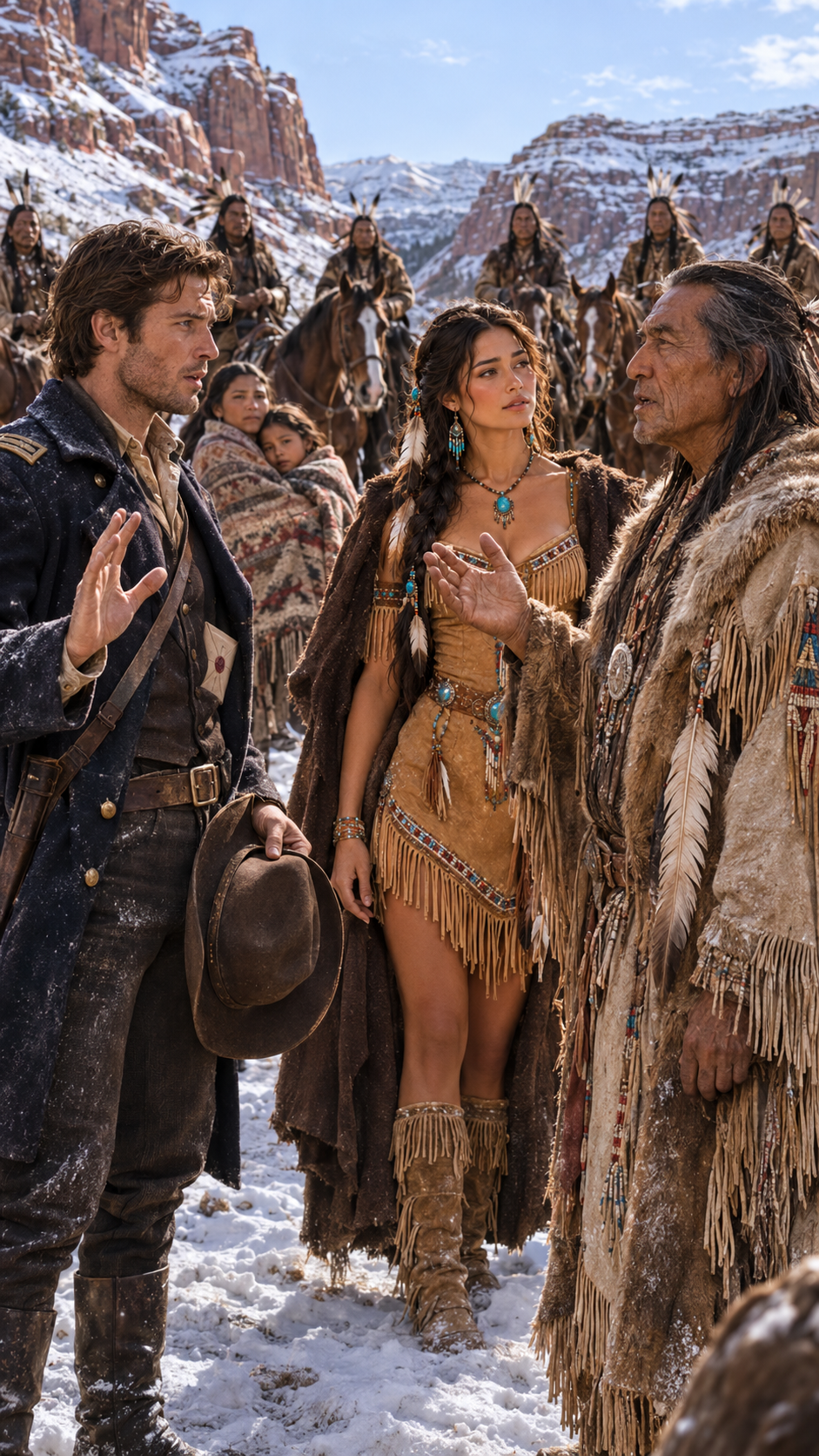
## The Brother Thomas Had Remembered Without Questions
Thomas carried James Reed’s report outside after sunset.
Ayana sat on a low adobe wall near the officers’ quarters while Toma spoke with Sergeant Price across the yard.
She knew immediately something had changed.
“What happened?”
Thomas handed her the paper.
She read slowly.
Her English was strong enough, though she paused at several military terms.
When she reached James’s name, she looked up.
“Your brother.”
“Yes.”
“The one who died?”
“Six years ago.”
“How?”
“Horse accident.”
He appreciated that she did not turn every death into mystery.
Life supplied enough ordinary grief.
Ayana looked down at the report again.
“You loved him.”
“Yes.”
“Still?”
Thomas stared.
“Of course.”
“Then this hurts.”
“Yes.”
She handed the page back.
Thomas sat beside her.
“James taught me to ride.”
“He taught me to shoot.”
“He was the reason I became a scout.”
“He used to say a man should learn the country before claiming to understand the people living on it.”
Ayana looked toward him.
“That sounds different from this report.”
“Exactly.”
“So find the difference.”
Thomas almost laughed.
“You make everything sound simple.”
“No.”
“I make the next question simple.”
That was different.
The next question was what James knew.
Captain Ward gave Thomas permission to examine older supply and patrol records.
Ayana remained at the fort as Chaska’s representative while corrections were transmitted.
Toma returned to inform the family that the relocation recommendation had been withdrawn.
Sela and Miri were safe.
Chief Chaska sent back a message for Ayana.
She translated only after Thomas asked.
“My father says not to agree to marry you merely because you found one honest captain.”
Thomas smiled.
“I like your father less every day.”
“No, you don’t.”
“No.”
He didn’t.
The old reports showed James had worked for three months as civilian assistant to a quartermaster.
His job involved tracking missing livestock and damaged freight.
The report blaming Chaska’s band had not been his first.
Two weeks earlier, he had written:
**Cause of losses uncertain.**
A week later:
**No tracks sufficient to establish direction.**
Then the final report abruptly named Chaska’s group.
Thomas frowned.
“What changed?”
Sergeant Price, who had been stationed elsewhere then, helped search correspondence.
They found the answer in a supply officer’s memo.
James had been instructed to rely on information from a local civilian guide.
Name: **Henry Sloane.**
Thomas stared.
“Sloane knew James?”
Ward nodded.
“Apparently.”
They summoned Sloane again.
By then the contractor looked exhausted.
He had spent two days answering auditors and officers.
Thomas placed James’s report on the table.
“You gave my brother information six years ago.”
Sloane read the signature.
His face changed.
“I remember him.”
“What did you tell him?”
“That horses had been seen near Chaska’s winter trail.”
“Whose horses?”
“Government.”
“Did you see them?”
“No.”
“Who did?”
“A rancher named Amos Bell.”
“Alive?”
“Yes.”
“Where?”
“Near Santa Pilar.”
Thomas asked Ward’s permission to contact Bell.
Ward sent a rider.
The response came the following afternoon.
Amos Bell remembered the incident clearly.
He had seen three loose cavalry horses near a trail later used by Chaska’s group.
He did not see anyone take them.
He told Sloane only that the horses were headed in that direction.
Sloane turned direction into association.
James turned association into suspicion.
The supply officer turned suspicion into a report.
Years later, that report became precedent.
No single lie had created the whole problem.
A chain of people had each spoken more confidently than the evidence allowed.
Thomas sat quietly after reading the statements.
Ayana joined him.
“My brother was wrong.”
“Yes.”
She did not soften it.
He appreciated that.
“He may not have intended harm.”
“No.”
“But he wrote more than he knew.”
“Yes.”
Thomas looked toward her.
“Does that make him a bad man?”
Ayana thought.
“No.”
Relief came too quickly.
She continued.
“It makes him a man who was wrong.”
Thomas laughed softly.
“You enjoy refusing easy answers.”
“I learned from my father.”
“That explains many things.”
They searched further.
A final packet contained James’s own later correction.
Thomas stared before opening it.
The paper was dated four months after the original accusation.
**To Territorial Supply Office:**
**I request amendment of my previous report concerning losses attributed to Chaska’s band.**
Thomas’s breath caught.
James wrote that subsequent evidence suggested the missing horses had wandered after a damaged fence allowed several animals to escape.
He acknowledged relying too heavily on secondhand statements.
He requested the accusation be removed from the permanent record.
Thomas looked toward Ward.
“Was it?”
Ward checked the file.
“No.”
“Why?”
A notation on the back explained.
**Received after quarterly summary completed.**
No malice.
Administration.
The correction existed.
The summary did not change.
Years later, Sloane could point toward the summary while the correction slept in a box.
Thomas felt something between grief and frustration.
Ayana read James’s amendment.
“He tried to correct it.”
“Yes.”
“Late.”
“Yes.”
“Still.”
Thomas smiled faintly.
“Both.”
She looked at him.
“What?”
“Wrong first.”
“Better later.”
“Yes.”
“Both.”
Ayana nodded.
“That is closer.”
Thomas asked Captain Ward to attach James’s correction permanently to the old summary and cite it in the new report.
Ward agreed.
He also ordered a review of other old accusations resting solely on contractor statements.
Nothing dramatic happened.
No trumpet sounded.
No one applauded.
A clerk simply began correcting indexes.
Thomas found the ordinary nature of it strangely moving.
Some injustices were created by small careless acts.
Perhaps some repair had to be small and careful too.
Henry Sloane’s contract review concluded within the week.
He admitted knowingly failing to correct the reimbursement claim after the mules were returned.
He also admitted writing the accusation against Chaska’s group without evidence.
Captain Ward could not personally determine final criminal charges, but Sloane lost immediate authority over military freight pending territorial review and was required to repay the improper reimbursement.
Thomas expected Ayana to be pleased.
She was thoughtful instead.
“You wanted more?”
he asked.
“No.”
“Then?”
“I was thinking how close this came to changing where families slept this winter.”
Thomas nodded.
“And it happened because a gate broke.”
“A man became embarrassed.”
“Another man wanted money.”
“A message became shorter.”
“A report became older.”
“Yes.”
She looked at him.
“People like dramatic causes.”
“They are easier.”
“Yes.”
The closeness between them grew through these conversations.
Not through rescue.
Not through gratitude.
Thomas began asking Ayana about her actual life.
She helped her father with negotiations involving traders because she spoke more English than many older relatives.
She had learned from a missionary couple who spent several years near the region and from Whitfield, an elderly trader her family trusted cautiously.
She loved horses.
Disliked sewing.
Was patient with children but impatient with adults who spoke slowly to her merely because they assumed she did not understand.
Thomas laughed.
“I did that the first day.”
“Yes.”
“Did you hate me?”
“No.”
“Disappointed.”
“That seems worse.”
“It was.”
She smiled.
He told her about his own childhood.
His father had been a carpenter.
His mother ran a boardinghouse after he died.
James became the family’s steady center.
Thomas worshipped him.
When James died in a riding accident, Thomas had joined the scouts partly because wearing a military coat made grief feel like continuation.
Ayana understood.
“You became him.”
“Tried.”
“But you are not him.”
“No.”
“Good.”
Thomas looked at her.
“You say that easily.”
“It is not insult.”
“I know.”
That was part of what he loved about her.
The realization frightened him.
He did not say it yet.
Their relationship deserved more than a feeling born during crisis.
Then Miri and Sela arrived at the fort with Chief Chaska.
Sela had recovered.
Miri ran toward Thomas carrying his spare scarf.
“You forgot.”
Thomas laughed.
“I gave that to you.”
“You said temporary.”
“Did I?”
“Yes.”
Children remembered inconvenient details.
Chief Chaska met Captain Ward.
The conversation was careful.
Direct.
The captain formally stated the theft accusation lacked evidence and that no relocation action would proceed from it.
Chaska asked whether a new accusation could simply appear next month.
Ward did not promise impossible certainty.
Instead, he proposed a local procedure.
Any future livestock accusation involving Chaska’s group would require direct inquiry with designated representatives before being described as confirmed theft in official summaries.
Not perfect justice.
A practical safeguard.
Chaska agreed to designate two people.
One was Ayana.
Thomas smiled when he heard.
She noticed.
“Why smiling?”
“Nothing.”
“Poor liar.”
The second representative was Toma.
Good.
No one made Ayana the sole bridge between worlds.
That mattered.
The evening before Chaska’s family returned south, Thomas walked with Ayana beyond the fort wall.
Snow had vanished from the lower ground.
Cold remained.
Stars filled the desert sky.
Thomas stopped.
“I want to tell you something.”
Ayana looked toward him.
“That sounds dangerous.”
“Probably.”
He smiled.
“When your father offered you to me—”
“He did not offer only me.”
“Thank you for reminding me.”
“Twenty women.”
“I remember.”
She laughed.
Thomas continued.
“I thought the strangest thing was that I wanted to say yes to knowing you.”
“And now?”
“Now I know why.”
Her expression changed.
“Why?”
“Because you do not let me hide inside good intentions.”
Ayana’s eyes softened.
“You ask what I know.”
“You ask what I only believe.”
“You make me uncomfortable without making me feel small.”
He took a breath.
“And I think about you when you are not there.”
Ayana smiled faintly.
“That last one sounds less philosophical.”
“I worked hard on it.”
“Good.”
Thomas looked toward her.
“I do not want to ask for marriage yet.”
She seemed surprised.
“Why?”
“Because I have known you through a storm, a military inquiry, and your father testing me.”
“That is several lifetimes.”
“Yes.”
“But I would like to know you through ordinary days too.”
Her smile widened.
“So would I.”
Then she reached for his hand.
This time Thomas did not feel as though the touch were an answer.
It was simply another beginning.
When he returned to his quarters, Captain Ward was waiting.
“There you are.”
Thomas frowned.
“What happened?”
“Nothing bad.”
Ward handed him a letter.
“District command.”
Thomas opened it.
He had been offered a permanent appointment as senior civilian scout attached to the Arizona posts.
Higher pay.
Steadier work.
Authority.
A career.
Six months earlier, Thomas would have accepted before reaching the second paragraph.
Then he read the final condition.
The position required him to relocate north within thirty days and remain available for extended patrol assignments lasting months at a time.
Ayana was leaving south in the morning.
Thomas looked toward the dark horizon.
For years, he had believed military service was the closest thing he possessed to a home.
Now the army was offering him a future precisely when he had begun wondering whether that future was actually the one he still wanted.
**–END OF PART 4–CLICK “NEXT” AT THE BOTTOM OF THE PAGE TO CONTINUE READING**
✓ Lynn R. Adams
## The Brother Thomas Had Remembered Without Questions Thomas carried James Reed’s report outside after sunset. Ayana sat on a low adobe wall near the officers’ quarters while Toma spoke with Sergea…