PART 4: The Name on the Record 056
Part 4 – The Promise Beneath the Ashes
“You remember, Vincent.”
Marco’s phone remained between them, its screen bright against the shadowed office.
Vincent read the message again, then looked at the phrase beneath it.
“The old promise stays buried.”
He felt the words settle into the room like dust disturbed from a long-closed door.
“Who else knew that phrase?” Marco asked.
“No one who should be involved in this.”
“Should be,” Marco repeated quietly.
Vincent’s gaze sharpened.
“Don’t turn a message into proof.”
“I’m not. I’m telling you someone has knowledge we may have believed was private.”
Rosa sat on the sofa with Emma tucked against her side.
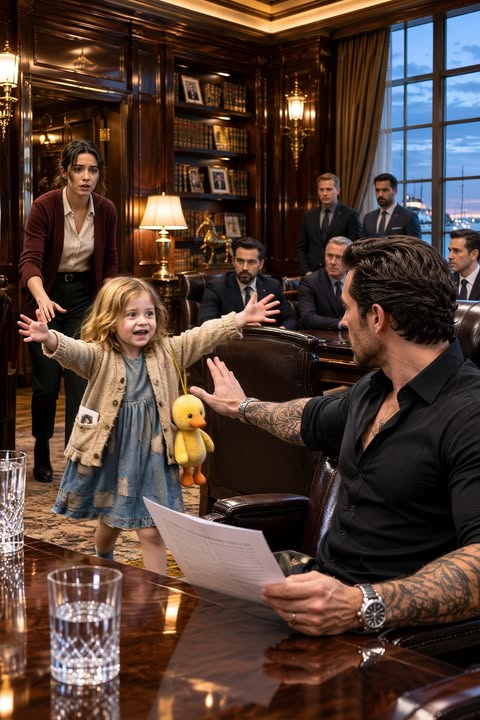
The little girl had fallen asleep, her stuffed duck held beneath her chin, unaware that the adults around her were tracing the edges of a past she had been born into.
Vincent looked at the child, then at the note and birth record on his desk.
“Get the old archives,” he said.
Marco did not move.
“Which ones?”
“Everything connected to the agreement my father made with the Calder group.”
Rosa’s expression changed.
“What agreement?”
Vincent glanced at her.
“I don’t know how much Isabella told you.”
“She never mentioned a Calder group.”
“She may not have known the name.”
Marco’s eyes were fixed on Vincent.
“You think the message is connected to that?”
“I think the phrase could be.”
“And if it is?”
“Then someone has reached into a matter that was supposed to be closed.”
Marco’s silence carried a question he did not want to ask in front of Rosa.
Vincent answered it anyway.
“I’ll explain what I can.”
He returned to the desk and opened a cabinet secured by a key he kept on his ring.
Inside were folders he had not touched in years, their labels worn at the corners.
He searched until he found a slim gray file marked Calder, then set it on the desk beside Isabella’s note.
The name brought back a winter evening in his father’s study, when Vincent had been young enough to believe that a signed document could keep people safe simply because the men who signed it had decided it should.
His father had called it a peace arrangement.
The rival faction would keep to its territory, the Moretti organization would keep to its own, and neither side would interfere with the other’s legitimate businesses.
It had been an agreement made quietly, without a public announcement, because the appearance of cooperation mattered less than the reality of it.
Vincent had not been present when it was signed.
He had only been told that the arrangement prevented a conflict and that the details were no longer relevant.
“What’s in the file?” Rosa asked.
“An old agreement.”
“Between your family and the people who are threatening Isabella?”
“We don’t know that they’re the same people.”
“Then why are you looking at it?”
“Because the sender knows a phrase from my past with Isabella, and my past overlaps with this agreement.”
Rosa studied his face.
“Did Isabella find out about it?”
Vincent opened the file.
The first page was a copy of a memorandum, its ink faded to brown.
The next was a handwritten list of names.
He recognized his father’s signature at the bottom of the final page, and beneath it the name of Calder’s representative.
“What was the arrangement supposed to do?” Rosa asked.
“Keep the peace.”
“And did it?”
“For a while.”
The answer seemed to unsettle Marco more than the papers did.
He stepped closer and examined the names.
“This copy is incomplete,” he said.
“Where’s the original?”
“Not here. My father kept the signed document in his private archive.”
“He’s been gone for years.”
“But his records are still at the old house.”
Vincent turned to the last sheet.
A single handwritten note had been attached to the back, its paper thinner than the rest.
The writing belonged to his father.
If this arrangement is ever broken, do not assume the breach came from the other side.
Vincent read it twice.
“Who added that?” Rosa asked.
“My father.”
“Did he suspect someone inside your organization?”
“He suspected everyone of something.”
“That isn’t the same as knowing.”
“No,” Vincent said. “It isn’t.”
Marco took the note carefully, checking its edges.
“Someone could have added the phrase from Isabella’s message to this file.”
“Could they?”
“Possibly. The file’s been in the archive for years, but we haven’t reviewed every chain of access.”
“Can you find out who has?”
“I can try.”
“Do it.”
Marco looked at the birth record and Isabella’s note beside the old file.
“Vincent, if Isabella knew about this agreement, she may have been in danger long before the apartment break-in.”
“That’s what I’m trying to understand.”
Rosa rose, careful not to disturb Emma.
“Is there a way to know what she found?”
Vincent thought of the words on the birth record.
I did not leave because I stopped loving you.
“She left me something else,” he said. “A warning, perhaps. Or a clue.”
“Where?”
“I don’t know yet.”
He turned back to the file and searched the pages again.
A narrow envelope had been tucked between the memorandum and the list of names.
It was sealed, though the flap had yellowed with age.
Vincent stared at it.
“Was that there before?” Marco asked.
“I don’t remember.”
“You’ve seen this file?”
“Years ago. Not since my father’s funeral.”
The envelope had no writing on its front.
Vincent slid a finger beneath the flap and opened it.
Inside was a small, square photograph.
He recognized the room immediately: his father’s study, with the tall windows and the dark bookcase behind the desk.
His father stood beside a younger man Vincent knew as Paolo Vescari, a senior lieutenant who had served the Morettis for decades.
Between them lay an open document.
On the back of the photograph, a date had been written in his father’s hand.
The day the Calder agreement was signed.
Vincent’s eyes narrowed.
“Paolo was there?”
Marco leaned in.
“Paolo was already a lieutenant then.”
“Why didn’t I know?”
“You were younger, and your father kept the negotiations close.”
“Was he the one who carried messages between the two sides?”
Marco studied the photograph.
“I don’t know.”
Vincent placed it beside the memorandum.
The old agreement had been more private than he realized, and the presence of Paolo made it feel less like history than a door someone had quietly left open.
“Find him,” Vincent said.
Marco hesitated.
“Paolo’s been away from the city since yesterday. He said he was visiting his sister.”
“Where?”
“On the north shore.”
“Has anyone confirmed that?”
“I haven’t.”
“Then do so.”
Marco picked up his phone.
Vincent watched him begin a call, then turned to Rosa.
“Did Isabella ever mention the name Paolo?”
“No.”
“Vescari?”
“No.”
“Did she keep papers at the apartment?”
“She kept some in a desk drawer, but I don’t know what was in them.”
“Is there anything you remember her saying about an old agreement?”
Rosa considered the question.
“She once said that people can make promises in private and break them in public.”
“When?”
“Maybe a year before she left. She was reading something at the kitchen table. I asked whether it was work, and she said it was an old agreement that had been broken.”
Vincent felt the room draw closer around him.
“You remember what she said after that?”
“She told me she had been foolish to think the truth would protect anyone.”
“Did she say who had broken it?”
“No. She only said she had to be careful about what she knew.”
Marco lowered his phone.
“Paolo’s sister says he never arrived.”
Vincent’s attention returned to him.
“When did she last hear from him?”
“Yesterday morning.”
“Did he say where he was going?”
“He told her he had business in the city.”
“Is his phone on?”
“Not now.”
Vincent looked again at the photograph.
A man who had stood beside his father the day the peace agreement was signed had disappeared from his usual routines on the same day Isabella vanished.
The coincidence was not proof, but it was enough to change the shape of the room.
“Don’t alert the full team,” Vincent said. “I want quiet confirmation of his location.”
“I’ll handle it.”
“Only people we both know are loyal.”
Marco’s gaze held his for a moment.
“Understood.”
Vincent heard the strain beneath the words and felt it answer something in his own chest.
“Marco,” he said, “I’m not accusing you.”
“I know.”
“Do you?”
Marco looked toward the sleeping child.
“I know what you’re trying to protect.”
“That isn’t the same as knowing what you believe.”
“No,” Marco said. “It isn’t.”
For a moment, the two men stood with the old file between them and every unspoken suspicion pressing at its edges.
Then Marco turned away to make another call.
Vincent kept his attention on the photograph.
His father and Paolo stood in the study as if the agreement had been a simple matter of business.
But his father had written a warning on the back of the file.
Do not assume the breach came from the other side.
Someone inside had known what the agreement meant.
Someone had known Isabella was carrying Vincent’s child.
And someone had used their private phrase to make him understand that the past had not stayed buried.
A soft sound came from the sofa.
Emma had stirred in her sleep and reached for Rosa’s hand.
Rosa touched her hair, then looked toward Vincent.
“Do you think Isabella found out who broke the agreement?”
“I think she found something that made her afraid.”
“Afraid of you?”
“Afraid of what would happen if the wrong person knew about Emma.”
Rosa’s face tightened.
“Then she did what she thought would keep her safe.”
“Maybe.”
“You don’t believe that?”
“I believe she was trying to protect her. I don’t know whether she had to do it alone.”
He had expected that thought to bring anger.
Instead, it brought grief, slow and precise.
He had imagined Isabella choosing a life without him.
Now he was beginning to see that she may have been choosing a life for Emma, with no good choices available to her.
The distinction did not erase the years of silence, but it changed what those years meant.
A guard entered and handed Marco a thin folder.
“From the building archive,” the guard said. “The access report you requested.”
Marco opened it and scanned the page.
“The schedule was viewed from the operations account,” he said. “It was accessed at six this morning.”
“By whom?”
“The account log lists an administrator code.”
“Can we identify the user?”
“Not from this printout.”
“Get the full record.”
Marco’s eyes moved down the page.
“There’s another entry here. The same account accessed the old Calder file three weeks ago.”
Vincent stepped closer.
“Who?”
“Again, administrator code.”
“Could it have been Paolo?”
“Possibly.”
“Could it have been you?”
“Possibly.”
“Could it have been me?”
Marco met his eyes.
“Possibly.”
The honesty was uncomfortable, but Vincent preferred it to a false certainty.
“Secure the records,” he said. “Make copies for us and no one else.”
The guard nodded and left.
Rosa had come closer, listening.
“Three weeks ago,” she said. “That was before the apartment break-in.”
“Yes.”
“Could Isabella have known?”
“Maybe.”
“Could she have come to you if she had?”
Vincent looked at her.
“She might have thought coming to me would make the danger worse.”
“Would it have?”
“I don’t know.”
Rosa’s eyes filled again.
“That’s what I was afraid of.”
He had no simple reassurance to offer.
He wished he could tell her that his power had always been enough, that his people would find Isabella, that he could erase the danger by deciding it was over.
But the truth was that someone had entered their lives without leaving a clear trail, and the past he had thought settled was beginning to reveal its own hidden fractures.
Emma woke with a start and looked around the office.
“Mommy?” she asked.
Rosa moved to her at once.
“Not yet, sweetheart.”
Emma saw Vincent and held out both arms.
He lifted her gently.
She tucked her face beneath his chin, then reached for the stuffed duck she had left on the sofa.
Vincent passed it to her.
“Quack,” she whispered.
“Quack,” he answered.
Her eyelids lowered again.
As she settled against him, Vincent looked down at the old photograph and wondered how many secrets could fit inside one family before the truth became another kind of danger.
Marco’s phone rang.
He listened without speaking, then looked at Vincent.
“We found Paolo’s car,” he said.
“Where?”
“Parked outside the old Moretti house.”
The place where Vincent’s father had kept the original records.
“Is Paolo there?”
“We don’t know. The house is locked, and there’s no answer.”
“Who checked?”
“Two people from the outer team.”
“Bring them back. No one goes inside until we know the approach is clear.”
Marco nodded, already sending the order.
Rosa looked at Vincent.
“If Paolo has the original agreement, could it tell you who broke it?”
“It could tell us what was promised.”
“And the letter?”
“Maybe.”
“Then shouldn’t you go there?”
Vincent looked down at Emma.
She had fallen asleep again, her fingers curled around the duck’s neck.
“I won’t leave her here without a plan.”
“I can stay with her.”
“I know.”
“You don’t have to protect me from your world, Mr. Moretti.”
“I’m not. I’m trying to keep Emma safe.”
Rosa considered him, then nodded.
“Then let me help.”
The words softened something in him.
He had spent the afternoon receiving help from people he had not expected to need, and learning that care did not always arrive in the form of strength.
He set Emma on the sofa again and covered her with his coat.
Before stepping away, he placed the stuffed duck beside her hand.
“Stay with her,” he told Rosa.
“I will.”
He turned to Marco.
“We go to the house together.”
“Quietly,” Marco said.
“Quietly.”
They left the office by the inner corridor, with two trusted guards following at a distance.
The old Moretti house stood on a narrow street behind a row of bare trees, a stone building that had belonged to Vincent’s family for generations.
It was not far from the city, but the streets around it were hushed, as if even the traffic avoided disturbing the place.
Vincent had not entered since his father’s funeral.
The outer gate was closed.
A dark sedan stood beside the front steps, its engine cold and its doors locked.
Marco’s men waited at the curb.
“Any sign of movement?” Vincent asked.
“None,” one of them replied. “We didn’t touch the door.”
“Good.”
Vincent looked toward the upper windows.
A single curtain shifted, though there was no wind.
Marco noticed it too.
“Someone may be inside.”
“Or the window isn’t latched.”
They approached the door slowly.
Vincent still had the old key on his ring, though he had not used it in years.
The lock turned with a stiff click.
Inside, the house smelled of polished wood and closed rooms.
Nothing had changed in the front hall: the same narrow table, the same framed photograph of Vincent’s parents, the same staircase rising into shadow.
He moved toward his father’s study.
The door stood open.
The room looked almost exactly as Vincent remembered it, with the desk before the tall windows and the bookcases filling the walls.
But the lower drawer was open, and the lock hung loose.
Someone had been searching.
“Don’t touch anything,” he said.
Marco stayed near the doorway while Vincent examined the room.
The archive cabinet stood against the back wall.
Its outer door was open, and the shelves had been disturbed.
The original Calder agreement was gone.
So was a thin folder marked Correspondence, 2008.
Vincent ran his gaze over the remaining records.
“Is anything else missing?” Marco asked.
“I don’t know.”
“You said your father kept the signed agreement here.”
“He did.”
“What was in the correspondence folder?”
“Letters, probably. Notes from the negotiations.”
“Could the person who took them know what they mean?”
“If they knew enough to look for them.”
Vincent’s eyes moved to the desk.
A sheet of paper lay beneath the lamp, its top edge visible under a closed ledger.
He lifted the ledger.
The sheet was a photocopy of a letter, typed on old paper and signed in his father’s hand.
He read the first line, then felt the years between himself and the room collapse.
To whoever finds this after the agreement has failed: the Calder arrangement was never meant to protect the men who signed it.
It was meant to protect the people who had no say in it.
Vincent continued.
His father had written that the agreement would remain in force only if both sides upheld a set of conditions, including a promise that no one would use family members as leverage.
If that promise was broken, the arrangement was void.
Below that, his father had added a second paragraph.
I have reason to believe someone close to us has already begun to use the agreement as cover for private business.
I cannot prove it yet.
If Vincent ever asks, tell him I should have told him sooner.
Vincent’s hand tightened on the page.
“Your father suspected an insider,” Marco said.
“He did.”
“Did he leave a name?”
“No.”
“Is there anything else?”
Vincent turned the sheet over.
A single line had been written on the back in a different hand.
Isabella saw the original.
He recognized the handwriting before he fully understood what he was reading.
Isabella’s.
The words were not a confession or a note meant for him.
They were a line she had written for herself, perhaps in haste, perhaps while searching through the same files.
Below it was a date from three years earlier, a few weeks before she disappeared.
Vincent stared at it.
“She was here,” he said.
Marco stepped closer but did not touch the paper.
“She found the original agreement.”
“And the warning.”
“Then she knew there was someone inside.”
“She knew enough to be afraid.”
The understanding came in pieces, each one changing the shape of the past.
Isabella had not simply learned about an old arrangement.
She had discovered that someone had used it as cover, and that the protection it promised had already been broken.
She had been pregnant.
She had been receiving anonymous warnings.
And she had believed that bringing Vincent into the matter could put their child in greater danger.
“Was she trying to contact my father?” Marco asked.
“He was dead by then.”
“Then who was she looking for?”
Vincent studied the note.
He imagined Isabella standing in the study, alone beneath the tall windows, reading the same document he now held.
He imagined her realizing that the danger was not only outside the family.
“Someone she thought might still be trusted,” he said.
“Did she find them?”
“I don’t know.”
The floor creaked upstairs.
Marco turned toward the staircase.
Neither of them moved for a heartbeat.
Then came a soft, uneven step.
Vincent slipped the copied letter into his coat and signaled for Marco to wait.
He climbed the stairs with measured care, stopping at the landing where a narrow hallway led to his father’s bedroom and the small library.
The library door stood ajar.
A lamp was on inside.
Vincent pushed the door open.
The room was empty.
On the table lay the missing original agreement, opened to its final page.
A sheet had been placed across the signature lines.
It was not a letter from his father.
It was a recent photograph of Isabella, taken outside the apartment building two days earlier.
On its back, in the same handwriting that had appeared on the threatening messages, were six words.
She found the name you still trust.
Vincent looked at the picture, then at the original agreement beneath it.
The name on the signature line was Paolo Vescari’s.
**–END OF PART 4–CLICK “NEXT” AT THE BOTTOM OF THE PAGE TO CONTINUE READING**
* * *
[PREVIOUS: PART 3](https://storyly.idolsgift.com/blog/part-3-the-name-on-the-record-056) | [NEXT: PART 5](https://storyly.idolsgift.com/blog/part-5-the-name-on-the-record-056)
✓ Lynn R. Adams
Part 4 – The Promise Beneath the Ashes “You remember, Vincent.” Marco’s phone remained between them, its screen bright against the shadowed office. Vincent read the message again, then looked at th…