PART 4: The Name on the Envelope 008
Part 4 – The Letter Sofia Left Behind
“He called the woman who wrote it family.”
Paula’s words seemed to quiet the café around us.
The clatter of cups and the murmur of conversation faded beneath the thought taking shape in my mind.
“Did he say her name?” I asked.
“No,” Paula replied. “He only said ‘family.’ I’m sorry, Michael. I should have told you sooner.”
Sophie and Emma returned with their cookies, and Renee was still smiling at something Emma had said.
I looked at them and felt the familiar instinct to shield Renee from every question, every half-formed suspicion.
But protecting her could not mean making decisions about her life without care.
“Thank you for telling me,” I said to Paula. “I’ll speak to the attorney before I ask anyone else.”
Paula nodded.
She didn’t reach for an excuse, and I was grateful for that small change.
We stayed at the café a little longer.
Renee and her cousins compared cookie crumbs and argued amiably about which fish in the garden pond had the most dramatic name.
When they left, Sophie asked whether they could see Renee again soon.
“That’s up to Renee,” I said.
Sophie looked at her cousin.
“Would you like us to come over sometime?”
“Maybe,” Renee said after a moment. “We could draw.”
“That sounds good,” Sophie replied.
It was a modest exchange, but nobody tried to hurry it into forgiveness.
On the drive back, Renee sat quietly beside me.
She held the silver star bracelet Sophie had given her, turning it over in her palm.
“Did you hear what Aunt Paula said?” I asked.
“Some of it.”
“Do you want to know what we were talking about?”
Renee looked out at the winter streets.
“Was it about my letter?”
“It might be connected to the letter.”
She rubbed her thumb along the bracelet’s smooth edge.
“Is that a bad thing?”
“I don’t know yet.”
I made myself leave the silence open, rather than filling it with promises I could not yet keep.
After a moment, she asked, “If there’s more about my birth mother, will you tell me?”
“I will tell you what I learn in a way you can understand.”
“Even if Grandma doesn’t want you to?”
“Yes.”
She nodded, then settled against the seat.
At home, I called Miriam Vale and told her what Paula had heard.
The attorney listened without interrupting.
When I finished, she said, “That may be enough to help identify the supplemental record.”
“Can you tell me anything now?”
“I can tell you that the authorization has come through.”
I stood by the window, watching the snow drift past the glass.
“Whose authorization?”
“The record was sealed at the request of the birth mother, with specific provisions for later review under circumstances such as these.”
“Can you disclose it to me?”
“Yes, with one condition.”
“What condition?”
“The record contains sensitive information about the birth mother and her relatives,” Miriam said. “I want to be certain you understand that learning it may affect other people as well as Renee.”
“I understand.”
“Do you?”
I heard no accusation in her voice, only caution.
I thought of the way the family had used silence as a substitute for care, and of how easily I could make the same mistake by demanding every answer at once.
“I’m not asking for permission to expose anyone,” I said. “I’m asking to understand Renee’s history and protect her privacy.”
“Then come in tomorrow morning,” she replied. “I’ll show you what the record permits me to share.”
The next day, Renee stayed with Elena while I met Miriam at the firm.
Before I left, Renee asked me to bring back something from the bakery.
“Not a surprise present,” she said. “Just the little cinnamon roll.”
“I can do that.”
She watched me put on my coat.
“Will you be back before lunch?”
“I will.”
At the office, Miriam had set a slim archival folder on the conference table.
A handwritten note, folded twice, rested inside a clear protective sleeve.
The paper had yellowed at the edges, but the ink remained legible.
Miriam waited until I sat down.
“This was written by Renee’s birth mother,” she said. “Her name was Sofia.”
The name seemed to open a door inside me.
I had never heard it before.
“Why was her identity absent from the adoption file?”
“Sofia requested confidentiality,” Miriam replied. “The placement agency honored that request, and the adoption proceeded through the proper legal channels.”
“Did she know about me?”
“She knew Renee was placed with you, but the record does not suggest that she chose you personally. The agency’s process was independent, and the adoption was completed lawfully.”
I looked down at the folded note.
“May I read it?”
“Yes.”
I took a moment before opening the sleeve, aware that these were not merely old papers.
They were the remains of a young woman’s decision, made before Renee could remember anything, and preserved because she had wanted something for her child.
The note began with a date written in the corner, more than six years earlier.
The first lines were addressed to the attorney handling the placement.
Sofia wrote that she wanted her daughter to grow up somewhere calm, with people who could love her without asking her to carry the burdens of the family she had been born into.
She wrote that she had made the decision carefully and that no one had forced her to place Renee for adoption.
My breath eased as I read those words.
The adoption had been wanted.
It had been chosen with care.
The next lines were shorter, and the handwriting leaned more sharply across the page.
“Please keep her away from the DeLucas.”
I stopped.
Miriam said nothing.
I read the line again, then lowered the page.
“Why would she write that?”
“I can’t infer more than the record establishes,” Miriam said. “There is an attached family notation, but I want you to read the rest of Sofia’s letter first.”
I continued.
Sofia wrote that the DeLucas had become a name she could not safely live beneath.
She did not accuse any one person of a specific act.
She did not claim the family had interfered with the adoption, and she did not challenge the choice of adoptive parents.
Instead, she asked that Renee be allowed to grow without being drawn into old conflicts or family expectations.
The last paragraph was addressed to her daughter.
“If she ever learns who I am, please tell her I wanted her to have a life that belonged to her,” Sofia had written.
I lowered the paper.
The room felt suddenly too small.
For years, I had thought my parents’ coldness toward Renee had come from their obsession with blood and inheritance.
I had believed that their contempt was a cruel expression of an old family rule.
Now I understood that there had been something more behind it, though not something that excused a single word they had said.
“Who was Sofia?” I asked.
Miriam turned to a separate page.
“This notation was added by the agency at the time the file was sealed.”
She pushed the page toward me.
It listed Sofia’s full name.
I read it once, then again.
Sofia was Carmen’s niece.
My mother’s sister’s daughter, the cousin I vaguely remembered from childhood as a young woman who had disappeared from family gatherings long before I was old enough to understand why.
I sat motionless.
The person my mother had refused to name was not a stranger who had once asked the DeLucas for help.
She had been a member of the family.
“Carmen knew,” I said.
Miriam did not answer for her.
“Was the adoption still entirely lawful?” I asked.
“Yes,” she said. “The documents confirm that. Your rights as Renee’s adoptive father were never in question.”
“Did my parents arrange it?”
“The record does not show that. Sofia worked through the agency and the attorney. She wanted her identity protected from the DeLucas, and the placement process honored her request.”
I stared at the phrase again.
Keep her away from the DeLucas.
The words had been a boundary, not a warning that Renee was unwanted.
Sofia had not been asking anyone to keep Renee from love.
She had been asking that the child be spared the family’s shadow.
The irony of it pressed painfully against my ribs.
Carmen had found out that Renee was Sofia’s daughter and responded by treating her like an outsider.
She might have told herself that distance would protect the child.
But distance without kindness had only taught Renee to feel alone.
“Do you know when my mother learned the connection?” I asked.
“I don’t,” Miriam replied. “The supplemental record says the agency informed the family only if the birth mother’s identity was independently discovered. It does not document when that happened.”
“Could Carmen have opened the letter because she knew the name?”
“That seems possible, but I can’t confirm it.”
Miriam carefully returned Sofia’s note to its sleeve.
“Mr. DeLuca, I want to remind you that Sofia’s request was specific. She wanted Renee’s identity and privacy protected from the family’s history.”
I looked at the note.
“I won’t make this public.”
“I’m not asking you to promise anything today,” she said. “I’m asking you to consider that the record contains more than information. It contains Sofia’s wishes.”
I thought of Renee, waiting at home for a cinnamon roll.
“She wanted her daughter to have a life that belonged to her,” I said.
“Yes.”
“And I want that too.”
Miriam nodded.
She made certified copies of the pages I was authorized to receive, sealed the original again, and explained how the record would remain protected unless Renee chose to learn more when she was older.
I left the office with no sudden certainty, only a different understanding of the silence that had surrounded my daughter’s past.
When I returned, Renee was at the kitchen table with Elena, drawing a row of three houses.
The smallest one had a bright red door.
She looked up as I came in.
“Did you bring my cinnamon roll?”
“I did.”
I set the bakery bag on the table.
She smiled and opened it, then broke off a small piece and offered it to Elena before taking a bite herself.
I waited until she finished chewing.
“I learned something about your birth mother,” I said.
Renee’s smile faded, but she did not look afraid.
“Can you tell me?”
“I can tell you the part that matters most right now.”
She put the pastry down.
“Your birth mother’s name was Sofia,” I said. “She wanted you to have a loving home and a life that was yours. She chose adoption so you could be cared for.”
Renee listened without looking away.
“Was she sad?”
“I think it was a hard decision for her,” I said. “But her letter made clear that she wanted you to be safe and loved.”
“Did she know you?”
“She knew you would be adopted by a family. The records say she didn’t choose me herself, but the adoption was proper, and she wanted you to have a home.”
Renee looked down at the table.
“Did she want me?”
“Yes,” I said. “She wanted you to have a good life. That was the clearest thing in her letter.”
Renee traced the red door on one of her houses.
“Does Grandma know her?”
I could have said I wasn’t sure.
But Renee deserved a truth she could hold, not a half-answer designed to make the adults more comfortable.
“Yes,” I said. “Sofia was Grandma Carmen’s niece.”
Renee’s hand stopped moving.
“So Grandma knew?”
“I think she found out after you came to live with me.”
“Why didn’t she tell you?”
“I don’t know yet.”
Renee’s face tightened, and I put my hand on the table near hers without touching it until she chose to reach for me.
“Did Grandma not like my birth mom?”
“I can’t answer that for her.”
“Did she not like me because of her?”
I felt my throat close.
“Nothing about who Sofia was makes you less worthy of love,” I said. “And nothing your grandmother did was your fault.”
Renee looked at my hand.
Then she placed her fingers over mine.
“Can I ask more later?”
“Whenever you’re ready.”
She nodded.
We sat together for a while, the bakery bag open between us and the drawings scattered across the table.
After Renee went to bed, I drove to my parents’ house.
I had told Carmen I needed to speak with her, and this time she did not ask me to wait.
She opened the door herself.
The Christmas wreath was still hanging above her, though its red ribbon had begun to droop.
“Michael,” she said.
“Was Sofia your niece?”
Carmen closed her eyes briefly.
“Yes.”
The single word held no surprise, only exhaustion.
“When did you find out?”
“After Renee’s adoption.”
“How?”
“I recognized a name in the placement paperwork you left on the table one evening,” she said. “I didn’t know for certain at first. Then I called the agency, and they confirmed what I suspected.”
“You asked an agency about Renee’s private records?”
“I did not ask them to change anything. I only asked whether the connection was real.”
“That was still her private history.”
“I know.”
“Why didn’t you tell me?”
Carmen’s gaze fell toward the floor.
“Because Sofia asked to be kept away from the DeLucas.”
“So you decided the best way to honor that was to make Renee feel she didn’t belong?”
“No.”
“But that is what happened.”
“I thought if we kept our distance, she would be safer.”
“Safer from what?”
“From the things the family carried. From the expectations, the arguments, the parts of our past that never truly went away.”
Her voice trembled, but she did not turn away.
“I thought I could keep the connection from growing. I thought if nobody named it, it would have no power over her.”
“Silence doesn’t erase a child’s questions.”
“I know that now.”
“Do you?” I asked.
Carmen’s eyes shone.
“I should have treated her gently. I should have told you the truth. I should never have let your father speak to her that way, and I should never have said she needed to know her place.”
The apology was plain, without a defense attached.
It did not make the hurt disappear.
It did, however, sound like the first honest thing she had offered me.
“Did you ever know Sofia well?” I asked.
Carmen nodded.
“She was bright, stubborn, and kinder than she knew how to be with herself. She came to me once, years before Renee was born. She asked the family for help getting away from the life we expected her to accept.”
“What did the family do?”
“My brother told her to stop making trouble. Your father said she had embarrassed us by questioning the family’s business. I was young, and I didn’t stand beside her.”
I thought of the note, of Sofia asking for a life that belonged to her daughter.
“And later, when Renee came into this family, you repeated the same choice.”
Carmen lowered her head.
“Yes.”
The admission settled between us, heavier than any argument.
My father appeared in the hall behind her.
He had heard enough to know what we were discussing.
“Carmen, don’t put all of this on yourself,” he said.
She turned toward him.
“I’m not putting anything on myself that doesn’t belong there.”
My father stopped.
For once, he had no quick response.
I looked at him.
“Did you know Sofia was Renee’s mother?”
“I knew who she was,” he said.
“Did you know about the letter?”
“I knew she had asked to keep the child away from this family.”
“And you still treated Renee like an outsider.”
His face hardened, but only briefly.
“I thought that was what Sofia wanted.”
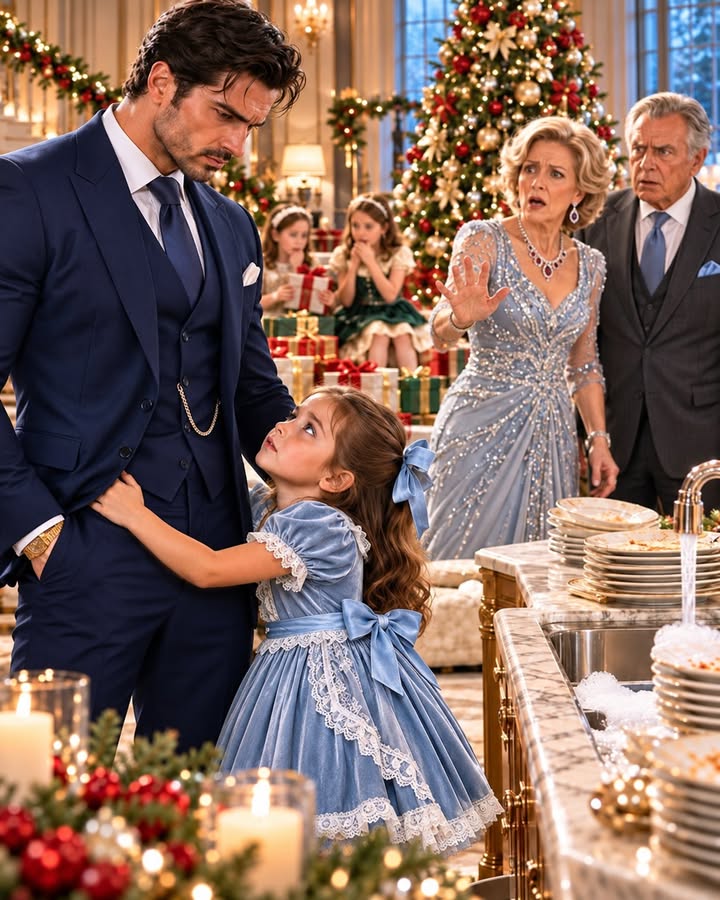
“You thought she wanted her daughter to be made to scrub dishes while her cousins opened presents?”
“No.”
“You thought she wanted Renee to hear that she wasn’t our blood?”
My father looked toward the sitting room, unable to meet my eyes.
“No.”
“Then don’t use Sofia’s request to explain what you chose to do.”
He absorbed that in silence.
Carmen stood between us, her hands clasped before her.
“I was wrong,” she said. “I thought protecting her meant keeping the truth from her. It didn’t.”
“No,” I replied. “It meant keeping the truth from me and the kindness from her.”
She looked as if she wanted to argue, then let the words stand.
“I know.”
I left without deciding what should happen next.
On the drive home, Sofia’s letter seemed to ride beside me, though it was sealed in a folder at the attorney’s office.
The family had spent years treating silence as a kind of shelter.
But a shelter could become a locked room when nobody inside was allowed to ask why the doors were closed.
At home, I found Renee asleep on the sofa, one of her drawings resting against her chest.
Elena had covered her with a soft blanket.
I carried her to bed, careful not to wake her, and placed the drawing on the nightstand.
It showed the three of us beneath a tree, standing close together.
In the corner, Renee had drawn a small figure with dark hair and a gentle smile.
When she stirred, I asked softly, “Who’s that?”
She opened her eyes halfway.
“That’s Sofia,” she murmured. “I wanted her to be in the picture too.”
Then she settled back beneath the blanket.
I stood beside her, looking at the drawing until the room went quiet again.
For the first time, I understood that the truth had not been hidden because Renee was unwanted.
It had been hidden because someone in our family had once been brave enough to say no to the DeLucas, and the rest of us had never learned what to do with that refusal.
But when I called Miriam the next morning to ask about preserving Sofia’s original letter, she told me there was another sealed page attached to the record.
It had been addressed to Renee.
And according to the attorney, Sofia had written it to be opened only when Renee herself was old enough to decide whether she wanted to know more.
**–END OF PART 4–CLICK “NEXT” AT THE BOTTOM OF THE PAGE TO CONTINUE READING**
* * *
[PREVIOUS: PART 3](https://puretales.idolsgift.com/blog/part-3-the-name-on-the-envelope-008-1) | [NEXT: PART 5](https://puretales.idolsgift.com/blog/part-5-the-name-on-the-envelope-008)
✓ Lynn R. Adams
Part 4 – The Letter Sofia Left Behind “He called the woman who wrote it family.” Paula’s words seemed to quiet the café around us. The clatter of cups and the murmur of conversation faded beneath t…