PART 4: The Name Mr. Harrison Recognized 047
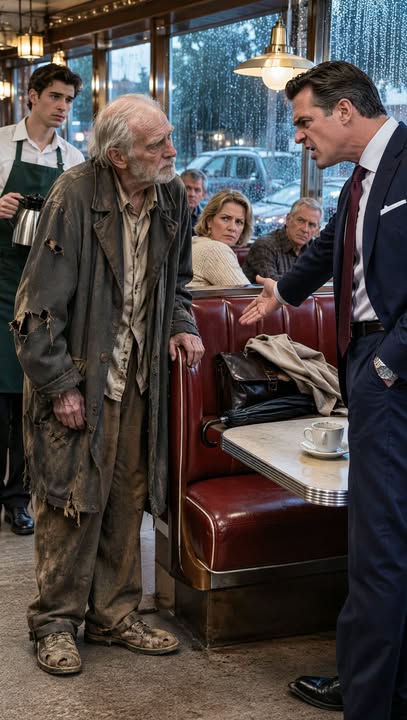
Part 4 – The Promise Beneath the Photograph
Maria held the photograph close to the window, turning it slightly until the pale afternoon light settled across its faded surface.
“The woman beside Mr. Harrison isn’t one of the workers,” she had said.
Then she had pointed to the man standing next to her.
Daniel stared at the image, trying to understand the words that came next.
“That’s not my father.”
Mr. Harrison drew the photograph toward himself, careful not to bend its brittle corners.
“You’re certain?”
Maria nodded, though her gaze remained fixed on the faces.
“I knew your father’s face better than my own. This man is someone else.”
The photograph showed Mr. Harrison at least thirty years younger, standing in front of the old factory with a group gathered around him.
The woman’s expression was serious, her hair pinned away from her face, while the man beside her seemed to be listening to something beyond the camera.
Daniel leaned closer.
The print was too faded for him to see the man’s features clearly.
“Who is she?” he asked.
Maria’s fingers hovered above the woman’s face.
“I don’t know her name.”
“But you said she brought Dad to the meeting.”
“I said she brought him there. I didn’t say I knew her.”
Mr. Harrison looked up from the photograph.
“What do you remember?”
Maria drew a slow breath.
“I remember your father coming home with this picture’s twin,” she said. “Or one that looked very much like it. He kept it in his desk for years.”
Daniel glanced at her.
“Why didn’t you tell me?”
“Because I’d forgotten about it until now.”
She looked toward the window again, searching the rain-softened street as if the old memory might be waiting there.
“After the factory closed, your father kept papers everywhere. He had a box in the attic, a folder in the desk, and envelopes tucked into the kitchen cupboard. Some of them were ordinary work records. Some were letters he thought might matter later.”
“What happened to the photograph?”
“I don’t know. I may have put it with the rest of his things.”
Mr. Harrison’s face had gone pale.
“Was your husband at the meeting shown here?”
“I don’t know.”
“Could the man beside that woman have been another union representative?”
“He could have been.”
Maria looked at him, and her voice sharpened with the effort of keeping grief separate from anger.
“But I won’t pretend to remember what I don’t.”
Mr. Harrison lowered his eyes.
“That’s fair.”
Daniel watched the two of them, feeling as if the photograph had opened a door into a room his family had never entered.
His father had become a collection of small memories: the brass hook by the door, a chipped blue mug, stories that stopped whenever Daniel walked into the kitchen.
Now those memories seemed to connect to something larger, something that had shaped the years after the factory closed.
“Why was the woman important?” he asked.
Mr. Harrison rested one hand on the folder beside him.
“I don’t know,” he said. “She was not named in the records I found.”
“And the man?”
“I don’t recognize him.”
Daniel looked again at the photograph.
“You owned the company. You were there, but you don’t know who these people are?”
“I attended several meetings during that period,” Mr. Harrison said. “I cannot claim I remember every face. This picture may have been taken at a different gathering than the one I’m thinking of.”
Maria’s fingers tightened around her cup.
“Then what do you remember?”
Mr. Harrison sat back, his attention settling on her.
“I remember your husband.”
The words quieted the booth.
Daniel felt his mother shift beside him.
“What do you remember about him?” she asked.
“That he was prepared. He brought lists, figures, and questions that no one else had thought to ask.”
A faint, pained smile crossed Maria’s face.
“That sounds like him.”
“He was not interested in making speeches for the sake of hearing himself speak,” Mr. Harrison continued. “He wanted people to understand exactly what would happen to the workers and their families.”
“That sounds like him too.”
“He challenged me about what we owed those people.”
Maria’s expression grew guarded.
“Did he?”
“Yes.”
“What did you tell him?”
“That the company would provide a fair transition package.”
Daniel looked from one to the other.
“You made that promise?”
“I agreed to it,” Mr. Harrison said. “There was a proposed package for the affected workers, including notice, assistance with job placement, and additional support for those whose circumstances required it.”
Maria’s mouth tightened.
“Your father told me there had been a promise,” she said. “He said the company had agreed to help the workers find their footing after the closure.”
Mr. Harrison nodded, though the movement was slow.
“He was the reason I agreed to more than the standard severance.”
“Then why didn’t we receive it?” Daniel asked.
“I don’t know.”
“You said you were told the agreement had been carried out.”
“I was.”
“And you believed them.”
“Yes.”
The admission hung between them.
Daniel felt his hands curl beneath the table, and he forced them open.
He wanted to be angry, but he did not know where to place the anger.
Mr. Harrison had signed the agreement, or agreed to it, and then trusted others to see it through.
His father had believed the promise was real.
His mother had spent years waiting for something that never arrived.
“Who told you?” Daniel asked.
Mr. Harrison opened the folder and removed a handful of copied records.
“These are the documents I found in the company archive. A summary prepared after the plant closed. It says the transition program was completed, that the workers received the benefits outlined in the plan, and that all outstanding claims were resolved.”
Maria took the pages.
She read the first sheet, then another.
Her eyes moved slowly down the lines.
“This isn’t a list of payments,” she said.
“No.”
“It doesn’t show who received anything.”
“No.”
“Then how could you call it proof?”
“I didn’t call it proof,” Mr. Harrison replied. “I said it was what I was told.”
Maria placed the papers on the table.
“Those are not the same thing.”
“No,” he said again. “They aren’t.”
Daniel felt his mother’s hurt rise through her restraint.
“Your father was the one who asked me to verify the payments before the file was closed,” Mr. Harrison said. “I remember that now.”
Maria stared at him.
“Why didn’t you?”
“I don’t have a good answer.”
“Did he ask you directly?”
“Yes.”
“And you told him you would?”
Mr. Harrison’s face tightened.
“I believe I did.”
Maria turned away for a moment.
The diner’s ordinary sounds seemed distant: a chair scraped across the floor, someone laughed by the counter, and Ruth called an order toward the kitchen.
At their booth, the years between the promise and its failure gathered like dust.
Daniel looked at his mother.
“Do you remember Dad saying he was waiting for the company to follow through?”
“I remember him saying he had done everything he could to secure the agreement,” she said. “He believed the payments would come once the paperwork was finished.”
“And then?”
“Then the letters stopped.”
Mr. Harrison lowered his head.
“I should have followed up.”
Maria’s eyes returned to him.
“You should have.”
“I know.”
“You were the owner.”
“I know.”
“You had the power to ask whether the families had received what your company promised.”
“I did.”
Her voice softened, but only slightly.
“Then why didn’t you?”
Mr. Harrison looked down at his hands.
“Because I trusted the people reporting to me, and because I let the next problem take my attention. I told myself the matter had been handled. I did not check.”
Maria’s anger did not vanish, but something in her expression shifted.
Perhaps she had expected a denial.
Perhaps his willingness to admit failure left her with no easy place to set her resentment.
“Your husband did not want special treatment for himself,” Mr. Harrison said. “He wanted the workers to be treated fairly.”
“He did.”
“I remember him asking whether the company could help with retraining for people whose jobs could not be replaced locally.”
“He said there might be a program.”
“There was meant to be one.”
Maria looked back at the paperwork.
“Meant to be.”
The words sounded small in the booth, but they carried the weight of years.
Daniel thought of the medical bills after his father’s illness, the late notices, and his mother’s careful effort to keep their home.
He had always believed those troubles came from one hard loss followed by bad luck.
Now he wondered how much had been made worse by a promise that never reached them.
“Can you show us the actual agreement?” he asked.
Mr. Harrison turned another page in the folder.
“I’m trying to find it. The archive is incomplete, but I have requested the remaining files.”
“From the company?”
“Yes.”
“Will they give them to you?”
“They should.”
Maria’s eyes met his.
“Should?”
“I still have a legal interest in the company, but the records are held by its current administration. I’ve asked them to preserve everything connected to the closure.”
“Why weren’t you already looking?”
“Because until Daniel told me your name, I didn’t understand that the matter might still be unresolved.”
Maria pushed the papers away.
“The workers who lost their jobs should not have had to wait for your memory to catch up.”
“No,” Mr. Harrison said. “They shouldn’t.”
Daniel watched his mother absorb the answer.
She had spent years learning how to live without expecting apologies from people who had moved on.
He could see that this was not simple relief.
It was an old wound being given a new name, and a new reason to hurt.
Maria picked up the photograph again.
“Why did you bring this one?”
“I found it in a box with the company correspondence,” Mr. Harrison said. “I thought your husband might be in it.”
“Why?”
“Because the box held records from meetings about the closure.”
Maria studied the woman and the unfamiliar man.
“Then this picture may matter.”
“I hope it does.”
“What did the label on the box say?”
“Just the year and the plant’s name.”
“No names?”
“No.”
Daniel pointed to the lower edge of the photograph.
“There’s writing here.”
The ink was so faint that he had missed it at first.
Mr. Harrison leaned over, and Maria angled the picture toward the light.
A few words had been written along the bottom border, nearly erased by time.
Maria squinted.
“‘Transition meeting,’” she read. “And then there’s a date.”
Mr. Harrison checked the papers in his folder.
“That date was two weeks before the closure was announced.”
Maria lifted her gaze.
“Then this wasn’t a photograph from after the workers lost their jobs.”
“No,” Mr. Harrison said. “It looks like it was taken during the negotiations.”
Daniel traced the outline of the unknown man without touching the paper.
“Could he be the person who arranged the agreement?”
“I don’t know.”
“Could he have been the one who reported that everything was paid?”
Mr. Harrison’s expression grew more troubled.
“I don’t know that either.”
Maria set the photograph down carefully.
“You keep saying you don’t know.”
“Because I don’t want to invent an answer.”
“I would rather hear that than another promise.”
Mr. Harrison nodded.
“I understand.”
Daniel turned toward him.
“What happens now?”
“I continue the investigation. I’ll find the signed agreement, the payment records, and the names of everyone responsible for carrying out the plan.”
“And if you find that the support wasn’t paid?”
“Then I’ll take responsibility for making it right.”
Maria watched him closely.
“Not by giving Daniel another check.”
“No,” Mr. Harrison said. “By addressing what was owed to the people who were affected.”
The clear distinction eased something in Daniel, though it did not remove the questions.
He glanced at the folder containing the gift documents, which he had brought with him.
“I still haven’t decided what to do about your offer,” he said.
“You don’t have to decide today.”
“I know, but I want you to understand something.”
Mr. Harrison waited.
“If I accept that gift, it can’t be part of this.”
“It isn’t.”
“It can’t be a reason to stay quiet about what happened to my father or the other workers.”
“It won’t be.”
“And if my family was owed money, that’s different from accepting a gift.”
Mr. Harrison gave a grave nod.
“Completely different.”
Maria looked at Daniel, pride and worry moving across her face together.
“He’s right,” she said. “The gift is his choice to consider. What the company owed is not a favor.”
“I agree,” Mr. Harrison replied.
“Then we keep the matters separate.”
“Yes.”
Daniel studied the older man.
He could not yet tell whether the promise would hold up under pressure, but he believed Mr. Harrison understood the difference.
For now, that was all the family could ask.
Maria placed the photograph in the center of the table.
“May I take this home and look through my husband’s things?”
“Of course,” Mr. Harrison said. “I can have a copy made first.”
“I’d rather take the original, if you’re willing.”
He hesitated only a moment before sliding it toward her.
“Please do.”
Maria tucked it into the folder with the lawyer’s documents, keeping it flat between two sheets of paper.
The three of them sat quietly for a little while.
Daniel thought of his father’s desk and the old boxes in the attic.
He imagined his mother opening them, finding papers and fragments of the life his father had kept private to protect his family from worry.
He was not sure he wanted the past to explain the present.
But he knew they could not leave the questions unanswered.
When they rose to leave, Mr. Harrison remained beside the booth.
“I’m sorry for what your family carried alone,” he said to Maria.
She stood with one hand on the table.
“My husband carried it because he believed people could be held to their promises.”
Mr. Harrison looked at the folder under her arm.
“He was right to believe that.”
“I hope you can prove it.”
“I will try.”
Maria did not thank him.
She did not tell him the matter was forgiven.
She simply nodded once, and Daniel understood that this was the most she could offer until the truth was clear.
Outside, the rain had stopped.
The clouds remained low over the town, but the wet pavement reflected a thin strip of pale sky.
Daniel walked with his mother toward the car.
“Did you know Dad kept the photograph?” he asked.
“I knew he kept a lot of papers.”
“Do you remember him talking about that woman?”
“No.”
“About the man?”
“No.”
Maria placed the folder on the passenger seat and closed the door.
“Your father was careful with his words,” she said. “He did not bring home every worry from work.”
“Maybe he wanted to protect us.”
“He always wanted to protect us.”
Daniel thought of the bills, the promises, and the years his father had spent trying to keep the workers from being discarded without help.
“Do you think he knew the company never paid?”
“I don’t know,” Maria said. “He might have believed the payments were delayed. He might have thought the process was still going on.”
“Did he ever say he was disappointed?”
“Not in a way I understood at the time.”
She looked down at the folder.
“He tried to make sure other families were not left behind. I suppose he hoped someone would make sure ours wasn’t either.”
Daniel felt a heaviness settle in his chest.
At home, they brought down the first box from the attic.
Dust rose in the slanting light, and Maria tied her hair back before kneeling beside it.
The box held old tax forms, work schedules, a union newsletter, and envelopes marked with dates.
Emily came to help after finishing her homework, setting each paper in a neat pile on the kitchen table.
Daniel searched the envelopes while Maria examined a folder of factory correspondence.
For nearly an hour, they found nothing that explained the photograph.
Then Maria lifted a thin stack of letters tied with a faded piece of blue ribbon.
“I think these are from the year the factory closed,” she said.
Daniel joined her.
The top envelope carried his father’s handwriting, though the ink had faded at the edges.
He had written a date in the corner and two words beneath it:
“Final agreement.”
Maria’s fingers went still.
She untied the ribbon.
Inside were several pages of typed notes, a folded letter, and a small carbon copy bearing the factory’s letterhead.
Daniel read over her shoulder.
The first page summarized the workers’ transition package, including severance, retraining support, and additional payments for employees whose families faced particular hardship.
His father had underlined one sentence twice.
“Every eligible family will receive written confirmation of the amount and timing of its support.”
Maria read the line again, then moved to the next page.
The letter was addressed to Daniel’s father.
It thanked him for his persistence and confirmed that the company had approved the package in full.
At the bottom was a signature.
Maria leaned closer.
“Do you recognize the name?” Daniel asked.
She studied the handwriting.
“I remember seeing it on letters from the company.”
“Who was it?”
“Someone in the executive office, I think. Your father mentioned him once.”
She searched her memory, eyes narrowed.
“I can’t remember the name.”
The signature was difficult to decipher, but Daniel could make out the initials and a surname ending in two slanted strokes.
Mr. Harrison’s records might clarify it.
Maria set the letter beside the photograph.
“Take a picture of everything,” she said. “We’ll keep the originals safe.”
Daniel reached for his phone.
Before he could frame the documents, a smaller paper slipped from the folded letter and floated to the table.
It was a receipt.
The paper had yellowed, and its printed lines were nearly worn away, but the date was clear.
So was the amount.
Daniel stared at it.
“Mom, this says there was a payment.”
Maria picked it up, her face paling.
“It says a payment was authorized.”
“Not that it was received,” Daniel said.
At the bottom of the receipt, beneath a line marked “recipient,” was his father’s name.
The signature beside it looked like his father’s, but Daniel had never seen him sign anything.
Maria bent close to the paper.
“That doesn’t look right.”
“You recognize his signature?”
“I’ve seen it on hundreds of documents.”
She turned the receipt toward the light.
“This isn’t his handwriting.”
The room seemed to go very quiet.
Emily stopped sorting the papers.
“Then who signed it?”
“I don’t know,” Maria said.
Daniel looked at the date, then at the total.
The amount was large enough to have helped his family stay ahead of the medical bills, but there was no bank stamp, no record of a deposit, and no proof the money had ever reached them.
“Could it have been a draft?” he asked.
“Maybe,” Maria said. “Or an internal record.”
She searched through the remaining pages, moving faster now.
Another sheet had been folded in half and tucked behind the letter.
On it was a list of workers and the amounts assigned to their families.
Daniel recognized several surnames from the old neighborhood.
Some families had moved away.
Others still lived nearby.
Beside Maria’s name, someone had written a short note in a different hand.
Maria read it aloud, her voice barely above a whisper.
“‘Hold pending verification.’”
Daniel looked at her.
“Verification of what?”
“I don’t know.”
The words sat beneath the promise that every eligible family would receive confirmation of its support.
A door opened somewhere in Daniel’s understanding, revealing not a simple delay but a decision made by someone he could not yet identify.
His mother folded the paper carefully.
“Mr. Harrison needs to see this.”
Daniel glanced at the photograph beside the papers.
The woman in the faded image stood close to the younger Harrison, her face turned toward the man no one had recognized.
The unknown man’s hand rested on the same leather folder Mr. Harrison had brought to the diner.
Daniel looked back at the receipt.
If the payment had been authorized, someone had claimed his father’s name.
If the family’s support had been put on hold, someone had decided it would not reach them.
And if Mr. Harrison had believed the workers were paid, then whoever prepared the final report had given him a story that did not match the records.
Maria gathered the papers into a neat stack.
“We should call him tomorrow,” she said.
Daniel nodded, unable to look away from the receipt.
Then Emily lifted the photograph again, examining its back.
“There’s writing on this side,” she said.
Maria turned it over.
In faint pencil, almost hidden beneath the old paper, was a single line Daniel had not seen before:
“Ask Leon before the transfer is signed.”
**–END OF PART 4–CLICK “NEXT” AT THE BOTTOM OF THE PAGE TO CONTINUE READING**
* * *
[PREVIOUS: PART 3](https://echoesofstories.idolsgift.com/blog/part-3-the-name-mr-harrison-recognized-047) | [NEXT: PART 5](https://echoesofstories.idolsgift.com/blog/part-5-the-name-mr-harrison-recognized-047)
✓ Lynn R. Adams
Part 4 – The Promise Beneath the Photograph Maria held the photograph close to the window, turning it slightly until the pale afternoon light settled across its faded surface. “The woman beside Mr. …