PART 4: The Message She Carried 052
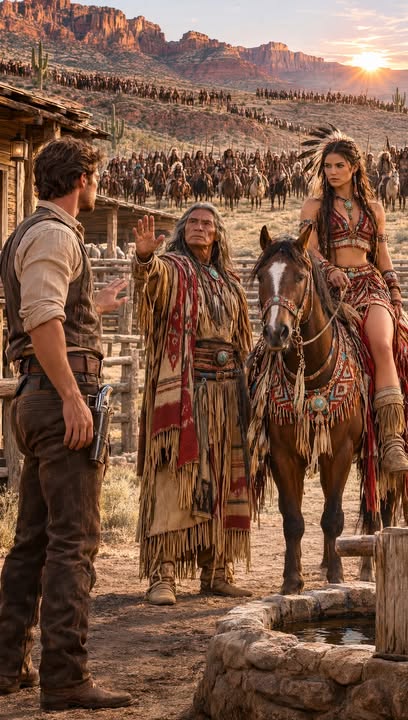
Part 4 – The Hand That Changed the Map
“If your route was corrected, Corvin, who changed it before the raid?”
Nantan’s question remained between them as the last light drained from the western ridge.
Corvin looked down at the brass disc in his hand.
He could feel its stamped letters against his thumb, each one seeming to draw him farther back toward a night he had spent years trying to leave behind.
“I don’t know,” he said.
The words sounded familiar now, and no less inadequate.
Taza watched him closely.
“Do you have the original route?”
“Not on me.”
“In the ledger?” Nantan asked.
Corvin looked toward the house.
“I wrote down what I was given.”
“And kept it?”
“I kept the ledger.”
“Then we should look.”
Corvin hesitated.
The ledger had been the one record he had never thrown away, though he had told himself it was only because the pages were useful for accounts.
He had written feed costs, weather notes, fence repairs, and the names of people who had come through the valley.
It held the ordinary shape of his life, and tucked among those ordinary things was the part he had never managed to understand.
“Come inside,” he said.
Nantan followed him through the doorway.
Taza remained outside with the scout, speaking quietly as dusk settled across the ranch.
The room seemed smaller than it had before.
Corvin crossed to the table and lifted the thick ledger from beneath a folded map.
Its leather cover was cracked along the spine, and the edges of its pages had darkened with age.
He placed it between himself and Nantan.
“You wrote the entry before the raid?” she asked.
“I wrote it after I delivered my notes to Captain Mercer.”
“How long after?”
“Two days, perhaps.”
“Then it was not the original route.”
“It was the route I was told to record.”
Nantan rested her fingertips on the edge of the book.
“Show me.”
Corvin opened the ledger carefully.
The first pages were crowded with old figures and names, his handwriting narrow and even.
He turned past years of ranch accounts until he reached the section marked with the month of the raid.
There it was: a brief entry about the trail, the patrol, and the route north of the eastern ridge.
Corvin read it once.
Then again.
His face grew still.
“What is it?” Nantan asked.
He brought the book closer to the lamp.
The entry was dated the day before the raid.
The route line had been written in his own hand, but a short section had been crossed through and replaced in darker ink.
At the end of the correction was a small hooked mark.
Corvin knew the shape, though he could not remember where he had seen it.
Nantan leaned closer.
“Is that your writing?”
“The first part is.”
“And the correction?”
“No.”
“Did you notice it then?”
“I must have.”
“That is not an answer.”
“I don’t remember seeing it.”
His voice had grown hoarse.
He pressed one finger to the crossed-out words.
The original route had led around the eastern ridge and away from the settlement.
The replacement sent the patrol through the low pass beside the homes.
Corvin stopped breathing for a moment.
“I wrote that the pass was unsafe,” he said.
“Then who changed it?”
“I don’t know.”
He turned the page, searching for a note or a later entry that might explain the alteration.
The next page held nothing but accounts for grain and lamp oil.
He flipped back, then forward again, as if the answer might have been hidden in the margins.
Nantan studied the correction.
“Could it have been Captain Mercer?”
“Possibly.”
“Could it have been Voss?”
“He never had the ledger.”
“Could someone have copied your notes?”
“They could have.”
“But you cannot remember who saw them.”
Corvin stared at the hooked mark.
“Mercer had the route notes,” he said. “Voss had been asking questions about the land and the trails. I gave Mercer my written report, and he told me it would be kept with the patrol records.”
“Did you speak with Voss after that?”
“Yes.”
“What did he ask?”
“Whether I knew a faster way through the pass.”
“And what did you tell him?”
“That the low pass was dangerous, and that the eastern route was safer.”
“Did he know you had written the same thing?”
“I don’t know.”
Nantan withdrew her hand from the ledger.
“You have spent years saying you led families away from the raid.”
“I did.”
“Then why did the patrol ride into the settlement?”
“I thought they were following the route I had given them.”
“But the record says otherwise.”
“The record says someone changed it.”
Her gaze held his.
“And you did not find out who.”
“I was told the correction came from the patrol office.”
“By whom?”
“Mercer.”
“Did you believe him?”
Corvin closed his eyes briefly.
“I wanted to.”
The answer left no room for defense.
Nantan stepped away from the table and looked out through the open doorway.
Beyond her, the ranch yard lay in deepening blue shadow.
The riders who remained near the house moved quietly between their horses, their silhouettes crossing and vanishing beneath the stars.
“My family was told the patrol had come because the route was clear,” she said.
Corvin looked at her.
“Who told them that?”
“Some survived long enough to speak of it. Others heard the story from the few who escaped.”
“I never knew.”
“You never asked.”
“I didn’t know who to ask.”
“You could have come back.”
“I was told the area was closed to outsiders.”
“By Mercer?”
“Yes.”
“Did you accept that?”
“I was a civilian guide. I had no authority to argue with an army officer.”
“But you had authority to leave.”
The words were gentle, which made them difficult to withstand.
“I did,” he said.
A long silence followed.
Corvin looked down at his hands.
He had not been the one to alter the route.
He had not ordered the patrol into the settlement.
He had not wanted anyone hurt.
Still, his name sat beneath the entry, and the path he had mapped had carried armed men to the place where Nantan’s family lived.
A person could be innocent of one thing and responsible for another.
He had spent too long believing those were the same question.
Nantan returned to the table.
“Tell me what you remember of that night,” she said.
Corvin lifted his eyes.
“I remember a wind from the east. It kept shifting smoke across the low ground. Mercer said the settlement was empty.”
“Was it?”
“I had no reason to think it wasn’t.”
“That is what you were told.”
“Yes.”
“By Mercer?”
“By Voss.”
Nantan went still.
Corvin’s mouth tightened.
“I’m certain of that part now.”
“You said Voss was not with the patrol.”
“He wasn’t. He was waiting near the rise with two men.”
“And you spoke to him?”
“Briefly.”
“What did he say?”
“He said the families had already left.”
“Did you believe him?”
“I saw people moving west. I thought he meant the settlement had been cleared.”
“Did you see the people?”
“No.”
“Did you ask?”
“I should have.”
“What did you do after that?”
“I took the families farther along the western trail. We heard a sound from the direction of the settlement, but the wind covered most of it.”
Nantan’s fingers curled lightly against the table edge.
“Then you reached the dry wash.”
“Near dawn.”
“And the settlement was already burning?”
“Some buildings were. The rest were damaged.”
“Did you see bodies?”
“No. I was ordered not to enter.”
“Who gave the order?”
“Mercer.”
“And you obeyed.”
“Yes.”
The word seemed to carry the weight of the years it had been waiting inside him.
Nantan turned her face away.
For a moment, Corvin thought she might leave.
Instead, she stood very still, as though the room had become a place where every movement required care.
“My family searched for survivors after the soldiers left,” she said.
“I know.”
“They found my aunt’s home empty.”
“Empty?”
“Empty of the people who had been inside. They found signs that some had escaped, but they did not know where they had gone.”
Corvin gripped the table.
“Were there children among them?”
“Yes.”
“Could one have been Luta?”
“I thought you said you did not remember the children clearly.”
“I don’t. But I remember the woman with the blue blanket. She had a little girl in her arms.”
Nantan’s eyes returned to him.
“My aunt had a blue blanket.”
He felt the words land before he understood their meaning.
“What was your aunt’s name?”
“Ishta.”
Corvin searched his memory, trying to separate faces from shadows, names from the half-heard voices of that night.
“I don’t know if I heard her name.”
“Would you recognize her?”
“I don’t know.”
“Would you recognize the child?”
“I don’t know.”
Nantan lowered her gaze.
“Then we still have no answer.”
“No,” Corvin said. “But we have a reason to look.”
She watched him carefully, and he wondered whether she could see how badly he wanted the possibility to be true.
Hope was not kindness.
It could hurt as sharply as grief when it proved false.
Taza appeared in the doorway, carrying a small lantern.
“The people near the river have been warned,” he said. “Most are preparing to move beyond the bend.”
“Has there been trouble?” Nantan asked.
“No. Voss’s riders have not come closer.”
“Have they been watching the valley?”
“From the western creek.”
Corvin closed the ledger halfway.
“Did your scout say why they have the brass disc?”
“He said one of the men carried it openly,” Taza replied. “It was shown to the others as they examined the crossing.”
“Then Voss wants us to find it.”
“Or wants us to know he has it,” Nantan said.
Corvin looked down at the blackened disc.
“He has my name, the old mark, and the date. He may be trying to make me look responsible for the raid.”
“Or he may be reminding you of something you were meant to forget,” Taza said.
Corvin turned the disc over again.
The two words scratched into the scorched metal remained visible beneath the lamp.
Route corrected.
He looked back at the ledger.
The hooked mark at the end of the altered line seemed familiar because he had seen it before, though not on a page.
It had been carved into the corner of Voss’s old map case, a small flourish he used whenever he marked a route as approved.
Corvin felt the room tilt around that recognition.
“I’ve seen that mark,” he said.
Nantan moved closer.
“Where?”
“On Voss’s maps.”
“Are you certain?”
“I think so.”
“You think?”
“I have not seen his maps in years.”
Taza set the lantern on the table.
“Then we must not mistake memory for proof.”
“No,” Corvin said. “But it may tell us where to look.”
He returned to the ledger and examined the correction more closely.
There was another small note in the margin, almost lost against the fold.
A time.
.
Corvin frowned.
“What is it?” Nantan asked.
“I don’t know.”
He turned the ledger so the lamplight fell across the page.
The figures were faded, but the ink in the margin looked darker than the original entry.
“Could it be the time you wrote the correction?” Taza asked.
“Maybe.”
“Do you remember that day?”
Corvin searched through the pieces he had kept: the morning he had ridden to the patrol camp, the route notes in his saddlebag, Mercer’s stiff order to leave the report and go back to the ranch.
Then the memory shifted.
Not a full recollection, but a detail rising from the dark.
He had returned to the camp at to retrieve a map he had forgotten.
Voss had been there, alone beside the folding table.
Corvin had seen a sheet of paper beneath his hand.
He had asked what he was doing.
Voss had said he was marking a safer route.
At the time, Corvin had been grateful.
“I came back to the camp at that hour,” Corvin said.
“What did you see?” Nantan asked.
“I’m not sure.”
“Try.”
“I saw Voss by the maps. He said he was correcting the route.”
“And you let him?”
“I thought he was working with Mercer.”
“Did you see what he changed?”
“No. I was only there a moment.”
The silence in the room gathered again, but this time it held a new shape.
Corvin had not changed the route.
He had not been entirely absent from the moment it changed, either.
“I should have remembered,” he said.
“Memory is not a witness you can command,” Taza replied. “But it is a trail.”
Nantan looked at the ledger, then at the brass disc.
“Why would Voss use your name now?”
“To frighten me into silence,” Corvin said.
“Or to make the valley believe the raid was your doing.”
“He may not need to make anyone believe it. I barely know what to believe myself.”
Nantan’s expression softened, though the doubt remained.
“That is the first honest answer you have given me about the past.”
He accepted the judgment.
“I’m sorry.”
“Do not spend the night apologizing.”
“What should I do instead?”
“Find the truth.”
He nodded.
Outside, the wind rose and moved across the ranch yard, carrying the faint, dry scent of creosote.
A horse shifted in the corral, and someone murmured to calm it.
The ordinary sounds of the ranch seemed to keep the past from swallowing the room whole.
Corvin opened the ledger again.
He traced the altered route with the tip of one finger.
“I kept this because I thought it was my mistake,” he said. “Every time I looked at the page, I saw the line and the names of the people who were lost.”
“But it was changed,” Nantan said.
“After I wrote it.”
“And you never knew?”
“I knew the patrol took a different path. I never knew this page had been changed.”
“What about your report?”
“Mercer kept the original.”
“Could it still exist?”
“If the patrol records were preserved.”
“Where?”
“The territorial office, perhaps. Or wherever they sent the papers when the post was closed.”
Taza’s face grew thoughtful.
“If Voss has come for the land, he may also want to remove whatever proves how he took it.”
Corvin’s attention snapped back to the ledger.
“Why would my route notes matter to a land claim?”
“Because a false path can make a settlement appear abandoned,” Nantan said.
She spoke slowly, looking at the faded writing.
“If the patrol was led into the homes, people fled. If they fled, Voss could later say they had left the valley.”
“And the papers he brought,” Corvin said. “He claims they give him rights to the land.”
“Then the raid was not only a tragedy,” Taza said. “It was part of the plan.”
Corvin stared at the page.
The thought was so simple that it felt impossible.
He had believed the raid was a disaster of confusion, a terrible misjudgment made by officers who trusted the wrong information.
Now the pieces began to settle into a different pattern.
Voss had wanted the land.
He had known the trails.
He had been near the patrol.
He had possessed a reason to move families from the valley.
And the route that led soldiers into the settlement had been altered after Corvin delivered his notes.
Nantan’s voice was quiet.
“My people were not driven from their homes by chance.”
“No,” Corvin said.
The answer hurt because it fit.
Taza leaned over the ledger, careful not to touch the page.
“Can you prove who made the correction?”
“Not from this.”
“Can you prove your original route was different?”
“The entry shows it.”
“But the writing is yours?”
“The first line is.”
“And the correction is another hand.”
Corvin looked more closely at the letters.
The numbers were narrow, slanting slightly to the right.
He had seen that handwriting on letters from Voss, though he could not remember if he still possessed any.
“I may be able to identify it.”
“You must be certain before you accuse him,” Nantan said.
“I know.”
“Knowing what he did is not the same as being able to show it.”
“I know that too.”
“Do you?”
Her question held no contempt.
It held the weariness of someone who had seen truth arrive too late to save anyone.
Corvin shut the ledger gently.
“Then I’ll find the original report.”
“And the people you led away,” Nantan said.
He looked at her.
“Luta may have been one of them.”
“She may have been.”
“If she survived, someone knows where she went.”
“My family sheltered survivors from the raid,” Nantan said. “Some were our own. Some had fled from farther west.”
“Did any children come back?”
“Not that I know.”
The uncertainty in her voice made the answer more painful than a refusal.
Corvin thought of the little girl beneath the blue blanket.
He had carried that fragment of the night for years without knowing it might belong to someone whose name Nantan still spoke.
“I can’t promise she’s alive,” he said.
“I have never asked you to.”
“But if she is—”
“Then the truth will have found us late, but not too late.”
For the first time since the token had been found, Corvin felt something in him shift away from blame and toward purpose.
It did not absolve him.
It gave him something to do with the guilt besides carrying it.
A low call came from outside.
Taza stepped toward the doorway and listened.
Another voice answered from the edge of the yard.
The old warrior returned to the room.
“One of the scouts has seen a light near the western creek,” he said. “It may be a campfire.”
“Voss’s men?” Corvin asked.
“Most likely.”
“How far?”
“Near enough that we should keep watch.”
Nantan tied her shawl more securely around her shoulders.
“You should stay inside and guard the ledger,” Corvin told her.
“I will decide where I am needed.”
“You’re injured.”
“And you are thinking too much about keeping me safe.”
He looked at her, then let the argument go.
“You’re right.”
A faint surprise crossed her face.
“Am I?”
“Sometimes.”
“Then I’ll try to remember this moment.”
Taza took the brass disc and placed it beside the ledger.
“Do not leave these where they can be taken.”
Corvin reached for the book.
“I’ll put them in the chest.”
As he moved to close the ledger, a loose sheet slid from the back cover and drifted onto the floor.
He bent to pick it up.
It was a narrow page, brittle at the edges, folded twice and pressed flat between the last leaves.
Corvin recognized his own handwriting across the top.
His fingers began to tremble.
“What is it?” Nantan asked.
“I don’t remember putting this here.”
He unfolded the page.
It was a copy of the route notes he had written before delivering the original report.
The first line matched the route in the ledger before the correction.
The second described a safe western approach for moving families away from the settlement.
Below it, in his own hand, was the date.
And beneath that, almost hidden where the page had been folded, was a short message signed with the same hooked mark as the correction.
Corvin read it once without understanding.
Then he read it again.
Nantan stood beside him, close enough to see the color leaving his face.
“What does it say?”
Corvin swallowed.
“‘Leave the eastern trail open. The families must be gone before the patrol arrives.’”
Taza leaned over the page.
“Who wrote the message?”
“Not me.”
“Can you identify the hand?”
Corvin looked at the signature.
He could.
It belonged to Elias Voss.
Nantan’s fingers tightened around the edge of the table.
“Then he knew people were still there.”
“Yes.”
“And he knew the patrol would come.”
Corvin stared at the words, hearing again Voss’s calm assurance that the settlement had been cleared.
“He knew,” Corvin said.
The discovery should have made everything clear.
Instead, it opened one last door in the past.
Beneath Voss’s message, written in faint pencil, was a second line.
A name.
Luta.
Part of it had been rubbed away, but the letters remained unmistakable.
Corvin looked up at Nantan.
“Why would Voss have written her name?”
Nantan’s face had gone pale.
She reached for the page, but stopped before touching it.
“I don’t know,” she said.
Taza lifted the lantern higher.
The pencil marks emerged from the fold, revealing two more words beneath the name.
**Found alive.**
**–END OF PART 4–CLICK “NEXT” AT THE BOTTOM OF THE PAGE TO CONTINUE READING**
* * *
[PREVIOUS: PART 3](https://storyly.idolsgift.com/blog/part-3-the-message-she-carried-052) | [NEXT: PART 5](https://storyly.idolsgift.com/blog/part-5-the-message-she-carried-052)
✓ Lynn R. Adams
Part 4 – The Hand That Changed the Map “If your route was corrected, Corvin, who changed it before the raid?” Nantan’s question remained between them as the last light drained from the western ridge…