PART 4: The Mark in the Photograph 041
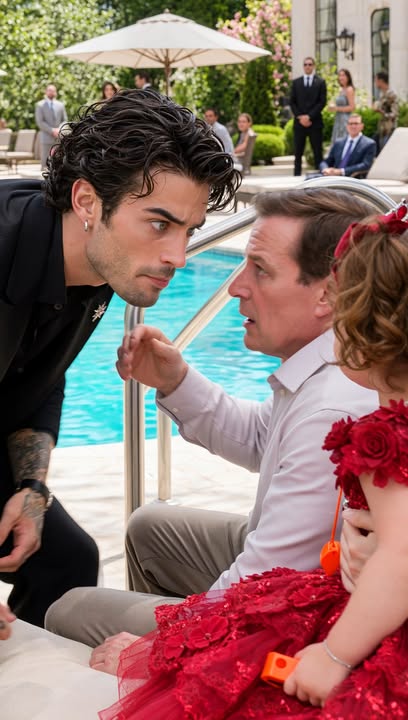
Part 4 – The Name Beneath the Story
Vincent remained still, the open letter in his hand, while Rosa held the sleeping Sophie against her shoulder.
“Your mother,” he repeated softly.
Rosa nodded.
“I’m sorry.”
The apology sounded less like a confession than a grief she had carried too long.
Vincent set the letter on the desk.
“You knew the woman in the photograph was your mother.”
“I did.”
“And Elena knew?”
“She came to understand it shortly before she died.”
“How?”
“She found my mother’s name in an old record, then asked me about the photograph.”
Rosa shifted Sophie gently, careful not to wake her.
“I told Elena the truth about my mother, but I didn’t know what it meant for her.”
Vincent looked again at the faded image.
The woman beside little Elena had Rosa’s eyes and the same quiet curve to her smile.
“Was she Elena’s birth mother?”
“I believe so.”
“You believe?”
“My mother died when I was young,” Rosa said.
“I was old enough to remember her, but not old enough to know everything she had lived through.”
She drew a breath.
“She had an older sister who became pregnant and died not long after giving birth.”
Vincent’s gaze fixed on her.
“Your mother’s older sister?”
“Yes.”
“What happened to the child?”
“My mother told me the baby was adopted by a family from this area.”
Rosa glanced at the letter.
“She said the adoption had been arranged quietly, through people who knew the Moretti family.”
Vincent’s expression changed.
“Connected to my family?”
“Connected to them, yes.”
“Do you know which family?”
“No.”
“Did your mother?”
“She knew the child had been raised with a different name.”
Rosa’s voice thinned, but she kept going.
“She never knew whether the girl was told she had been adopted, or whether she grew up believing her birth family was unknown.”
Vincent looked down at Elena’s handwriting.
“She was told she knew nothing about her birth family.”
“That is what she told me.”
“Then how did she find out?”
“I don’t know every step.”
Rosa’s eyes settled on the photograph.
“She told me she had found a record that seemed to connect her to my mother’s sister, and she asked whether the woman in the photograph was my mother.”
“You said yes.”
“Yes.”
“But you couldn’t confirm the rest.”
“No.”
Vincent let the silence sit between them.
For years, he had thought of Elena’s adoption as a closed chapter, something she had accepted without wanting to reopen.
Now the image of his wife as a child seemed to hold an entire history he had never known.
He looked at Rosa.
“Why didn’t you tell me the moment you realized?”
“Because I had no proof.”
“You knew the photograph was of your mother.”
“I knew who the woman was.”
“But not whether Elena was her niece.”
“Not until Elena showed me the record.”
“Why didn’t you tell me then?”
Rosa’s face tightened.
“Because Elena was still trying to understand what she had found.”
“She asked me to keep her confidence until she had enough to be certain.”
“And after she died?”
“She had left the letter with Mrs. Bellini.”
“That doesn’t answer me.”
“No,” Rosa said.
“It doesn’t.”
She looked down at Sophie’s sleeping face.
“I was afraid that if I came to you with a possibility, your relatives would take it from Elena and make it theirs.”
Vincent’s jaw set, but he did not interrupt.
“They would ask for names and records,” Rosa continued.
“They would decide what the connection meant before anyone had the chance to know.”
“Some of them might have.”
“I thought so.”
“I didn’t know Elena had been afraid of them.”
“She didn’t want her past turned into a family matter to be managed.”
Rosa’s voice was quiet, but no longer uncertain.
“She wanted the truth to belong to her first.”
Vincent looked at the letter again.
Elena had written that the story she had been told might not be complete.
She had not written that she knew who her mother was.
She had not called the photograph proof.
She had left questions behind, not a verdict.
“What did your mother say about the adoption?” he asked.
“She said her sister had died before the family could make plans.”
“Did she know the baby’s adoptive name?”
“No.”
“Did she ever try to find her?”
“She did, once.”
Rosa paused.
“She was young when it happened, and the people who arranged the adoption told her the child was settled with a family.”
“What did she do?”
“She asked whether she could see her.”
“What happened?”
“They said it would be better not to disturb the child’s life.”
Vincent’s gaze lowered to the photograph.
“Did your mother believe that?”
“I think she wanted to.”
Rosa shifted Sophie again, and the little girl murmured in her sleep.
Rosa began to turn toward the door.
“Wait.”
She stopped.
“You said Elena asked you to help her understand the record.”
“She did.”
“Did she ask you to find her birth mother?”
“She asked me whether my mother had ever spoken of a baby born to her sister.”
“And you told her what you knew.”
“Yes.”
“Did you tell Elena that the baby might have been adopted by someone connected to my family?”
“I told her what my mother had told me.”
“Did she say what she wanted to do with that?”
“She wanted to know the woman’s name.”
“Did she find it?”
“I don’t know.”
Vincent studied her face.
“Rosa, are you keeping something else from me?”
“I’m trying not to turn what I remember into certainty.”
“That isn’t the same as keeping something from me.”
“No,” she said.
“But the difference can be hard to see when someone is asking for an answer.”
He held her gaze, then looked toward Sophie.
“Is she Elena’s biological daughter?”
Rosa’s arms tightened around the child—not protectively against Vincent, but with the tenderness of someone who knew how much the answer mattered.
“I think she was.”
“You think.”
“Vincent, the mark is only a mark.”
“And the photograph?”
“A resemblance.”
“And your mother’s story?”
“A family memory.”
“None of it proves anything.”
“No.”
For the first time, Rosa’s voice carried a thread of relief.
“Those things may point toward the truth, but they cannot establish it.”
Vincent heard the distinction and understood why Elena had been careful with her words.
The mark that had once seemed like a simple inheritance from mother to daughter was now no more than a clue.
The photograph offered a face, not a record.
And Rosa’s recollection, however sincere, could not supply what the years had erased.
“Then we find out what can be proven,” he said.
Rosa closed her eyes briefly.
“I don’t know whether Elena wanted that.”
“She left me a letter because she wanted the story preserved.”
“She also wanted Sophie to have a choice.”
“I won’t tell Sophie more than she can understand.”
Rosa searched his face.
“Will you tell your family?”
“Not until we know what there is to tell.”
“And if they ask?”
“Then they can wait.”
It was a simple answer, but he felt the effort behind it.
His first instinct had always been to control the path ahead: decide who knew what, decide when, decide how to prevent a question from becoming a problem.
Elena had asked him to do something less familiar.
Listen before deciding.
Wait before naming.
Leave space for Sophie to grow into her own understanding.
Rosa lowered her eyes.
“I should put her to bed.”
“Yes.”
She reached the doorway, then paused.
“Vincent.”
He looked at her.
“I never meant for you to feel shut out.”
“But I do.”
“I know.”
“I trusted you with Sophie.”
“And I have loved her as I promised Elena I would.”
“I believe you.”
Rosa’s expression eased, but the hurt in his voice remained between them.
“I’m sorry I didn’t trust you with the rest,” she said.
Vincent did not offer easy forgiveness.
He did not punish her with silence, either.
“I need time to understand what the rest is.”
Rosa nodded.
“That’s fair.”
She carried Sophie upstairs.
Vincent stayed in the study, the letter open beside Elena’s photograph.
He read it once more, slower this time, attending not only to what Elena had written but to what she had carefully left uncertain.
She had been trying to protect her story from being claimed by people who might care more about the family name than the person behind it.
She had also trusted Rosa and Mrs. Bellini to preserve the question until it could be answered responsibly.
Vincent had spent years believing the small mark on Sophie’s wrist belonged to Elena’s side of the family.
Now he understood that belief had come from love, not evidence.
It had been comforting to see Elena in their daughter, but comfort did not make a guess true.
A soft knock came at the study door.
Daniel stood there, one hand on the frame.
“Rosa asked me to check whether you needed anything.”
“I’m all right.”
Daniel stepped inside.
“She’s upstairs with Sophie?”
“Yes.”
He glanced at the letter, then at Vincent.
“Did you find out who the woman was?”
“Rosa’s mother.”
Daniel’s eyebrows rose.
“Then she really was connected to Elena?”
“Possibly.”
Vincent told him what Rosa had explained, making it clear where the facts ended and the family story began.
Daniel listened without interruption.
When he was finished, he said, “Your wife might have been my mother’s cousin.”
“If the story is right.”
“That would make Sophie…”
“Connected to Rosa’s family, if the connection is confirmed.”
Daniel sat down slowly.
“My mother never knew any of this.”
“She knew Elena had left a letter.”
“She didn’t know what was in it.”
“I believe her.”
Daniel looked troubled, but not surprised.
“She must be stunned.”
“I’ll speak with her.”
“Do you want me to call her?”
“Not yet.”
Vincent folded the letter carefully and set it back beside the photograph.
“I want to understand what Elena found before the story spreads further.”
Daniel nodded.
“That makes sense.”
“Did your mother keep any other records from that time?”
“I don’t know.”
“Ask her, but don’t press.”
“I won’t.”
Daniel stood.
“Vincent, I should tell you something else.”
Vincent looked up.
“When I showed Rosa the photograph from the barbecue, she didn’t just recognize the birthmark.”
“What else did you notice?”
“She seemed to recognize the photograph itself, or the person in it.”
“She said it reminded her of someone.”
“I thought she meant Elena, but now I’m not sure.”
Vincent absorbed this.
“Did you tell her about the birthmark?”
“Only that you should know it looked like the mark in the old picture.”
“And she said?”
“She asked me to be careful about calling it proof.”
The phrasing was so close to what Rosa had just told him that he felt a quiet chill pass through his thoughts.
“She said that to you?”
“Yes.”
“Why didn’t you tell me before?”
“I didn’t know it mattered.”
Daniel looked genuinely apologetic.
“After today, I can see that it did.”
Vincent’s expression softened.
“You brought me a question, not an accusation.”
“I know, sir.”
“And you’re getting medical care.”
“I have an appointment next week.”
“Good.”
Daniel started toward the door, then stopped.
“If Sophie is part of this family, does that change anything for her?”
Vincent glanced toward the ceiling, where the child was sleeping.
“No.”
The answer came more firmly than any he had given that day.
“Whatever her history says, she is my daughter.”
Daniel seemed relieved.
“That’s good.”
“It’s the one thing I don’t have to investigate.”
After Daniel left, Vincent remained with the letter until dusk.
He did not call his relatives.
He did not send anyone to search old files or question the town’s records office.
Instead, he called the family physician and asked for a private appointment, explaining that he wanted guidance on how to handle a possible family-history question without putting pressure on Sophie.
The doctor listened and advised him not to draw conclusions from a birthmark or old photograph.
If the adults wanted certainty, she said, they should begin with reliable records and, if appropriate, speak with a genetic counselor before considering any family DNA testing.
Vincent thanked her and wrote down the recommendation.
It was the first plan of the day that did not rely on what he thought he knew.
The next morning, he asked Rosa to join him in the sitting room after Sophie had eaten breakfast.
A small wooden puzzle lay scattered across the rug.
Sophie was trying to fit a blue piece into the space meant for a yellow one, her lower lip caught between her teeth.
Rosa sat opposite Vincent with a cup of tea untouched in her hands.
“I spoke with our doctor,” he said.
“She said the photograph and the mark are not proof.”
Rosa nodded.
“That is what I believed.”
“She recommended that we begin with records, and that we ask for professional guidance before doing any testing.”
“Would you want to do that?”
“I want to know what Elena found.”
He looked down at the letter resting on the table.
“But I don’t want to make an investigation out of Sophie’s life without thinking about what it might mean for her.”
Rosa’s eyes warmed.
“That sounds like something Elena would have wanted you to consider.”
“I wish she had told me herself.”
“So do I.”
The honesty between them was easier than the night before, but it did not erase what remained unresolved.
Vincent placed the photograph between them.
“Do you recognize the place?”
Rosa studied it closely.
“No.”
“Anything about it?”
“The way my mother is standing.”
“Can you tell from that?”
“No.”
She leaned nearer to the image.
“She wore a brooch with a little leaf carved into it.”
Vincent looked at the woman’s collar.
A tiny shape was visible there, blurred by age.
“Is that it?”
“I can’t be sure.”
Rosa drew back.
“I don’t want to tell you it is simply because I want it to be.”
He appreciated the restraint, though it was difficult to live inside it.
“You’re sure the woman is your mother.”
“Yes.”
“You’re sure your mother had an older sister who gave birth to a child.”
“Yes.”
“And you’re sure that child was adopted by a family connected to mine.”
“I know what my mother told me.”
“Did your mother say the child’s name?”
“No.”
“Did she say what happened to her sister?”
“She said her sister died in the weeks after the birth.”
Rosa’s voice faltered.
“She never told me where she was buried, or who had handled the adoption.”
Vincent lowered his gaze.
“How old were you when your mother told you this?”
“Not much older than Sophie is now.”
The answer changed the room again.
Rosa looked toward the little girl, who had finally set the yellow piece aside and was trying the blue one in a different space.
“My mother didn’t tell me everything at once,” Rosa said.
“She only told me the part she thought I could understand.”
Vincent glanced at her.
“And you kept that lesson?”
“I tried.”
The child looked up, holding two puzzle pieces in her hands.
“Rosa, help.”
Rosa set her tea aside and went to her.
“Let’s see which one belongs there.”
Sophie watched her demonstrate, then placed the yellow piece into the opening.
It fitted neatly.
“Got it!”
“You did,” Rosa said.
Sophie clapped for herself.
Vincent watched them, aware of how naturally Rosa’s hand rested at Sophie’s back.
The woman in the photograph might have been the mother of Elena’s birth mother.
The facts were still incomplete, but the possibility had turned Rosa from a beloved nanny into something closer to family than either of them had known.
That realization did not diminish the years she had cared for Sophie.
It made those years feel deeper, and more complicated.
Later that afternoon, Vincent sat with Sophie in the garden while Rosa trimmed dead leaves from the roses.
Sophie had brought her whistle and a small notebook with thick crayons.
She drew three circles and a line that wandered off the page.
“Who’s that?” Vincent asked.
“Me.”
“And this one?”
“Dada.”
She pointed to the third circle.
“Rosa.”
Vincent smiled.
“Very good.”
Sophie placed the crayon on the page and tapped all three drawings.
“Family.”
The word was too simple to carry the history adults were trying to untangle, but it held something truer than any record.
Vincent bent to kiss the top of her head.
“Yes, sweetheart.”
Rosa turned toward them.
For a moment, she looked as if she might speak.
Then she returned to the roses.
Vincent did not ask her to name the connection aloud.
Not yet.
In the days that followed, they began carefully.
Daniel’s mother sent copies of the photographs Elena had left among her old belongings, along with a note explaining that she had never known what the sealed letter contained.
Vincent arranged for the family doctor to refer them to a counselor experienced in adoption and family history.
Rosa agreed to speak with her own relatives, though she warned him that there might be little left to find.
No one told Sophie there was a secret waiting for her.
At two, she needed only to know that she was loved, that Daniel was getting better, and that strawberries belonged in the red bowl.
Still, Vincent noticed the way Rosa sometimes paused when Sophie showed her wrist.
He noticed the way Rosa looked at Elena’s photograph when she passed the study.
And he noticed that the woman beside Elena in the picture wore, pinned to her collar, a tiny metal leaf.
One evening, Rosa brought him a small tin box she had kept since childhood.
“My mother gave this to me,” she said.
“She told me it held things I might want to understand when I was older.”
Inside lay a faded ribbon, a pressed flower, and a small silver brooch shaped like a leaf.
Vincent looked from the brooch to the photograph.
Rosa’s fingers trembled as she set the brooch beside it.
The shape matched.
Sophie, standing at Vincent’s knee, pointed at the picture.
“Rosa mommy?”
Rosa’s face went pale.
Vincent crouched beside his daughter.
“Rosa’s mother,” he said gently.
“Like my mommy?”
“Like Mommy,” he agreed.
Sophie studied the photograph, then looked up at Rosa.
“Rosa family?”
Rosa knelt to meet her eyes.
“Yes, sweetheart.”
Sophie reached for her.
Rosa gathered her close, and Vincent saw how both of them held on as if the answer had been waiting in the room for years.
Then the doorbell rang.
Marco answered it and returned with a slim folder, addressed to Vincent in careful handwriting.
“It came by courier,” he said.
Vincent opened the folder.
Inside was a copy of an old adoption record, newly located through the counselor’s research.
A name had been typed into the space for the child’s birth mother.
He read it once, then again.
Rosa leaned over his shoulder.
Her lips parted, but no sound came.
The name on the record was not Rosa’s mother’s.
It was the name of a woman Vincent knew.
His own mother.
**–END OF PART 4–CLICK “NEXT” AT THE BOTTOM OF THE PAGE TO CONTINUE READING**
* * *
[PREVIOUS: PART 3](https://echoesofstories.idolsgift.com/blog/part-3-the-mark-in-the-photograph-041) | [NEXT: PART 5](https://echoesofstories.idolsgift.com/blog/part-5-the-mark-in-the-photograph-041)
✓ Lynn R. Adams
Part 4 – The Name Beneath the Story Vincent remained still, the open letter in his hand, while Rosa held the sleeping Sophie against her shoulder. “Your mother,” he repeated softly. Rosa nodded. “…