PART 4: The Mark Beneath the Frame 046
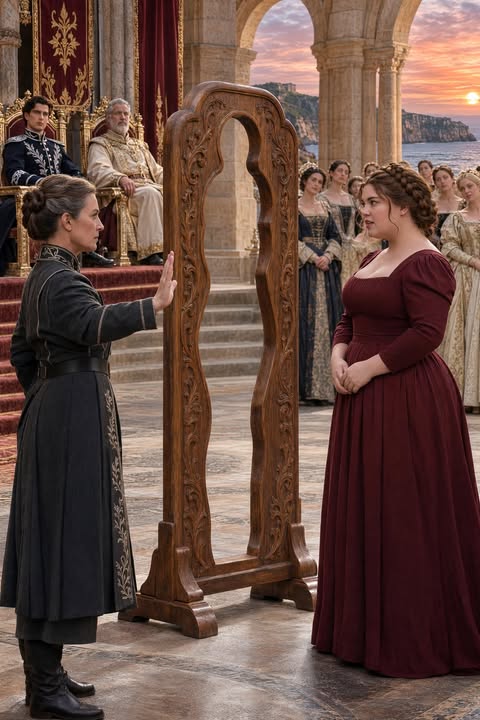
Part 4 – The Maker’s Mark
“Frame to be retained as a test.”
The archivist’s finger rested beside the words, careful not to touch the brittle paper.
For several seconds, the only sound in the library was the rain ticking softly at the windows.
I read the line again, hoping the ink might rearrange itself into something less consequential.
It did not.
“Who wrote the note?” Alexander asked.
“The same hand as the account, I believe,” the archivist said. “The ledger records the workshop payments and the disposition of completed commissions. This was not an ordinary frame.”
King William looked down at the page.
“Do we know what the test was meant to test?”
“No, Your Majesty. The accounts do not say.”
“Then we have found a purpose, but not an explanation.”
The king’s voice was measured, yet his gaze had settled on the words as if he could make them tell him more by force of attention.
Alexander leaned over the ledger.
“Could you find any other reference to the frame?”
“I have searched the workshop accounts and the inventories,” the archivist replied. “There are gaps. Several pages were removed from one volume, and another has suffered water damage.”
“Removed deliberately?”
“I cannot say. The binding was repaired long ago, and the missing leaves may have been lost before that.”
The archivist turned the ledger slightly so I could see the entry more clearly.
Eleanor Carter, American craftswoman, paid for frame construction and fitting.
My fingers curled around the edge of the table.
“Is there any record of what happened to Eleanor?” I asked.
The archivist looked at me with an expression that was kind without being comforting.
“Not yet, Miss Carter. Her name appears in the workshop records for several months. After that, the references stop.”
“Does it say why she left?”
“No.”
The silence that followed felt full of all the questions we could not yet ask.
My mother had said the initials might be hers.
She had warned me not to trust the palace’s version.
Now I knew that a woman named Eleanor Carter had worked here decades ago, and had built the very frame that had brought me into the throne hall.
But the ledger did not tell me whether that woman had been my grandmother, or whether the palace had once held a place in my family’s history that my mother had never chosen to share.
King William closed the ledger gently.
“We should take care not to confuse a name with a person,” he said. “There may have been more than one Eleanor Carter.”
“I know,” I said.
It was the sensible answer.
It was also not enough to steady me.
Alexander watched my face.
“Would you like to see the frame again?”
“I think I would.”
The king glanced toward the archivist.
“Can the ledger be moved?”
“Not safely without a proper support,” the old man replied. “I can bring the relevant records to the conservation room later.”
“Then we’ll take the rubbing and leave the ledger here.”
Alexander did not ask whether I wanted him to accompany me.
He simply waited, giving me the choice to walk beside him or go alone.
I chose to walk with him.
We crossed the palace’s inner corridor in silence, passing windows that looked down on the garden.
The clouds had lowered over the cliffs, and the sea beyond the walls seemed almost the same color as the stone.
At the entrance to the throne hall, two guards stood aside.
The room was empty except for the frame, which had been returned to the pale marks on the floor.
Without the candidates, the officials, and the watching court, it looked smaller than I remembered.
The opening had seemed almost absurdly narrow when I first faced it.
Now it looked like a doorway someone had made with care.
A piece of folded cloth had been placed beneath the stand, protecting the wood from the stone.
The brass plate was visible, though the stand’s foot still covered part of it.
Alexander crouched beside the frame.
“Do you want to look?”
I lowered myself beside him.
Together, we studied the narrow space beneath the foot.
The letters showed clearly in the light.
E.C.
The lower stroke of the E curled inward.
I could see the same little flourish on old birthday cards from my mother, though the resemblance alone could not prove anything.
“Eleanor Carter made this,” I said.
“According to the ledger.”
“And it was kept as a test.”
“Yes.”
“Was it always used in the competition?”
“I don’t know. The court has used it for as long as I can remember, though I never asked where it came from.”
“Neither did anyone else?”
“Not that I know.”
We both looked at the frame.
“Perhaps that was the point,” Alexander said.
“What was?”
“To make us ask.”
I rested my hand on my knee, careful not to touch the wood.
“If Eleanor built it as a test, then she expected people to question the rules around it.”
“Or the person giving the rules.”
“That is not always welcome in a palace.”
“No,” he said. “It isn’t.”
He stayed crouched beside the frame, his posture relaxed in a way it had not been in the throne hall.
“I keep thinking about my mother,” he said after a moment.
I looked at him.
“She’s gone, isn’t she?”
“Several years now.”
“I’m sorry.”
“Thank you.”
He glanced at the old wood.
“She used to say that a tradition was only worth keeping if someone still remembered why it mattered.”
“Did she know about the frame?”
“I don’t know.”
The answer carried more than uncertainty.
It held a kind of grief for the ordinary conversations people never realized they would want back.
“Have you asked your father?” I said.
“I haven’t.”
“Why not?”
“Because he becomes careful when my mother is mentioned.”
“Careful how?”
“He answers, but he chooses each word as if the wrong one might change something.”
I looked at the brass plate.
“Perhaps it already has.”
Alexander’s eyes met mine.
“Yes,” he said. “Perhaps it has.”
The conservator arrived with a padded case and a narrow wooden tool.
He explained that he had found a safe way to lift the foot just enough to expose the full plate, while leaving the frame in place.
King William joined us, followed by the archivist, who carried a thin folder of workshop notes.
We watched as the conservator placed a wedge under the stand.
The brass plate emerged a fraction at a time, its surface dulled by decades of dust.
No one spoke while he worked.
When the foot was raised enough, the full engraving lay exposed.
Beneath the initials, a line of smaller letters had been hidden against the stone.
Eleanor Carter, maker.
My breath caught.
The archivist bent toward the plate.
“That wording is not mentioned in the account.”
“It may have been concealed by the stand’s foot from the beginning,” the conservator said. “The metal has darkened evenly. I see no sign it was uncovered and then hidden again.”
The king’s face had gone pale beneath the lamplight.
“Why would she place her name underneath?”
“Perhaps she did not want it seen,” I said.
“Or perhaps she did not expect it to remain hidden,” Alexander replied.
I thought of the words in my mother’s letter.
Do not trust the palace’s version of this story.
She had not said the frame was hers.
She had not claimed the plate.
She had simply warned me.
“Could the initials have been mistaken for mine?” I asked the conservator.
“It is possible, but the full name makes the matter clearer. This is a maker’s mark, not an inscription added later.”
My mother’s signature had brought me to the question.
The frame had answered with another woman’s name.
Eleanor Carter, maker.
A tremor passed through me, though the room was not cold.
“Miss Carter,” the king said, “your mother may have known nothing about this.”
“I know.”
“Even if the craftswoman was related to her, that would not establish a connection to the current palace or to the competition.”
“I know that, too.”
But knowledge was not the same as feeling.
A family story had appeared in the room without asking whether I was ready to inherit it.
Alexander shifted slightly nearer to me, but did not touch me.
“You don’t have to make sense of it now,” he said.
“I’m trying not to.”
The king looked from Alexander to me, then toward the frame.
“Let us find out what the records can tell us before we make assumptions.”
The conservator lowered the stand back onto the protective cloth.
“Would you like me to take another rubbing of the full inscription?”
“Yes,” Alexander said. “And a photograph for the archive.”
The king nodded.
“Make no changes to the plate. We need to preserve it exactly as it is.”
The conservator gathered his tools.
As he worked, the archivist opened the folder he had brought.
“I found a second entry in the workshop accounts,” he said. “It concerns a payment made after the frame was completed.”
“Does it name Eleanor?” King William asked.
“No. It records payment to the royal household for arranging passage to the coast.”
The king’s expression tightened.
“Whose passage?”
“The page is damaged. The recipient’s name is gone.”
“Does it give a reason?”
“No.”
He turned the paper toward us.
A line had been written in a different ink, perhaps added later.
The words were faint, but still readable.
Departure arranged at the queen’s request.
Alexander straightened.
“My mother?”
“The entry does not say which queen,” the archivist replied. “It refers to the late queen in the index, but the index itself may have been compiled later.”
The king closed his eyes for a brief moment.
“Who was paid for the passage?”
“The name is missing.”
Alexander looked at his father.
“You knew about this?”
“No.”
The king’s reply came quickly, then he softened it.
“I knew no such record existed.”
“That is not the same thing,” Alexander said.
“I understand.”
King William’s face had changed, and not in the way it had when he was defending the palace’s reputation.
There was sorrow in his expression now, and something close to shame.
He looked toward the frame.
“My wife kept many things from me,” he said quietly. “Some were hers to keep.”
Alexander’s voice gentled.
“I’m not accusing you.”
“I know. But I have spent years assuming I understood the shape of her choices.”
The archivist set the paper down.
“Your Majesty, I cannot say this is proof of a connection. The entry could refer to another worker, another journey, another request.”
“Then we will not claim more than it says,” the king replied.
He seemed to be speaking as much to himself as to anyone else.
I understood the feeling.
The facts were small and incomplete.
A craftswoman’s name.
A frame made for the throne hall.
A hidden maker’s mark.
A passage arranged at the late queen’s request.
Together, they suggested a story.
But suggestions could become dangerous when people wanted them to be true.
“I need to write to my mother,” I said.
Alexander glanced at me.
“You should.”
The king nodded.
“Her privacy remains yours to protect. No one will contact her without your consent.”
I was grateful he understood that, but a fresh question had begun to press against the inside of my ribs.
If my mother had known nothing, she could say so.
If she knew something, I wanted to hear it from her, not from a palace record interpreted by people who had inherited only the pieces they could find.
The archivist tucked the workshop page into its folder.
“I will continue examining the accounts. There may be a household diary or correspondence connected to the late queen.”
“Search the private archive,” King William said. “You have my permission.”
The words seemed to startle the archivist.
“That collection has not been reviewed in years.”
“Then it is time.”
Alexander looked at his father, and something unspoken passed between them.
Perhaps it was not agreement.
Perhaps it was the beginning of one.
When the others left the hall, I lingered beside the frame.
The conservator had removed the wedge, and the stand rested again on the pale floor marks.
I leaned down enough to read the inscription one last time.
Eleanor Carter, maker.
The full name felt both close and strange.
My mother had told me about the woman who taught her to sew.
She had never said that woman’s name.
I had never thought to ask.
“Do you believe she was your grandmother?” Alexander asked.
“I don’t know.”
“Would you like to?”
“I would like to know the truth, even if I don’t like it.”
He nodded.
“That sounds like you.”
“Does it?”
“You ask what the rule means before you decide whether to follow it.”
I looked at him.
“And you?”
“I’m trying to learn that the person asking the question may be the one I should trust.”
The answer reached me more deeply than I expected.
For a moment, the empty hall seemed less like the stage on which a competition had gone wrong and more like a room where two people could speak without needing to perform.
Then a footstep sounded behind us.
King William stood at the threshold.
“Alexander,” he said. “The archivist has found something in your mother’s papers.”
Alexander’s expression changed.
“What is it?”
The king held a narrow sheet of paper in his hand.
“An old letter.”
“From whom?”
“We do not know yet. It has no signature.”
He looked at me, then at the frame.
“But it mentions Eleanor Carter by name.”
Alexander crossed the hall.
“Can we read it?”
“Not here,” the king said. “The paper is fragile, and the archivist is preparing it for us.”
“Does it explain why my mother arranged the passage?”
“Not directly.”
“Then what does it say?”
The king’s thumb pressed lightly against the fold in the paper.
“It says Eleanor refused the marriage the court had arranged for her.”
The words moved through the hall like a draft under a door.
I turned toward the frame.
“A marriage?” I asked.
“To whom?” Alexander said.
The king unfolded the letter, though he did not hand it over.
“The passage was arranged so she could leave the kingdom. The writer says the late queen helped her escape the court’s plans.”
Alexander’s face tightened.
“Father, what plans?”
“I don’t know.”
“Was the marriage meant to secure an alliance?”
“The letter does not say.”
“Then we need to read the whole thing.”
“We will,” the king said. “When the archivist has stabilized the paper.”
His restraint was understandable, but I could feel the questions gathering in him.
“Why would Eleanor’s refusal matter to the frame?” I asked.
The king looked at me.
“Perhaps the test was connected to the marriage. Perhaps it was not.”
“Or perhaps the frame was built to make sure the court learned something from what happened to her.”
Alexander’s gaze returned to the inscription.
“What did she want the court to learn?”
I had no answer.
The frame had been built as a test, and now we knew that the woman who made it had once refused to let the court choose her future.
The thought changed the room around us.
It changed the frame from a piece of palace furniture into an argument that had survived its maker.
The king folded the letter again.
“There is one more thing,” he said.
The archivist had discovered a second page attached to the first, written in the late queen’s hand.
Alexander looked at his father.
“What does it say?”
The king hesitated.
Then he read the single line aloud.
“If the frame is ever used again, let it ask whether the candidates will obey a rule that has been changed without their consent.”
**–END OF PART 4–CLICK “NEXT” AT THE BOTTOM OF THE PAGE TO CONTINUE READING**
* * *
[PREVIOUS: PART 3](https://echoesofstories.idolsgift.com/blog/part-3-the-mark-beneath-the-frame-046) | [NEXT: PART 5](https://echoesofstories.idolsgift.com/blog/part-5-the-mark-beneath-the-frame-046)
✓ Lynn R. Adams
Part 4 – The Maker’s Mark “Frame to be retained as a test.” The archivist’s finger rested beside the words, careful not to touch the brittle paper. For several seconds, the only sound in the librar…