PART 4: The Mark Beneath the Crown 057
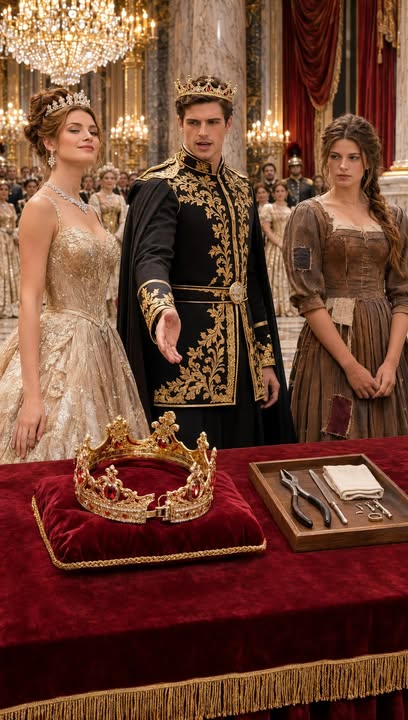
Part 4 – The Name They Left Out
“It is why my family asked your mother to disappear from the story.”
Adrian’s question lingered above the old paper.
Elara read the note once more, though the words had not changed.
Her mother’s name sat at the bottom in a stranger’s hand, while the sentence above it reduced her work to a quiet payment and an instruction to keep silent.
“She never said she had been paid,” Elara murmured.
“Perhaps she did not want you to think her work had been a favor,” Celestine said.
Elara looked up at her.
“Perhaps,” she answered, though the thought did not settle.
Adrian drew the note closer, careful not to crease its brittle edge.
“The record tells us the jeweler supervised the work,” he said. “It does not tell us why Mara was kept out of the public account.”
“Or what she repaired,” Celestine added.
Elara’s gaze moved to the crown beneath its cloth.
The tiny sprig-mark beneath the band no longer seemed merely mysterious.
It seemed like a quiet hand reaching from the past, asking to be recognized.
“I would like to see the rest of the file,” she said.
Adrian glanced toward the chamberlain.
“Is there more?”
“The archive clerk found this attached to the inventory,” the chamberlain replied. “The original work order may have been filed separately.”
“Then please ask the clerk to search the adjacent records as well,” Adrian said. “Not only the royal jeweler’s account, but the household payments and correspondence from that month.”
The chamberlain inclined his head and left.
Celestine took a slow breath.
“I should tell you why I asked the steward to look into the records,” she said.
Adrian turned toward her.
“I was curious,” she continued, “but that is not the whole reason.”
She glanced at Elara.
“When you found the mark, I wondered if you were using your mother’s connection to draw his attention.”
The words stung, though Celestine spoke them without malice.
Elara kept her face still.
“I was not.”
“I know that now.”
“How?”
“Because you have had several chances to claim more than you knew, and you have done the opposite each time.”
Celestine’s eyes lowered to the note.
“I am sorry I thought otherwise.”
Elara considered her.
Celestine had apologized before, for laughing at her in the ballroom.
This apology was less graceful, perhaps because it asked her to admit something more difficult than a careless remark.
“Thank you for saying so,” Elara replied.
It was not forgiveness offered all at once.
But Celestine seemed to understand that.
Adrian placed the note beside the sketch of the maker’s mark.
“We should not decide what this means until we have the full record.”
Elara nodded.
The words steadied her.
She wanted to know the truth about her mother, but she did not want longing to turn every uncertain clue into proof.
The archive clerk returned before noon carrying a narrow bundle of papers tied with faded blue tape.
The bundle had been stored in a box of correspondence belonging to Adrian’s grandmother.
A note on its wrapper said that the papers concerned preparations for the ceremony held more than twenty years earlier.
Adrian dismissed the chamberlain only after confirming that the documents had been handled by the archive staff and that none had been removed from their original order.
Then he untied the tape.
The first papers concerned seating arrangements and the arrival of guests.
Others listed alterations to garments and ceremonial furnishings.
The last two sheets were written in Adrian’s grandmother’s own hand.
He read the first silently, his expression tightening.
“What is it?” Celestine asked.
“A letter to the royal jeweler.”
He passed it to her.
Celestine read carefully, then handed it to Elara.
The letter thanked the jeweler for attending to the crown and asked him to ensure the clasp would remain secure through the ceremony.
It said that the gold was delicate and that the fastening had been made adjustable at the request of the wearer.
There was no mention of Mara.
Elara turned the page over, looking for a note or signature.
Nothing.
“Perhaps the next one says more,” Adrian said.
He unfolded the second sheet.
This was not a letter, but a private memorandum, written in the margin of a household account.
The handwriting was smaller, hurried in places, and less formal.
Adrian’s eyes moved over the lines.
Then he stopped.
“Read it aloud,” Celestine said softly.
He hesitated, then began.
“The clasp was not made to fit my head,” he read. “It was made to fit the crown to me.”
Elara’s breath caught.
Adrian continued.
“Mara saw that the old band would never sit securely and devised a sliding hinge with a hidden fastener. The jeweler agreed to supervise the work, though the design was hers.”
The prince lowered the page.
The room seemed to have gone very still.
Elara looked at the words again.
Her mother had not merely repaired the crown after the ceremony.
She had changed how it fit.
“She made the adjustable clasp,” Elara said.
Adrian nodded, but his gaze remained on the handwriting.
“My grandmother’s note says Mara devised it.”
“The fastener was made to move with the band,” Elara added. “That is why the pin has to sit exactly in its channel.”
“And why forcing it broke the metal,” Celestine said.
No one answered for a moment.
The old crown had seemed like an object fixed in its history, complete and untouchable.
Now it held the hidden shape of Mara’s thought.
A practical idea, made carefully enough to disappear into the goldwork.
Elara felt a warmth rise in her chest, followed by grief so close behind that the two could not be separated.
Her mother had never told her she had made something for the royal household.
She had never said she had altered a crown.
Perhaps she had believed the work did not matter.
Or perhaps she had decided that the silence mattered more.
“Why would the jeweler receive credit for her design?” Celestine asked.
Adrian read the memorandum again.
“The answer may be in the next lines.”
His voice changed as he continued.
“My grandmother wrote that one of the noble patrons had mishandled the crown before the ceremony and bent the original fitting.”
Celestine’s attention sharpened.
“Who?”
“The page does not name them.”
Adrian paused before reading on.
“The jeweler feared the story would become a scandal, and that the crown would be blamed for failing during the procession. Mara offered a solution that would preserve the original band and allow it to be worn safely.”
Elara watched his face.
“Then the royal jeweler was credited because the palace did not want to admit the crown had been mishandled.”
“Perhaps,” Adrian said. “The note suggests the family wanted to protect the ceremony and the noble patron’s reputation.”
“Was the patron protected by hiding Mara’s work?” Celestine asked.
“It appears so.”
Celestine’s mouth tightened.
“Then the silence was meant to preserve more than the jeweler’s credit.”
Adrian did not answer.
He had the look of someone discovering that a family story could be wrong without being entirely false.
The crown had been repaired.
The ceremony had gone ahead.
The official record had preserved the palace’s dignity.
But it had done so by making the person who solved the problem almost invisible.
Elara touched the edge of the memorandum, stopping just short of the paper.
“Did my mother know they would leave her name out?”
Adrian lowered his eyes to the page.
“I do not know.”
The answer was honest, and therefore harder to bear.
Celestine came to stand beside Elara.
“She may have agreed to it,” she said. “Or she may have been told the arrangement was temporary.”
“Either way, the record did not change later,” Elara replied.
“No,” Celestine said. “It did not.”
There was no excuse in her voice.
Only recognition.
The chamberlain returned with a second packet from the archive.
This one contained payment records and a brief receipt bearing Mara’s signature.
The amount was modest, but it was not the kind of payment given for a single patch or simple adjustment.
It was enough to confirm that the work had involved more than a few minutes of repair.
At the bottom of the receipt, Mara had written a note in her own hand.
The clasp should not be closed until the matching fastener is fitted.
Elara stared at the sentence.
The words were plain and practical.
She could almost hear her mother saying them across their kitchen table.
“She wrote that,” Elara whispered.
Adrian’s face softened.
“She wanted whoever handled it next to know what was safe.”
The note brought the past close enough to hurt.
Mara had not been careless with the crown.
She had left instructions.
Someone had preserved them, but not the name of the person who wrote them.
Elara looked at the old payment record.
Her mother had been paid quietly, perhaps fairly for the work, but left out of the public account.
The fact that she had received money did not make the omission harmless.
Nor did the omission erase the possibility that Mara had chosen not to seek recognition.
“She never told me,” Elara said.
“Perhaps she thought it would not help you,” Adrian replied.
“Or perhaps she did not want me to build my life around something she had done.”
Elara’s fingers closed around the cloth in her apron pocket.
Her mother had taught her to mend without making a display of it.
She had said that a strong repair did not need to announce itself.
But there was a difference between humility and being denied a name.
Adrian seemed to follow the same thought.
“I am sorry,” he said.
Elara turned to him.
“You did not make the record.”
“No, but it belongs to my family.”
“That is not the same as saying you caused it.”
“It is still mine to answer for.”
The words carried weight, but not self-pity.
Elara believed him.
Master Orin arrived later that afternoon to examine the memorandum and confirm that its description matched the crown’s construction.
He listened while Adrian explained what they had found.
Then he inspected the clasp with the small lens.
“The design is consistent with the note,” he said. “This sliding joint is unusual, but very sensible. It allows the band to adjust without forcing the gold.”
“Could Mara have shaped the fastener herself?” Adrian asked.
“She could have, if she had the tools and experience. The work is delicate, but not beyond a skilled craftsperson.”
“Would the maker’s mark be hers?”
“Possibly. We would need to compare it with a registered mark or another surviving piece.”
Elara glanced at the sprig sketched on the page.
“My mother stitched that same shape into her cloth.”
Master Orin looked at the drawing.
“It may have been her personal mark, adapted from a stamp she used in her work. But resemblance alone is not proof.”
“I understand.”
The goldsmith studied her for a moment.
“You have been careful with every conclusion.”
“I was taught to look before deciding.”
“Then you were well taught.”
He turned back to Adrian.
“The original fastener is missing, and the remaining metal is too fragile to close without a replacement. I can fashion one from gold, but I will need to know how much original material you are willing to use.”
“The crown should be restored as closely as possible to its intended design,” Adrian said.
“Then a small amount of the original gold may need to be reshaped.”
Adrian looked toward Elara.
She did not answer for him.
The work belonged to the crown’s owner and the royal household, not to her alone.
Master Orin packed his lens away.
“There is no need to decide today,” he said. “We should first confirm the measurements and inspect the original fastener, if it can be found.”
After he left, Adrian read the memorandum once more.
“What is your family’s account of this ceremony?” Celestine asked.
“The account says the crown was inspected and adjusted by the royal jeweler.”
“And the noble patron?”
“No name.”
“Perhaps that omission was meant to protect them.”
Adrian folded the page.
“It may have been.”
Celestine looked toward Elara.
“Would your mother have wanted her name restored to the record?”
“I cannot answer for her.”
“Would you?”
Elara sat with the question.
A part of her wanted the answer to be immediate.
Her mother had made the clasp; her work had been credited to a royal workshop; her name had been omitted from the public account.
Surely it should be corrected.
But Elara also knew what it meant to have someone else decide what a person ought to want.
“My mother’s work should not be called someone else’s,” she said at last. “Beyond that, I would need to know what she wanted.”
Adrian nodded.
“That is fair.”
“If she chose silence, it should not be rewritten as cowardice,” Elara continued. “And if she was pressured into it, the truth should not be softened just to make the palace comfortable.”
Celestine absorbed the words.
“And if we cannot learn which it was?”
“Then we should say what we know, and admit what we do not.”
Adrian looked down at his grandmother’s memorandum.
The truth had become clearer, but it had not become simple.
The old record showed that Mara devised the adjustable clasp and repaired it after the ceremony.
It showed that her name was kept from the public account.
It did not reveal whether she had consented, whether she had objected, or whether she had believed the work would be remembered in private.
Later, the three of them returned to the library table.
A second letter from Adrian’s grandmother had been found folded inside the cover of the memorandum book.
It was addressed to the royal jeweler and dated several weeks after the ceremony.
Adrian opened it carefully.
The letter praised the jeweler’s skill and thanked him for keeping the clasp secure.
Near the bottom, in a line written more lightly than the rest, his grandmother added, “Mara’s solution has served me well, and I hope she knows how grateful I remain.”
Elara closed her eyes.
That line sounded like the note in the wooden box.
You saved what others thought beyond repair.
Her mother had been thanked, at least in private.
But gratitude had not been enough to place her name beside the work.
Adrian set the letter down.
“My grandmother was grateful,” he said. “She also allowed the public account to remain incomplete.”
“Yes,” Elara replied.
The answer was not a judgment, but it was not a pardon either.
Celestine stood at the far side of the table, looking at the two letters.
“Perhaps she thought secrecy protected Mara,” she said.
“Perhaps it protected the household,” Adrian answered.
“Both can be true.”
“They can.”
Elara watched the lamplight move across the written words.
Her mother had taken a damaged clasp and made it adjustable.
She had left instructions for anyone who came after her.
She had kept a thank-you note, but not the story behind it.
The pieces of Mara’s life were becoming visible one by one, and each revealed another place where silence had been mistaken for an answer.
Adrian closed the folder.
“We will preserve these documents together,” he said. “No more separating the note from the work order.”
“And the public record?” Celestine asked.
“I have not decided what to do about it.”
His honesty surprised Elara more than a promise would have.
A decision made too quickly might turn her mother into a symbol before anyone had asked what she truly wanted.
Still, the old account could not remain untouched simply because changing it would be uncomfortable.
Elara left the library when Mrs. Vale sent word that her hour was over.
As she walked through the palace passage, she kept thinking of the memorandum.
The clasp had been designed to move, but only within its channel.
Perhaps people were like that too: shaped by what they had inherited, but not meant to be forced into a single position.
That evening, she was called back to the royal library.
The chamberlain explained that another document had been located among the private correspondence, and Adrian wanted her to see it before it was added to the archive.
When she arrived, the prince stood alone beside the desk.
The wooden box containing his grandmother’s sewing things was open.
Beside it lay a small envelope, yellowed at the edges.
“I found it inside the lining of the box,” Adrian said. “The archive clerk had not seen it before.”
Elara looked at the handwriting on the front.
It was not her mother’s.
The envelope was addressed simply: For Mara, after the crown is returned.
Adrian did not open it.
“It may be personal,” he said. “I thought you should decide whether to read it.”
Elara’s throat tightened.
“She kept it all this time?”
“We do not know who placed it in the box, or when.”
Elara looked at the envelope, then at the old cloth beside it.
The three-leaf mark was visible in its corner.
Her mother had left the palace, built a life beyond its walls, and never told her daughter the crown had passed through her hands.
Yet somewhere in the royal household, someone had saved a letter addressed to Mara and hidden it with the tools she had used.
“Was it from your grandmother?” Elara asked.
“The handwriting may be hers. I cannot be certain from the outside.”
He offered the envelope, but did not press it into her hand.
Elara took it.
The paper was light and delicate, and its sealed edge had not yet been broken.
For a moment, she considered putting it back.
Whatever was inside might explain why Mara had kept quiet.
It might also reveal that she had never wanted her name restored.
The truth would not be less complicated for being written down.
Elara slipped a finger beneath the seal.
The paper opened with a soft sound.
Only one sheet lay inside, folded twice.
She unfolded it.
At the top, the message read:
“Mara, if they insist on crediting the workshop, let them—but do not let them tell you the crown was yours to claim.”
Below it, the page continued in a different hand, one Elara recognized from the palace register.
And the next line began, “The person who mishandled it was…”
**–END OF PART 4–CLICK “NEXT” AT THE BOTTOM OF THE PAGE TO CONTINUE READING**
* * *
[PREVIOUS: PART 3](https://storyly.idolsgift.com/blog/part-3-the-mark-beneath-the-crown-057) | [NEXT: PART 5](https://storyly.idolsgift.com/blog/part-5-the-mark-beneath-the-crown-057)
✓ Lynn R. Adams
Part 4 – The Name They Left Out “It is why my family asked your mother to disappear from the story.” Adrian’s question lingered above the old paper. Elara read the note once more, though the words …