PART 4: The Mark Beneath the Chair 057
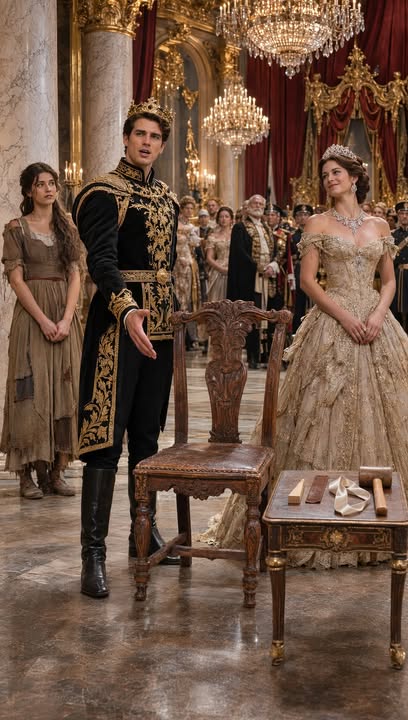
Part 4 – The Warning in the Archive
Inside the sunlight, its maker’s mark was half concealed beneath a dark patch of wood.
Mara could not take her eyes from it.
The torn edge of Eveline’s ledger seemed to hold the rest of the story just beyond reach, like a door left open only a finger’s width.
“May we see the original?” Julian asked.
Eveline closed the book carefully.
“I will write to my mother today,” she said. “She can send it with someone she trusts.”
The archivist gathered his notes.
“I will search the old household office files for Elias Hart’s report,” he said. “If he submitted one, it may have been filed under the floor inspection rather than the chair.”
Julian nodded.
“Look for both.”
The archivist departed with the royal ledger tucked beneath his arm.
Eveline remained at the desk, one hand resting on her family’s copy.
“My grandfather wrote that the floor required further review,” she said. “I never knew.”
“Neither did I,” Julian replied.
Mara looked from one to the other.
“Perhaps he was trying to make sure the room was safe.”
Eveline’s mouth tightened as she considered the words.
“Perhaps. But someone deferred the review.”
“That does not tell us why,” Julian said.
“No,” Eveline answered. “It does not.”
The caution in her voice was not the uncertainty of someone unwilling to know.
It was the care of someone who understood that a family’s good intentions could still leave harm behind.
Mara felt the same caution in herself.
Her father’s name was approaching them through ledgers and half-hidden marks, but she could not yet see what it would ask of her.
Julian turned toward the chair.
“We should wait for the original record before drawing conclusions.”
Mara nodded.
The three of them left the music room without another answer.
That afternoon, the building steward began inspecting the west ballroom floor.
He brought two assistants, a level, and a narrow measuring rod, and asked Mara to show them where she had first noticed the scrape.
She led them to the chair’s former place.
The floor dipped there, just as she had seen the previous day.
The steward checked several points across the marble, then marked them on a plan of the room.
“There are other low places,” he said, frowning at the measurements. “They are subtle, but they should have been corrected before the room was put into regular use.”
“Can they be repaired?” Julian asked.
“Yes, Your Highness. It will take time, but there is no reason it cannot be done properly.”
“Then we will have it done properly.”
The steward glanced toward the chair.
“Was this the piece that drew your attention to the floor?”
“It was,” Mara said.
He ran his fingers lightly above the scrape without touching it.
“Furniture often tells us where a building is failing,” he said. “Though it seems we have been asking the chair to explain itself for a long time.”
Mara thought of her father’s old lessons.
A chair could be sound and still seem faulty if the ground beneath it was wrong.
She wondered how many people had heard that warning and decided the chair was easier to blame.
The steward promised to send a report to Julian before the end of the week.
Mara returned to her duties with a restless feeling she could not set aside.
At supper, she told Thomas and Nell that the ballroom floor was uneven in more than one place.
Thomas tapped the table with a spoon.
“So Father was right?”
“We do not know what he said yet,” Mara replied. “Only that someone wrote the floor needed another inspection.”
Nell set down her sewing.
“Could that be why he lost his position?”
“It might be connected.”
The room grew quiet.
Their father’s departure from the palace had never been explained in a way that satisfied them.
Some people said his work had failed.
Others said there had been a complaint after a royal gathering.
Mara had been young enough to remember the change in their home, but not old enough to understand the details.
She remembered her father coming back one evening with his tools wrapped in a cloth.
She remembered him setting the measuring gauge on the table and looking at it for a long time before saying that good work deserved a fair hearing.
At the time, she had thought he was speaking about a chair.
Now she wondered.
“Do you want to know what happened?” Thomas asked.
Mara looked at her brother’s earnest face.
“I have wanted to know for years.”
“Then keep looking,” Nell said.
Mara reached for their father’s gauge, which lay beside her cup.
Its initials caught the candlelight.
“I will.”
The following morning, a palace page brought Mara word that the archivist had found a box of old household papers.
Julian had asked her and Eveline to join him in the archive.
The archive occupied a quiet wing below the palace’s east gallery, where narrow windows admitted pale bars of daylight and the air smelled of leather, paper, and dust.
Rows of shelves rose nearly to the ceiling.
At the center stood a long table, already cleared for the papers the archivist had brought.
Eveline arrived with a folded letter in her hand.
“My mother has sent the original ledger,” she said. “It should arrive tomorrow.”
“Did she say anything about the torn page?” Julian asked.
“She said the book was in poor condition when it came into her care, but she never noticed the missing lines.”
Eveline set the letter aside.
“She has also promised to search the family papers for any correspondence with the palace workshop.”
Mara looked at the open archive box.
“What did you find?”
The archivist adjusted his spectacles.
“Several records from the household office, a contractor’s account, and a report about the west ballroom floor.”
He unfolded a document, weighing its corners with small brass paperweights.
“The report is dated shortly before the chair was delivered.”
Julian moved to the table.
“Who wrote it?”
“The inspection was conducted by two palace workers. One signed his name, and the other is listed as Elias Hart.”
Mara’s hands went still.
The archivist read from the page.
“‘The west ballroom floor varies in level across the central span. The difference is small but sufficient to unsettle furniture placed near the south doors.’”
Eveline leaned over the table.
“Does it recommend repairs?”
“It does.”
The archivist traced the next lines without touching the paper.
“‘Before public use, the lower boards should be raised and fixed. Should repairs be delayed, the room should be marked unsuitable for seating until the work is complete.’”
Julian’s face hardened with concentration, not anger.
“And the report was received?”
“There is a stamp showing it entered the household office.”
“Was it acted upon?”
The archivist turned the page.
“The following note says, ‘Inspection acknowledged; repairs to be scheduled after the royal gathering.’”
Mara felt the words settle in her chest.
The floor had not merely been uneven.
Her father had noticed it and asked for repairs before people gathered in the room.
“Who wrote that note?” Eveline asked.
The archivist examined the faded signature.
“It appears to be the office secretary’s hand, but the approval mark belongs to Lord Aveline.”
Eveline drew a slow breath.
“My grandfather.”
The archivist nodded.
“According to this record, yes.”
Eveline did not look away.
“Does it say he refused the repairs?”
“No. It says they were postponed.”
Julian studied the page.
“Was there a reason?”
“Not on this sheet.”
The archivist set it aside and opened another record.
“This is an account from the workshop.”
It listed the cost of timber, pegs, and labor for a demonstration frame built by Elias Hart.
A second entry described a carved chair delivered to Lord Aveline’s household, then transferred to the palace.
The date matched the family inventory.
Mara recognized the small notation beside it.
“‘To demonstrate movement on uneven flooring,’” she read aloud.
The archivist looked up.
“That is what it says.”
The room seemed to narrow around the words.
Julian glanced from the paper to the chair sketched in the margin.
“Your father built it to show the court what the floor was doing.”
“And how a sound chair would behave on it,” Mara said.
Eveline read the notation again.
“Then the chair was never an ordinary purchase.”
“It was furniture,” Mara replied. “But it was also evidence.”
The words felt strange in her mouth.
She had thought of the chair as an old palace furnishing, something misplaced and forgotten.
Now she understood that it had been built to make a point people might otherwise ignore.
The archivist continued.
“I found another entry connected to the gathering.”
He opened a thin report, its lower corner creased.
“‘Mr. Hart requested that the chair be placed on the ballroom floor during inspection, to demonstrate the effect of the low boards.’”
Mara leaned toward the page.
“Was the request approved?”
The archivist searched the margin.
“There is no approval mark.”
Eveline’s face had gone pale.
“Was the chair kept in my grandfather’s household?”
“Only briefly,” the archivist said. “A delivery receipt shows that it was passed to the palace workshop for inspection, then placed in the ballroom.”
Julian rested both hands on the table.
“Did the inspection happen?”
The archivist unfolded a final sheet.
“This record describes a gathering in the west ballroom. There is mention of a chair shifting when someone sat, though no injury is reported.”
Mara’s heart began to beat faster.
“What happened afterward?”
The archivist’s gaze moved down the page.
“Here it says that the chair was judged defective.”
“By whom?” Julian asked.
“The household office. The note says the maker was responsible for the unstable construction.”
Mara looked at the report.
Her father had warned the court about the floor.
The chair had rocked because of the floor.
Then the court had blamed him for building an unstable chair.
The pieces fit together so clearly that she felt, for a moment, as if the room itself had tilted.
“That cannot be the whole account,” Eveline said.
The archivist looked at her.
“No. It is only one document.”
“Was the floor repaired?”
“I found no record that it was.”
Julian’s gaze lowered to the table.
“Was the chair examined after the gathering?”
“There is a repair note from several years later. It describes the rear support as loose and the chair as unsafe.”
Mara thought of the ribbon slipping around the support in the ballroom.
“The support was loose,” she said. “But it was not why the chair rocked.”
“The record does not mention the floor,” the archivist said.
Eveline pressed her palms against the edge of the table.
“My grandfather had already written that the floor needed review.”
“Yes,” Julian said.
“And the repair was deferred.”
“Yes.”
She closed her eyes briefly.
“I do not know whether he understood what might happen if it was delayed.”
“Neither do we,” Julian replied. “We should not decide that without the rest of the record.”
Mara admired him for saying it.
The evidence was beginning to tell a painful story, but he did not turn it into a judgment before they had found all its pages.
The archivist set the documents in date order.
“There are gaps,” he said. “A letter may explain more. I will keep searching.”
“What happened to my father after the gathering?” Mara asked.
The archivist glanced through the papers.
“There is a note stating that Elias Hart was removed from the workshop schedule pending review.”
Mara’s throat tightened.
“Was he dismissed?”
“An employment register marks him as released from palace service later that season.”
For a moment, no one spoke.
Julian’s expression had changed.
The prince who had once stood beneath the chandeliers and announced a contest now seemed to be looking at the room from another place entirely.
“They blamed him for the chair,” he said.
“That is what this record shows,” the archivist replied.
“But they never repaired the floor.”
The archivist turned over another page.
“I cannot find a completion report.”
Eveline’s eyes had filled with tears, though none fell.
“My grandfather supported him,” she said, looking at the account. “The note in his hand asks for the floor to be reviewed.”
“That is true,” Mara said.
“But he also approved the delay.”
Eveline’s voice was small.
“We do not yet know what he was told, or what choices he had.”
“No,” Mara said. “We do not.”
Eveline gave her a grateful look.
Mara knew how much it mattered not to reduce a person to the worst line in a ledger.
The same care should be offered to her father.
For years, people had described him with one word: careless.
Yet the records now showed that he had noticed the danger before the gathering, had built a demonstration chair to make the problem visible, and had asked for repairs.
The truth did not make the past simple.
It made the old judgment harder to bear.
Julian walked to the narrow window.
Beyond it, the palace grounds were green with early spring growth, and gardeners moved between the hedges with baskets of cuttings.
“When I announced the competition, I thought I was asking the women here to solve a practical problem,” he said.
He turned back toward them.
“I did not know that the chair itself had once been used to show the court that it was asking the wrong question.”
Mara stood beside the table.
“Sometimes the wrong question is easier to answer.”
Julian looked at her.
“And easier to judge.”
The words made Eveline lower her gaze.
“I am sorry,” she said. “For laughing at you, and for treating the chair as if the answer were obvious.”
“You apologized already,” Mara said.
“I know. But I understand more now.”
She paused.
“You were not just noticing a scrape. You were doing what your father had taught you to do, while everyone else trusted the record that had blamed him.”
Mara felt something open inside her, tender and painful.
Until that moment, she had thought she was trying to discover whether the chair belonged to her father.
Now she was beginning to understand that the more important question was whether the palace had ever listened to him.
The archivist searched through the remaining papers, then stopped at a folded letter tucked inside a thin cover.
“This was filed with the workshop correspondence,” he said. “It has no date on the outer fold, but the seal suggests it belongs to the same period.”
Julian returned to the table.
“Can you tell who wrote it?”
The archivist opened the letter carefully.
The paper crackled faintly as it unfolded.
The first line was in a familiar, neat hand.
“Your Highness,” the archivist read, “I submit this note in support of Elias Hart’s warning concerning the west ballroom floor.”
Eveline leaned closer.
“My grandfather wrote it.”
The archivist continued.
“‘The chair he has constructed is sound in its workmanship. Its movement is caused by the uneven boards, not by a failure of the frame. I have examined the joints myself and found them properly made.’”
Mara’s breath caught.
The letter went on.
“‘I asked that the floor be repaired before the royal gathering. The request was postponed, and the subsequent incident should not be laid at the carpenter’s feet.’”
The room was utterly still.
Eveline pressed one hand to her mouth.
“My grandfather knew.”
“He knew the chair was sound,” Julian said.
“He defended Elias,” Mara whispered.
The archivist read the signature at the bottom.
“Lord Aveline.”
Eveline reached for the chair’s back, then stopped before touching it.
“My family record says the maker was never entered,” she said. “But my grandfather knew who made it.”
“And he wrote this,” Julian replied.
The letter did not erase the years in which Mara’s father had been blamed.
It did not restore his position or return the time their family had spent struggling after his dismissal.
But it gave his silence a different shape.
He had not simply watched the palace forget him.
At least one person in the court had written down what he had done right.
“Where was this letter kept?” Julian asked.
“In the household office files,” the archivist replied. “It seems it was never placed with the chair’s official record.”
“Was it sent to anyone?”
“There is no recipient’s name, and no sign that it left the office.”
Eveline stared at the sheet.
“Perhaps my grandfather intended it to be sent.”
“Perhaps,” Julian said. “We still need to learn why it remained here.”
Mara looked at the lines of ink, each one steady and deliberate.
Her father had been cleared in a letter that no one had shown him.
The court had possessed the truth, but it had not reached the man who needed it.
Julian’s voice was quiet.
“We will continue until we find the rest of the record.”
The archivist placed the letter beside the report about the floor.
“Here is another entry from the day after the gathering,” he said. “It concerns the chair’s inspection.”
Eveline leaned toward it.
The short note had been written in the same office hand that recorded the chair as defective.
It read: “Mr. Hart’s warning acknowledged by Lord Aveline; maker’s mark to be removed during repair, pending settlement of responsibility.”
Mara froze.
“What does that mean?” Thomas might have asked.
Mara read the line again, willing it to become clearer.
The archivist turned the page over.
On the reverse was a cramped addition, written in a second hand.
“Chair retained as demonstration piece; record to be amended when the matter is resolved.”
Julian’s face had gone very still.
“The mark was removed because someone expected the matter to be resolved,” he said.
“Or because they wanted the maker’s name out of sight until it was,” Eveline replied.
Neither explanation comforted Mara.
She looked at the hidden patch beneath the chair’s seat.
The mark had not been covered by accident.
Someone had deliberately concealed her father’s initials, while the same records acknowledged that his warning had been right.
“Who ordered the mark removed?” Julian asked.
The archivist studied the entry.
“The note does not say. It is in the household office hand, but the instruction may have come from someone else.”
“Can you identify the second hand?”
“I will compare it with the other files.”
Eveline drew in a careful breath.
“My grandfather defended him, but the chair was still marked as defective, and the maker’s name was hidden.”
“We do not know who made that decision,” Julian said.
“No,” Eveline replied. “But we know that the truth did not correct the record.”
Mara thought of her father coming home with his tools wrapped in cloth.
She imagined him believing that no one had listened, while a letter in the palace archive said otherwise.
It was not the kind of discovery that brought relief.
It was a new grief, sharper because it came with proof.
Julian asked the archivist to copy the relevant documents and seal the originals for careful review.
Then he turned to Mara and Eveline.
“I will not make any announcement until we understand the record as a whole.”
Eveline nodded.
“I agree.”
Mara looked at the letter bearing Eveline’s grandfather’s signature.
For a moment, she could only think of the long silence that followed it.
Then she saw something else beneath the signature, a small line written so faintly that the archivist had not read it aloud.
She leaned closer.
“What does this say?”
The archivist took up his magnifying lens.
The words emerged slowly beneath the glass.
“‘A copy delivered to Elias Hart at his home.’”
Mara gripped the edge of the table.
Her father had received a copy.
The letter had not been hidden from him after all.
Julian’s gaze shifted to the archivist.
“Is there a receipt?”
The archivist searched the folded paper and found a small slip attached at the back.
It bore a date and the initials E. H.
Mara recognized her father’s careful hand.
Beneath the initials, he had written a single sentence.
“Received, with thanks. I ask only that the floor be made safe before anyone else is blamed.”
**–END OF PART 4–CLICK “NEXT” AT THE BOTTOM OF THE PAGE TO CONTINUE READING**
* * *
[PREVIOUS: PART 3](https://storyly.idolsgift.com/blog/part-3-the-mark-beneath-the-chair-057) | [NEXT: PART 5](https://storyly.idolsgift.com/blog/part-5-the-mark-beneath-the-chair-057)
✓ Lynn R. Adams
Part 4 – The Warning in the Archive Inside the sunlight, its maker’s mark was half concealed beneath a dark patch of wood. Mara could not take her eyes from it. The torn edge of Eveline’s ledger se…