PART 4: The Mark Beneath the Carpet 046
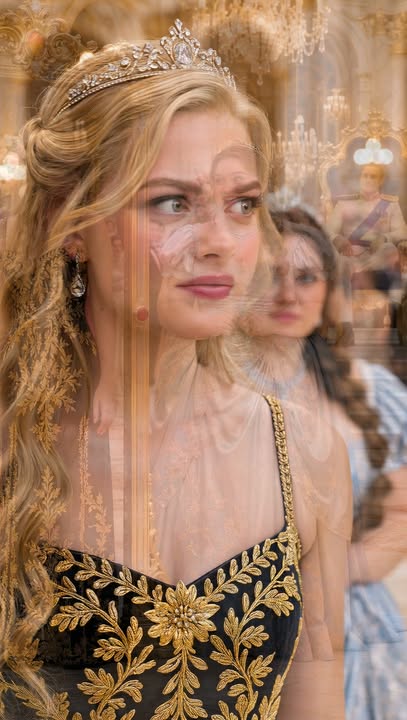
Part 4 – The Measure of a Life
The words on the drawing seemed to shift beneath my gaze, though I knew they had not changed.
The frame is not to measure the body, but the space the body requires.
My great-grandmother had written them with care, as if she wanted the sentence to survive whoever might later try to erase it.
Beside her name, a different hand had added an instruction to fix the measurements before the next royal selection.
I felt Adrian grow still beside me.
“Could that note have been written after the frame was made?” he asked.
Mr. Bell, who had followed us from the archive, bent toward the page without touching it.
“The ink appears consistent with the date recorded below,” he said. “Though I would not claim certainty without a specialist.”
“And that date,” I said, “was the year my grandmother repaired the frame.”
The attendant who had delivered the parcel shifted his weight.
“Should I return this to the records office, Your Highness?”
“Not yet,” Adrian replied. “Please ask Mr. Bell to make a secure copy and record precisely where the drawing was found.”
The attendant bowed and withdrew.
I kept my eyes on the little bird mark.
My grandmother used to sketch it on the corner of scraps of paper when she was explaining how a hinge should move, or why a chair needed room to flex beneath someone’s weight.
She had never told me that the mark belonged to her mother.
She had never told me that her mother had built the frame.
“She must have been afraid the drawing would disappear,” I said.
“Perhaps,” Adrian answered. “Or perhaps she believed keeping it safe was the best thing she could do.”
I glanced at the note again.
The measurements are to be fixed before the next royal selection.
“Safe for whom?” I asked.
Adrian did not pretend to have an answer.
Vanessa came back into the gallery, her notebook tucked beneath one arm.
“I was told the archive found another document,” she said, then noticed the drawing spread across the table. “Is this the original?”
“It appears to be an early plan,” Mr. Bell said. “We are still verifying its provenance.”
Vanessa read the inscription.
Her expression changed as she reached the sentence about the space a body requires.
“So it was never meant to judge anyone’s proportions.”
“It seems it was meant to help people make room,” I said.
She glanced toward the ballroom, where the frame stood under a protective cloth.
“Then what did the indicators record?”
“That is what we need to find out.”
Mr. Bell examined the drawing’s margins.
“There are notations here,” he said. “Some refer to garments and household furnishings. The frame appears to have been designed as an adjustable guide.”
“For what kind of work?” Vanessa asked.
“Tailoring, fitting, perhaps arranging ceremonial robes or checking the clearance of a chair or screen.” He followed a pencil line with his eyes. “The width could be altered to suit the task. The indicators seem to have recorded contact with the outer edge of the material being measured, not contact with a person.”
I thought of Vanessa’s skirt brushing the bar and the red signal that had declared her a failure.
It had not measured her.
It had measured a moment of contact and allowed the court to give that moment a meaning it had never been designed to carry.
“Who changed it?” I asked.
Mr. Bell studied the darker note.
“We cannot tell from this sheet alone.”
Adrian looked toward the far end of the gallery.
“The frame’s original plans were removed from the collection, and later records describe it as a test of ideal proportions. Someone changed its purpose and then let the new meaning become tradition.”
“Maybe it happened gradually,” Vanessa said.
“Maybe,” I replied. “But that instruction to fix the measurements suggests someone made a decision.”
The thought settled heavily between us.
I wondered what my grandmother had understood when she repaired the base.
Had she found the drawing then?
Had she known her mother’s work had been turned into something else?
And if she had, why had she never told me plainly?
My grandmother had taught me to pay attention to hidden adjustments and false measurements.
She had left me a sketch and a warning.
But she had never given me the whole story.
“Could we examine the frame’s original plans?” Adrian asked the clerk. “Not the catalogue entries. The plans themselves, if any remain.”
Mr. Bell’s expression tightened with professional regret.
“The archive has no complete set.”
“Then we look for the supporting documents.”
“There are references to them in several registers,” the clerk said. “One says household furnishing plans. Another says ceremonial equipment. The records have been separated over time.”
“Can they be brought together?”
“With time.”
Adrian looked at the drawing.
“How much time?”
“I cannot promise a day or an hour, Your Highness.”
“I’m not asking you to promise what you cannot control.”
His answer softened Mr. Bell’s face.
“I will begin at once.”
The clerk carried the drawing to a table where the light was better, and Vanessa followed to help compare its marks with the entries in her notebook.
Adrian and I remained by the gallery window.
Outside, the palace gardens lay beneath a thin veil of morning mist.
The hedges were clipped into careful shapes, their edges straight enough to seem drawn with a ruler.
“When I asked the candidates to come here,” Adrian said, “I thought I was opening the court to people who had been overlooked.”
“You did invite people from different backgrounds.”
“I did not ask whether the ceremony itself was built to overlook them.”
“You didn’t know.”
“I should have wanted to know.”
I leaned against the stone sill.
“That is a different kind of mistake from pretending nothing is wrong.”
He turned toward me.
“Does that make it easier to forgive?”
“I’m not sure anyone has asked me to forgive anything yet.”
A small, rueful smile touched his face.
“No,” he said. “They haven’t.”
We watched the mist lift from the garden.
I had imagined the prince as a distant figure, someone who could speak about fairness because other people carried the cost of changing things.
Yet he had not defended the test when its foundation began to crack.
He had not called the frame harmless or dismissed my grandmother’s drawing as a family story.
Still, his willingness to listen could not undo what had happened to Vanessa, or what the court had made the frame mean for generations.
“Why are you searching for a bride through a public test at all?” I asked.
His gaze remained on the garden.
“Because the court expected a selection.”
“And you accepted that expectation.”
“I did.”
“Why?”
He took a quiet breath before answering.
“My parents married through a formal arrangement. It was not an unhappy marriage, but everyone around them treated it as proof that families and duty were the same thing as affection.”
“Were they?”
“Sometimes. Not always.” He looked down at his hands. “When I was young, I thought I would avoid the mistakes they made by choosing someone myself. Then I found that the court had already written a list of acceptable ways to choose.”
“And the frame was on it.”
“Yes.”
There was no self-pity in his voice, only recognition.
“I thought a ceremony could be harmless if I did not believe its outcome was absolute,” he continued. “I see now that a symbol can still do damage even when the person using it doubts its power.”
I thought of the red light, bright and decisive above Vanessa’s shoulder.
“It did not feel harmless when everyone laughed.”
“No,” he said. “It did not.”
Across the room, the old drawing caught the morning light.
For a moment, the pencil lines seemed almost as dark as fresh ink.
Then a servant entered with a note for the prince.
Adrian read it once, then passed it to me.
The palace steward had found a reference to a storage room beneath the old workrooms, where unused furniture plans and retired tools had been kept after a renovation.
“Could there be more documents there?” I asked.
“There could be,” he said. “The steward is arranging access.”
“Can I come with you?”
“Of course.”
Vanessa looked up from her notebook.
“I’d like to come too, if I may.”
Adrian nodded.
“We should all see what is there.”
The old workrooms were in a quieter wing of the palace, far from the grand entrance halls and the ballroom.
Their narrow windows let in pale strips of daylight, and the walls still held faint marks where benches and cabinets had once stood.
The storage room was reached through a low door concealed behind a panel of carved oak.
A household keeper unlocked it for us, then stepped aside as we entered.
Dust rose in a soft cloud from the stone floor.
The room smelled of cedar, old paper, and metal tools that had been left unused for years.
Shelves ran along both walls, crowded with rolled diagrams, wooden patterns, and boxes whose labels had faded nearly to nothing.
The keeper lit two lamps.
“Anything here would have been placed in storage during the east wing renovation,” he explained. “The room was catalogued, but some of the older materials were never fully sorted.”
Adrian thanked him, and the keeper left the door open while he waited in the corridor.
We began with the nearest shelf.
Vanessa checked the labels against the dates in her notebook.
Mr. Bell was not with us; the archive had asked him to remain with the drawing while its copy was made.
In his place, an assistant archivist named Elin helped us identify which boxes might contain furnishing records.
I moved carefully between the shelves, reading each label.
The work felt familiar in a way I could not explain.
My father’s workshop had been crowded with drawers full of screws, hinges, and pieces of wood that might one day fit something else.
The palace room was grander, but the principle was the same: nothing was useless simply because its purpose had been forgotten.
“Here,” Vanessa called from the far shelf.
She had found a slim ledger wrapped in cloth.
Its cover bore the words Fittings and Measurements, though the year was difficult to read.
Elin placed it on a clear worktable.
The pages inside were filled with sketches of coats, chairs, screens, and ceremonial garments.
Several drawings showed the golden frame from different angles.
The opening had been marked with measurements that varied from page to page.
“Adjustable,” I said.
“Designed for different uses,” Elin replied. “Look at the notes beside the markings.”
A line in faded ink read: To be widened or narrowed according to the work and the wearer’s needs.
The phrase held me still.
The wearer’s needs.
Not the court’s preferences.
Not an ideal measurement.
A person’s needs.
Vanessa leaned close to the page.
“The indicators are drawn on the outside,” she said.
“Just as they were in the other sketch,” Adrian replied.
Elin turned another page.
There was a diagram of a ceremonial robe suspended from a frame.
A tailor stood beside it, using the adjustable bars to check that the garment hung without snagging.
A note beside the diagram read: Contact indicates allowance required, not a defect.
My chest tightened.
The device’s signal had not been designed to declare a person unworthy.
It had been designed to tell a craftsperson that more room was needed.
“It was a tool for making things fit,” Vanessa said quietly.
“And they turned it into a test of whether people fit the court,” I replied.
Adrian’s eyes remained on the page.
“How can such a change go unnoticed?”
“It may not have gone unnoticed,” Elin said, then seemed to regret speaking until Adrian turned toward her.
“Do you know something?”
“Only that the ledger contains several notes about the frame being ‘standardized’ for ceremonial use. I assumed the court wanted consistent readings.”
“Consistent readings of what?” Vanessa asked.
Elin looked at the diagram again.
“Perhaps that is the question.”
I studied the ledger’s handwriting.
The earliest entries were neat and open, with long curves in the letters.
Later notes were tighter, written in darker ink and crowded into the margins.
One phrase appeared repeatedly: ideal passage.
It was not on the original diagrams.
It had been added in the spaces between them.
The oldest drawing in the ledger showed the frame with its brass wheel clearly visible.
A small instruction beside it explained that each column could be adjusted independently to account for uneven floors, different garment widths, or the natural variation of the body.
“Look here,” I said.
The note continued in a smaller hand.
The base must remain free to move; lock only during transport.
Vanessa’s face went pale.
“The frame was never supposed to be fixed in one position.”
“Not permanently,” Elin said.
Adrian pointed to a later entry.
“Here, it says the base was secured for the royal selection.”
I found the date.
It was the same year my grandmother had repaired the frame.
The room seemed to narrow around the page.
My grandmother had worked on the frame after the court began using it as a test.
She had seen the adjustable base.
She had seen the indicators.
She had known the device could be altered.
And the note beside her repair record said the measurements were wrong.
“Did she try to restore it?” I asked.
Elin looked through the entries.
“The repair notes mention reinforcing the hinge, but they do not say whether she changed the base.”
“She might have been told to leave it secured,” Adrian said.
“Or she may have found a way to loosen it without drawing attention,” I said.
I imagined my grandmother’s hands moving over the brass parts, feeling for a joint or a hidden catch.
She had never been careless with a tool.
She had always believed that repairs should preserve what an object was meant to do.
Yet she had returned home with an old sketch and the words the court’s measurements are wrong.
Perhaps she had known she could not change the whole tradition in one visit.
Perhaps she had hoped the right person would find the evidence later.
Vanessa ran a finger along the page’s edge.
“Is it possible the base shifted during the test without anyone touching the wheel?”
“It is possible,” Elin said. “The frame is old. If the locking pin is worn, the base might move under pressure.”
“Then the official could have been trying to correct it,” Vanessa said.
“He could have,” Adrian answered. “Or he could have been trying to alter the opening. We still do not know.”
The possibility mattered.
It prevented the room from turning one uncertain act into a verdict against a person.
I felt grateful for that, though it did not ease my concern.
We continued searching.
At the bottom of a narrow drawer, Elin found a bundle of loose sheets folded inside a leather sleeve.
The sleeve’s clasp had rusted shut.
The keeper brought a small tool, and after a careful effort, the clasp opened with a faint click.
Inside were several original plans, their edges worn but intact.
One drawing showed the frame’s full construction, including the inner track, the adjustment wheel, and a set of sliding brass markers.
Another sheet listed measurements for different garments and furnishings.
The frame had not been built to measure a single kind of body.
It had been built to help a range of people and objects pass through a shared opening without damage.
The markers were not thresholds.
They were records of where something needed more room.
I felt the truth settle over me with a weight that was almost physical.
A craftswoman had made something flexible and useful.
The court had fixed it in place, hidden its purpose, and turned its design into a measure of worth.
My great-grandmother’s invention had not been a test.
It had been an invitation to make room.
Adrian read the note beneath the diagram.
“‘The frame shall be adjusted to the person or object brought before it, and never the other way around.’”
He looked up.
“That is the original instruction.”
“Then the tradition was built on its opposite,” I said.
“Not simply built on it,” Vanessa murmured. “It was built by forgetting the person who made the frame.”
Elin carefully turned over the first sheet.
A small label had been pasted to its back.
The paper was brittle, but the writing was clear enough to read.
Eleanor Wren, master craftswoman, commissioned for the household measuring frame.
My throat tightened.
“My great-grandmother’s name,” I whispered.
Adrian read the rest.
“‘For use by the palace workrooms, with no judgment of the wearer implied.’”
The words were plain, almost ordinary.
That made them more powerful.
They left no room for a grand interpretation or a convenient excuse.
The frame had been meant to serve people, not sort them.
Vanessa lowered herself into the chair beside the table.
“I crossed that threshold believing I had failed,” she said. “I still don’t know whether the bar registered my dress, the frame shifting, or something else.”
“You were given a verdict before anyone had asked what the device was for,” I said.
She studied the old plan.
“I wanted to win because I thought winning would prove I could choose my own future.”
“And now?”
“I still want to choose my future.” She paused, searching for the words. “I’m just not sure I want it to be decided by a ceremony that never understood what it was measuring.”
Adrian did not interrupt.
He looked as though each new document was removing another layer of a belief he had inherited without examining.
“I allowed this tradition to continue,” he said.
“You did not invent it,” Vanessa replied.
“No, but I gave it my approval.”
“You can still decide what to do now.”
He glanced toward me.
The silence between us held more than the question of the frame.
It held the choice that would come after the evidence was gathered, and the knowledge that the truth might ask more of him than an apology.
Elin lifted the remaining sheets from the sleeve.
“There is one more page.”
It was folded into a smaller square and secured with a strip of linen.
The paper had been protected from dust, perhaps deliberately.
On the front, a notation read: Original measurements, retained by E. Williams.
My grandmother’s name.
I drew a careful breath.
“May I open it?” I asked.
Elin nodded.
The linen loosened beneath my fingers.
Inside lay a small chart with the same measurements as my grandmother’s sketch, but there were more of them than I had ever seen.
Some were for the frame’s narrowest setting.
Others showed the opening widened by several inches on either side.
A series of notes explained how to adjust the base for different heights, different garments, and uneven floors.
At the bottom, in my grandmother’s handwriting, were the words:
Do not let them say the frame cannot change.
I read the sentence once.
Then I read it again.
My grandmother had not merely believed the court’s measurements were wrong.
She had known exactly how they could be corrected.
Beneath her note, another line had been written in a hand I did not recognize.
It was dated the year she repaired the frame.
The adjustable base is to remain locked during selections, by order of the household steward.
Vanessa leaned over the page.
“Does it name the steward?”
I turned the paper toward the light.
The line below the order was faint, nearly hidden beneath a crease.
It bore a signature I knew from the official correspondence Adrian had shown us the night before.
The official who had reached for the wheel had not been the first person to know the frame could be changed.
At the bottom of the chart, beneath my grandmother’s warning, another sentence had been added years later in a different ink.
The original measurements are not the only record kept in this family.
I looked up at Adrian.
“What does that mean?”
He had gone very still.
The family crest printed at the top of the official order was not the crest of the steward who signed it.
It belonged to the royal household itself.
And beside it, in the margin, someone had written a name that made Adrian’s face lose color.
His grandmother’s.
**–END OF PART 4–CLICK “NEXT” AT THE BOTTOM OF THE PAGE TO CONTINUE READING**
* * *
[PREVIOUS: PART 3](https://echoesofstories.idolsgift.com/blog/part-3-the-mark-beneath-the-carpet-046) | [NEXT: PART 5](https://echoesofstories.idolsgift.com/blog/part-5-the-mark-beneath-the-carpet-046)
✓ Lynn R. Adams
Part 4 – The Measure of a Life The words on the drawing seemed to shift beneath my gaze, though I knew they had not changed. The frame is not to measure the body, but the space the body requires. M…