PART 4: The Little Girl Who Saw What Everyone Else Missed_063
## Part 4 – What Javier Left Behind
Maria stared at Javier’s handwriting until the words blurred.
Beneath the floor.
Dmitri read the sentence again.
“That sounds dramatic.”
“Javier enjoyed drama when he wasn’t the one experiencing it.”
“Do you know what he meant?”
“No.”
The structural engineer cleared his throat.
“If somebody concealed something beneath these floorboards, I would strongly prefer that nobody start pulling them apart without determining which sections are load-bearing.”
Maria looked at him.
“We’re not digging.”
“Thank you.”
Dmitri glanced around the old auditorium.
“Then what are we looking for?”
Maria thought about Javier.
His habits.
His irritating precision.
The man alphabetized spices but routinely forgot where he left his glasses.
He loved riddles as long as the answer was practical.
If he wrote beneath the floor, he probably did not expect Maria to arrive with a crowbar.
She examined the architectural plans.
“Where was his office?”
“He didn’t have one,” the engineer said.
“Where did he work when he came here?”
The man found an older site map.
“There was a temporary engineering station backstage.”
Maria moved immediately.
Behind the stage they discovered a small room with peeling green paint.
A battered drafting table remained against one wall.
Maria touched its edge.
Javier had stood here.
Perhaps drinking terrible coffee.
Perhaps thinking about her.
Perhaps imagining a future he never lived long enough to see.
She swallowed.
A corkboard hung above the table.
Nothing remained except rusted pushpins.
Dmitri checked the cabinets.
Empty.
Maria looked downward.
The old linoleum had been removed years ago.
Concrete showed beneath.
Nothing.
Then she noticed a phrase written in pencil on the underside of the drafting table.
**Hospitals have basements. Engineers have measurements.**
Maria laughed.
Dmitri turned.
“What?”
“He thinks he’s funny.”
“Present tense?”
The question landed softly.
Maria considered it.
“Yes.”
Some people remained present tense for a long time.
She crouched.
Numbers had been written beneath the sentence.
8 – 4 – 12.
The engineer frowned.
“Measurements?”
“Eight feet, four inches, twelve—”
Maria stopped.
“Tiles.”
“What?”
She looked into the corridor.
Old black-and-white floor tiles created a checkerboard outside the room.
They counted.
Eight tiles forward.
Four left.
Twelve more toward the former auditorium.
The final tile was slightly different.
Not visibly.
But when Dmitri tapped it with his shoe, the sound changed.
Hollow.
The engineer removed it carefully.
Beneath was a narrow recessed compartment.
Inside sat another envelope.
No diamonds.
No secret fortune.
No dangerous conspiracy.
Only paper.
Maria almost laughed at the absurdity.
Then she saw her name again.
This time Javier had written it.
She sat on the dusty floor.
Dmitri stepped backward.
“I’ll give you privacy.”
“Stay.”
He did.
Maria opened the envelope.
There were two documents.
The first was an acceptance letter.
Her acceptance letter.
To a nursing credential-transition program.
Dated three years earlier.
Before Javier died.
Maria stopped breathing.
She had applied.
Of course she remembered applying.
What she remembered afterward was receiving an email saying additional documentation would be required.
She had assumed the application stalled.
Then Sophie became ill with pneumonia.
Then Javier’s accident happened.
Then life fractured.
“I got in,” Maria whispered.
Dmitri did not speak.
She read the letter.
Provisional admission.
Scholarship eligibility.
Clinical placement assistance.
Javier must have requested a paper copy.
He had hidden it here.
Attached was a note.
Mari,
You keep saying you’ll do this when life becomes easier.
I have bad news.
Life is terrible at becoming easier.
So I applied for the scholarship paperwork while you were busy telling me not to interfere.
Maria covered her face.
She could hear him saying it.
The exact rhythm.
The grin he would have worn.
She continued.
You still have to decide.
I cannot decide for you.
That matters.
But I can make sure fear doesn’t get to pretend it is the same thing as choice.
If you don’t want nursing anymore, I will believe you.
If you do want it, don’t wait for the universe to send permission.
It is notoriously slow with paperwork.
She laughed through tears.
Dmitri looked away discreetly.
At the bottom Javier had written:
And if Alexei is standing there reading over your shoulder, tell him the east stairwell estimate is correct and he owes me forty dollars.
Maria handed the page to Dmitri.
He read it.
For the first time she had ever seen, Dmitri Volkov laughed without restraint.
It echoed through the abandoned building.
Alexei received his pacemaker the next morning.
He complained about the hospital breakfast.
This, according to Dmitri, was proof of recovery.
Maria visited after the procedure.
Sophie carried a handmade card.
On the front she had drawn Alexei with an enormous red heart.
There were sparkles around it.
Inside she had written, with Maria’s help:
YOUR HEART NEEDS BETTER BATTERIES.
Alexei studied the card.
“Accurate.”
“The doctor put one in,” Sophie said.
“So I’m told.”
“Can you run fast now?”
“No.”
“Why?”
“Because I’m forty-one.”
Sophie considered this a satisfactory medical explanation.
She climbed onto the visitor chair.
Maria placed Javier’s documents on the tray table.
Alexei’s expression changed.
“You found it.”
“Both things.”
“Both?”
She handed him the letter containing the forty-dollar accusation.
Alexei read it.
Then closed his eyes.
“He was wrong about the stairwell.”
“He died believing he was right.”
“That seems consistent.”
“You owe his widow forty dollars.”
Alexei reached toward the bedside drawer.
Maria laughed.
“I’m joking.”
“I am not.”
“Alexei.”
“A debt is a debt.”
“You are impossible.”
“Frequently.”
Their eyes met.
For a moment something unspoken passed between them.
Not romance.
Not yet.
Something more fundamental.
Recognition.
Two people who had survived losses by becoming practical.
He by controlling.
She by enduring.
Both had confused survival with living.
Maria placed the trust documents before him.
“I haven’t signed.”
“I didn’t expect you to.”
“I want the building inspected.”
“I’ve already ordered it.”
“I want an independent evaluation.”
“I expected that.”
“I want to understand the finances.”
“You should.”
“I won’t be a ceremonial trustee.”
Alexei almost smiled.
“Javier warned me.”
“What did he say?”
“That if you ever became involved, I would regret teaching you how to read a balance sheet.”
“I already know how.”
“Yes. That was the problem.”
She sat down.
“Why did Harbor House matter to you?”
The question quieted him.
For a while Alexei watched Sophie drawing.
Then he said, “My mother was a physician.”
Maria blinked.
“I didn’t know.”
“Most people don’t.”
“In Russia?”
“Ukraine first. Later Russia. When we came to the United States, she never practiced again.”
“Credentials.”
“Language. Money. My father. Life.”
Maria waited.
“She worked nights cleaning a rehabilitation center.”
The irony settled between them.
Maria looked at her uniform.
Alexei followed her gaze.
“That was why Javier’s proposal bothered me.”
“Bothered?”
“He talked about people being forced to become smaller versions of themselves because systems were complicated.”
“He would say something like that.”
“I thought he was exaggerating.”
“Then?”
“My mother heard him.”
Maria smiled faintly.
“And?”
“She spent forty minutes explaining why I was an idiot.”
“I would have liked her.”
“Everyone did.”
“What happened to her?”
“She died nine years ago.”
There it was.
Another absence.
Maria nodded.
“So Harbor House became hers too.”
“Yes.”
“Then why stop after Javier died?”
Alexei looked toward the window.
“My father died that week.”
“You told me.”
“The company was unstable. There were lawsuits. Old partnerships that needed ending. Properties that needed selling.”
The vague darkness surrounding the Petrov name entered the room without anyone inviting it.
Maria chose her words carefully.
“Your family’s reputation.”
“Yes.”
“Was it true?”
“Some of it.”
“And the rest?”
“Stories become efficient. They save people the trouble of asking complicated questions.”
Maria understood that too.
Housekeeper.
Widow.
Immigrant.
People loved nouns because nouns simplified human beings.
“Did you do the things people say?”
“No.”
“Did your father?”
Alexei was silent.
“Some.”
Maria accepted the answer.
Not because it explained everything.
Because it sounded true.
“And you spent years cleaning up his legacy.”
“Yes.”
“Then maybe that’s why you stopped Harbor House.”
Alexei frowned.
“What do you mean?”
“You thought you had to finish repairing the past before you were allowed to build something new.”
He stared at her.
She shrugged.
“I’m not a psychiatrist.”
“No.”
“Just a housekeeper.”
He looked offended.
“You were a trauma nurse.”
“Former.”
“Temporarily former.”
Maria shook her head.
“You don’t get to decide that.”
“Correct.”
He looked at Javier’s letter.
“He doesn’t either.”
“No.”
“Good.”
“But?”
“But maybe you should.”
The words remained between them.
Weeks passed.
Alexei returned to the estate under strict instructions he pretended to resent.
Maria discovered that Sophie had appointed herself his rehabilitation supervisor.
“You walked today?” she asked each morning.
“Yes.”
“How many?”
“Steps?”
“Yes.”
“Several.”
“That’s not a number.”
Alexei looked toward Maria.
“Your child is exhausting.”
“You encouraged her.”
“I nearly died.”
“That does not excuse poor judgment.”
Something changed in the house.
Not dramatically.
The guards remained.
Black SUVs still entered the gates.
Business meetings still occurred behind closed doors.
But Sophie no longer sat obediently by the wall.
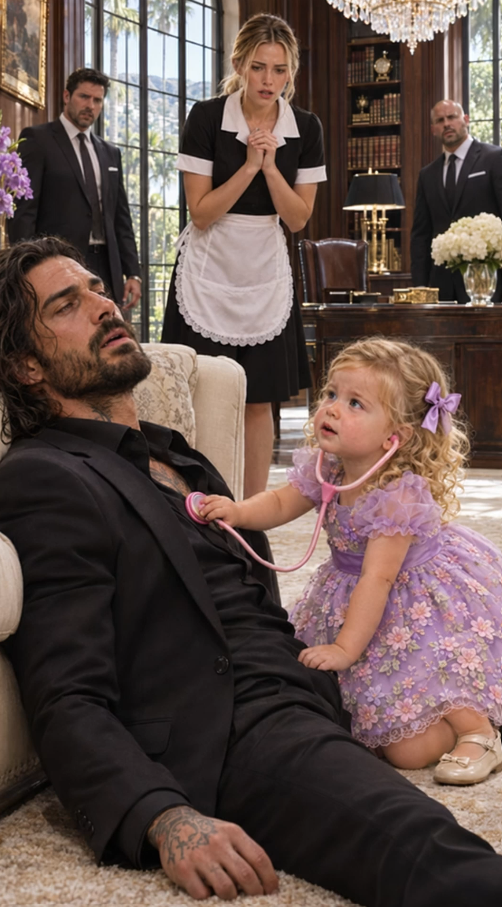
She occasionally appeared in Alexei’s study carrying her medical kit.
The first time Maria tried to stop her, Alexei merely said, “My physician is making rounds.”
Dmitri began leaving fruit on Alexei’s desk instead of pastries.
Alexei complained.
Dmitri ignored him.
Meanwhile Harbor House underwent inspection.
The results surprised everyone.
The building was old.
The plumbing was dreadful.
The heating system bordered on prehistoric.
But Javier’s structural assessments had been right.
The building could be saved.
At considerably less cost than rebuilding.
Maria requested copies of everything.
She began reading financial statements after Sophie went to sleep.
At first the numbers exhausted her.
Then something old woke inside her.
The same part of her mind that had once memorized drug interactions and monitored six patients at once.
She could learn this.
The realization frightened her.
Because wanting something was dangerous.
Wanting created the possibility of losing.
One evening she found Sophie asleep beside a stack of credentialing documents.
The pink stethoscope lay across Maria’s notebook.
Maria picked it up.
Cheap plastic.
Probably worth four dollars.
She placed the earpieces in her ears.
Then pressed the disc against her own chest.
Naturally she heard almost nothing.
Yet she smiled.
Two months after Alexei’s collapse, the trust board met for the first time.
Dr. Evelyn Hart joined by video from Boston.
She was seventy-one now.
Silver-haired.
Sharp-eyed.
When Maria appeared on screen, Evelyn covered her mouth.
“Javier’s Maria.”
Maria smiled uncertainly.
“I suppose.”
“No suppose about it.”
Evelyn told stories Maria had never heard.
How Javier argued over doorway widths.
How he insisted the childcare center needed windows facing the courtyard.
How he carried photographs of Sophie while Maria was pregnant and announced to everyone that the baby would have Maria’s stubbornness.
“He was correct,” Evelyn said.
Maria laughed.
Then Evelyn became serious.
“There is one thing you should know.”
Alexei leaned forward.
“What?”
Evelyn looked at him.
“You don’t know either.”
“That sentence rarely improves my day.”
“Javier contacted me the night before his accident.”
Maria went still.
“What did he say?”
“He had found something in the old trust records.”
“What?”
“He wouldn’t tell me over the phone.”
“Why not?”
“He said he needed to confirm it.”
Maria glanced at Alexei.
“What kind of thing?”
Evelyn hesitated.
“He said Harbor House had never actually belonged to the Petrov company.”
Alexei stared.
“That is impossible.”
“That’s what I told him.”
“He was wrong.”
“Perhaps.”
Evelyn leaned closer to her camera.
“But Javier said he had found the original deed.”
Alexei’s voice became quieter.
“Where?”
“He never told me.”
Maria remembered the metal box.
The plans.
The hidden envelope.
Everything beneath the floor.
“There wasn’t a deed in the compartment.”
Evelyn frowned.
“Then someone moved it.”
Dmitri, standing at the back of the room, spoke for the first time.
“Who?”
Nobody had an answer.
The meeting ended an hour later.
Maria gathered her documents.
Sophie had been coloring at the far end of the conference table.
Suddenly she called, “Mommy?”
“Yes?”
“This lady.”
She held up Javier’s old photograph from Harbor House.
Dr. Evelyn Hart stood between Alexei and Javier.
“What about her?”
“I know her.”
Maria smiled.
“No, baby. You’ve never met Dr. Hart.”
Sophie shook her head.
“Yes.”
“Where?”
Sophie pointed toward the elderly woman’s coat.
A small enamel pin was attached to the lapel.
A blue bird.
“I saw that bird at our house.”
Maria’s smile disappeared.
“When?”
Sophie thought carefully.
“When Daddy was there.”
Maria’s heart began pounding.
Sophie had been only two when Javier died.
Memories from that age were fragile.
Unreliable.
Maria crouched beside her.
“Who had the bird?”
Sophie pointed again at the photograph.
“Grandma lady.”
Maria slowly turned toward the screen, but Evelyn had already disconnected.
Alexei was staring at the blue bird pin.
His face had gone completely still.
“Alexei?”
He did not respond.
“Do you recognize it?”
“Yes.”
“From where?”
He looked at Maria.
“My mother had one exactly like it.”
**–END OF PART 4–CLICK “NEXT” AT THE BOTTOM OF THE PAGE TO CONTINUE READING**
✓ Lynn R. Adams
## Part 4 – What Javier Left Behind Maria stared at Javier’s handwriting until the words blurred. Beneath the floor. Dmitri read the sentence again. “That sounds dramatic.” “Javier enjoyed drama …