PART 4: The Life She Had Been Quietly Saving 029
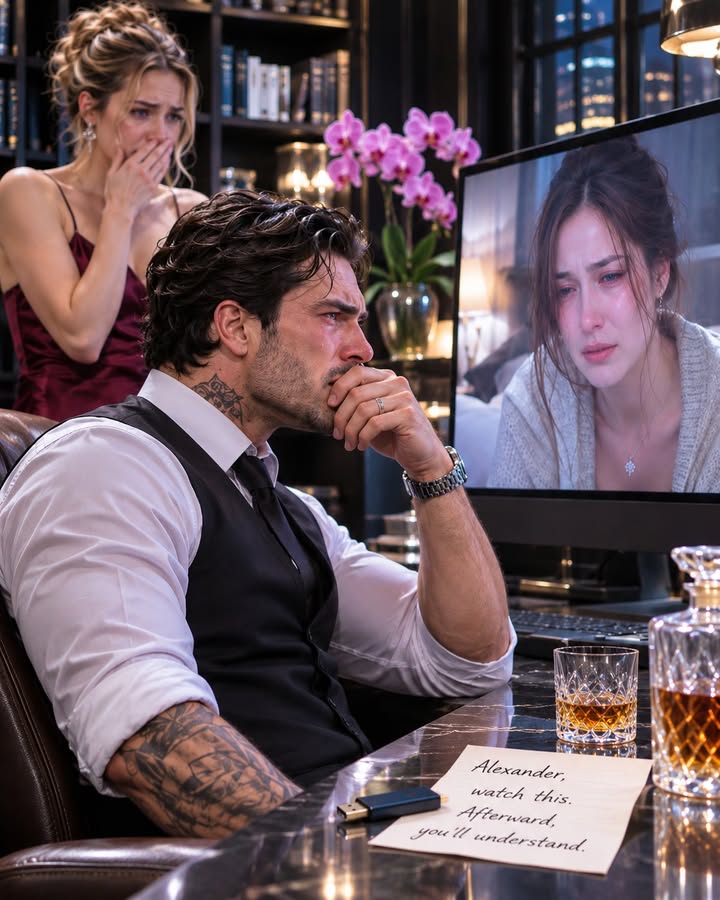
Part 4 – What Endurance Couldn’t Save
“Grandma said the same thing before she died.”
Alexander held the card beneath the desk lamp, turning it slightly until the faint ink stood clear against the paper.
The words were written in Claire’s hand, but they seemed to carry another voice with them.
He had met her grandmother only twice, years earlier, when Claire had brought him to her small house outside Evanston.
She had been a slight woman with silver hair pinned at the nape of her neck, and she had looked at Alexander with an expression that was neither impressed nor intimidated.
At the time, he had taken it for reserve.
Now he wondered whether she had simply been paying attention.
He read the line again, then set the card down without turning it over a third time.
The urge to call Claire’s attorney rose in him, but he did not know what he would ask.
He had promised not to make his need to understand into another demand on Claire.
So he sat in the quiet office and let the sentence remain unanswered.
The following afternoon, his counselor asked him to describe what he had learned about the difference between concern and control.
Alexander tried to respond, then stopped.
“I’m not sure I know the difference yet,” he said.
“What makes you think you might be confusing them?”
“I want to know everything she was carrying.”
“That sounds like concern.”
“It also sounds like I want to reach into a part of her life she didn’t share with me.”
The counselor waited.
Alexander glanced toward the window, where rain blurred the buildings along the river.
“I keep thinking that if I understand every detail, I’ll be able to put the past in order.”
“Would that give Claire anything she has asked for?”
“No.”
“Would it give you something?”
He considered it.
“Maybe the feeling that I can still do something.”
“And if there is nothing you can do with what you learn?”
Alexander looked down at his hands.
“Then I have to let it be true.”
“That may be harder than finding an explanation.”
He left with no new instructions, only a question he could not answer quickly.
At the house, the orchid had begun to lean toward the window.
Alexander adjusted its position by an inch, then stopped, remembering the care card and its warning not to mistake his attention for knowledge.
He checked the soil instead.
It was still damp.
He left the watering can untouched.
That evening, Claire’s attorney sent him a message.
The divorce papers were being prepared, and Claire had asked that the practical arrangements remain straightforward.
Alexander read the note, then typed, “I understand.”
Before sending it, he added, “Please tell her I hope therapy is helping.”
He stared at the sentence for several seconds.
Then he deleted it and sent only the acknowledgment.
Across the city, in a small apartment where the furniture was plain and the windows faced a courtyard, Claire sat in a therapist’s office with her hands folded around a paper cup of tea.
Dr. Patel had recommended the therapist, a woman named Dr. Lin, who spoke gently and did not fill every silence.
The first few sessions had been about sleep, appetite, and the simple practicalities of getting through a day.
That afternoon, Dr. Lin asked about the card Claire had mentioned.
“My grandmother wrote it,” Claire said.
“She wrote the sentence about endurance.”
“She wrote more than that.”
Claire looked toward the window.
The courtyard below was still wet from the rain, and a small maple tree stood bare against the brick wall.
“She left me a letter after she died,” Claire said.
“I kept it with my documents.”
“Have you read it recently?”
“No.”
“Would you like to?”
Claire pressed her thumb against the warm cup.
“I don’t know.”
Dr. Lin did not urge her.
The letter had been folded and unfolded so many times that its edges had softened.
Claire had read it years ago, when she was newly married and still believed that love meant staying patient through every season.
She had not read it again after her grandmother’s funeral.
“I think I was afraid she would tell me I had made the wrong choice,” Claire said.
“Which choice?”
“Marrying Alexander.”
Dr. Lin let the silence settle.
“Did she ever tell you not to marry him?”
“No.”
“Did she ever say she thought he was cruel?”
“No.”
Claire looked down at the cup.
“She liked him, actually.”
“Then what are you afraid the letter might say?”
“That I knew I was unhappy long before I admitted it.”
She returned to the apartment after the session and took the envelope from the box where she kept her personal papers.
It was cream-colored, with her name written across the front in her grandmother’s careful script.
Claire set it on the table and made herself tea.
She stood at the counter while the kettle cooled, listening to the quiet hum of the refrigerator.
Then she carried the cup to the table and opened the letter.
Her grandmother had written about ordinary things at first: the small garden behind her house, a neighbor’s new puppy, the scarf Claire had left in the hall after her last visit.
The letter was not a warning disguised as a goodbye.
It was a conversation between two people who had loved each other for a long time.
Near the middle, Claire found the sentence from the care card.
“Do not mistake endurance for love, my darling.”
She paused, her fingers resting on the page.
The next lines were less certain, as if her grandmother had rewritten them before deciding to leave them in.
“Endurance may be necessary when life is difficult, but it cannot be the only thing that keeps you somewhere.”
“You are allowed to ask whether a home is helping you grow or teaching you to disappear.”
Claire stopped reading.
For several minutes, she looked at the words without taking them in.
The letter had been written two months before her grandmother died, long before the depression became severe, long before she and Alexander stopped sharing their days.
Her grandmother had not known what would happen.
She had not been predicting a marriage’s end.
She had simply wanted Claire to remember that staying and loving were not always the same act.
Claire placed the letter beside her tea.
She had spent years imagining that her grandmother’s last wish had been some grand instruction she had failed to obey.
Instead, the wish was smaller and more demanding.
It asked her to tell herself the truth.
That evening, she opened the sketchbook she had brought from the house.
The first page held a drawing of the orchid, its petals carefully shaded and its stem bent toward a narrow strip of sunlight.
She had drawn it two years earlier, before she stopped showing Alexander her work.
Claire sat for a long time without moving her pencil.
Then she began to sketch the courtyard tree.
The lines were faint at first, but they strengthened as she continued.
The next day, Dr. Lin asked whether she had read the letter.
“Yes,” Claire said.
“Was it what you expected?”
“No.”
“What did it say?”
“That I was allowed to stop enduring.”
Dr. Lin nodded.
“And what does that mean to you now?”
Claire considered the question.
“It means I don’t have to make my leaving sound like a punishment to justify it.”
The words seemed to settle something inside her.
“I keep worrying that Alexander will think I left because of Sophia,” she continued.
“Or because of the jacket, or the gift, or one awful night.”
“Did you?”
“No.”
“Then you don’t have to shape your decision around what he might believe.”
Claire looked at the sketchbook open across her knees.
“I don’t want to be unfair to him.”
“Being fair doesn’t require you to make yourself available before you feel safe.”
Claire drew a small branch, then another.
“I think I’m beginning to understand that.”
Several days later, Alexander’s attorney called him to review the first draft of the divorce settlement.
The terms were fair and uncomplicated.
Claire had asked for no extravagant payment, no public statement, and no dispute over the property she had chosen to leave behind.
She wanted her personal belongings returned if anything had been missed, and she wanted the orchid kept alive until she decided whether she wished to take it.
Alexander read the pages in silence.
“Do you have any changes?” his attorney asked.
“No.”
“You should review the financial schedules carefully.”
“I will.”
“You don’t need to sign today.”
“I know.”
He looked at the section listing the mansion, the investments, and the other shared assets.
The figures were large enough to turn the lives of most people upside down.
For Claire, the settlement would provide security without requiring her to remain tied to him.
He felt the familiar instinct to offer more, to make the number so generous that no one could call his choice anything but devotion.
Then he remembered the counselor asking whether such a gesture would give Claire anything she had requested.
“Is this what she asked for?” he said.
“It is what her attorney proposed, and it is within the fair range.”
“Then it’s enough.”
His attorney studied him.
“You seem unusually certain.”
“I’m trying to stop treating money as an apology.”
“That’s probably wise.”
When they ended the call, Alexander opened the folder on his computer and looked again at the private recordings Claire had left.
He had not played them since the nurse’s message.
He had learned that each new detail could tempt him to turn understanding into an excuse to reach for her.
But the letter was not something he had discovered in secret.
The care card had come to him because Claire had left it with the orchid.
He allowed himself to look at its photograph again.
“Grandma said the same thing before she died.”
He wondered what her grandmother had meant by it, and whether Claire had understood the words differently now.
He did not search for the letter.
He did not ask anyone to find it.
Instead, he returned to the work in front of him: his own choices, his own habits, the years in which Claire had tried to explain her distress and he had answered as though it were a task interrupting him.
At his next counseling session, he spoke about the night he had told her he could not handle another crisis.
“I wasn’t talking about her,” he said.
“But she heard herself in it.”
“What did you want her to hear?”
“That I was overwhelmed.”
“Did you say that?”
“No.”
“What did she need to hear?”
“That I was still there.”
The counselor nodded.
“Can you understand why your intention doesn’t erase the effect?”
“Yes.”
He had once believed that understanding the effect meant admitting he had meant harm.
Now he knew the two things could be true at once: he had not intended to make Claire feel alone, and his choices had repeatedly left her feeling that way.
He carried that understanding with him when he returned to the house.
The rooms were still immaculate, but they no longer felt like proof that his life had been arranged.
They felt like rooms where he had failed to notice what was missing.
In the library, he opened a drawer to put away the orchid care card and found an old envelope beneath a stack of stationery.
His name was written on it in Claire’s hand.
The envelope had been sealed, then opened at some point and folded closed again.
He took it to the desk and recognized the date on the corner.
It was from the year Claire’s grandmother had died.
He did not open it.
He could not be certain whether it had been intended for him, or whether Claire had simply used it to store something private.
He set it back in the drawer.
That night, he dreamed of sitting at the kitchen table while Claire spoke to him from the other side.
He could hear her, but each time he reached for a reply, the words slipped away.
When he woke, the house was still dark.
He went downstairs and turned on a single lamp in the library.
The orchid stood near the window, its first bloom beginning to fade.
He checked the care card again, then remembered the last instruction written on the reverse.
“Don’t mistake the fact that I stayed for proof that I was all right.”
The sentence no longer felt like an accusation.
It felt like a truth he had been given late, but not too late to learn from.
Across the city, Claire placed her grandmother’s letter back among her papers.
She did not hide it in the bottom of the box this time.
She set it beside her sketchbook, where she could find it again.
Then she drew until the light outside the window faded.
A week passed.
Claire kept her appointments, cooked small meals, and began to sleep for longer stretches at a time.
She did not feel suddenly well.
Some mornings still came with the old heaviness, and some nights still left her awake and listening to a silence that seemed to stretch too far.
But she was no longer waiting for someone else to decide whether her pain deserved attention.
Alexander kept his counseling appointments, too.
He did not send flowers or gifts.
He did not ask the staff to report whether Claire had visited the house.
When his attorney relayed a practical question from Claire’s side, he answered it promptly and without adding a message meant to travel farther than the paperwork.
The first draft of the divorce agreement arrived at his office on a Thursday morning.
He read it alone.
The final page contained a blank line for his signature.
His pen rested beside it while his phone rang.
It was Martin.
“Your communications team is asking for you,” his assistant said.
“What happened?”
“There’s a problem with the company announcement.”
“What kind of problem?”
“Several outlets are asking questions about the partnership schedule, and the board wants a statement before the market opens.”
Alexander looked at the unsigned papers.
“How serious?”
“Serious enough that they want you in the room now.”
He heard the tension in Martin’s voice and glanced toward the window.
The city below was bright with midmorning sun, its streets already filling.
“I’m coming.”
He gathered the settlement papers and placed them in a folder.
The signature line remained empty.
Before leaving, he stopped in the library.
The orchid’s newest bloom had opened overnight, a pale shape turned toward the glass.
For a moment, he thought about Claire’s care note, the letter from her grandmother, and all the things he had once believed he could repair by moving quickly.
Then he closed the folder and carried it with him.
At the office, the conference room was already crowded.
The company’s advisers spoke over one another, outlining calls, statements, and possible consequences.
One of them noticed the folder in Alexander’s hand.
“Is that the divorce settlement?”
“Yes.”
“Today?”
“It’s ready to be signed.”
The adviser lowered his voice.
“Given what’s happening with the partnership, you may want to wait.”
“Why?”
“Because the timing creates unnecessary attention.”
Another executive joined in.
“You don’t need to make a personal decision while the company is under pressure.”
Alexander placed the folder on the table.
“It’s been a personal decision for months.”
“But the announcement could become a distraction,” the adviser said.
“We can ask Claire’s attorney for a delay.”
“No.”
The room quieted.
Alexander looked at the faces around the table, then down at the papers.
For once, he understood that waiting could be another way of taking control.
He opened the folder.
The top page shifted, revealing a note in Claire’s handwriting that her attorney had included with the final documents.
It contained only one sentence.
“Please don’t make my recovery another decision you believe you can postpone.”
Alexander stopped breathing for a moment.
He recognized the handwriting from the care card, from the note beside the USB, from the message he had not been allowed to answer.
But he did not recognize the words.
He had never seen them before.
And beneath the sentence, in smaller writing, was a date from months earlier—long before the accident, long before he had known Claire was preparing to leave.
**–END OF PART 4–CLICK “NEXT” AT THE BOTTOM OF THE PAGE TO CONTINUE READING**
* * *
[PREVIOUS: PART 3](https://puretales.idolsgift.com/blog/part-3-the-life-she-had-been-quietly-saving-029) | [NEXT: PART 5](https://puretales.idolsgift.com/blog/part-5-the-life-she-had-been-quietly-saving-029)
✓ Lynn R. Adams
Part 4 – What Endurance Couldn’t Save “Grandma said the same thing before she died.” Alexander held the card beneath the desk lamp, turning it slightly until the faint ink stood clear against the pa…