PART 4: The Letters He Never Saw 034
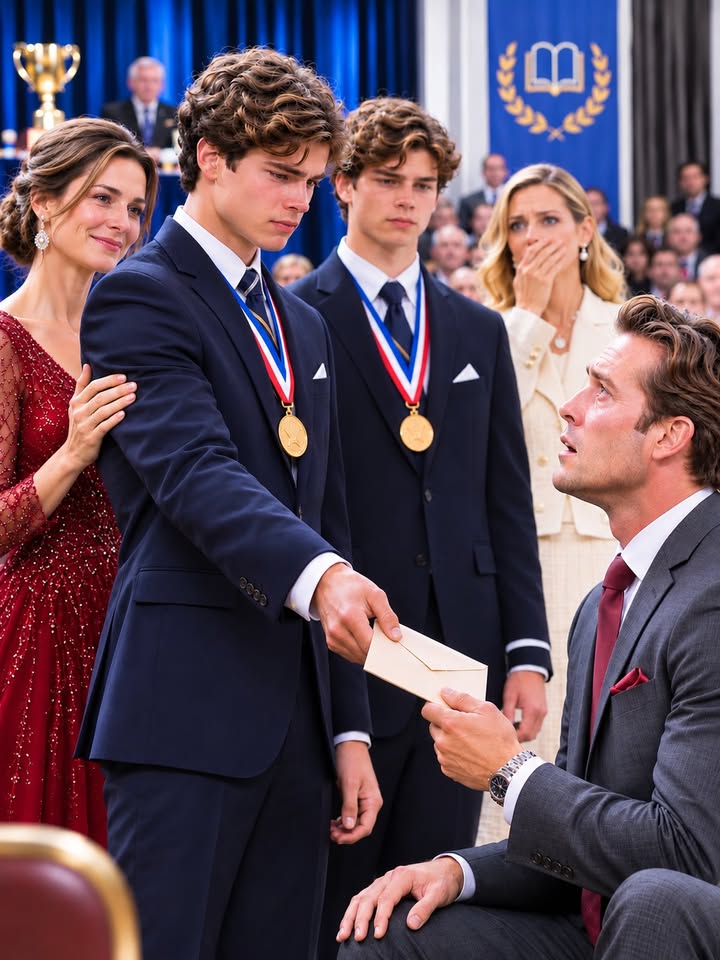
Part 4 – The Letters in the Box
The note in my mother’s handwriting remained on the kitchen table long after the boys had gone upstairs.
I read it again and again, hoping the words might rearrange themselves into something less impossible.
Returned to me unopened.
He said he didn’t want to hear from us.
“I never mailed this,” I said, though the room was empty now.
The words sounded no more convincing the second time.
My mother had written the note beneath the date, as if recording a small fact for herself.
She had not written who returned the letter, or when, or how it had reached her.
The boys had gone to their room with the wooden box between them, trying to give me space while staying close enough to hear if I called.
I could hear their quiet voices through the ceiling.
They were discussing the envelope, the handwriting, the parts of the story none of us could put together.
I picked up my phone and called Brian.
He answered on the second ring.
“Did you find something?”
“Yes,” I said. “A note from my mother. She wrote that a letter of mine was returned to her unopened.”
There was a silence.
“I thought you said you never sent anything.”
“I didn’t. I wrote a letter, but I never mailed it.”
“Then how did it get to her?”
“I don’t know.”
I could hear him breathe in, then let the air out slowly.
“What did the note say exactly?”
I read it aloud.
He did not answer at once.
“Do you still have the letter?” he asked.
“Yes.”
“Could I see it?”
“That’s not up to me alone.”
“I understand.”
I looked toward the stairs.
The twins had come down quietly and were standing in the doorway.
My older son held the wooden box against his hip.
“You can tell him we’ll decide,” he said.
I repeated the words into the phone.
“Of course,” Brian replied. “I’ll wait.”
After we hung up, the boys brought the box back to the table.
We examined the letter again, this time with the note beside it.
My handwriting filled most of the page.
The words were not an apology, exactly, and not a plea.
I had written about the boys, about the routines we were building, and about how difficult it was to explain a sudden absence to two children who still expected their father to come through the front door.
Near the end, I had written that I did not know whether Brian wanted to hear from me, but that the boys were too young to understand what had happened.
I had never finished the last sentence.
The page ended halfway through a line.
My older son lifted the paper carefully by its edges.
“Grandma wrote this after she got it back?”
“I think so.”
“Did she ever tell you she sent it?”
“No.”
“Did she say Dad had answered?”
“No.”
My younger son turned the paper over.
There was nothing on the back but the faint shadow of ink from the other side.
“Maybe she thought she was helping,” he said.
I sat with that possibility.
My mother had loved the boys fiercely.
She had also believed that a family could be protected from pain by keeping difficult truths out of sight.
I had learned that lesson from her before I understood its cost.
“Did Grandma ever talk about your dad after he left?” my older son asked.
“Not much.”
“Why?”
“I think she thought I needed to stop looking back.”
The words felt inadequate.
The boys waited, but they did not press me to make my mother into either a villain or a saint.
They knew she had been a loving grandmother.
They also knew love did not make every choice harmless.
My younger son set the letter down.
“Should we call Dad back?”
“Would you like to?”
“Yes,” he said. “But I don’t want him to think this means we’ve decided anything.”
“It doesn’t have to mean that.”
My older son nodded.
“We can ask him what he knows.”
I called Brian again and put him on speaker.
He did not speak until one of the boys told him he could.
“We found the letter,” my older son said. “It’s the one Mom told you about. She wrote it but never mailed it.”
“I understand.”
“Then how could Grandma have written that it was returned?”
“I don’t know,” Brian said. “But I think I need to look for something.”
“What?” I asked.
“Old records. There may be more to this than I understood.”
The carefulness in his voice unsettled me.
“What do you mean?”
“When I left, I had a lawyer handling the separation. I trusted him with the practical things because I didn’t want to keep arguing with you.”
“You never told me he was handling anything.”
“I know.”
“Did you ever ask him about the boys?”
There was a pause.
“Once, early on.”
The boys exchanged a look.
“What did he say?” my older son asked.
“He said your mother had moved and didn’t want me contacting her.”
“I didn’t move,” I said.
“I know that now.”
“And you accepted that?”
“I did.”
The answer came without defense.
It did not make the years disappear, but it showed that he was not trying to hide from the part he had played.
“Why didn’t you check?” my younger son asked.
“I should have. I told myself I was respecting a boundary, even though I had never heard that boundary from your mother.”
“You could have called her,” the older one said.
“Yes.”
“You could have asked someone else.”
“Yes.”
“You could have tried again.”
“Yes.”
Brian’s voice had grown quieter.
“I should have done all of those things.”
No one spoke for a moment.
Then he said, “I’m going to find the lawyer’s old files. I don’t know whether they still exist, but if they do, I want to understand what happened.”
“You’re not going to use that to blame Mom?” my younger son asked.
“No.”
“Or to say you had no choice?”
“No. Whatever I find, I chose not to check.”
The boys seemed to hold on to that distinction.
“Tell us what you find,” my older son said. “But don’t call every day.”
“I won’t.”
After the call ended, we sat around the table until the kitchen grew dim.
Neither of my sons asked whether I believed Brian.
I did not know how to answer.
The next day, I drove them to school as usual.
We spoke about a chemistry assignment, a permission slip, and whether we had enough milk at home.
Ordinary life continued its quiet insistence that breakfast still had to be made and homework still had to be finished.
But the note stayed with me.
That evening, I searched through the wooden box once more, removing each photograph and card and looking beneath the lining.
I found no other envelope.
The old letters were all accounted for.
The returned envelope Brian had shown us remained an unexplained piece, its sealed flap cut open and its interior empty.
I called my mother’s sister, Aunt Ruth, who had helped us move after Brian left.
She answered with the warm surprise of someone who rarely expected a call on a weekday.
When I told her about the note, the line went quiet.
“Ruth?”
“I’m here.”
“Do you remember my mother sending a letter to Brian?”
“I remember her taking something to the post office.”
“What was it?”
“I don’t know. She said she was helping you.”
“I didn’t ask her to send anything.”
“No,” Ruth said softly. “You might not have known.”
I looked at the kitchen table, where the note lay beneath a glass paperweight.
“Did she tell you it came back?”
Another pause.
“She mentioned that he wouldn’t accept it.”
My fingers tightened around the phone.
“Did she say how she knew?”
“She said it was returned.”
“Did you see it?”
“No.”
“Did she say it was addressed to Brian?”
“I don’t remember.”
Aunt Ruth sounded troubled now.
“I’m sorry, Hannah. That was a long time ago.”
“I know.”
“She thought she was protecting you.”
“From what?”
“From waiting for an answer that might never come.”
The words settled heavily between us.
I thanked her and ended the call.
For years, I had thought silence had come directly from Brian.
Then I had thought it had come from a decision I made on his behalf.
Now my mother’s note suggested that she might have carried a message between us without telling me.
I did not know whether she had sent my unfinished letter, another letter altogether, or simply wanted me to believe she had tried.
Whatever had happened, the story was no longer one clean line from Brian’s rejection to my silence.
It was a knot.
The following afternoon, Brian called.
“I found a storage box,” he said. “It was in the back of my closet. I thought it was all tax papers and old leases.”
“Did you find something?”
“Yes. I’m still going through it.”
The hesitation in his voice made me sit down.
“What did you find?”
“Files from the separation. Letters. Notes from my lawyer.”
“Can you tell me what they say?”
“I want to read them carefully before I tell you something wrong.”
The answer irritated me, but I could not fault him for wanting certainty.
“Then call when you know.”
“I will.”
He called the next evening.
This time, his voice sounded worn.
“I found the correspondence,” he said. “My lawyer kept copies of what he sent and received.”
“What did he receive?”
“Letters from you.”
My stomach tightened.
“I never sent him any.”
“I know. They were addressed to me.”
“Then how did your lawyer get them?”
“He intercepted them.”
The word seemed too blunt for the quiet room.
The boys were doing homework at the kitchen table.
I put the phone on speaker so they could hear.
“Why?” I asked.
“He wrote in his notes that he thought the letters would inflame the dispute. He said you were upset and that responding could make the separation harder.”
I stared at the table.
“Were they the boys’ letters?”
“Some were from you. One was addressed to me from the boys.”
The twins stopped writing.
“What did it say?” my older son asked.
“I don’t have it in front of me,” Brian replied. “I only saw the envelope and a note from the lawyer.”
“Was it the one we found?” my younger son asked.
“I don’t know yet.”
Brian’s voice caught for a moment, then steadied.
“My lawyer’s note says he held the letters and intended to discuss them with me after the separation was finalized.”
“Did he?” I asked.
“No.”
“Did you ever ask him what happened?”
“I asked once about you and the boys. He told me you had moved and wanted no contact.”
“And you believed him.”
“Yes.”
“You never asked to see the letters?”
“No.”
The answer came quietly, but it remained an answer.
My older son had stopped writing.
“Did you know the lawyer was keeping them?”
“No. I found out tonight.”
“Were the letters in the box?”
“I don’t know. Some papers are still tied together. I haven’t sorted them all.”
“Then why did you call us?”
“Because you deserve to know what I’ve found so far. But I don’t want to pretend this explains everything.”
The boys exchanged a glance.
“What does the note say?” my younger son asked.
Brian read from the page in front of him.
“‘Received correspondence from Hannah Campbell. Given the level of hostility, I have retained it pending further instruction. I advised Brian that direct contact may be counterproductive.’”
He paused.
“Another note says he told me you had moved.”
“What does it say about that?” I asked.
“He wrote, ‘Client accepts that contact is unwelcome and will not pursue further communication.’”
I closed my eyes.
There it was, in tidy words, the shape of a decision neither Brian nor I had fully made.
A lawyer had taken my letters and then described my silence as a choice.
Brian had accepted the description.
I had accepted Brian’s earlier rejection as permanent.
My mother, perhaps, had tried to intervene and had created another silence of her own.
No single discovery could restore the years.
The boys sat very still.
“So the lawyer took Mom’s letters,” the older one said, “and then told Dad Mom didn’t want him.”
“That’s what the notes suggest,” Brian replied.
“But Dad didn’t ask to see the letters,” the younger one said.
“No,” Brian answered. “I didn’t.”
“Why not?”
“I was ashamed of how things had ended. I believed your mother had moved on, and I thought asking again would only make things worse. I let my lawyer’s answer become a reason not to try.”
The older twin studied the notebook in front of him.
“Then the lawyer lied, but you still chose not to check.”
“Yes.”
The response came without hesitation.
I felt something in me loosen and tighten at once.
The truth was not simple enough to absolve anyone.
It was not simple enough to condemn them, either.
“What happened to the letter from the boys?” my younger son asked.
“I haven’t found it yet. There are more files to go through.”
“Was it returned to Grandma?”
“I don’t know.”
“Could the empty envelope have been the one she sent?”
“It could have been,” Brian said. “The address is my old address, and the postal mark is from around the same time.”
“But why would it be empty?” my older son asked.
“I don’t know.”
The mystery remained, but it now had a possible path.
The boys looked at me.
I could see them fitting the new information into the story they had carried for years, making room for the failures of adults without pretending those failures had not shaped their lives.
My younger son spoke first.
“We need time to think.”
“Take all the time you need,” Brian said.
“Don’t send anything to the house without asking us.”
“I won’t.”
“And don’t come to school.”
“I wouldn’t.”
The boy nodded, then returned to his unfinished homework.
Brian stayed on the line for another moment.
“I’m sorry,” he said. “I know that doesn’t repair it.”
“No,” my older son replied. “It doesn’t.”
“I understand.”
The call ended.
The kitchen seemed quieter than before.
I looked at the two boys, their pencils paused over their notebooks.
“Do you want to talk about it?” I asked.
“Not yet,” my older son said.
His twin pressed his pencil to the page and began writing again.
The next few days were careful and ordinary.
Brian did not call.
He sent one message through me to say that he had found more papers and would share what they showed when he had read them all.
I did not answer for the boys.
I only told them the message had arrived.
They said they would decide later whether they wanted to hear more.
When they were ready, I called Brian with both of them beside me.
“I found the letter,” he said.
The boys leaned closer.
“Was it ours?” the older twin asked.
“Yes.”
“Which one?”
“I think it’s the one from the envelope you gave me. The handwriting matches. It was in the file with the other correspondence.”
“Was it inside the returned envelope?” I asked.
“No. It was separate.”
“Then what was in that envelope?”
“I still don’t know. I’ve asked the lawyer’s old office whether they have any remaining records, but they’re searching their archives.”
The boys were silent.
“Can you read the letter?” the younger one asked.
Brian paused.
“If you want me to.”
“Not yet,” his brother said. “Just tell us whether it’s in good condition.”
“It is. The paper is folded, but it’s readable.”
“Keep it safe,” the younger one said.
“I will.”
There was a rustle on the line.
“I also found another note,” Brian continued. “This one is from my lawyer to me. He wrote that he had received a letter from Hannah, but he advised me not to respond because it might reopen the conflict.”
“That was my unfinished letter,” I said.
“I think so.”
“How could it have been mailed if I never sent it?”
“I don’t know.”
“Could my mother have sent it?”
“Maybe.”
“But why would she?”
“I can’t answer that.”
My throat tightened.
For the first time, I wished my mother were still alive—not so I could blame her, but so I could ask what she thought she was doing.
The lawyer’s note had been written years before he claimed I had moved.
It might have been the first small decision that turned into a wall.
Brian’s next words changed everything again.
“There’s something else,” he said. “A note in the file says I asked him about the twins.”
The boys stopped moving.
“What did you ask?” the older one said.
Brian read slowly.
“‘Has Hannah sent any photographs of the boys? I would like to know how they are.’”
The room seemed to narrow around those words.
“How old were we?” the younger twin asked.
“About two,” Brian replied. “A little older, I think.”
“Did the lawyer answer?”
“Yes. He wrote that your mother had moved and did not want contact.”
“Did you ask again?”
“No.”
The silence that followed held more than anger.
It held the knowledge that Brian had wondered about them once, and then had allowed one answer to stand in place of all the years that followed.
“I’m sorry,” he said. “I know that question is too small compared with everything I didn’t do.”
The boys did not answer.
After the call, my older son went upstairs without saying anything.
His brother remained at the table, looking at the schoolwork he had not finished.
“Does finding out he asked make it better?” I asked.
“No,” he said.
“Does it make it worse?”
He thought about it.
“It makes it different.”
I understood.
The truth had not brought relief.
It had added another layer to the hurt, one that could not be reduced to whether Brian had cared.
He had cared enough to ask once.
He had not cared enough, or been brave enough, to ask again.
That evening, I sat alone with my mother’s note and the copy of my unfinished letter.
I thought of Brian’s lawyer keeping our words in a file.
I thought of my mother taking something to the post office, perhaps believing she was giving my letter a chance.
I thought of the boys writing to their father year after year, while I kept the pages safe because I believed he did not want them.
The next morning, Brian called again.
“I found the lawyer’s final file,” he said. “There’s a letter in it from the week the boys’ envelope was returned.”
“What does it say?”
“I don’t know yet. It’s sealed in a separate sleeve, and I haven’t opened it because I wanted to ask whether the boys wanted to hear about it first.”
I looked at my sons.
They had both come into the kitchen, their expressions alert.
The older one answered for them.
“We want to know what it says.”
Brian was quiet for a moment.
Then he said, “It’s addressed to me.”
“From the lawyer?” I asked.
“No.”
The boys moved closer to the phone.
Brian’s voice lowered.
“It’s in my handwriting, dated thirteen years ago.”
My hand tightened around the receiver.
“What does it say?”
“I haven’t read it yet,” he replied. “But the envelope has the same return mark as the empty one you found.”
None of us spoke.
Then Brian added, almost too softly to hear, “I think I may have written back to you—and never known it was sent.”
**–END OF PART 4–CLICK “NEXT” AT THE BOTTOM OF THE PAGE TO CONTINUE READING**
* * *
[PREVIOUS: PART 3](https://puretales.idolsgift.com/blog/part-3-the-letters-he-never-saw-034) | [NEXT: PART 5](https://puretales.idolsgift.com/blog/part-5-the-letters-he-never-saw-034)
✓ Lynn R. Adams
Part 4 – The Letters in the Box The note in my mother’s handwriting remained on the kitchen table long after the boys had gone upstairs. I read it again and again, hoping the words might rearrange t…