PART 4: The Knot That Rang the Bell 058
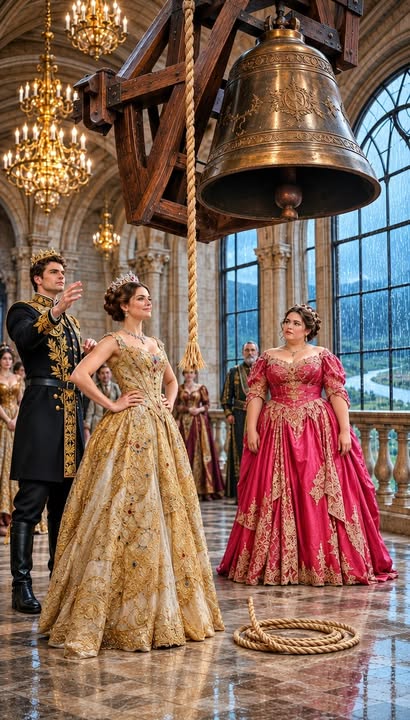
Part 4 – What the Flood Report Hid
Beneath the name Vale was a date from the night of the flood.
Amara’s hand tightened around the edge of the table, though she did not touch the paper.
“That was my great-grandfather,” she said.
The prince looked from the faded name to her face.
“Do you recognize the handwriting?”
“No,” Amara replied. “But I recognize the name.”
Master Ivers adjusted his spectacles and leaned closer to the folded sheet.
“It may be a letter, or a note attached to one,” he said. “We should open it only as far as the old fold allows.”
He eased the brittle paper apart with a thin spatula, moving slowly enough that each small shift seemed to take a breath from the room.
Inside, a few lines had survived the damp.
The first had been written in a clerk’s hand: “Received from Vale, after the second watch.”
Below it, in darker ink, someone had added: “Keep with the river report.”
“That is all?” Lena asked.
“For now,” said Master Ivers. “The rest may be on the other side.”
He turned the sheet carefully.
A watermark crossed the paper, faint but visible, and the lower corner had been torn away.
The back held more writing, though several lines had blurred into the stain.
The archivist bent close and read what he could.
“‘The keeper says the bell did not carry.’”
The prince’s face tightened.
Amara’s gaze moved to the official report lying nearby, the one that claimed the west bell had sounded.
Master Ivers continued, following the surviving words.
“‘His Majesty ordered the signal stopped until the celebration ended.’”
No one spoke.
Rain tapped against the archive window, light and steady, as though the storm outside had come only to listen.
The prince stared at the sentence.
For a long moment, he seemed unable to see anything beyond it.
Then he looked at Master Ivers.
“Is that what it says?”
“Yes.”
“Could ‘signal’ refer to something else?”
“It could,” the archivist said gently. “But the next line mentions the bell.”
The prince’s eyes lowered to the paper.
“Read it.”
Master Ivers drew a careful breath.
“‘The keeper was told to wait until the music ceased.’”
Amara closed her eyes briefly.
Lena felt the sentence settle over them, heavier than the dust in the archive room.
The old flood had not been a vague failure caused by worn rope or an unreliable mechanism.
Someone had ordered the alarm silenced while the river rose.
The prince’s father had been that someone.
The room remained quiet, not because the others had nothing to say, but because each of them seemed to understand that whatever they said first might decide what the truth became.
The prince moved away from the table.
He crossed to the narrow window, where the pale daylight caught the line of his shoulder.
“My father would never have wanted people in danger,” he said.
It was not an argument so much as a sentence he needed to hear spoken aloud.
Amara answered softly.
“Perhaps he didn’t believe anyone was in danger.”
“Then why stop the bell?”
“We don’t know yet.”
The prince turned back, his expression wounded and guarded at once.
“The note says he did.”
“It says he ordered the signal stopped,” Amara replied. “It does not tell us what he knew about the river, what he was told, or whether the keeper explained the risk.”
“That distinction won’t matter to the valley if the bell failed.”
“No,” Lena said. “It won’t.”
Her voice was quiet, but it drew the prince’s attention.
“The people who needed the warning didn’t have the luxury of knowing what he intended,” she continued. “They only knew whether the bell sounded.”
The prince looked down.
Lena wished she could offer him something steadier than that truth.
There was no comfort in making the past less serious than it had been.
Master Ivers had gone very still beside the table.
“I remember the celebration,” he said after a moment. “I was a junior clerk. I heard the music from the eastern rooms, but I was assigned to the records office and never saw the royal party.”
“Do you remember the flood?” Amara asked.
“I remember talk of high water, but not a public alarm.”
The archivist’s voice carried an old regret.
“By the following morning, I was told the bell had sounded and the valley was safe.”
“Who told you?” the prince asked.
“I don’t remember. There were many people in the palace then.”
He looked again at the note.
“I remember being relieved.”
The prince turned from the page.
“Was there damage in the valley?”
“The weather ledger records water above the lower markers,” Lena said. “It does not say whether anyone was hurt.”
“Then we need to find out.”
The answer came with a firmness that seemed to surprise even him.
Amara looked at him, searching his face.
“Yes,” she said. “We do.”
Master Ivers placed a clean sheet over the note to protect it.
“The retired tower keeper may be able to explain the wording,” he said. “If this is his account, he may have kept another copy.”
“Do you know where he is?” Lena asked.
“The palace register lists a residence in the lower village. He retired several years after the flood.”
The prince looked at the date on the page.
“His name?”
“Orlan Venn.”
The prince nodded, though his eyes remained distant.
“I remember him,” he said. “He used to bring me small carved birds when I was a child.”
“Then we should speak with him,” Amara said.
The prince took a moment before responding.
“We should. But not as though we already know everything.”
“Agreed,” said Lena. “Ask what happened before we decide what it means.”
The prince’s mouth tightened, then eased.
“You’re right.”
They arranged to visit the retired keeper the next morning, after Master Ivers had made a careful copy of the note and checked the archive for related entries.
Amara asked for a copy of the Vale account references, and the prince ordered that none of the papers be moved or altered until the archivist had recorded their condition.
The instructions were practical, almost ordinary.
Perhaps that was why Lena found them reassuring.
The truth had arrived in scraps, but it would have to be handled with care, not haste.
By the time they left the archive, the rain had stopped.
The palace courtyard smelled of wet stone and clipped rosemary.
Amara walked beside Lena beneath the covered passage, her face turned toward the open garden.
“I thought I was prepared to learn something uncomfortable about my family,” she said.
“Were you?”
“I thought so. I imagined a forgotten invoice, perhaps a careless signature. Something that might make me revise the portrait I’d made of him.”
“And now?”
“Now I’m wondering whether I’ve mistaken silence for innocence.”
Lena glanced at her.
“Your family may have been silent for reasons we don’t know.”
“That would not make the silence harmless.”
“No,” Lena said. “But it might tell us why it happened.”
Amara’s steps slowed.
“I keep thinking of how easily I blamed the rope when my knot slipped.”
“You didn’t know what the rope was made of.”
“I knew enough to look closer.”
Lena considered this.
“Knowing that you should look closer is a kind of knowledge.”
Amara gave a small, uncertain laugh.
“You make failure sound almost useful.”
“Only if you learn from it.”
“And if you don’t?”
“Then it stays a failure.”
Amara looked at her for a moment, then nodded.
The uneasy warmth between them had grown more substantial since the first day.
It was no longer simply relief that neither of them had to stand alone in the gallery.
It was trust beginning to take shape, though neither seemed ready to name it.
The next morning, they traveled to the lower village in a plain palace carriage, with no escort beyond a driver and one attendant.
The sky was clear, but the river remained swollen from the previous days of rain.
Its brown water pressed against the banks and dragged branches along its surface.
Lena watched the current from the carriage window.
She had lived near the valley long enough to recognize how quiet a river could look while gathering strength.
The village sat above the waterline, its houses gathered along a road that climbed toward the old mill.
At the end of the road stood a low cottage with a slate roof and a garden bordered by woven willow.
A carved wooden bird hung beside the door.
The prince noticed it before the others did.
“He still makes them,” he said.
Lena looked at the small figure, its wings spread as if it had been caught in the middle of flight.
The prince’s voice had softened.
For a moment, he was not speaking about a royal secret, but remembering a man who had once taken time to make something for a child.
Amara watched him.
The memory did not excuse what they were about to learn.
It did, however, make the past feel more human and more difficult.
Orlan Venn opened the door before they knocked.
He was a narrow-shouldered man in his late seventies, with silver hair and a steady gaze.
He recognized the prince at once.
“Your Highness,” he said, stepping back. “I wondered when the old bell would call you here.”
The prince blinked.
“Did you expect us?”
“No. I meant the bell itself.” Orlan glanced past him to the others. “It has a way of bringing people back to unfinished business.”
They introduced themselves and explained that they were looking into the old flood and the records surrounding the west bell.
Orlan’s expression changed when the prince mentioned the note from the archive.
He invited them inside without asking to see it.
The cottage was small but orderly, its shelves lined with books, tools, and wooden birds in various stages of carving.
A window overlooked the river.
Orlan poured tea into mismatched cups and sat at the head of the table.
“I wondered whether that note had survived,” he said.
“You wrote it?” the prince asked.
“I did.”
“Why did you hide it behind the bell bracket?”
“I didn’t,” Orlan replied. “I gave it to someone who said it would be kept with the report.”
The prince looked toward Master Ivers, who had accompanied them to make his own notes.
“It was found behind the bracket,” Lena said.
Orlan gave a tired smile.
“Then someone must have put it there later.”
“Who?” Amara asked.
“I never knew.”
The retired keeper folded his hands around his cup.
“I had hoped the report would tell the truth without my having to explain it.”
“Why didn’t you speak publicly?” the prince asked.
Orlan looked at him without anger.
“I did speak. I told the officers what had happened. I gave my account in writing.”
“But the report said the bell sounded.”
“Yes.”
“Why?”
“Because that was what the palace wanted recorded.”
The prince’s shoulders drew back.
“Did my father order you to stop the bell?”
Orlan’s fingers tightened around the cup.
“He did.”
The answer was plain, without drama.
“What did he say?” the prince asked.
“He said the lower river had not crossed the warning stones and that the alarm would frighten people unnecessarily. There was a celebration in the palace, and the music was carrying across the valley.”
Lena heard the words from the note again: wait until the music ceased.
“Did he know the river had risen?” Amara asked.
“He knew there was a flood watch. His steward told him the river was high but stable. I told the steward that the water was rising faster than our gauge showed.”
“Did you speak to the king directly?” the prince asked.
“I did. I went to the gallery and asked to sound the bell. His Majesty said to wait until the celebration ended.”
The prince’s gaze lowered to the table.
“Why did you obey?”
Orlan did not answer quickly.
When he did, there was no self-pity in his voice.
“Because I was a tower keeper, and he was the king.”
“That is not the whole answer,” Lena said.
“No,” Orlan agreed. “It isn’t.”
He turned his cup slowly between his palms.
“I was told the bell could be sounded if the water crossed the upper mark. I believed I might still have time. I thought if I disobeyed and caused a panic, I would be blamed for that too.”
“Did the river cross the mark?” Amara asked.
“Before the music ended.”
The cottage was quiet except for the soft ticking of a clock.
“What happened then?” Lena asked.
“I sounded the bell. It turned once, and then the rope slipped.”
Lena looked toward the window.
The swollen river moved beyond the glass, steady and brown.
“The old line was worn,” Orlan continued. “The replacement had been tied into it poorly. The bell rang once, perhaps twice, but not enough to carry in the rain.”
The prince closed his eyes briefly.
“Why did the official report say it sounded?”
“Because it was sounded,” Orlan said. “That was the word they used. It did not say that anyone heard it.”
The distinction was precise, and devastating.
“Who prepared the report?” Amara asked.
“I don’t know. I was asked for my account, then told a copy would be made.”
“Did you sign anything?”
“I signed a statement about the river and the bell. I did not sign the final report.”
Amara’s face had grown pale.
“Did my great-grandfather have anything to do with it?”
Orlan looked at her with care.
“Your great-grandfather was the household supplier who brought the replacement rope. He was there that night.”
“Why?”
“He had been asked to check the bell line after the first alarm. He was in the service court when the king ordered the signal stopped.”
Amara’s hands rested flat on the table.
“Did he know the rope had failed?”
“Yes.”
“Did he help falsify the report?”
Orlan held her gaze.
“He told them the line had been replaced before the flood. He did not tell them it had failed that night.”
Amara’s fingers curled against the wood.
“Why?”
“Because he was afraid.”
“Of what?”
“His workers and their families lived in company cottages. The palace had the authority to cancel his contracts and remove them. He had been told that if he accused the king or the tower office of negligence, the contracts would be reviewed.”
Orlan’s voice remained calm, but there was a deep weariness in it.
“He told me afterward that he had thought of every family who depended on his wages, and he had let that thought make the choice for him.”
Amara looked down.
The accusation she had feared had arrived, but it was not simple guilt.
Her ancestor had helped conceal the failure.
He had also been threatened with the loss of livelihoods that were not his alone to risk.
The choice did not become harmless because it had been made under pressure.
Nor did the pressure disappear because he had made a choice.
“My family never told us,” she said.
“Perhaps he thought silence was protection,” Orlan replied. “Perhaps he was ashamed. People can be afraid and ashamed at the same time.”
Amara’s eyes shone, but she did not look away.
“I wish he had told them.”
“So do I,” said Orlan.
The prince rose and walked to the window.
“Were people hurt?” he asked.
“Several families had water enter their homes. The river reached the lower lane before anyone understood how quickly it was rising.”
“Were there injuries?”
“Not that I know of. Some people left in time because they saw the water for themselves. Others were caught by the rising current and had to wait on higher ground until it receded.”
Orlan paused.
“The valley was fortunate. That is not the same as being safe.”
The prince stared out at the river.
His father had silenced the warning to preserve a celebration, and the bell had failed when the keeper finally pulled it.
The truth was more complicated than the clean accusation Lena had feared, but no less painful.
“Why did you keep the knot and the rope?” Lena asked.
“I didn’t keep the rope. The palace kept it. I asked them to preserve it, because a new line would not show what had happened.”
“What about the bell?”
“I replaced the rope myself after the flood. I thought if I made a secure bend, it would hold until the palace arranged a proper repair.”
“You used a bend between the old hemp and the new line?”
“Yes. The one you tied in the gallery looked much like mine.”
Lena felt the weight of that admission.
The knot she had tied had not merely passed a test.
It had repeated a repair made by someone who had tried to keep the bell working after the palace had concealed its failure.
“Did you report that you had replaced it?” the prince asked.
“I sent a request for the wheel and rope to be inspected. I never received a reply.”
“Why didn’t you tell the public what had happened?”
“I did, in the statement I gave. After the report was issued, I wrote again to the palace. I was told the matter had been settled.”
Orlan’s gaze moved to the prince.
“I should have gone to the village council. I should have kept speaking. I was tired, and I had a family to support, and I believed no one would listen to a keeper after the king’s name had been put on the report.”
The prince’s face reflected the river light.
“I’m sorry,” he said.
Orlan shook his head.
“You did not silence the bell.”
“No. But I inherited the palace that did.”
“And now you are asking what happened.”
The old keeper’s voice held no forgiveness, but it held recognition.
“That is not nothing.”
The prince lowered his head.
Amara stood beside him, close enough that their sleeves nearly touched.
“Thank you for telling us,” she said to Orlan.
“I should have told you sooner.”
“You didn’t know me.”
“I knew your family’s name.”
“That is not the same thing.”
“No,” Orlan said. “It isn’t.”
He looked at the prince.
“The records will make your father look cruel.”
The prince’s eyes lifted.
“They will make him look responsible.”
“That too.”
“I can’t change what he chose.”
“No,” Orlan said. “But you can choose what happens to the next warning.”
The prince glanced toward the river.
The statement was not a blessing.
It was a responsibility offered plainly, without a promise that anything could be repaired at once.
On the way back to the palace, no one spoke for several minutes.
The river followed them along the road, broad and restless beneath the afternoon light.
Amara sat across from Lena, her hands folded around the small notebook she had brought from home.
At last she said, “I had thought the worst thing we might find was a signature.”
“You found more than that,” Lena replied.
“I found a reason. I’m not sure whether that makes it easier.”
“It explains something. It doesn’t undo it.”
Amara looked out the window.
“My great-grandfather may have protected his workers, or he may have used them as a reason to protect himself. Perhaps both.”
“He would not be the first person to do both at once.”
“That is a difficult kind of truth.”
“It usually is.”
The prince had remained silent, watching the road ahead.
When the carriage reached the palace, he asked Master Ivers to bring every surviving copy of the flood report to the west gallery.
He then asked the archivist to prepare a list of what had been found and what remained uncertain.
He did not request that the records be sealed away.
He did not ask that his father’s name be removed.
But he did ask that no copies be circulated until he had read them all.
Lena understood the instinct.
There was a difference between hiding evidence and trying to understand it before it spread beyond its context.
There was also a danger in letting that difference become an excuse.
As the afternoon waned, Amara stood with Lena beside the old bell.
She had brought a length of spare rope and asked Lena to show her the bend again.
Lena demonstrated slowly, folding the thicker line, feeding the thinner end through, and guiding the turns into place.
Amara followed the movements with careful attention.
“Not too tight at first,” Lena reminded her. “Give the strands room to settle.”
Amara tried again.
Her fingers fumbled once, then found the path.
The knot was uneven, but secure.
“You’re dressing the turns well,” Lena said.
“I’m trying not to make it pretty before I make it hold.”
Lena smiled.
“That’s a good order.”
Amara pulled the rope gently.
It held.
For a brief moment, the archive, the hidden report, and the dead king’s decision seemed far away.
Then the bell wheel gave a small metallic click.
Both women looked up.
The sound was so slight it might have been mistaken for the settling of old wood.
Lena stepped closer to the mechanism.
“Did it do that when you tried the knot?” Amara asked.
“No.”
The prince entered the gallery behind them.
He had been reading the records in the adjoining office, but the click had drawn him from the doorway.
“Is something wrong?” he asked.
Lena examined the wheel, then the joint where the chain met the bracket.
“The strain from the test may have shifted something.”
“Can you tell what?”
“Not without looking at the upper housing.”
The prince glanced toward the bell.
“We should have the tower staff inspect it.”
“We should,” Lena said. “But we shouldn’t assume this is only a loose joint.”
Amara set down the rope she had been practicing with.
“Or only an old mistake,” she added.
The prince looked from one woman to the other.
Their caution seemed to steady him.
He called for Master Ivers, who was still in the archive, and asked that the tower keeper be sent for in the morning.
As the palace lights came on, the three of them remained in the gallery.
The knot they had tied for practice rested on the table, its turns secure but not elegant.
Beyond the windows, evening gathered over the lower valley.
Lena listened for the bell’s next sound.
It did not come.
When Master Ivers arrived with the final copy of the old flood report, he carried it inside a protective folder.
“I found the missing section,” he said. “It had been filed with the household correspondence.”
The prince took the folder but did not open it at once.
“What does it contain?”
“The account of who prepared the report, and who approved it.”
Amara moved closer.
Master Ivers opened the folder and laid the page on the table.
The lower half was intact.
A clerk’s name appeared first.
Beneath it was a second signature, cramped and slanted, as though the writer had been in a hurry.
Amara recognized it.
She leaned toward the page, her face paling.
“That is my great-grandfather’s handwriting.”
The prince’s eyes moved to the signature.
Beside it was a sentence added in the same hand.
“Bell reported sounded at second watch; no further inquiry required.”
Amara drew in a breath.
“My ancestor did more than sign for the rope.”
“He confirmed the report,” Lena said.
“Or repeated what he had been told,” the prince replied.
But his voice lacked its earlier certainty.
Master Ivers turned the page over.
On its reverse, in the same hurried writing, was a final note that none of them had yet seen.
The archivist read it once, then went still.
“What is it?” Amara asked.
He looked at the prince before answering.
“It says, ‘The instruction was mine. Vale’s people are not to be held responsible.’”
The prince stared at the sentence.
His father had not only ordered the warning stopped.
He had also written that the blame should not fall on the workers whose livelihood had been used to pressure Amara’s ancestor.
For a moment, the record seemed to offer mercy.
Then Lena saw the date beside the note.
It had been written years after the flood, after the official report was already filed.
The prince read it again, his face unreadable.
“Why would my father write this later?” he asked.
Master Ivers turned the page toward the light.
A faint line beneath the sentence had been almost erased.
It was not another signature.
It was a reference to a second file, one that the palace index did not list.
“Where does that lead?” Amara asked.
The archivist’s finger stopped over the faded number.
“I don’t know,” he said. “But it appears to have been stored under the royal household’s private correspondence.”
The prince looked at the hidden reference, then at the bell above them.
“Find it,” he said.
Master Ivers nodded.
Lena listened as the old wheel gave another faint click.
This time, it sounded less like a mechanism settling than a question waiting to be answered.
**–END OF PART 4–CLICK “NEXT” AT THE BOTTOM OF THE PAGE TO CONTINUE READING**
* * *
[PREVIOUS: PART 3](https://storyly.idolsgift.com/blog/part-3-the-knot-that-rang-the-bell-058) | [NEXT: PART 5](https://storyly.idolsgift.com/blog/part-5-the-knot-that-rang-the-bell-058)
✓ Lynn R. Adams
Part 4 – What the Flood Report Hid Beneath the name Vale was a date from the night of the flood. Amara’s hand tightened around the edge of the table, though she did not touch the paper. “That was m…