PART 4: The Gate Rose, but Emma Asked for Time 057
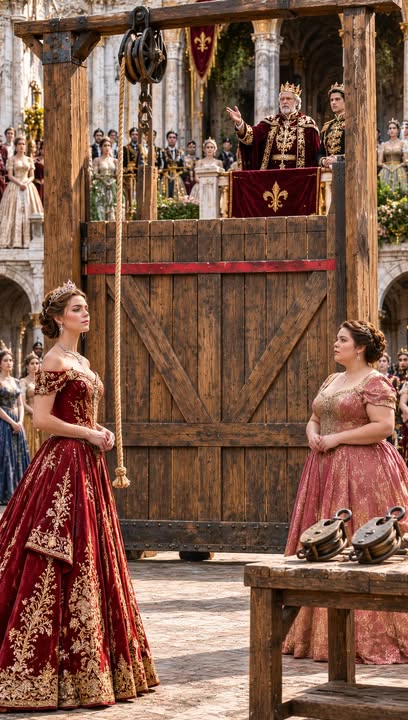
Part 4 – The Ink Beneath the Record
Emma stared at her father’s name, written twice beside the same amount.
The first payment had been for materials used to repair the gate.
The second bore a tiny mark in the margin that she did not recognize.
And beneath it, in unfamiliar ink, someone had written the words:
“Outstanding balance transferred to the royal account.”
For several seconds, no one spoke.
The lamps in the archive hissed softly, and somewhere beyond the tall windows a clock struck the hour.
Emma placed her hands flat against the table, as if she needed to feel its solid wood beneath her.
“Could the second entry mean he received the money again?” she asked.
Mr. Vale examined the page through his spectacles.
“It might,” he said. “But the wording is unusual. A payment to a worker would normally be recorded as issued, not transferred to an account.”
“Could it have been a correction?” Alexander asked.
“Possibly. The entry is in a different hand from the original ledger.”
Emma leaned closer.
The first line was written in dark brown ink, its letters rounded and familiar from the accounts she had already studied.
The second appeared narrower, its strokes sharp and pressed into the paper.
“The mark beside it,” she said. “I’ve seen it before.”
Alexander looked at her.
“Where?”
“In the maintenance notes, beside the gate repair.”
She found the inventory sheet and set it next to the ledger.
The small diagonal symbol stood beside the entry for the replacement wheel.
It was not identical to the mark in the account book, but the angle and the short hooked tail were unmistakably similar.
“My father used a cut like that to show a part had been checked,” Emma said. “But this one has an extra stroke.”
“Could the extra stroke have been added later?” Alexander asked.
“I don’t know.”
Mr. Vale turned the ledger toward the light.
“The paper is worn, but I can see a faint impression beneath this line.”
He fetched a sheet of thin archival paper and laid it gently over the page, then passed the side of a soft pencil across the surface.
A series of shallow marks appeared.
The first words were difficult to distinguish.
Then, little by little, a sentence emerged beneath the darker writing.
“Materials for the west gate,” Emma read.
The next words had been pressed so lightly that they seemed almost to vanish.
“Paid from the repair account.”
Alexander bent nearer.
“Someone wrote over it.”
Mr. Vale did not answer at once.
He compared the pressure of the two lines, then checked the adjacent page.
“The original entry was made before the darker notation,” he said. “The words beneath it are part of the first record.”
Emma’s mouth went dry.
“Can you read the rest?”
“Not yet. I would need better light and more time to avoid damaging the page.”
“Then let us give it both,” Alexander said.
He instructed the archivist to secure the ledger and limit access until it could be examined properly.
Mr. Vale covered the book with its protective cloth, but Emma kept looking at the place where the old sentence had surfaced.
The words “paid from the repair account” shifted the meaning of the repeated sum.
The money may not have gone to her father at all.
It may have been moved from one royal account to another, then recorded beside his name to make it appear otherwise.
Still, they had only fragments.
She had spent years holding to her father’s innocence as a private belief, and now the evidence seemed to offer a path toward it.
She was afraid to step onto that path too quickly.
“What does ‘transferred to the royal account’ mean?” she asked.
Mr. Vale gathered the papers into a careful stack.
“Without the full accounts, I can’t say.”
“Could it mean the balance was settled?”
“It could,” Alexander said. “Or it could mean someone moved the charge somewhere else.”
Emma looked at the prince.
“You’re trying not to reassure me.”
“I am trying not to mistake hope for proof.”
“That is kinder than reassurance,” she said.
He met her gaze and gave a slight nod.
The king arrived at the archive shortly afterward, having received word that the original register had been found.
He listened as Mr. Vale described the two entries, the changed handwriting, and the faint impression beneath the later notation.
The king’s face grew grave as he studied the page.
“This record should have been examined when the accusation was first made,” he said.
“It may have been,” Alexander replied. “We don’t yet know what the original inquiry contained.”
“Then we must find it.”
The king directed Mr. Vale to search the archive for the dismissal inquiry, related vouchers, and any correspondence between the former treasurer and the maintenance office.
He also ordered that no one make copies or remove records without the archivist’s supervision.
The instructions were measured, but the urgency beneath them was plain.
Emma watched the king as he spoke.
He did not try to soften the possibility that the palace had failed her father.
That mattered more than a promise that the truth would be pleasant.
When the king had finished, he turned to her.
“I cannot undo what your family endured,” he said. “But I can ensure that the record is examined properly.”
“Thank you, Your Majesty.”
“I hope the inquiry brings you an answer.”
“So do I,” Emma replied. “Even if it is not the answer I came looking for.”
The king studied her for a moment, then bowed his head before leaving with Alexander.
The archive grew quiet again.
Mr. Vale continued his search while Emma and Alexander walked to the narrow records room adjoining the library.
Shelves crowded its walls, and the air smelled of paper, dust, and the faint mineral scent of the stone beneath the palace.
A small desk stood beneath a high window.
Alexander opened a folder of copied maintenance reports, while Emma carefully examined a list of supplies used in the west gate repair.
One line named the replacement wheel.
A second recorded the iron pin.
The total matched the forty-two crowns on the voucher.
“This is the same sum,” she said.
“It is.”
“So the first entry was genuine.”
“Everything we have seen supports that.”
“And the second one?”
“We have not seen enough to know.”
She traced the paper’s edge with one finger.
“My father said accounts were like machines,” she murmured. “If a part did not fit, you had to find out where the strain was going.”
Alexander looked up from the folder.
“Do you remember him saying that before the accusation?”
“I’m not sure.” Emma let out a slow breath. “It may be a memory I have shaped around what I need now.”
“That does not make the memory useless.”
“It doesn’t make it evidence either.”
“No,” he said. “But it may tell us what he valued.”
His answer settled between them, warm without being easy.
They worked through the reports until the light beyond the window had begun to fade.
The records showed that Thomas Hale had repaired several palace mechanisms during his final year.
His notes were concise and precise, often including measurements and the names of the workers who had assisted him.
There was no sign of careless work.
But the inquiry folder remained missing.
Near dusk, Mr. Vale returned with a slim envelope bearing an old royal seal.
“I found this inside a box of correspondence from the former treasurer’s office,” he said. “It is addressed to the late king.”
The current king, who had remained in the palace, was summoned to the archive.
He arrived with Alexander and asked the archivist to read the letter aloud.
The page was dated a month before Thomas Hale’s dismissal.
Its author was the late king, writing to his treasurer.
The letter was brief and restrained.
It questioned a discrepancy in the maintenance accounts and asked for an explanation of several charges listed under the west gate repairs.
The final lines said that the king intended to review the original vouchers himself.
The current king lowered his eyes to the letter.
“My father had begun to question the accounts,” he said.
“Did he ever receive a reply?” Alexander asked.
“Not that I know of.”
“Could this have been related to my father’s dismissal?” Emma asked.
“It may have been,” the king said. “But the letter alone cannot tell us.”
He examined the seal and the date.
“My father died before I was old enough to understand these matters. I remember the palace changing after his death, but not the details.”
Emma felt the room shift around her.
For years, she had believed that the palace had accused her father and then forgotten him.
Now she learned that a king had questioned the records before the dismissal, perhaps trying to understand what had happened.
The thought offered no comfort, but it changed the shape of the past.
“Why was this letter not in the royal correspondence archive?” Alexander asked.
“It should have been,” Mr. Vale replied. “It may have been separated during the transfer of the treasurer’s papers.”
The king looked toward the shelves.
“Then we must find the rest of that correspondence.”
He asked Mr. Vale to continue searching, and he told Alexander to accompany Emma to the old maintenance workshop the following morning.
“If the gate repair left physical records or tools, they may help us understand the marks,” the king said.
Emma nodded.
“I’d like to see where my father worked.”
The king’s expression softened.
“Then you shall.”
Before they left the archive, Alexander asked whether she wished to return to the guest rooms.
Emma looked once more at the covered ledger.
“I think I need to see the gate again.”
They crossed the courtyard together beneath a sky washed with the last pale light of evening.
The enormous oak gate stood closed, its iron bands dark against the wood.
The two spare pulleys had been removed, and the royal mechanics had begun checking the permanent mechanism.
A worker held a lantern beside the frame.
Emma walked to the stone post where the red line had been painted for the challenge.
She touched the edge of it.
Only that morning, the line had marked a test she could meet through patience and thought.
Now she understood that the gate had been tied to her family’s history long before she stepped into the courtyard.
Alexander stood beside her without speaking.
“The pulley’s old mark was my father’s,” Emma said.
“It seems likely.”
“But someone added the newer one later.”
“Yes.”
“Whoever did that knew the mark would be recognized by someone.”
“Or they knew the records well enough to make it seem familiar.”
Emma turned toward him.
“You think the pulley was brought out to make us notice it?”
“I don’t know.”
“Then why place it among the challenge equipment?”
“I can’t answer that yet.”
She watched the mechanic test the permanent wheel.
The movement was smooth, but when the worker stopped turning it, the wheel gave a faint, uneven click.
Emma stepped closer.
“Could you turn it once more?” she asked.
The mechanic did.
The click came again, low and distinct.
“Have you heard that before?” Alexander asked him.
“Not in recent weeks, Your Highness. The gate is due for a full inspection.”
Emma listened to the sound again.
It was not the same catch she had felt in the spare pulley, but it was close enough to stir unease.
“Would my father have repaired this wheel?” she asked.
“He worked on the gate,” the mechanic replied. “I can’t say which parts he handled.”
The lantern light moved over the iron rim.
Emma leaned in and saw a narrow groove near the hub, almost concealed beneath old grease.
It looked like the angled inspection cut on the spare pulley, but the metal around it had been polished more recently.
“Please don’t touch that yet,” she said.
The mechanic stopped his hand.
Alexander came nearer.
“What is it?”
“A mark, perhaps. Or a scratch.”
The mechanic tilted the lantern so the light fell across it.
A second line, thinner and newer, crossed the first at an odd angle.
Emma’s pulse quickened.
“That is the same added stroke,” she said.
The mechanic examined the wheel without touching it.
“The permanent wheel was installed years ago. If the mark is new, someone has worked on it since.”
“Can we tell when?” Alexander asked.
“Not by looking alone,” the mechanic replied. “The metal would need to be examined in the workshop.”
The king had ordered the pulley preserved, but this wheel belonged to the gate and could not be removed casually.
The mechanic said he would arrange a careful inspection at first light.
Emma stepped back.
She had come to the palace hoping to find a clear record, a forgotten witness, or a simple proof that her father had been wronged.
Instead, every answer seemed to lead to another question.
The account showed a payment for legitimate materials.
A second entry repeated the same sum.
Someone had written over the original wording.
A pulley carried her father’s mark, then a newer one.
And now the gate itself bore a similar alteration.
“Do you still believe the evidence is leading somewhere?” Alexander asked.
Emma studied the darkened gate.
“Yes,” she said. “I just don’t know whether it is leading toward my father or away from him.”
Alexander’s hand rested on the stone post, close to hers but not touching.
“We’ll find out.”
The promise did not sound like a prince offering rescue.
It sounded like a person willing to stay beside her while the answer took shape.
The next morning, Emma returned to the maintenance workshop with Alexander and the royal mechanic.
The room had changed little since her childhood.
Its high windows let in a grey wash of daylight, and the long benches still held tools in orderly rows.
For a moment, Emma could almost see her father standing at the far bench, turning a small piece of iron in his hands.
She moved toward the cabinet where the old inspection tools were stored.
The mechanic unlocked it and brought out a shallow wooden box.
Inside lay files, measuring calipers, and several steel punches.
Emma recognized the handle of one file, its smooth curve worn by a familiar grip.
“My father used this one,” she said.
The mechanic looked at the tool.
“It was kept with the west gate kit after he left.”
Emma examined the file’s teeth.
They were dulled with age, but a small notch had been carved into its wooden handle.
Her father had made that mark himself.
She set the file down and looked toward the gate records stacked on the nearby bench.
One sheet listed the old wheel as inspected and fitted by Thomas Hale.
A later note, written many years afterward, recorded a repair to the same mechanism.
The name beside it was not a maintenance worker.
It belonged to the former treasurer’s office.
Alexander read the entry over her shoulder.
“Why would the treasurer’s office record a gate repair?”
“It shouldn’t,” the mechanic said. “They handled the accounts, not the machinery.”
The later note contained only a date and a short phrase: “Adjustment to balance, west gate.”
Emma looked at the phrase again.
“Adjustment to balance,” she said. “That sounds like an account, not a wheel.”
“It may have been copied onto the wrong sheet,” the mechanic suggested.
“Or someone wanted it to look as though it belonged here,” Alexander said.
Emma turned the page over.
A faint indentation showed through from the sheet beneath it.
She placed the record against the window and angled it toward the light.
There were marks where someone had written on another page above it.
Only a few words could be made out.
“Transfer… account… original voucher…”
The final word was blurred beyond recognition.
“Can the paper be examined?” Alexander asked.
The mechanic nodded.
“The archivist will know how to preserve it.”
Alexander sent an attendant to bring Mr. Vale.
Emma remained by the window, holding the sheet carefully by its edges.
The more she learned, the less she could rely on the story she had carried in her mind.
Her father might have made a mistake.
He might have received money he believed was owed.
Someone might have used his name without his knowledge.
Or the palace’s records might have been altered after his dismissal to hide a different theft.
She could not choose among those possibilities because one hurt less than another.
Mr. Vale arrived with the archival lamp and a magnifying lens.
He examined the paper, then the old tool marks in the workshop.
When he looked at the sheet against the light, he asked the mechanic to fetch a piece of clean glass.
The record was laid flat beneath it.
Using a small mirror, Mr. Vale directed light across the page at a shallow angle.
The faint impressions emerged more clearly.
“‘Transfer to the royal account’ is here,” he said. “And beneath it, I can make out the beginning of another line.”
“What does it say?” Emma asked.
“‘Original voucher returned to—’”
The rest of the words disappeared beneath a crease.
“Can you read the name?” Alexander asked.
“Not yet.”
Mr. Vale lifted the page and examined its lower edge.
A fragment of a paper seal clung to the back, its wax long since broken.
The seal bore the faded image of a crown and the initials of the former treasurer.
Emma felt her stomach tighten.
The old payment record had been connected to the treasurer’s office after all.
But that alone did not prove he had changed anything.
“Could the original voucher be in his correspondence?” she asked.
“It may be,” Mr. Vale said. “Or it may have been returned to the maintenance account.”
“Can we search both?”
“Yes.”
Alexander turned to the mechanic.
“Keep the gate secured until the wheel has been examined. No repairs to that hub until the archivist has documented its marks.”
The mechanic agreed.
The current king arrived shortly afterward, having been informed that the workshop record bore the former treasurer’s seal.
He read the fragment and the copied entry in silence.
“My father had begun asking questions about the same account,” he said. “Now we have a record showing the treasurer’s office handled a note concerning the gate.”
Emma watched him fold his hands behind his back.
“Your Majesty,” she said, “I need to ask something plainly.”
“Ask.”
“If the records show my father received that money, will you accept the entry as proof?”
“No,” the king replied. “Not without examining the original voucher, the source of the entry, and the circumstances of the payment.”
“And if the records show someone altered them?”
“Then we will identify who did it and why.”
The king’s answer was steady, but Emma heard the cost beneath it.
A royal account had been questioned.
A former treasurer’s seal had appeared beside an altered record.
The truth might expose more than one person’s mistake.
Still, the king did not ask her to remain quiet.
He asked Mr. Vale to search the treasury correspondence and directed the palace clerk to locate the complete dismissal inquiry.
Victoria entered the workshop as the king was leaving.
She had been helping the household staff prepare a list of old service cottages and their tenants, a task she had volunteered for after hearing about Emma’s family.
“I thought these might help,” she said, offering a folded page to the archivist. “The household records show which workers were moved after their employment ended.”
Emma accepted the paper.
Her family’s name appeared on the list, followed by the date they had left the cottage.
Beneath it, in a small note, was a reference to a storage room where personal effects left behind by former workers had been kept.
“My mother thought everything from our cottage had been lost,” Emma said.
“Perhaps not everything,” Victoria replied.
The note gave the number of a storeroom beneath the old administrative wing.
The king arranged for the room to be opened under supervision.
It held crates of worn uniforms, broken tools, and household objects no one had claimed.
Dust covered the shelves, and the air was cold enough to make Emma draw her shawl close.
She searched slowly, reading the faded labels.
Alexander stayed near the door while Victoria and the archivist helped sort the boxes.
At the back of the room, Emma found a small wooden case with her father’s name written across its lid.
She knew his handwriting at once.
Her fingers paused above the latch.
“Would you like me to open it?” Alexander asked.
“No,” she said. “I think I should.”
The latch gave way with a soft click.
Inside lay a worn leather notebook, two measuring tools, and a folded sheet of paper sealed with a strip of old thread.
Emma picked up the notebook first.
Its pages contained sketches of hinges, notes about repairs, and small reminders written in the margins.
Near the back, she found a drawing of the west gate pulley system.
The sketch showed two wheels and a supporting brace.
Beside it, her father had written the date of the repair and the words, “Checked after fitting; all parts accounted for.”
Below that, in a different hand, someone had added a short notation.
“Account adjusted by order of the treasurer.”
Emma’s hands went cold.
Alexander leaned closer.
“Is that your father’s writing?”
“No.”
The added words had been pressed into the paper with a sharp nib, the letters slanting forward.
Mr. Vale compared them with the altered entry in the ledger.
“The hands may be similar,” he said. “I would need time to be certain.”
Emma turned the page.
There, tucked into the fold, was a narrow strip of paper with a date and a line in her father’s careful handwriting.
“Payment received for materials only. Balance to be returned upon inspection.”
She read it twice.
The note did not prove he had returned the money.
But it showed he had understood the payment as a reimbursement, not as wages or personal funds.
A tremor passed through her.
“He kept this because he knew the account might be questioned,” she said.
“Or because he wanted a record for his own work,” Alexander replied.
“Either way, he was careful.”
The archivist examined the paper’s folds.
“This note was kept with the notebook, not added later to the case. The ink and paper appear consistent with the period.”
Emma held it against her chest for a moment, then lowered it.
The notebook offered evidence of her father’s care, but it also carried the strange added notation from the treasurer’s office.
The old story was no longer a simple accusation.
It was becoming a record of two people’s actions: a worker documenting what he had done, and someone with authority changing how that work was accounted for.
Mr. Vale found a small envelope tucked beneath the notebook.
It was addressed to the royal archives, but the envelope had never been opened.
The seal was broken already, and a line of writing showed at the top of the page inside.
The archivist unfolded it carefully.
The letter was dated three days before Thomas Hale’s dismissal.
It was written by the late king to his treasurer.
“My father’s letter,” the current king said quietly when he saw the royal seal.
Mr. Vale read the opening lines.
The late king asked the treasurer to provide the original voucher for the west gate repair and to explain why the balance had been transferred to the royal account.
Then he stopped.
“What is it?” Alexander asked.
The archivist looked at the bottom of the page.
“There is a second sheet.”
He lifted the letter, revealing a page folded beneath it.
The handwriting was not the late king’s.
It was the former treasurer’s.
The first line was addressed to the king, and the final line bore a signature.
Mr. Vale read it in silence, then looked up at Emma.
“The treasurer says he did not receive the original voucher,” he said.
Emma’s fingers tightened around the notebook.
The letter continued.
It claimed that Thomas Hale had taken the voucher with him after receiving the payment, leaving the account unsettled.
The accusation had been written only days before her father was dismissed.
The king’s face hardened, not with anger, but with concentration.
“Is there more?” he asked.
Mr. Vale turned the sheet over.
A short note had been added at the bottom, beneath the treasurer’s signature.
It read: “The original is held with the west gate record and will be presented when the account is called.”
Emma looked toward the notebook in her hands.
The note could mean her father had kept the voucher.
It could also mean the treasurer knew where it was and had chosen not to produce it.
Neither explanation felt complete.
Mr. Vale placed the letter beside the sketch of the gate.
The old cut marks in the drawing matched the marks on the pulley.
The newer mark, however, crossed through the first one.
It was the same unusual stroke that Emma had noticed beneath the grease.
The archived records, the physical machinery, and her father’s notebook now pointed toward the same person’s office.
But a question remained, sharp as the cut in the metal.
If the former treasurer had claimed the original voucher was missing, why had he written that it was held with the west gate record?
And who had hidden it before the account was called?
**–END OF PART 4–CLICK “NEXT” AT THE BOTTOM OF THE PAGE TO CONTINUE READING**
* * *
[PREVIOUS: PART 3](https://storyly.idolsgift.com/blog/part-3-the-gate-rose-but-emma-asked-for-time-057) | [NEXT: PART 5](https://storyly.idolsgift.com/blog/part-5-the-gate-rose-but-emma-asked-for-time-057)
✓ Lynn R. Adams
Part 4 – The Ink Beneath the Record Emma stared at her father’s name, written twice beside the same amount. The first payment had been for materials used to repair the gate. The second bore a tiny …