PART 4: The Cufflink in Bethany’s Hand 027
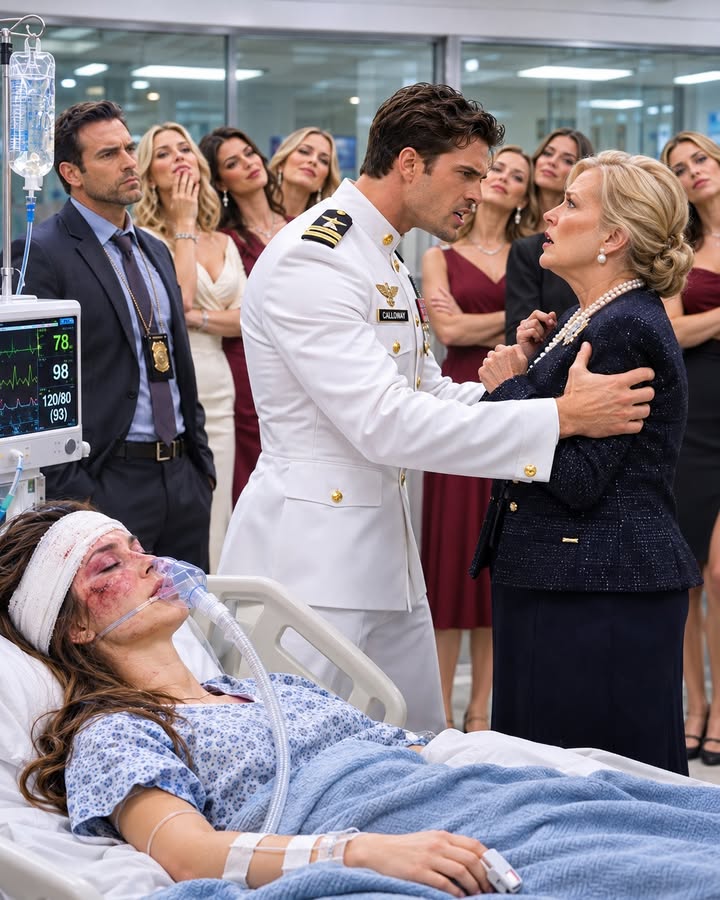
Part 4 – The Ledger’s Witness
For several seconds after Granger told me Adeline had been secretly meeting Vale, the consultation room held only the hum of its fluorescent lights.
I looked down at the photograph of the ledger page, at the careful handwriting and the sentence that had led us here.
“Can you tell me what happened at the company?” I asked Vale.
He stood by the window, hands clasped behind his back, his retirement suit neat and unremarkable.
“I can tell you what Adeline found,” he said. “But the ledger itself isn’t here.”
“Where is it?”
“Safe.”
“That isn’t an answer.”
“No,” he agreed. “It’s the answer I can give until I know who will have access to it.”
Granger pulled out a chair but did not sit.
“Colonel, you’re speaking with law enforcement,” he said. “If you have evidence connected to an assault and a possible corporate crime, withholding it could compromise the investigation.”
Vale’s eyes rested on him.
“I understand.”
“Then tell us where it is.”
“I will, once I can be certain it won’t be circulated without safeguards.”
Granger’s jaw tightened.
“You don’t get to decide that alone.”
“I know.”
Vale’s quiet reply carried no challenge, only exhaustion.
It was the first time I saw him as more than a polished officer from another part of my past.
He looked like a man who had held a secret too long and had begun to understand that secrecy had its own cost.
“Adeline trusted you,” I said.
“She did.”
“And you let me believe she was meeting you behind my back.”
“I didn’t know she had written that in her notebook.”
“You could have told me.”
“I could have,” he said. “But I had no reason to bring you into it without her permission.”
The words struck me because they sounded like something Adeline might have said.
Not to excuse herself, but to protect a boundary she had considered necessary.
I took a breath and let it out slowly.
“Start with what she found.”
Vale glanced at Granger.
The detective gave a small nod.
“Years ago, Voss Aeronautics was preparing a new aircraft component for certification,” Vale said. “A control assembly designed for a transport plane. It was lighter and cheaper than the model it replaced, and the company expected it to become a major contract.”
“What went wrong?”
“Testing showed that the assembly could fail under a specific combination of stress and temperature. The failure was rare, but the consequences were serious.”
A silence settled between us.
“Was there a crash?” I asked.
“Yes,” Vale said. “A test aircraft went down during a demonstration flight. The pilot died.”
I thought of Adeline in the ICU, her bruised face turned slightly toward the window.
“Was the component responsible?”
“It was a contributing cause. The official report described it as an isolated mechanical failure. The company’s internal review reached a different conclusion.”
“Who knew?” Granger asked.
“Several engineers, a safety manager, and members of the executive team. Adeline worked in compliance then. She helped assemble the internal reports.”
“Was she ordered to alter them?”
“Not at first. She was asked to correct inconsistencies, then to remove language that could be interpreted as admitting the company had ignored warnings.”
“And she refused?”
“She questioned the changes. She asked for the test data and the original inspection notes.”
Vale’s gaze dropped briefly to the floor.
“She believed the discrepancy could still be resolved through ordinary channels. She thought the company would correct the problem if the right people saw the evidence.”
“Did they?”
“No.”
His answer was simple, and for that reason it hurt.
“When the final report was filed, the warnings were described as speculative,” he continued. “The faulty component was approved for production. Adeline discovered that the raw data had been altered before it reached the certification team.”
Granger’s expression sharpened.
“Altered by whom?”
“People inside the company. I never saw enough to identify everyone involved.”
“But you saw enough to know the report was falsified.”
“I saw the original records. Adeline brought them to me.”
“Why you?”
“I was still in the Army then. I had been asked to consult on a separate evaluation, and she knew I had experience reviewing equipment failures. She wanted an independent assessment before she made a formal complaint.”
I looked at him.
“And what did you tell her?”
“That the evidence warranted a halt to production and an external investigation.”
“Did you help her report it?”
“I told her I would.”
His eyes met mine, and I saw the answer before he spoke again.
“But you didn’t.”
“No.”
The admission hung between us.
“Why not?” Granger asked.
Vale took a moment.
“I believed the matter was already being handled inside the company. Constance assured me an outside review had begun. I was reassigned to another contract, and I accepted that explanation.”
“Did you verify it?”
“No.”
It was the first answer that made him seem less like a keeper of secrets and more like a man who had made a choice he could not undo.
“Adeline later showed me that the review had never happened,” he said. “By then, the component had been installed in other aircraft.”
“Why did she keep working there?” I asked.
“She thought she could preserve the records. She believed that if she left, the only copies would disappear.”
I remembered Adeline telling me, years earlier, that she had finally resigned because she could no longer make herself useful to people who mistook patience for agreement.
At the time, I had thought she meant the family.
Now I understood she had been speaking about the company as well.
“What was in the ledger?” Granger asked.
“A record of the changes made to the safety reports,” Vale said. “Dates, names, internal references, and copies of the original test data.”
“Enough to prove the reports were falsified?”
“Enough to start a federal inquiry. The ledger also contains the identities of people who shared information with Adeline.”
“Whistleblowers?” I asked.
“Some. Others were engineers who answered questions without realizing their names would be included in a formal record.”
Vale’s eyes moved to the photograph on the table.
“Adeline was afraid the ledger would expose them to retaliation or public attention before they were protected.”
“And you took it from her?” Granger asked.
“She gave it to me temporarily. She wanted a copy secured outside the company while she sought advice on how to report it.”
“Why didn’t you turn it over to investigators?”
“I thought I could arrange a protected disclosure through people I trusted. I was wrong about how much time we had.”
I heard the faint scrape of a chair behind us.
Adeline’s nurse had opened the door, and Bethany stood beside her.
She looked pale, but her eyes were fixed on Vale.
“Did my mother know about the ledger?” she asked.
Vale turned toward her.
“Constance knew Adeline had records. I don’t know when she learned the full contents.”
“I heard her say, ‘Find it before anyone else does.’”
“I believe you.”
“Did she know what was in it?”
“I don’t know.”
Bethany’s voice trembled, but she kept going.
“Vivian was in the study with a man from security. Were they looking for the ledger?”
Vale looked at Granger before answering.
“That is what I believe.”
“Who was the man?”
“I don’t know his name.”
Granger leaned against the table.
“Colonel, do you know who arranged the attack?”
Vale’s expression tightened.
“I know what Adeline told me after it happened.”
“You’ve spoken to her since she was admitted?”
“No.”
“Then what did she tell you?”
Vale looked toward the ICU door.
“Before the attack, she called me and said Constance had learned about the ledger. She wanted me to meet her at the house, but I didn’t go.”
The air seemed to thin.
“Why not?” I asked.
“I was already on my way to the airport. I thought we could speak the next morning.”
“And then?”
“Then I saw the news that she had been admitted.”
“Why didn’t you tell the police?”
“I was afraid that if I approached them before I knew who was investigating, the ledger would disappear.”
Granger’s face hardened.
“You decided you could manage this alone.”
“Yes.”
“You made the same mistake Adeline did.”
Vale accepted that without protest.
“I know.”
The simple admission left me with no easy place to put my anger.
I wanted to blame him for withholding the truth, for letting Adeline take a risk while he stayed at a distance.
But he was already naming the failure himself.
That did not make it harmless.
It only made it harder to pretend I would have done everything differently.
Granger looked toward the corridor.
“I need to speak with the hospital about Adeline’s condition and arrange a formal interview,” he said. “This room is becoming crowded.”
Bethany’s attention remained on Vale.
“Did you ever tell my mother you had the ledger?”
“I told her I had documents related to the safety review. I did not tell her where I kept them.”
“But she knew you had something.”
“Yes.”
“Then how did she know it was at Adeline’s house?”
“I don’t know.”
The answer opened another silence.
I remembered Bethany’s account of the night, the low voice saying, “Get the ledger.”
I remembered Constance asking whether they had checked the study.
At the time, I had imagined a hurried search for something stolen from the company.
Now the phrase had a name, a history, and dead weight behind it.
Granger stepped out with Bethany to speak with the nurse.
Vale remained by the window.
“You said you have the ledger,” I told him.
“I do.”
“Then give it to the authorities.”
“Not until we know how to protect the names in it.”
“People were hurt because it was hidden.”
“I know.”
“Adeline was hurt.”
“I know.”
He said it again, and this time the words seemed to cost him.
“I thought keeping it safe would buy time,” he continued. “I did not understand that the people looking for it would force the timetable.”
“You knew Constance was looking.”
“I knew she wanted the records. I didn’t know she would send people into Adeline’s home.”
“Did you warn her?”
“I tried.”
“When?”
“Two days before the attack. She said she already knew.”
The hallway seemed to return around me—the hard hospital light, the unsteady breath I had been trying not to hear, Bethany’s small hand closing over the cufflink.
“Why did Adeline go back to the house?” I asked.
“It was her home.”
“She could have stayed somewhere else.”
“She wanted to believe she could still handle her family without letting the company take over her life.”
The sentence sounded too much like an explanation offered after the fact.
I turned away from him.
For years, I had thought Adeline’s silence was a distance between us.
Now I could see it as a wall she had built to keep danger from crossing into our home.
The wall had not saved her.
It had only left her standing alone when the people on the other side came through the door.
The ICU nurse returned and said Dr. Pike would allow a brief visit.
I went at once.
Adeline looked no different, yet the room felt changed by what we now knew.
I sat beside her and spoke softly.
“Vale says you found falsified safety reports at the company,” I said. “He says you copied the evidence because you wanted the truth brought out without exposing the people who helped you.”
Her fingers rested beneath the blanket.
“I’m sorry I didn’t know,” I continued. “I’m sorry I thought your silence meant you didn’t trust me.”
The monitor continued its steady rhythm.
“I want to understand why you chose to carry it alone. When you wake up, you can tell me in your own words.”
I stayed for a few minutes, then rose when the nurse signaled that she needed to check Adeline’s lines.
At the doorway, I looked back.
Nothing had changed in her face.
Everything had changed in the story I had been telling myself about her.
Granger was waiting outside.
“I’ve spoken with the hospital administrator,” he said. “They located the original access system record.”
“And?”
“It confirms Martin Hales entered the unit before the ambulance arrived.”
“Did he go into Adeline’s room?”
“The record shows his badge at the door. The hospital is still reviewing the camera footage.”
“Can they preserve it?”
“They’ve made a copy.”
“Good.”
Granger’s relief was slight but visible.
“The correction they gave me this morning was wrong,” he said. “I’m documenting how it happened and who authorized it.”
“Was it deliberate?”
“I don’t know yet. The administrator says a clerk restored an earlier version of the log after a software update.”
“Do you believe that?”
“I believe we need more than an explanation.”
Vale had joined us in the corridor.
“Martin Hales was employed by Constance,” he said. “He often handled the family’s travel and security arrangements.”
“Why would he go to the hospital before the ambulance?” I asked.
“He could have gone there to prepare for her arrival,” Vale said. “Or he could have had another reason.”
“Did you send him?”
“No.”
“Did Adeline?”
“No.”
Granger watched him closely.
“Do you know if Constance knew about the entry?”
“I don’t.”
Bethany stepped out of the family room, carrying a paper cup she had not touched.
“I remember Martin,” she said. “He was at the house sometimes, but he usually stayed near the cars.”
“Did you see him that night?” Granger asked.
“No. I heard the man with the radio, but I didn’t see his face.”
“Could it have been him?”
“I can’t say.”
“Don’t guess,” I told her.
“I’m not.”
She studied the floor, then lifted her gaze.
“I keep remembering the study door. Vivian went in, and the man stood outside for a moment. Then Mother said something from the hall.”
“What did she say?” Granger asked.
Bethany closed her eyes.
“I couldn’t hear all of it. She said, ‘Not until you find it.’”
The words fell between us.
“What happened after that?” Granger asked.
“I heard a crash. Then someone said Adeline’s name.”
“Who?”
“I don’t know.”
Bethany’s voice had become barely audible.
“I thought I heard Vivian answer, but I’m not sure.”
Granger wrote it down, careful to mark what she knew and what she did not.
“Did you hear any orders to hurt Adeline?”
“No.”
“Did you see anyone touch her?”
“No.”
Bethany’s hands tightened around the cup.
“I want to be clear about that. I didn’t see the assault.”
“You’re doing the right thing,” Granger said. “We’ll keep the distinction in your statement.”
A doctor approached from the unit and asked for me.
I followed him into a quiet office.
Adeline’s neurological readings were still stable, he said, but her body needed time and she remained deeply unconscious.
He did not make promises.
I did not ask him to.
When I returned, Granger was speaking with Vale in a low voice.
The detective’s posture had changed.
“Colonel, I’ve spoken with the district attorney’s office,” he said. “They agree the ledger needs to be secured, but they want to review it before deciding how to handle the names it contains.”
“Who in that office?” Vale asked.
“Chief Deputy Mercer.”
Vale’s face gave away little, but I noticed his eyes shift.
“Is that a problem?” Granger asked.
“I don’t know.”
“You’ve worked with him?”
“Years ago.”
“What do you know about him?”
“Nothing that would justify keeping evidence away from him.”
“But?”
Vale looked toward the ICU.
“But Adeline believed the county’s channels were compromised.”
Granger’s mouth tightened.
“That’s a serious concern.”
“It is.”
“You can’t withhold the ledger indefinitely.”
“I won’t.”
“Then where is it?”
Vale hesitated.
The pause lasted only a few seconds, but it seemed to gather every doubt we had been carrying.
“I placed it in a secure storage room at the company,” he said.
“You said it wasn’t with you,” I replied.
“It isn’t. I secured it there.”
“Then the company may already have access.”
“They don’t have the key.”
“Who does?”
“I do.”
Granger’s expression turned hard.
“Is that the only copy?”
“No.”
“Where is the other?”
Vale did not answer.
I stepped closer.
“Adeline asked you to protect it. She didn’t ask you to keep it from everyone.”
“I know.”
“Then give us the second copy.”
“I will,” he said. “But not here.”
“Why not here?” Granger asked.
“Because I don’t know who has access to the hospital’s records, the county’s files, or the company’s offices. I need a secure transfer.”
Granger studied him.
“I’ll arrange a federal evidence intake through the nearest field office. That gives us a documented chain of custody beyond the county.”
Vale considered it.
“That would be acceptable.”
“What does the ledger contain besides the safety reports?” I asked.
“Names, dates, internal correspondence, and notes about who provided each document.”
“Would those people be in danger if it became public?”
“Some could lose their jobs. Others could face lawsuits or intimidation. A few are still working at the company.”
“Then it can’t simply be dumped into the news.”
“No,” Vale said. “It can’t.”
I thought of Adeline’s sentence in the notebook: proof against all of us.
The ledger was not just a weapon against the Voss family.
It was a record of choices made by frightened people, people who had tried to do the right thing and might now be exposed by the evidence intended to save them.
Granger took out his phone and began arranging the federal transfer.
As he spoke, a nurse hurried from Adeline’s room.
“Major Calloway,” she said. “Dr. Pike wants you now.”
I followed her without waiting for an explanation.
Adeline’s eyes were open.
For a moment, I could not move.
The nurse leaned close to her, speaking softly and asking her to remain still.
Adeline’s gaze shifted, unsteady at first, then found me.
I crossed the room and stopped beside her bed, afraid that even a sudden breath might startle her.
“Adeline?”
Her throat moved beneath the tube.
Dr. Pike entered and checked the monitor, then spoke to the nurse.
They adjusted her breathing support and gave her time.
I stood where she could see me.
“It’s Wesley,” I said. “You’re in the hospital. You’re safe for now.”
Her eyes held mine.
A tear slipped from the corner of one eye and disappeared into her hair.
I reached for her hand, pausing until Dr. Pike nodded.
Her fingers shifted against mine.
“I’m here,” I whispered. “You don’t have to speak yet.”
She made a faint sound, so slight I almost mistook it for the ventilator.
Dr. Pike asked her to try blinking once for yes and twice for no.
Her first response was uncertain.
Then she managed one slow blink.
“We’re going to ask only a few questions,” he said. “If you get tired, we’ll stop.”
Adeline blinked once.
The room seemed to draw close around her.
I leaned in.
“Did you meet Colonel Vale to protect the ledger?”
One blink.
“Did you know Constance was looking for it?”
One blink.
“Did you tell her where it was?”
Two blinks.
“Did she come to the house that night?”
Adeline’s eyes moved toward me.
Then she blinked once.
My hand tightened around hers, but I tried to keep my voice even.
“Did Vivian come with her?”
One blink.
“Was the man from security there?”
One blink.
Dr. Pike reminded us that she needed rest.
I nodded, though I had a dozen questions pressing against my teeth.
Adeline’s eyes began to close.
Before they did, she made another small sound.
I bent closer.
“Adeline?”
Her lips moved around the tube, and the nurse asked her to blink if she wanted to continue.
One blink.
“Was the assault ordered by your mother?” I asked.
Her gaze flickered.
One blink.
The answer was small, but it changed the shape of the room.
Granger had come to the doorway.
He heard it too.
“Did Vivian strike you?” I asked.
Adeline blinked once.
“Did the security chief help her?”
One blink.
A pulse of anger rose in me, then passed through without finding anywhere to land.
I had imagined the attack as a mystery with one hidden face.
Now it had names.
The knowledge did not make me feel powerful.
It made me feel the distance between what I wanted and what justice would require.
“Did they come because of the ledger?” I asked.
One blink.
“Were they trying to take it?”
One blink.
She closed her eyes, and the nurse put a gentle hand on my shoulder.
“That’s enough for now,” she said.
Adeline’s breathing remained steady as the doctor checked her.
I stepped back, unable to trust my voice.
Granger waited until we were outside the room.
“She identified Constance, Vivian, and the security chief,” he said quietly. “We’ll need to take a formal statement when she’s able.”
“I know.”
“She also confirmed the ledger was the reason they came.”
“I know.”
For a while, neither of us spoke.
Through the glass, I could see Adeline lying still, her hand turned palm-up where I had held it.
The truth had not arrived as a clean explanation.
It had come in fragments, each one attached to a person we loved, a failure we had missed, or a choice we could no longer take back.
Bethany stood beside the nurses’ station, tears running silently down her face.
“She’s awake,” she whispered.
“Only for a few minutes.”
“But she knows we’re here.”
I nodded.
Bethany wiped her cheeks.
“I’m glad I told Granger.”
“Adeline is too.”
The words felt certain, even though I could not ask her to confirm them.
Vale joined us near the ICU doors.
“I’m sorry,” he said.
I looked at him.
“For what?”
“For not stopping the chain of events before it reached her.”
“You don’t know that you could have stopped it.”
“I should have tried harder.”
“Maybe,” I said. “But I’m not going to pretend that makes you responsible for what Constance and Vivian chose to do.”
Vale lowered his eyes.
Granger returned from the phone call.
“The federal field office will receive the ledger tomorrow morning,” he said. “I’ll arrange the transfer with a representative outside this county.”
“Will the names in it be protected?” I asked.
“They’ll be reviewed under seal first,” he said. “No public release until the investigators determine what can be disclosed safely.”
“Adeline wants the truth out,” I said.
“Then we’ll work toward that without putting the people in the ledger at unnecessary risk.”
I looked through the glass again.
A few hours ago, I had believed my wife’s silence meant she had hidden a life from me.
Now I understood that she had been trying to preserve the lives of people whose names I did not even know.
That truth did not erase the hurt between us.
It gave us something more honest to talk about when she was strong enough.
The corridor lights softened as evening settled over the hospital.
Granger went to prepare his report, and Bethany returned to the waiting room.
Vale stayed near the window, silent.
I took my place beside Adeline’s bed when the nurse allowed it.
Her eyes remained closed, but one hand rested close to mine.
I did not take it until she moved her fingers.
Then I held her gently.
“Your secret is safe for tonight,” I whispered. “But tomorrow we choose what happens to it together.”
Her thumb shifted against my palm.
I thought it was an unconscious movement.
Then she opened her eyes just enough to look at me.
She blinked once.
I leaned closer.
“Do you want the ledger released?”
One blink.
“Even if the names inside could hurt people?”
Her gaze held mine.
She blinked once again.
The answer carried no impatience, no anger, only the resolve that had led her to keep the records when others wanted them buried.
I looked toward the doorway, where Granger was returning with a sealed document in his hand.
“Then we’ll find a way to tell the truth without leaving them unprotected,” I said.
Adeline’s eyelids fluttered.
Before they closed, her lips moved once more around the tube.
The nurse leaned close, listened, then turned to me with a startled expression.
“She’s trying to tell you something.”
I bent down.
Adeline gathered what little strength she had and formed two silent words.
Not the ledger.
“The original?” I whispered.
She blinked once.
The nurse asked if the original was still with Vale.
Adeline blinked twice.
The room went very still.
Granger stepped inside, his expression sharpening.
“If the original isn’t with him,” he said, “where is it?”
Adeline’s eyes moved toward me.
Then, with a slow, deliberate blink, she answered the question none of us had thought to ask.
It was still in the house.
**–END OF PART 4–CLICK “NEXT” AT THE BOTTOM OF THE PAGE TO CONTINUE READING**
* * *
[PREVIOUS: PART 3](https://puretales.idolsgift.com/blog/part-3-the-cufflink-in-bethany-s-hand-027) | [NEXT: PART 5](https://puretales.idolsgift.com/blog/part-5-the-cufflink-in-bethany-s-hand-027)
✓ Lynn R. Adams
Part 4 – The Ledger’s Witness For several seconds after Granger told me Adeline had been secretly meeting Vale, the consultation room held only the hum of its fluorescent lights. I looked down at th…