Part 4 – The Crown Beneath the Roses-068
## Part 4 – The Choice No King Had Made
**Part 4**
For most of his life, Alexander had believed a crown was something one inherited.
That morning at Rosehill Cottage, he began to understand that it might also be something one questioned.
No one spoke for several moments.
Beyond the dusty windows, sunlight touched the abandoned glasshouses, turning their broken panes into scattered mirrors.
Emma finally looked at Lord Montgomery.
“You knew about Eleanor’s constitution?”
“Parts of it.”
“How?”
“My grandfather served on the Privy Council. Before he died, he gave me copies of several records.”
Victoria stared at her father.
“You never told me.”
“I thought I was protecting you.”
“From what?”
“From spending your life preparing for a position that might someday disappear.”
Victoria laughed once, without humor.
“So instead you encouraged me to spend my life preparing for exactly that position.”
Lord Montgomery lowered his eyes.
“Yes.”
The admission took much of the anger out of her.
Not because it excused anything.
Because it was honest.
Alexander stepped toward the window.
“What did Eleanor propose?”
Pembroke answered.
“A constitutional monarchy with substantially reduced royal authority. An elected assembly. Independent courts. Restrictions on hereditary privilege.”
Victoria blinked.
“In 1931?”
“Eleanor was ahead of her time.”
Emma smiled faintly.
“That seems to run in my family.”
Alexander turned.
“Your family.”
Emma heard the significance of those words.
Not _the royal family_.
Not _our family_.
Hers.
A history she could accept or reject for herself.
“What happened to the proposal?” Emma asked.
Lord Montgomery answered.
“The council buried it.”
Alexander’s jaw tightened.
“And the crown mechanism?”
“Eleanor created it as a safeguard. She believed future generations should periodically reconsider the relationship between crown and citizens. According to her notes, the mechanism can only be fully opened by the reigning heir and one of her descendants.”
“So all those noblewomen never had a chance,” Victoria said.
Pembroke looked uncomfortable.
“Apparently not.”
Victoria stared at the floor.
“That is rather humiliating.”
Emma touched her arm.
“You didn’t fail.”
Victoria looked at her.
“The contest wasn’t real.”
“No,” Emma said. “Which means none of you failed.”
Victoria’s expression softened.
“That is annoyingly generous of you.”
“I can stop.”
“Don’t.”
By afternoon they had found Eleanor’s constitutional draft in a concealed cabinet beneath the glasshouse potting tables.
The document was eighty-nine pages long.
Much of its language was outdated.
Some proposals had already become ordinary law over the decades.
Others were startlingly modern.
At its heart was a simple principle:
**No institution should survive merely because people are afraid to imagine life without it.**
Alexander read that sentence several times.
Emma found him alone afterward near the ruined rose garden.
“You disappeared.”
“I was thinking.”
“Dangerous.”
He glanced at her.
“Your confidence around princes continues to deteriorate.”
“I’ve had a difficult twenty-four hours.”
“So have I.”
She sat on a low stone wall.
After a moment he joined her.
The countryside stretched around them.
No ballroom.
No courtiers.
No crown.
Emma thought he looked younger outdoors.
“What will you do?” she asked.
“I don’t know.”
“That’s permitted.”
“Not usually.”
“Perhaps that’s part of the problem.”
Alexander nodded.
“My father wanted reform. I knew that. But I thought he meant smaller things. Financial transparency. More elected oversight. I didn’t know he was questioning the monarchy itself.”
“Maybe he wasn’t sure either.”
Alexander looked toward Rosehill Cottage.
“Everyone assumes being born an heir makes you certain you want to become king.”
“Do you?”
He did not answer immediately.
“I want to serve Rosehaven.”
“That’s not the same question.”
“No.”
A breeze moved through the high grass.
Emma waited.
Finally Alexander said, “I don’t know whether I want to be king.”
The confession seemed to surprise him.
Emma smiled gently.
“There. The sky didn’t fall.”
“Give it time.”
She laughed.
He looked at her then.
Really looked.
Not at Eleanor’s descendant.
Not at the woman who had solved the chest.
At Emma.
“What do you want?”
She was caught off guard.
“I don’t know either.”
“Good. Then we’re both disappointingly human.”
“I want my life to belong to me.”
Alexander’s expression became thoughtful.
“That sounds simple.”
“It isn’t.”
“No.”
Emma looked toward the cottage.
“I’ve spent years being a maid. I don’t dislike work. I like being useful. But people often assume that because you serve them, your dreams must be smaller.”
“What are they?”
“My dreams?”
“Yes.”
Emma hesitated.
No one in the royal household had ever asked.
“I wanted to study restoration.”
“Restoration?”
“Old buildings. Paintings. Decorative arts. Things people think are ruined when really they’ve just been neglected.”
Alexander smiled.
“That seems appropriate.”
“Why?”
“You found an entire forgotten history behind a pile of winter rugs.”
She smiled.
“I suppose I did.”
When they returned to the palace that evening, the story could no longer remain completely private.
Too many guests had witnessed the chest opening.
Rumors spread across Rosehaven.
But rather than inventing another lie, Alexander did something unusual.
He issued a short statement.
A historical discovery had revealed that the bride-selection tradition had been incorrectly understood for generations.
No engagement would be announced.
Independent historians would examine the records.
The palace would publish verified findings.
The statement caused astonishment.
But it also produced something Alexander had not expected.
Relief.
Several former contestants privately wrote to thank him.
One admitted she had participated only because her family insisted.
Another said she had been terrified she might actually win.
Victoria found that particularly amusing.
Two days later she entered Alexander’s breakfast room carrying a stack of newspapers.
“Congratulations.”
“For what?”
“You have achieved the impossible.”
She dropped them onto the table.
“The press is calling you sensible.”
Alexander winced.
“How devastating.”
Emma, who had been invited to join the discussion as a private citizen rather than a servant, smiled into her tea.
Victoria sat opposite her.
“You are worse. One paper calls you ‘The Rosehaven Mystery Woman.'”
Emma nearly choked.
“Oh no.”
“Another calls you ‘The Lost Princess.'”
“Absolutely not.”
Alexander looked suspiciously entertained.
Emma pointed at him.
“If you laugh, I am leaving.”
“I value my life too highly.”
Their growing ease did not escape Victoria.
Surprisingly, she did not resent it.
Perhaps because she was beginning to understand that what existed between Alexander and Emma could not have been manufactured by a ceremony.
Three days later the historians confirmed Eleanor’s journals.
Emma was indeed her direct descendant.
But the palace statement emphasized Eleanor’s own covenant: Emma held no title unless she requested recognition.
She did not.
Instead, Emma asked to remain employed temporarily while deciding what came next.
Alexander objected.
“Why?”
“Because everyone will think I’m keeping you here.”
“You are keeping me here.”
“As an employee?”
“I need income.”
He opened his mouth.
Closed it.
Emma smiled.
“Princes really don’t know how ordinary life works.”
“I am learning.”
She transferred from household service to the palace conservation office as a trainee.
It was an almost comically perfect arrangement.
Her first project was helping preserve Eleanor’s hidden archive.
For the first time, Emma entered the old west passage not with baskets of linen but with gloves, notebooks, and a place at the table.
Alexander visited often.
Perhaps too often.
He claimed an interest in preservation.
Emma eventually caught him holding a catalogue upside down.
“Studying?”
“Intensely.”
“Alexander.”
“Fine. I came to see you.”
Her cheeks warmed.
Neither knew what to do with that admission.
Their relationship grew through small moments.
Walks after work.
Conversations in the library.
Arguments about books.
Alexander discovered Emma loved terrible mystery novels.
Emma discovered Alexander could play the piano beautifully but hated performing publicly.
He told her about losing his father.
She told him about her mother.
Neither tried to solve the other’s grief.
That made the conversations easier.
A month after the ballroom challenge, Alexander finally asked:
“Would it be terribly formal if I invited you to dinner?”
Emma glanced around the archive.
“We’ve had dinner.”
“We’ve eaten sandwiches over eighteenth-century tax records.”
“They were good sandwiches.”
“Emma.”
She smiled.
“Are you asking me on a date?”
“I believe I am attempting to.”
“You’re not very good at it.”
“I’ve rarely needed practice.”
“That sounds arrogant.”
“It sounded worse as soon as I said it.”
She laughed.
“Yes.”
“Yes, it sounded arrogant?”
“Yes, I’ll have dinner with you.”
The dinner took place not in the state dining room but in a small greenhouse Alexander’s mother had loved.
There were no servants.
No press.
Alexander cooked.
Badly.
Emma ate the burned risotto anyway.
“This is terrible.”
“I know.”
“I appreciate the honesty.”
“You ate three bites.”
“I was confirming the evidence.”
They laughed until Emma had tears in her eyes.
Then Alexander grew quiet.
“Emma.”
“Hm?”
“I need to tell you something before this becomes something else.”
She waited.
“I’m going to reopen Eleanor’s constitutional proposal publicly.”
Emma stared.
“You’re serious.”
“Yes.”
“I thought the council opposed it.”
“They do.”
“And Parliament?”
“Divided.”
“Your advisers?”
“Also divided.”
“And you?”
Alexander looked through the greenhouse glass toward the palace lights.
“I think Eleanor asked the right question.”
“Whether the monarchy should continue?”
“Whether it should continue in its current form.”
He looked at Emma.
“I don’t know where the process ends. But people deserve the choice.”
Emma reached across the table and took his hand.
Not because he was a prince.
Because she knew how frightening it was to question a life assigned before you were old enough to speak.
Alexander curled his fingers around hers.
Neither said anything.
They did not need to.
A week later, the palace announced the creation of a national constitutional convention.
Representatives would come from every province.
Citizens, legal scholars, elected officials, civic organizations, and members of the royal household would participate.
Lord Montgomery publicly endorsed it.
Victoria did too.
“What will you do now?” Emma asked her.
Victoria smiled.
“Something scandalous.”
“What?”
“Find out who I am when I’m not trying to become queen.”
She enrolled in diplomatic law.
To everyone’s surprise except perhaps her own, she was exceptionally good at it.
The constitutional convention opened in spring.
For weeks Rosehaven debated.
Some wanted to preserve the monarchy.
Some wanted a purely ceremonial crown.
Others favored a republic.
Alexander attended without wearing ceremonial uniform.
Emma watched from the public gallery.
The discussion was sometimes difficult, but it remained thoughtful.
And gradually a compromise emerged.
Rosehaven would retain the monarchy as a symbolic institution, but nearly all remaining governing authority would transfer to elected bodies.
The royal family would be funded transparently.
Succession would no longer carry special political privileges.
And future royal marriages would require no approval beyond the law applicable to any citizen.
On the evening the preliminary agreement was reached, Alexander found Emma on the palace roof terrace.
“You did it,” she said.
“We did part of it.”
“You know what I mean.”
He leaned against the railing.
“The final document still requires a national vote.”
“Are you nervous?”
“Extremely.”
Emma smiled.
“Good.”
“Why good?”
“Because people who are never nervous about important decisions are usually not thinking hard enough.”
Alexander laughed.
Then his expression changed.
“There is one final thing.”
He produced Eleanor’s silver rose medallion.
“The crown chest.”
Emma’s smile faded.
They had never completed the mechanism.
Alexander’s father had said the final lock would reveal Eleanor’s proposal.
But they had already found that proposal at Rosehill Cottage.
“What could still be inside?” Emma asked.
“Pembroke thinks we should find out before the referendum.”
That evening the ballroom opened again.
No guests.
No contestants.
Only Alexander, Emma, Victoria, Pembroke, Lord Montgomery, and Captain Hart.
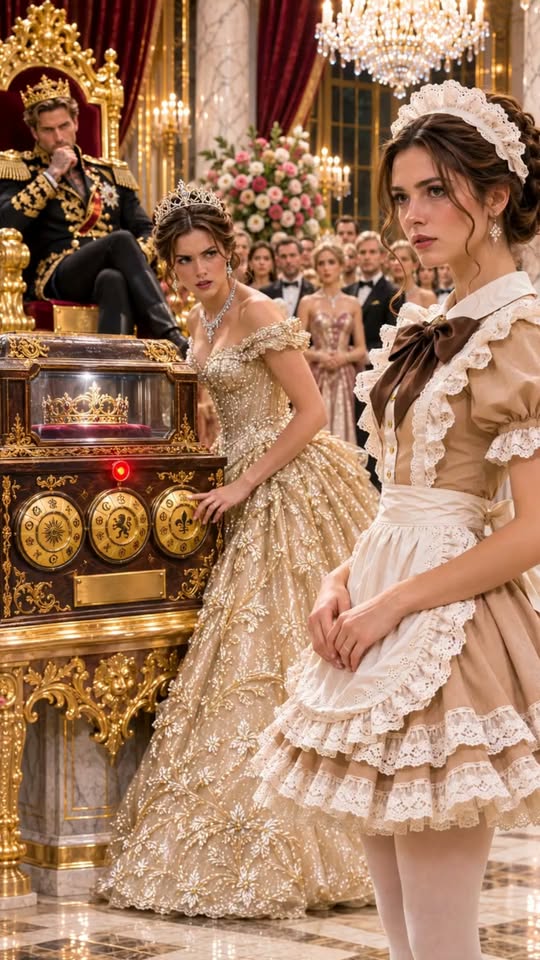
The ancient chest waited beneath the chandeliers.
Emma stood before it.
“Last time I did this, everything became complicated.”
Alexander moved beside her.
“Then perhaps we should stop.”
She looked at him.
“Are you afraid?”
“Yes.”
“So am I.”
He smiled.
“Together?”
Emma nodded.
They turned the three wheels according to Eleanor’s journals.
First: the crown.
Second: the citizen.
Third: truth.
The mechanism clicked.
The lid opened.
Inside lay the Crown of Rosehaven.
Alexander lifted it carefully.
Beneath the velvet cushion was another compartment.
Emma inserted Eleanor’s medallion.
A panel opened.
Inside rested a sealed envelope.
Alexander recognized the handwriting immediately.
“My father.”
He opened it.
The message was short.
_My dear Alexander,_
_If you have reached this point, you have learned Eleanor’s history._
_There is one truth I never had the courage to tell you while I was alive._
Alexander stopped reading.
Emma touched his arm.
He continued.
_The constitutional question was not the only reason I protected Margaret Carter and her daughter._
_Margaret once saved my life._
Emma stared.
The letter continued.
_And before she died, she entrusted me with something intended for Emma._
_It is not in the palace._
_Ask Pembroke where he buried the blue box._
Everyone turned.
Pembroke’s face went white.
Emma whispered:
“What blue box?”
**–END OF PART 4–CLICK “NEXT” AT THE BOTTOM OF THE PAGE TO CONTINUE READING**
✓ Lynn R. Adams
## Part 4 – The Choice No King Had Made **Part 4** For most of his life, Alexander had believed a crown was something one inherited. That morning at Rosehill Cottage, he began to understand that it…