PART 4: The Crest on the Sword 057
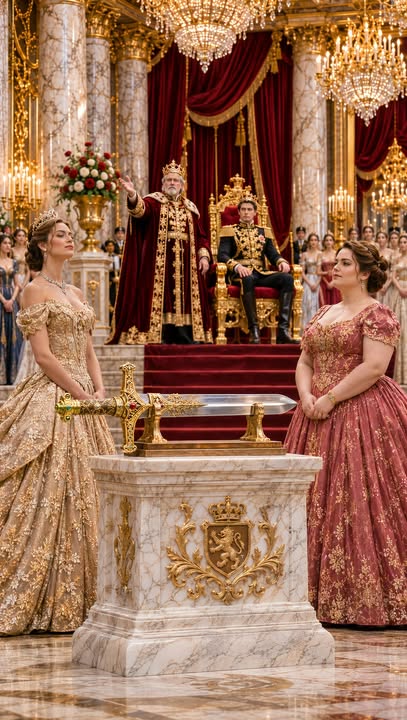
Part 4 – The Letter Behind the Glass
The next morning, the palace archives smelled of rain-damp wool and old paper.
Mara stood at the long table while Archivist Bell placed the damaged ledger before her, taking care to support its brittle binding with both hands.
Alexander had arrived before her, and the king was already waiting beside the windows.
The three of them had agreed that no conclusion would be drawn until the remaining records had been examined.
Mara had asked for that promise, and the king had given it without qualification.
Now she watched him as he studied the ledger, his lined face unreadable in the gray morning light.
“Have you found anything new?” she asked.
Archivist Bell glanced at the king before answering.
“I have found a reference to a box of correspondence that was never entered into the main catalogue.”
“Where was it kept?” Alexander asked.
“In the old ceremonial gallery, according to a note in the household inventory.”
The king’s hand tightened around his cane.
“The gallery was closed for repairs years ago,” he said. “Most of its contents were moved.”
“Most,” Archivist Bell replied. “The inventory does not say that everything was removed.”
Mara felt the bracelet press against her wrist beneath her sleeve.
“What kind of correspondence?”
“I cannot say yet,” said the archivist. “The note describes it only as papers connected to the sword display.”
The king looked toward her.
“Your mother’s accusation and the sword may be connected,” he said. “But we should not assume that they are.”
Mara appreciated the caution, even as the words made her pulse quicken.
“What does a box of papers have to do with the sword?”
“I don’t know,” the king answered. “That is why we must look.”
They left the archive together, following Archivist Bell through corridors Mara had not seen during the ceremony.
The palace was quieter in the morning, its grand rooms not yet filled with visitors or courtiers.
Their footsteps sounded softly against the stone as they passed portraits of kings and queens who seemed to watch them go.
At the end of a narrow passage, the archivist unlocked a door with a small brass key.
Beyond it lay a gallery lined with covered furniture and tall, shuttered windows.
Dust softened the outlines of chairs and display cases.
At the far end stood the ceremonial sword’s former display case, its wooden frame darkened with age.
Mara recognized the place from the carved crest on its side.
The sword had been displayed here before it was moved to the throne room for the contest.
“The inventory says the box was kept behind this case,” Archivist Bell said.
Alexander drew back the heavy velvet curtain that hung behind it.
The wall was paneled in dark oak, with a narrow recess concealed by decorative molding.
A section of the panel sat slightly crooked.
The king leaned closer but did not touch it.
“Could that be the hiding place?”
“It may be,” said Archivist Bell. “The molding appears to have been loosened before.”
She fetched a small tool from her case and eased the panel outward.
A thin space opened behind it.
Inside lay a flat wooden box, its surface dulled by dust.
Mara’s breath caught.
The king watched as Archivist Bell lifted the box carefully and set it on a nearby table.
It was sealed with a strip of wax that had cracked but not broken.
The seal bore the same tiny crest as Mara’s bracelet.
She drew back her sleeve.
The silver bracelet seemed suddenly brighter against her skin, though she knew it was only the light from the window catching the engraving.
The king stared at it.
“Your Majesty,” Alexander said quietly.
The king blinked, as if returning from a memory.
“That seal belonged to the queen’s household,” he said. “It was used for personal correspondence, not official orders.”
“Was my mother allowed to use it?” Mara asked.
The king’s eyes stayed on the wax.
“She served in the household offices. She may have been entrusted to carry letters bearing it.”
“Then it could have belonged to her.”
“It could have,” he said. “But we should not decide that before we open the box.”
Archivist Bell studied the wax.
“The seal is already damaged, and the contents may be fragile,” she said. “I can open it without disturbing the papers.”
The king nodded.
Mara folded her hands together to keep them still.
The archivist slid a narrow blade beneath the broken edge of the wax and gently lifted the lid.
Inside lay a small packet of letters, a folded sheet of parchment, and a narrow strip of faded blue ribbon.
The top letter was addressed to the king in a hand Mara did not recognize.
The king lifted it by its edges.
His face changed as he read the first line.
“What is it?” Alexander asked.
The king did not answer at once.
He turned the page slightly toward the window, where the pale light fell across the ink.
“This is a letter from the queen,” he said at last.
Mara looked up at the portrait hanging above the gallery mantel, though from where they stood she could see only its gilded frame.
“What does it say?”
The king continued reading, his expression growing heavier with every line.
“It was written shortly before Eleanor left the palace.”
“Does it mention her?” Mara asked.
“Yes.”
The word was quiet, but it struck her with the force of a door closing.
The king lowered the letter.
“Would you like me to read it aloud?”
Mara’s throat had tightened.
“Yes.”
He unfolded the page fully and began.
“My dear, I am writing this because I fear that my spoken words will be lost among the noise of the council.”
The king paused, his voice faltering on the queen’s familiar phrasing.
Then he continued.
“Eleanor has brought me copies of the village accounts, and they show that money intended for winter grain never reached the families named in the treasury records.”
Mara went very still.
Alexander looked toward Archivist Bell.
The archivist had stopped writing.
The king read on.
“She believes the missing funds were diverted through orders bearing the royal seal, but the handwriting on the authorizations is not hers.”
The king looked up.
“The royal seal,” Mara whispered.
He nodded and returned to the page.
“Lord Harrow has accused her of stealing the seal before she could place the copies before you.”
Mara felt the room narrow around her.
The accusation in the old ledger had not been a vague misunderstanding.
It had been used to silence her mother.
The king’s voice dropped as he reached the next paragraph.
“I asked Eleanor to remain in the palace while I examined the matter, but she fears Harrow knows that she has spoken to me.”
The king stopped reading.
His eyes had become bright, though he made no effort to hide it.
“Please,” Mara said. “Keep going.”
He drew a slow breath.
“She has chosen to leave before the accusation reaches the wider court, believing that her departure will protect the queen’s household from further suspicion.”
The words blurred for a moment before Mara could make sense of them.
Her mother had not simply vanished from the palace.
She had left because she thought her presence might place other people in danger of rumor and disgrace.
The king continued.
“I have told her that she should not bear the blame for another person’s actions.”
His voice roughened.
“But she has asked me to promise that the villagers will not be forgotten, even if her name is.”
The king lowered the letter.
No one spoke.
Mara touched the bracelet beneath her sleeve, feeling the cool edge of the engraved clasp.
“She knew,” Mara said. “She knew what had happened to the money.”
“She had evidence,” Alexander replied. “And she tried to bring it forward.”
“Did she give this letter to you?”
The king looked down at the page.
“I don’t remember receiving it.”
“Could it have been hidden before it reached you?” Archivist Bell asked.
“It may never have been sent,” he said. “The letter could have been kept with the queen’s papers.”
He turned the page over, searching for a date or a second note.
There, near the bottom, was a line written in a different hand.
Mara recognized the queen’s narrow, elegant script from the portrait inscription in the palace chapel.
“For Eleanor, who served with loyalty and courage. May this remind her that the crown knows the worth of her service.”
The king’s gaze fell to Mara’s bracelet.
The room seemed to hold its breath.
“The queen gave it to her,” he said.
Mara looked at the tiny crest.
Her mother had never told her who had placed the bracelet in her hand.
She had only said it came from a family that once served the crown.
Mara had always imagined that the words referred to a distant family, perhaps one that had helped the palace generations ago.
Now she understood that the phrase had been a careful way of describing the queen’s gift without reopening the wound that had followed.
“Why didn’t my mother tell me?” she asked.
The king’s face folded with grief.
“I cannot answer for her.”
“No,” Mara said. “You can’t.”
The king accepted the rebuke without looking away.
“I believed the accusation,” he said.
Alexander turned toward him.
“Father.”
“I believed it because Lord Harrow was trusted, and because Eleanor had already left before I took the time to ask her what she knew.”
The king looked at the letter again.
“I told myself there would be time to investigate later. Then the matter was closed in the records, and I let the silence become an answer.”
Mara could hear the regret in his voice.
She could also hear that regret had not brought her mother back to the palace, nor given Eleanor the chance to defend herself in front of the people who had judged her.
“Did you know she had found missing money?” Mara asked.
“No,” he said. “Not until now.”
“Did you know she had tried to bring you evidence?”
“No.”
“Then what did you know?”
The king lowered his eyes.
“Only that the seal was missing and Eleanor had left. I accepted the report that she had taken it.”
Mara’s fingers curled around her bracelet.
“And you never asked why.”
“No.”
The honesty of his answer hurt more than a polished denial would have.
Alexander stepped closer to Mara, but left space between them.
“I’m sorry,” he said.
She looked at him.
“You didn’t make the choice.”
“No,” he replied. “But I can’t pretend the choice belongs to no one.”
Archivist Bell had been examining the remaining items in the box.
“There are copies of account entries here,” she said. “And a list of village families.”
She opened the folded parchment on a clean sheet of archival cloth.
Several columns had been written in cramped handwriting, naming villages, grain allotments, and payments marked as delivered.
Along the margin, someone had made small notes that did not match the official totals.
“These figures appear to show payments recorded as complete,” Archivist Bell said, “though the distribution notes indicate that the grain never arrived.”
The king bent over the parchment.
His face hardened, not with anger directed at Mara, but with the shock of recognizing his own failure in the numbers.
“Can you verify them?” he asked.
“I can compare them with the treasury books,” said the archivist. “It may take time, but these entries are consistent with the surviving records we have already examined.”
Mara looked down the list.
There were names, not just numbers.
Families who had waited through a winter believing the crown had forgotten them.
“Did my mother know who the money was meant for?”
“She did,” Archivist Bell said. “She wrote the names beside the allotments.”
The care in the handwriting was familiar.
Mara had seen Eleanor label jars in their kitchen with the same neat, patient script.
The thought brought a sudden ache to her chest.
Her mother had carried those names with her.
Perhaps she had remembered them every winter, when the frost pressed against their windows and their small home grew cold.
“Is there anything else?” Alexander asked.
Archivist Bell lifted the faded blue ribbon.
It had been tied around a second bundle of papers, thinner than the first.
One end carried a small tag.
The ink had nearly disappeared, but the archivist could make out the words.
“For the king, when he is ready to hear it.”
The king closed his eyes.
“I don’t know who wrote that.”
“Could it have been the queen?” Mara asked.
“The handwriting is not hers,” said Archivist Bell. “It may be Eleanor’s.”
The king seemed unable to look at the tag.
“Then she left me a message I never received.”
“Or one you never found,” Mara said.
He met her gaze, and the distinction landed between them.
He did not defend himself.
Archivist Bell carefully unwrapped the bundle.
Inside were several copies of treasury orders, along with a small note written on thin paper.
She read it silently first, then glanced at Mara.
“Would you like me to read it?”
Mara nodded.
The archivist unfolded the note.
“Your Majesty, I have copied the names and amounts because I fear the originals will not remain where they are.”
She continued.
“I have not taken the seal, nor would I use it without permission.”
Mara could hear her mother’s voice in the measured rhythm of the words.
“If I am dismissed, please do not let my leaving be mistaken for confession.”
The king covered his mouth with one hand.
The final line had been written more faintly, as though the ink had begun to run out.
“The villagers are owed more than an explanation. They are owed what was promised to them.”
Silence filled the gallery.
Mara felt anger rise, but it was neither sharp nor simple.
It was grief for the years her mother had spent carrying a secret she should never have had to bear.
It was sorrow for the households who had waited for help that never came.
And beneath both was the painful knowledge that the king had once possessed the power to ask the right question.
He had not.
“I want the records checked against the treasury accounts,” Mara said. “Every name, every amount.”
“They will be,” the king promised.
“And the families’ descendants should know what happened.”
“Yes.”
“No one should make a public announcement until the records are confirmed.”
The king looked at her with a new kind of attention.
“You are right.”
“I don’t want the truth to become another rumor, even if it is one that helps my mother.”
“It will not,” he said.
Alexander glanced at the accounts.
“We can begin tracing the village names through the regional registers.”
Archivist Bell nodded.
“I will prepare the documents for careful examination and contact the treasury archivists.”
Mara drew a breath and looked again at the queen’s letter.
Her mother had been braver than Mara had known, and lonelier than she had ever imagined.
“Did she leave because she thought nobody would believe her?” she asked.
The king’s voice was soft.
“I believe she left because she thought she could protect others by making herself disappear.”
Mara looked at him.
“Perhaps she also knew you had already believed them.”
The king bowed his head.
“Yes,” he said. “Perhaps she did.”
They returned to the archive carrying the box under Archivist Bell’s supervision.
The king walked more slowly than before.
Alexander stayed beside Mara, though neither of them spoke until they reached the open ledger.
Archivist Bell placed the queen’s letter beside the damaged entry recording Eleanor’s dismissal.
The two documents seemed to belong to different stories.
One described an accusation.
The other revealed the reason behind it.
Together, they made the past impossible to misunderstand.
“Lord Harrow framed her,” Alexander said.
“We know he accused her,” Mara replied. “We know the accounts point toward money being diverted. We don’t yet know exactly how he did it.”
“You’re right,” he said. “We should be precise.”
The king took his place at the table.
“Lord Harrow is long dead,” he said. “But his records may remain, and the households that suffered may still have descendants who were never repaid.”
Mara watched him closely.
“Will you tell the court what you found?”
“When the evidence is verified, I will tell them all of it.”
“Even that you believed the accusation?”
The king looked down at the ledger, then back at her.
“Especially that.”
Mara did not answer.
She was not ready to decide what his apology meant, or whether it could ever mend the years in which her mother had lived with the burden alone.
Alexander rested one hand on the edge of the table.
“Your mother’s name can be cleared,” he said. “And the families can be helped.”
“Then let that be the first thing we do.”
“It will.”
For the first time since entering the palace, Mara felt the mystery opening rather than closing around her.
There would be records to compare, families to find, and difficult questions to ask.
But the story of Eleanor Vale no longer belonged to an accusation written by someone else.
It belonged to the evidence she had kept, the people she had tried to protect, and the daughter standing before the truth at last.
Archivist Bell began arranging the papers in order.
As she lifted the final sheet from the bottom of the box, a small folded slip fell onto the table.
It bore no seal and no name.
Only a date, written in the queen’s hand, and a brief line beneath it.
The king leaned closer.
His face drained of color as he read the words.
“What is it?” Alexander asked.
The king looked at Mara, then at the small silver bracelet on her wrist.
“She wrote this after Eleanor had already left.”
“What does it say?” Mara asked.
The king’s voice was barely above a whisper.
“‘If her daughter ever comes to the palace wearing the bracelet, give her the choice I could not give her mother.’”
**–END OF PART 4–CLICK “NEXT” AT THE BOTTOM OF THE PAGE TO CONTINUE READING**
* * *
[PREVIOUS: PART 3](https://storyly.idolsgift.com/blog/part-3-the-crest-on-the-sword-057) | [NEXT: PART 5](https://storyly.idolsgift.com/blog/part-5-the-crest-on-the-sword-057)
✓ Lynn R. Adams
Part 4 – The Letter Behind the Glass The next morning, the palace archives smelled of rain-damp wool and old paper. Mara stood at the long table while Archivist Bell placed the damaged ledger before…