PART 4: The Count Beneath the Music 046
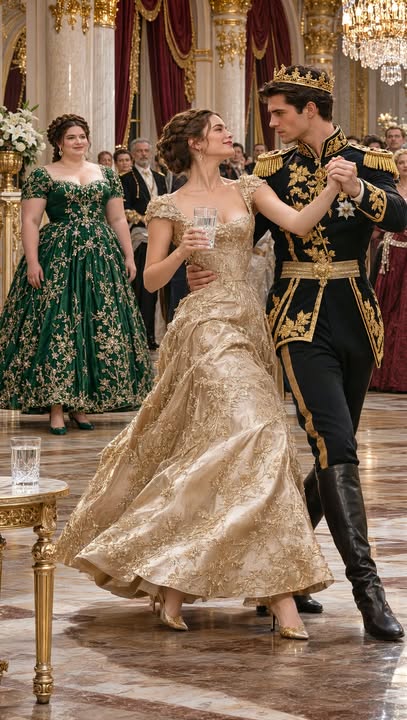
Part 4 – The Dance That Never Was
“Please put that back.”
Master Vale’s voice was quiet, but the strain in it made me hold the ledger more carefully.
“I’m sorry,” I said again.
“I found it on the floor.”
He reached for the book, then stopped when he saw the open page.
“Is this the pattern from the old performance?” I asked.
“Yes.”
“Who wrote it?”
His eyes moved to the initials at the foot of the notation.
“I think you should ask your family what your mother was doing at the palace.”
The words left me with nowhere to look but the page.
My mother had been dead for six years.
She had taught dance in a small studio above a bakery, where the floorboards creaked in winter and the mirrors were clouded at the edges.
She had never spoken of the palace.
At least, not to me.
“My mother taught dance,” I said.
“I know.”
“You knew her?”
The tutor’s mouth tightened, and for a moment he looked less like a man guarding a secret than one who had been asked to carry it too long.
“I knew of her work.”
“That isn’t the same thing.”
“No,” he said. “It isn’t.”
I lowered the ledger onto the storage table between us.
The notation remained visible, its faded strokes crossing the paper like the memory of a path.
“What was she doing here?”
Master Vale glanced down the corridor.
“We should speak somewhere private.”
The prince’s voice came from behind me.
“Is there something I should hear as well?”
I turned.
He had returned from the stairwell, his expression alert but not alarmed.
The tutor looked from him to me.
“Yes,” he said after a pause. “I believe there is.”
The three of us went into the small sitting room nearby.
Its curtains were half drawn against the late afternoon light, and the fire had burned low, leaving a mild warmth in the air.
Master Vale eased himself into a chair.
The prince remained standing beside the hearth, while I sat opposite the tutor with the ledger between us.
“Your mother’s name,” he said to me, “was Elianor.”
I had not heard her name spoken in that room before.
“Did you know her?” I asked.
“I did.”
“How?”
“I was the prince’s dance tutor,” he said. “Before that, I helped prepare the palace’s annual performances.”
The prince turned toward him.
“You said the old records were incomplete.”
“They are.”
“You did not say my mother’s dance had involved her.”
“I was not certain the contestant was her daughter,” Master Vale replied.
The prince’s gaze shifted to me.
Neither of us had told the court my mother’s name.
I had given my own, but the family name had not been included on the list of candidates.
“Then you recognized the pattern,” I said.
“I recognized the count,” the tutor answered. “And the way you moved through it.”
He looked down at his hands.
“Your mother had a distinctive habit of allowing the pause to settle before the turn. You did the same.”
The dance came back to me in a rush: the prince’s sudden stillness, the suspended beat, the turn I had followed without knowing why it felt familiar.
“Was the challenge based on her pattern?” I asked.
The prince’s expression changed.
“I used a sequence from the old rehearsal notes,” he said. “I remembered the count from my mother’s lessons.”
“You knew it came from the performance?”
“I knew it was part of something she had practiced. I did not know who created it.”
His voice had gone careful, each word set down as if he wanted no part of the truth to be mistaken.
“I remembered my mother telling me she would dance it at a public event,” he continued. “I was a child. I thought the performance had simply been postponed.”
“It was canceled,” Master Vale said.
The prince’s attention sharpened.
“Why?”
The tutor looked to the window, where the garden beyond the glass had begun to disappear into evening.
“Your mother and Elianor devised the pattern together,” he said. “They were preparing a public performance to raise money for struggling dance schools.”
The room seemed to draw inward around the words.
“My mother worked here?” I asked.
“For several months,” he replied. “She had been invited to help with the choreography and to train the younger dancers.”
I tried to fit the image to the woman I remembered.
My mother in a plain rehearsal dress, hair pinned back, tapping a rhythm against the studio floor with the side of her shoe.
My mother listening before she moved, teaching me to wait for the music rather than chase it.
I had always thought those lessons belonged only to our little studio, to the life she built after she left the palace.
“You never told me,” the prince said.
“I should have.”
“Why didn’t you?”
Master Vale’s face tightened.
“Because the performance ended in an accident.”
He did not raise his voice.
He did not need to.
A chill moved through me that had nothing to do with the darkening window.
“What happened?” I asked.
“The temporary staging shifted during a rehearsal,” he said. “One of the supports had been fitted incorrectly. Your mother and the queen were both present.”
The prince’s hand closed around the stone edge of the mantel.
“Was my mother hurt?”
“Not seriously. She was shaken, and one of the dancers suffered a sprained ankle. No one was in lasting danger.”
“Then why cancel the performance?”
“Because the court feared what the accident would mean once the public heard of it.”
Master Vale let out a breath.
“The staging had been approved by palace staff. They feared blame would fall on the household, and they feared the event would be remembered for the accident instead of its purpose.”
I looked at the notation on the ledger.
“Who was blamed?”
“Your mother.”
The answer came without ornament, and the room went silent around it.
“She had been directing the rehearsal,” he continued. “The officials called her pattern too difficult and her timing unsafe. They said the incident had shown that she was unfit to lead the performance.”
“But the stage was faulty.”
“Yes.”
“And they knew that?”
“I knew it. The crew knew it. The queen knew it.”
The prince’s face had gone pale beneath the warm light of the fire.
“My mother knew Elianor had been blamed?”
“She did.”
“Then why didn’t she stop it?”
Master Vale’s gaze lowered.
“She tried.”
The prince did not move.
“Your mother objected to the account that was being prepared,” the tutor said. “She wanted the faulty support named, the rehearsal reviewed, and Elianor’s work credited properly.”
“But she was the queen,” I said.
“She was also the king’s wife, the mother of an heir, and the person the court expected to preserve the family’s standing.”
The explanation did not make the silence easier.
It made it more understandable, which was worse.
“She was told that pressing the matter would put the entire royal household under scrutiny,” Master Vale continued. “The officials claimed it could undermine support for the school fund before it had even begun.”
The prince stared at the fire.
“She let them write that my mother was at fault.”
“She did not agree with them.”
“Did she correct them?”
“No.”
The single word seemed to land harder than an accusation.
The tutor clasped his hands over the head of his cane.
“She believed she could repair the damage privately. She arranged for Elianor to be paid for the work she had done and asked her to stay at the palace. Your mother refused.”
“Why?”
“Because she would not accept a private apology in place of a public correction.”
I felt a small, bright ache beneath my ribs.
That sounded like her.
She had not been easy to persuade when she thought something was wrong.
At home, she had once spent half a day writing letters to a landlord because a neighbor’s rent had been raised without explanation.
She had never mentioned the palace, but I could imagine her standing in a corridor there with the same stubborn calm.
“She left without being cleared,” I said.
“Yes.”
“Did she ever tell anyone what happened?”
“Not that I know.”
The prince turned from the hearth.
“Why did you let me believe the performance had simply been canceled?”
“I never told you that was all there was to it.”
“You let me remember it that way.”
Master Vale accepted the rebuke without defensiveness.
“You were a child,” he said. “Your mother had died, and the court was not prepared to reopen the matter. I thought the truth would only burden you.”
“It was not your choice to make.”
“No,” the tutor said. “It was not.”
For a moment, his voice caught.
“I told myself I was protecting you. Then years passed, and the silence became easier to maintain than the truth.”
I looked at him.
“Why tell us now?”
He glanced at the ledger.
“Because the pattern returned. Because you recognized it. And because I have watched the palace prepare another charity event with the same words it used before.”
The prince turned toward the table.
“Which words?”
“Generosity. Tradition. Public spirit.” The tutor’s eyes rested on the draft plans I had seen earlier. “Words that can mean something good, or cover the absence of it.”
My thoughts returned to the unfinished line in the ball proposal: the donation to be decided after the event.
The prince followed my gaze, though the papers were no longer in the room.
“We’ll make the fund real,” he said.
“That is not the same as correcting the past,” I replied.
“No,” he said. “It isn’t.”
I had wanted an explanation.
Now that I had one, I found I wanted the record.
A payment made quietly to my mother could not undo the way she had been dismissed.
A dance pattern stored in an old ledger could not restore the work she had been denied the chance to finish.
“Do you have proof?” I asked.
Master Vale nodded toward the ledger.
“There may be more in the archive.”
“You said the old records were incomplete.”
“Some are missing. Others were placed in the wrong boxes when the east wing was reorganized.”
“And the correspondence?”
His silence answered before he did.
“I do not know whether it remains.”
The prince took a step closer to the table.
“Then we find it.”
Master Vale looked at him.
“Your Highness, the archive has not been searched in years.”
“Then it is overdue.”
The tutor seemed to study the prince’s face, perhaps searching for the child who had once been told not to ask about a canceled performance.
At last, he nodded.
“I will help.”
We went to the palace archive shortly before dusk.
It occupied two rooms beyond the old library, one lined with catalogues and the other crowded with boxes of programs, ledgers, and letters.
The head archivist had already been sent for, and she waited at a broad table with a stack of registers open before her.
She was a composed woman with iron-gray hair and a pencil tucked behind one ear.
When Master Vale told her what we were searching for, her expression became cautious, but she did not object.
She brought out the catalogues for the year of the accident.
The prince and I searched one side of the table while Master Vale and the archivist reviewed the other.
The records were arranged by event rather than by name.
A folder marked “Spring Musical Evening” contained a seating chart, several invoices, and a list of performers.
My mother’s name appeared halfway down the page.
Elianor Vale.
I touched the ink with one finger, careful not to smudge it.
“She used her family name here,” Master Vale said. “She had only recently married.”
I had never seen her name written in that formal hand.
For a moment, the letters looked like the beginning of a person I had not known.
Beneath the list of performers was a dated program.
Its paper had browned at the edges, but the print remained legible.
A public dance performance was announced to benefit the Royal Dance Schools Fund.
The performers included the queen, several palace dancers, and my mother as choreographer and instructor.
The prince read the page over my shoulder.
“This was the event I was told would happen.”
“Yes,” the tutor said.
The date was less than a month before the accident.
Tucked behind the program was a correspondence file, bound with faded blue thread.
The archivist asked Master Vale to confirm that we could open it.
He looked to the prince.
The prince nodded.
The first few letters concerned costumes, rehearsal hours, and the selection of students from nearby schools.
Then I found a note in my mother’s hand.
Its writing leaned gently forward, familiar enough to make me forget the room.
She thanked the queen for insisting the school places remain open to children who could not afford lessons.
Another letter described the turning sequence, the one marked with the unusual count.
My mother called it “a way of letting a pause speak without leaving anyone behind.”
I read the line twice.
The prince stood close beside me, not touching, but present.
“That sounds like something she would say,” he murmured.
“It does.”
The next letter was from the queen.
She wrote that she had been practicing the turn in the blue salon and had stumbled over the pause until Elianor reminded her to wait for her partner.
A quiet breath escaped me.
The pattern had not been designed as a test.
It had been made by two women learning to move together.
There was no contest in the words, no prize to claim, no one waiting to see who would fail.
Only a shared piece of work intended to bring children into a room where they might otherwise never have been invited.
I turned another page.
The correspondence changed after the accident.
One letter from the queen, written two days later, expressed concern for my mother and promised that the staging report would be reviewed.
Another letter, from a senior household official, asked that further copies of the report be withheld until the palace had agreed on “a unified account.”
A third note, signed by the queen, objected.
She wrote that she would not allow the instructor’s reputation to be sacrificed for the convenience of the household.
But the letter was marked “not delivered.”
At the bottom, in a different hand, someone had added a short instruction.
“Hold until the matter is settled.”
I looked up at Master Vale.
“Was it ever delivered?”
He studied the note.
“I don’t know.”
“Was the official account ever changed?”
“No.”
The prince took the letter from me only after I offered it.
He read it with a stillness that seemed to deepen as he reached the end.
“She knew,” he said.
“She tried to speak,” Master Vale answered.
“But the letter was stopped.”
“Yes.”
The prince laid the paper down with great care.
His anger was not loud.
It was a quiet, contained grief, made more difficult by the knowledge that his mother had tried and still failed to correct what happened.
The archivist opened another box.
Inside were invoices and rehearsal reports, their edges softened by age.
One report described the stage support that had shifted during the rehearsal.
The notation was clear: a wooden brace had been cut too short, and the platform had not been properly tested under weight.
A later document stated that the rehearsal plan had been judged “unsafe in its complexity.”
That statement carried no signature from the crew who had built the platform.
It carried the name of a court official who had not attended the rehearsal.
I felt my face grow warm.
“Can we prove the stage was faulty?”
“The reports support it,” the archivist said. “But the official conclusion relied on a separate summary.”
“Where is that summary?”
She checked the register.
“Not in this file.”
Master Vale lowered his eyes.
“Perhaps it was never kept here.”
“Or perhaps it was removed.”
The archivist looked at him.
He did not answer.
The prince rested both hands against the table.
“Can the record be corrected with what we have?”
The archivist spoke carefully.
“The documents establish that the staging was faulty and that the queen objected to blaming the instructor. They do not tell us who stopped the correspondence or why the final report omitted the crew’s findings.”
“We know why,” I said.
“We know what the officials feared,” the prince replied. “We do not yet know who made the decision.”
That distinction mattered.
The truth had taken shape before us, but a portion of it still lay out of reach.
The archivist continued searching the registers.
As the light faded outside, Master Vale sat back in his chair, his hands clasped over his cane.
“I should have spoken sooner,” he said.
I did not want to soothe him.
Not yet.
“What stopped you?”
He looked at me, and the shame in his eyes was plain.
“Fear, at first. Then loyalty. Then habit.”
“Loyalty to whom?”
“To the queen. To the prince. To a palace that had given me my profession.” He swallowed. “I thought I was protecting the people I served. I did not understand that silence could harm them too.”
The prince remained quiet.
I thought of my mother leaving the palace without the public correction she wanted, carrying her work and her disappointment back into a smaller life.
I thought of the way she had taught me to listen for the pause.
“I wish she had told me,” I said.
“So do I,” Master Vale replied.
The archivist turned a page in the register.
“Here is a reference to a second box,” she said. “It is listed as ‘royal rehearsal materials,’ though the location has been changed.”
“Where was it moved?” the prince asked.
The archivist traced a line in the catalogue.
“It should be in the lower archive vault.”
“Can we see it tonight?”
“With the key.”
She rose and went to a cabinet at the back of the room.
Master Vale stood with care.
The prince looked at me.
“You needn’t stay.”
“I want to.”
He nodded, accepting the answer without trying to soften it.
The archivist returned with a key and a lantern.
We followed her down a narrow stone staircase into the lower vault.
The shelves there were close together, and the air smelled of dust, old paper, and cedar.
Boxes were arranged in rows, each marked with a number that matched the catalogue.
We found the one listed for the year of the canceled performance.
Its lid had been sealed with a strip of yellowed paper.
The archivist cut the paper carefully.
Inside lay a small collection of rehearsal notes, folded music, and several envelopes.
The tutor breathed out as if he had been holding his breath for years.
The top envelope bore my mother’s name.
I recognized her handwriting at once.
The letter was addressed to the queen, dated the evening after the accident.
The paper had never been opened.
I looked to the prince.
His face had gone very still.
The archivist offered me a clean pair of gloves.
I put them on, then lifted the envelope.
The seal was intact.
For a moment, I could not make myself break it.
My mother had been gone for years, and still some part of me wanted to ask whether I was allowed to read her words.
Master Vale lowered his head.
“She wanted the truth recorded,” he said. “Whatever she wrote, it belongs to the record now.”
I opened the envelope.
The letter inside was brief.
My mother thanked the queen for speaking on her behalf, then said she would not return to the palace unless the accident was publicly attributed to the faulty staging.
She wrote that she would not accept a private apology as a substitute for an honest account.
At the bottom, she had added a final line.
“If the dance is ever restored, it must be performed for the children it was meant to welcome, not for the court that abandoned them.”
I read it aloud.
The words seemed to settle into the vault, among the boxes and the dust and the old music.
The prince closed his eyes briefly.
“She was right,” he said.
The tutor held on to his cane with both hands.
“I should have made sure that letter reached the queen.”
The archivist took the empty envelope to examine its markings.
“This was filed as correspondence received,” she said. “But it was never opened.”
A small notation appeared near the flap.
The date it had been received.
And, beneath it, the initials of the person who had sealed the box.
The archivist’s gaze moved from the writing to the prince.
“Your Highness,” she said, “these initials belong to the king’s private secretary.”
The prince’s face hardened—not with anger alone, but with the dawning knowledge of how far the silence might have reached.
“Was he acting on his own?” he asked.
The tutor looked at the sealed letter in my hands.
“I don’t know.”
The archivist turned the envelope over once more.
“There is something else.”
She pointed to a faint line written beneath the seal, nearly hidden where the paper folded.
It was a second note, in a hand unlike my mother’s.
“Not for the queen,” the archivist read softly. “Deliver to the prince’s father.”
The prince stared at the words.
His father had been king then.
The letter had not merely been lost.
Someone had intercepted it, redirected it, and left it unopened in an archive box.
“Did my father ever receive it?” the prince asked.
The archivist looked down at the register.
“I cannot tell from this record.”
Master Vale’s face had gone ashen.
The prince turned to him.
“Do you know who wrote that instruction?”
The tutor’s mouth opened, but no answer came.
Before he could speak, a door closed somewhere above us.
The sound traveled down the stairwell, followed by approaching footsteps.
The archivist lifted the lantern.
Someone was coming toward the vault.
The prince looked at the unopened box, then at the letter in my hand.
“Who else knew this was here?” I asked.
Master Vale’s eyes shifted to the dark at the top of the stairs.
“Until tonight,” he said, “I thought no one.”
**–END OF PART 4–CLICK “NEXT” AT THE BOTTOM OF THE PAGE TO CONTINUE READING**
* * *
[PREVIOUS: PART 3](https://echoesofstories.idolsgift.com/blog/part-3-the-count-beneath-the-music-046) | [NEXT: PART 5](https://echoesofstories.idolsgift.com/blog/part-5-the-count-beneath-the-music-046)
✓ Lynn R. Adams
Part 4 – The Dance That Never Was “Please put that back.” Master Vale’s voice was quiet, but the strain in it made me hold the ledger more carefully. “I’m sorry,” I said again. “I found it on the …